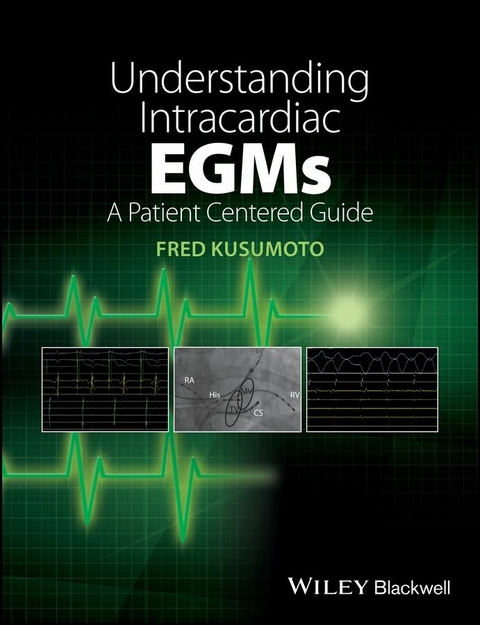
Understanding Intracardiac EGMs (eBook)
John Wiley & Sons (Verlag)
978-1-118-72135-3 (ISBN)
- Follows a case based step-wise approach focused on the EP lab that allows readers to follow along with the thought process behind how experienced electrophysiologists first diagnose, then prepare, treat and manage patients with common rhythmic abnormalities, including atrial fibrillation
- Written by award-winning Mayo Clinic Physician-educator Dr. Fred Kusumoto
- Ideal for fellows, new EPs, nursing and technical staff in the EP lab
- Includes clinical questions to help readers test their understanding of the steps and concepts covered in the book and prepare for certification exams
Fred Kusumoto, MD
Dr Kusumoto is Professor of Medicine, Mayo Clinic College of Medicine and Director of the Electrophysiology and Pacing Section at Mayo Clinic, Jacksonville, Florida. He has been involved in teaching and research and received the Excellence in Training in the Discipline of Cardiovascular Diseases two years in a row at Mayo Clinic. He was also named Teacher of the Year at the University of New Mexico. Dr Kusumoto has written two books on cardiac devices and cardiac pathophysiology and two books for Wiley-Blackwell: Understanding Intracardiac ECGs and EGMs and ECG Interpretation for Everyone: an On-the-spot Guide. In addition he has authored over fifty journal articles and book chapters.
Dr Kusumoto s unique new book takes a step-wise, patient-centered approach to guide readers through the thought process required during an electrophysiology study and the development of new findings. Follows a case based step-wise approach focused on the EP lab that allows readers to follow along with the thought process behind how experienced electrophysiologists first diagnose, then prepare, treat and manage patients with common rhythmic abnormalities, including atrial fibrillation Written by award-winning Mayo Clinic Physician-educator Dr. Fred Kusumoto Ideal for fellows, new EPs, nursing and technical staff in the EP lab Includes clinical questions to help readers test their understanding of the steps and concepts covered in the book and prepare for certification exams
Fred Kusumoto, MD Dr Kusumoto is Professor of Medicine, Mayo Clinic College of Medicine and Director of the Electrophysiology and Pacing Section at Mayo Clinic, Jacksonville, Florida. He has been involved in teaching and research and received the Excellence in Training in the Discipline of Cardiovascular Diseases two years in a row at Mayo Clinic. He was also named Teacher of the Year at the University of New Mexico. Dr Kusumoto has written two books on cardiac devices and cardiac pathophysiology and two books for Wiley-Blackwell: Understanding Intracardiac ECGs and EGMs and ECG Interpretation for Everyone: an On-the-spot Guide. In addition he has authored over fifty journal articles and book chapters.
Preface vii
Glossary ix
1 Basic electrophysiology 1
2 Supraventricular tachycardia case 1 17
3 Supraventricular tachycardia case 2 45
4 Supraventricular tachycardia case 3 55
5 Supraventricular tachycardia case 4 67
6 Supraventricular tachycardia case 5 83
7 Supraventricular tachycardia case 6: baseline preexcitation 97
8 Supraventricular tachycardia case 7: baseline preexcitation 111
9 Supraventricular tachycardia case 8 125
10 Supraventricular tachycardia case 9 135
11 Supraventricular tachycardia cases 10 and 11 143
12 Supraventricular tachycardia case 12 153
13 Supraventricular tachycardia case 13 163
14 Supraventricular tachycardia case 14: atrial fibrillation 177
15 Supraventricular tachycardia case 15: atrial tachycardia after atrial fibrillation ablation 187
16 Supraventricular tachycardia case 16: atrial tachycardia after atrial fibrillation ablation 195
17 Supraventricular tachycardia case 17: atrial tachycardia after atrial fibrillation ablation 205
18 Supraventricular tachycardia case 18: atrial tachycardia after atrial fibrillation ablation 215
19 Supraventricular tachycardia case 19: atrial tachycardia after atrial fibrillation ablation 227
20 Wide complex tachycardia case 1 237
21 Wide complex tachycardia case 2 253
22 Wide complex tachycardia case 3: premature ventricular contractions 263
23 Wide complex tachycardia case 4 273
24 Wide complex tachycardia case 5 281
25 Wide complex tachycardia case 6 291
26 Syncope 297
27 Multiple choice questions and answers 303
Appendix 323
Index 331
Chapter 1
Basic electrophysiology
For our discussion, electrophysiology is a general term used to describe the “electrical” characteristics of the heart. The fundamental diagnostic tools used by electrophysiologists are small catheters that are placed in the heart most commonly via the vascular system. The catheters are essentially plastic-coated wires with metal electrodes at the tip that have two functions: measurement of the electrical activity of the heart and provision of a conductive pathway to allow stimulation of the heart. Often, multiple catheters are placed in different parts of the heart, which when evaluated together can provide clues into possible mechanisms for bradycardia or tachycardia in an individual patient. Bradycardia is a far less common reason for performing an electrophysiology study and is often evaluated in the context of a patient with syncope (Chapter 26).
Most commonly, electrophysiology studies are often performed in patients with known tachycardia or patients who are at risk for tachycardia. Practical use and performance of the electrophysiology study in the evaluation of tachycardias will be the focus of all but one of the subsequent cases. Before we go through the cases, it is instructive to review the basic methods for classifying tachycardias. Clinically, tachycardias are usually classified by QRS complex width, because a narrow QRS complex suggests that the ventricles are being activated normally, while a wide QRS complex is a sign of abnormal activation of the ventricles. Although supraventricular tachycardias can be associated with profound symptoms such as shortness of breath or chest pain, they are generally not life-threatening, while a wide QRS tachycardia may signify the presence of ventricular tachycardia that can be life-threatening due to ineffective cardiac contraction. In the electrophysiology laboratory, more detailed evaluation of tachycardias is possible and, because it is often possible to treat the tachycardia by identifying and eliminating critical components, it is important to consider both anatomic location and mechanism. Unfortunately, electrophysiology can use specialized jargon or phrases that are hard to “keep straight” particularly for the novice. Some common abbreviations used in electrophysiology are defined in Table A1 in Appendix.
Mechanistic tachycardia classification
From a mechanistic standpoint, there are two basic types of tachycardias. The most common tachycardia mechanism is reentry. In reentry, there are two parallel pathways that are electrically separate and with different electrophysiologic properties (differences in conduction and refractoriness). An electrical impulse (generally an early beat) conducts “down” only one pathway and is able to enter the other pathway in a retrograde direction. The most well-studied example of this phenomenon are tachycardias that use an accessory pathway (Figure 1.1). In this case, the accessory pathway and the atrioventricular (AV) node provide anatomically separate connections between the atria and the ventricles. The accessory pathway and the AV node/His bundle axis are anatomically discrete, and the atria and the ventricles are electrically separated by the mitral and tricuspid annuli. Reentry can also occur in the setting of a scar that has a slowly conducting pathway through it. In this case, the slowly conducting pathway and normal tissue represent the two pathways that form the substrate for development of reentry. Traditionally, scar is described in ventricular tissue because of a myocardial infarction but could also be present in atrial tissue in the setting of atrial fibrosis from natural processes or prior ablations. It is not surprising that reentry generally is more common around “holes” in the heart, because these “holes” increase the likelihood that two separate pathways of electrical activation exist. For example, in the most common form of atrial flutter, the reentrant circuit uses a critical isthmus formed by the inferior vena cava and the tricuspid valve. The inferior vena cava and the tricuspid valve act as natural barriers that allow perpetuation of a reentrant circuit. In this case, the inferior cavotricuspid isthmus serves as one pathway, and the superior portion of the right atrium serves as the second pathway (Figure 1.2).
Figure 1.1 For most types of reentry, two separate pathways have different electrophysiologic properties, and with a carefully timed impulse, depolarization can occur in one pathway and “turn around” to depolarize the parallel pathway. The most well-described and the best clinical example of this is a patient with an accessory pathway (a). Normally, the AV node forms the only electrical connection between the atria and the ventricles, but in patients with an accessory pathway, the second electrical connection between the atria and ventricles can allow a reentrant circuit to develop. Another common scenario for reentrant arrhythmias is ventricular tachycardia in the setting of a prior myocardial infarction (b). In this case, a “patchy” myocardial scar forms an alternate pathway along with normal myocardium to activate one side of a scar to the other side of the scar.
Figure 1.2 Initiation of typical atrial flutter. (a): In sinus rhythm (*), atrial depolarization proceeds down the lateral wall of the right atrium (RA) and superiorly toward the septum. (b): With a premature atrial contraction from the left atrium (*), inferior atrial depolarization blocks in the cavotricuspid isthmus (CTI), but the wave of depolarization travels superiorly to activate the superior and lateral portions of the right atrium and enters the CTI from the other direction. (c): Slow conduction through the CTI initiates atrial flutter.
The second type of tachycardia is a focal source of rapid activation. This tachycardia mechanism is easier to conceptualize and can be thought of as outward spreading of electrical activation similar to a series of waves from repetitive drips into a pool of still water. Often, rapid activation is due to abnormal automaticity from a nest of cells, but in some cases, very small reentrant circuits can appear as focal activation. This type of reentry is often called microreentry to differentiate it from larger circuits of reentry that are called macroreentry. The actual reentrant circuit cannot be visualized unless specialized techniques are used, and often, the reentrant mechanism must be inferred by the behavior of the tachycardia. For example, termination of a tachycardia with a premature extrastimulus suggests the possibility of reentry. While reentrant circuits can be extinguished by a single early depolarization causing refractoriness, a tachycardia due to automaticity generally does not terminate, instead the usual response is transient suppression of the tachycardia.
The reason that tachycardia mechanism is so important is that it will dictate the therapeutic plan, particularly if ablation will be an option. In patients with reentry, effective ablation targets a critical pathway, isthmus, or “channel” that is essential for maintaining the tachycardia (often called “substrate”). Successful ablation is characterized by producing conduction block that can be thought of as a “dam” or a “wall” that prevents electrical current from passing. In patients with a focal source of tachycardia successful ablation targets the specific “source” of the arrhythmia.
Anatomic tachycardia classification
In addition to mechanism, it is also important from an electrophysiologic standpoint to consider tachycardia using an anatomic classification. Obviously, considering the anatomic location of the tachycardia is important to effectively treat the arrhythmia with ablation. A comprehensive review of different types of tachycardia is discussed in Understanding Intracardic EGMs and ECGs (Wiley Blackwell 2010) and is beyond the scope of this case-based book. However, a cursory review at this point is reasonable. In general terms, there are only four basic anatomic locations for tachycardia (Figure 1.3).
Figure 1.3 Anatomic classification of tachycardias
(adapted with permission from Kusumoto F, Cardiovascular Pathophysiology, Harris Barton Press 1999).
Firstly, a tachycardia can arise solely within the atrium. This could be due to a stable reentrant circuit within the atrium, continuous irregular activation of the atrium (perhaps due to unstable reentrant circuits), or one or more abnormal foci of automaticity. The way to consider this is that in atrial flutter or atrial fibrillation, there is activation of the atrium somewhere all the time. In contrast, in focal or multifocal atrial tachycardias, a site(s) leads to depolarization of the atria, and the atria are quiescent until the next depolarization. Perhaps, another analogy distinguishing between reentry and automaticity is useful. Automaticity or repetitive focal firing is similar to a blinking light(s): when the light goes “off” there is no light. Reentry can be compared to the spinning earth, where as the earth spins, different areas of the earth are in the dark and “lights are turned on.” In the latter case, there is always somewhere where the lights are on (the Pacific Ocean, with very few lights from ships and islands could be thought of as a region of “slow conduction”). Regardless of whether automaticity or reentry is the cause of the arrhythmia, the...
| Erscheint lt. Verlag | 27.4.2015 |
|---|---|
| Sprache | englisch |
| Themenwelt | Medizin / Pharmazie ► Allgemeines / Lexika |
| Medizinische Fachgebiete ► Innere Medizin ► Kardiologie / Angiologie | |
| Medizin / Pharmazie ► Medizinische Fachgebiete ► Radiologie / Bildgebende Verfahren | |
| Naturwissenschaften ► Biologie | |
| Technik | |
| Schlagworte | Cardiovascular Disease • electrophysiology • Elektrophysiologie • Fred Kusumoto patient-centered approach electrophysiology study EP step-wise EP lab electrophysiologists rhythmic abnormalities atrial fibrillation Mayo Clinic • Kardiovaskuläre Erkrankung • Kardiovaskuläre Erkrankungen • Kardiovaskuläre Erkrankung • Kardiovaskuläre Erkrankungen • Medical Science • Medizin |
| ISBN-10 | 1-118-72135-7 / 1118721357 |
| ISBN-13 | 978-1-118-72135-3 / 9781118721353 |
| Informationen gemäß Produktsicherheitsverordnung (GPSR) | |
| Haben Sie eine Frage zum Produkt? |
 EPUB (Adobe DRM)
Kopierschutz: Adobe-DRM
Adobe-DRM ist ein Kopierschutz, der das eBook vor Mißbrauch schützen soll. Dabei wird das eBook bereits beim Download auf Ihre persönliche Adobe-ID autorisiert. Lesen können Sie das eBook dann nur auf den Geräten, welche ebenfalls auf Ihre Adobe-ID registriert sind.
Details zum Adobe-DRM
Dateiformat: EPUB (Electronic Publication)
EPUB ist ein offener Standard für eBooks und eignet sich besonders zur Darstellung von Belletristik und Sachbüchern. Der Fließtext wird dynamisch an die Display- und Schriftgröße angepasst. Auch für mobile Lesegeräte ist EPUB daher gut geeignet.
Systemvoraussetzungen:
PC/Mac: Mit einem PC oder Mac können Sie dieses eBook lesen. Sie benötigen eine
eReader: Dieses eBook kann mit (fast) allen eBook-Readern gelesen werden. Mit dem amazon-Kindle ist es aber nicht kompatibel.
Smartphone/Tablet: Egal ob Apple oder Android, dieses eBook können Sie lesen. Sie benötigen eine
Geräteliste und zusätzliche Hinweise
Buying eBooks from abroad
For tax law reasons we can sell eBooks just within Germany and Switzerland. Regrettably we cannot fulfill eBook-orders from other countries.
aus dem Bereich