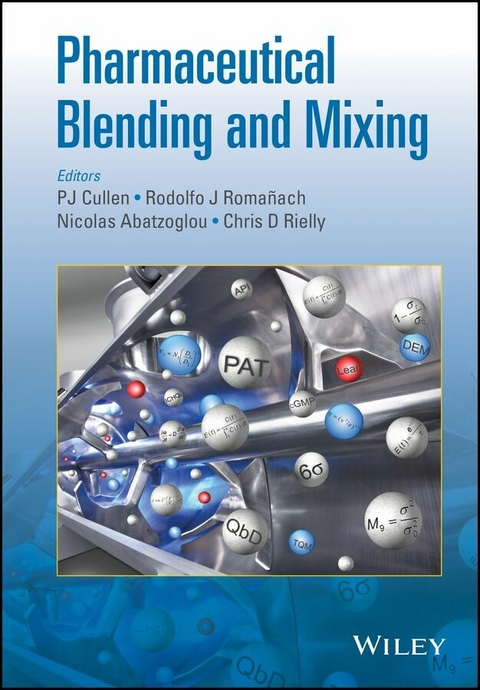
Pharmaceutical Blending and Mixing (eBook)
John Wiley & Sons (Verlag)
978-1-118-68280-7 (ISBN)
Dr PJ Cullen is a lecturer in?the Faculty of Engineering at the University of New South Wales. His current research interests include rheology, mixing, chemical imaging and non-thermal plasmas for biological applications in food. He has published over 35 journal papers, 15 book chapters and edited 1 book on food mixing. Professor Rodolfo J. Romañach is Professor of Chemistry at the University of Puerto Rico. He has over 20 years of experience in vibrational spectroscopy, and worked in Puerto Rico's pharmaceutical industry for 12 years prior to joining the UPR-Mayagüez faculty. In the pharmaceutical industry he worked extensively in assay and cleaning validation, and in providing analytical support for API and pharmaceutical process related problems. Professor Nicolas Abatzaglou is Director of the?Chemical Engineering and Biotechnological Engineering Department and Holder of the Pfizer Chair: PAT in Pharmaceutical Engineering at the Universite de Sherbrooke, Canada. He is the current recipient of Quebec's Minister of Education (MELS Chantier II) Fellowship award for his excellence in research and teaching. Professor Chris Rielly is Head of the Department of Chemical Engineering at Loughborough University. He has taught chemical engineering for over 20 years at Cambridge and Loughborough Universities and is a Fellow of the Institution of Chemical Engineers with more than 20 years of experience working in experimental and computational fluid mechanics. His interests include multi-phase flow, mass transfer and turbulent mixing in chemical processing equipment. He has served on the Scientific Committees of the European Conference on Mixing, the International Conference on Gas-Liquid-Solid Reaction Engineering and the Process Innovation and Intensification Conference. He is an academic consultant to BHR Group's Fluid Mixing Processes Industrial Consortium and Chairman of the IChemE's Fluid Mixing Subject Group. He has previously edited books.
1
Mixing Theory
Chris D. Rielly
Department of Chemical Engineering, Loughborough University, UK
1.1 Introduction
Mixing of ingredients, or dispersion of one phase in another, is an essential step in many pharmaceuticals processes. For example, the vast majority of manufacturing routes to form an active pharmaceutical ingredient (API) make use of crystallization, which involves a number of mixing steps in a liquid phase, such as: dispersion and dissolution of solid reagents into a solvent, blending of liquid reagents with the solvent phase, creation of super-saturation through mixing, for example with an anti-solvent addition, chemical reaction, or heat removal and suspension of the API crystals during subsequent growth (Kirwan & Orella, 2002; Paul et al., 2004). Each of these operations involves a mixing step, which is aimed at removing gradients of concentration, temperature or solids mass fraction within the crystallizer vessel, to give a more uniform environment for chemical reaction and/or crystal growth.
A second example may be taken from later in a pharmaceutical manufacturing process: during the formulation of solid dosage forms, dry-powder mixing of an API with excipients (themselves mixtures of binders, diluents, flow modifiers and granulating agents) is required to produce suitable physical, flow and mechanical properties for tableting (for example Lee, 2002). Here, the objective is to remove concentration differences within the dry powder mix, so that each tablet contains a mixture with exactly the same properties and with a tightly-controlled amount of the API. Other forms of oral dosage may involve the blending of suspensions, emulsions and syrups to give a formulated liquid product; again the objective of mixing is to ensure that each dosage contains almost exactly the same amount of the active ingredient.
These examples demonstrate that in a mixing process the objective is to reduce inhomogeneities in composition to an acceptable level, to provide a more uniform processing environment and/or a more uniform product. The examples also illustrate that there are differences between fluid mixtures of miscible phases and particle mixtures, which can, in principle, unmix; for example, by segregation effects (Sommier et al., 2001). Segregation often occurs in free-flowing powders and is driven by differences in particle size and density. The phenomenon occurs when particulate mixtures are shaken (Rosato et al., 1987), or during flow within or between vessels (e.g. discharge from a vessel). During shaking or shear flow, there is relative motion between particles and small particles can fall into gaps beneath larger particles. Thus, the larger particles tend to rise to the surface, whereas small particles percolate downwards. Therefore, segregation can cause a previously well-mixed material to undergo unmixing into a non-uniform solid form; a way to counteract the tendency to segregate is to introduce a binder or adjust the moisture content to produce cohesion within the particulate mixture. In many processes a granulation operation follows the blending stage to prevent segregation in subsequent processing steps (Fung & Ng, 2003).
A distinction may also be drawn between batch and continuous flow mixing processes, although similar measures of mixing quality may be defined for both. Almost all current pharmaceutical processes operate by transferring batches of material between stages of the manufacturing process, rather than by continuous inflow and outflow to process equipment. Therefore this chapter will focus mainly on batch mixing processes, where the purpose is to use fluid mechanics, molecular diffusion and dispersion effects to produce spatially homogeneous mixtures; up to a point, an increase in the batch time will lead to an improvement in the mixture quality, that is a reduction in the level of spatial inhomogeneities, but thereafter, the degree of mixedness will not improve. The chapter will address the question of what is an ‘acceptable’ measure of mixedness; the idea of a scale of scrutiny of the mixture will be introduced in Section 1.3 and various measures of the quality of a mixture will be discussed. The examples given here consider two rather different situations of mixing (1) between components in a liquid and (2) between different types of solid particles. In this context it is useful to differentiate between fine and coarse-grained mixtures and this is discussed in Section 1.4. Selection of different definitions of the end-point for a mixing process will be considered in Section 1.5, to consider their sensitivity at various stages of mixing and their sensitivity to sampling methods.
Recently the pharmaceuticals industries have paid increasing attention to continuous manufacturing operations, as potentially they could significantly reduce production costs and provide more reliable manufacturing routes; see, for example, Schaber et al. (2011). Therefore, the final section (Section 1.6) of this chapter will consider continuous mixing of ingredients. In such operations the mixing objective is to obtain a product with a homogeneous distribution of ingredients in the correct proportions, which requires careful metering of the feed flow rates, as well as achieving a high degree of homogeneity. In continuous flow devices, the output product composition should not vary in time and the processing history of each element of the mixture should be the same. Variations in the feed composition to a continuous flow mixer can be compensated to an extent by allowing ‘mixing in time’, that is not all elements of fluid spend the same amount in the mixer, allowing materials that have arrived early, to mix with materials that have arrived late. Thus the concept of a residence time distribution will be introduced in Section 1.6 to describe the process of back-mixing, or mixing in time. Furthermore it will be shown that back-mixing can effectively filter out higher frequency variations in feed composition and still give a uniform product. Thus, there are processing advantages and disadvantages in having some width to the residence time distribution.
Throughout this chapter, the term concentration will be used quite generally to described the composition of a material within a mixture; for a single liquid phase the term can be interpreted as mass (or mole) fraction, or mass (or moles) per unit volume of a specific component; for particulate mixtures it could represent mass fraction, number fraction or volume fraction of one type of solid; for a multi-phase mixture it could be the volume or mass fraction of a specific phase. In general, the mixedness will be judged from a statistical measure of the distribution of concentrations of key components within samples drawn from a mixture.
1.2 Describing Mixtures
In practice, the whole of the composition of a mixture cannot be determined at a single time, so sampling is often used to assess the state of mixedness; sampling at an appropriate scale of scrutiny will be discussed in Section 1.3, but first the degree of uniformity between samples will be considered. The average concentration of a species in the whole mixture is determined by the amounts of all components added and can be calculated straightforwardly from a mass balance. The average species concentrations obtained from samples drawn from this mixture ought to have values distributed about the average for the whole mixture; it is the width of this distribution that provides information about the quality of the mixture, not the average value from the various samples.
Figure 1.1 shows an example of an idealized mixture comprising 50% white particles and 50% black particles. The whole mixture is divided into 36 samples, each containing 16 particles. Figure 1.1(a) is a homogeneous, but non-random mixture; each sample contains exactly eight white particles (or 50% white particles), which is exactly the same as the mean concentration of the mixture. Figure 1.1(b) shows the number of particles in each sample and indicates that there are no spatial differences in concentration; hence the mixture can be regarded as perfectly mixed. This mixture is ‘perfect’ in the sense that each sample contains exactly the same concentration as the whole mixture average; in other words there is no variance between the samples. The probability of forming such a mixture by a stochastic process is rather small, so this situation is very unlikely to occur in a conventional mixing process.
Figure 1.1 Idealized mixtures of 50% white and 50% black particles (a) non-random perfect mixture, (b) number of white particles in each 4 × 4 sample of the non-random mixture (c) random mixture and (d) number of white particles in each 4 × 4 sample of the random mixture
In contrast, Figure 1.1(c) shows a mixture that has been generated entirely randomly by giving each particle an equal probability of being black or white; the overall composition of the whole mixture is still 50% white particles, but each sample now shows deviations from the whole mixture mean, as shown in Figure 1.1(d). Some samples contain as few as four particles, whereas others have 12 or 13, compared to the expected eight, which might lead to the conclusion that the material is not well mixed. However, further mixing, or randomization, of the particles will not lead to any significant improvement in the distribution of white...
| Erscheint lt. Verlag | 11.5.2015 |
|---|---|
| Sprache | englisch |
| Themenwelt | Naturwissenschaften ► Chemie ► Technische Chemie |
| Technik ► Umwelttechnik / Biotechnologie | |
| Schlagworte | blending of particulate powders, fluid mixing, blending processes, pharmaceutical manufacturing industry, pharmaceutical science, particle mixing processes, bioprocessing, pharmaceutical manufacture, granules, Quality by design, liquids, suspensions • chemical engineering • Chemie • Chemische Verfahrenstechnik • Chemistry • Industrial Chemistry • Mischen • Pharmaceutical & Medicinal Chemistry • Pharmazeutische Chemie • Pharmazeutische u. Medizinische Chemie • process development • Technische Chemie • Technische u. Industrielle Chemie • Verfahrensentwicklung • Verfahrenstechnik |
| ISBN-10 | 1-118-68280-7 / 1118682807 |
| ISBN-13 | 978-1-118-68280-7 / 9781118682807 |
| Informationen gemäß Produktsicherheitsverordnung (GPSR) | |
| Haben Sie eine Frage zum Produkt? |
 EPUB (Adobe DRM)
Kopierschutz: Adobe-DRM
Adobe-DRM ist ein Kopierschutz, der das eBook vor Mißbrauch schützen soll. Dabei wird das eBook bereits beim Download auf Ihre persönliche Adobe-ID autorisiert. Lesen können Sie das eBook dann nur auf den Geräten, welche ebenfalls auf Ihre Adobe-ID registriert sind.
Details zum Adobe-DRM
Dateiformat: EPUB (Electronic Publication)
EPUB ist ein offener Standard für eBooks und eignet sich besonders zur Darstellung von Belletristik und Sachbüchern. Der Fließtext wird dynamisch an die Display- und Schriftgröße angepasst. Auch für mobile Lesegeräte ist EPUB daher gut geeignet.
Systemvoraussetzungen:
PC/Mac: Mit einem PC oder Mac können Sie dieses eBook lesen. Sie benötigen eine
eReader: Dieses eBook kann mit (fast) allen eBook-Readern gelesen werden. Mit dem amazon-Kindle ist es aber nicht kompatibel.
Smartphone/Tablet: Egal ob Apple oder Android, dieses eBook können Sie lesen. Sie benötigen eine
Geräteliste und zusätzliche Hinweise
Buying eBooks from abroad
For tax law reasons we can sell eBooks just within Germany and Switzerland. Regrettably we cannot fulfill eBook-orders from other countries.
aus dem Bereich