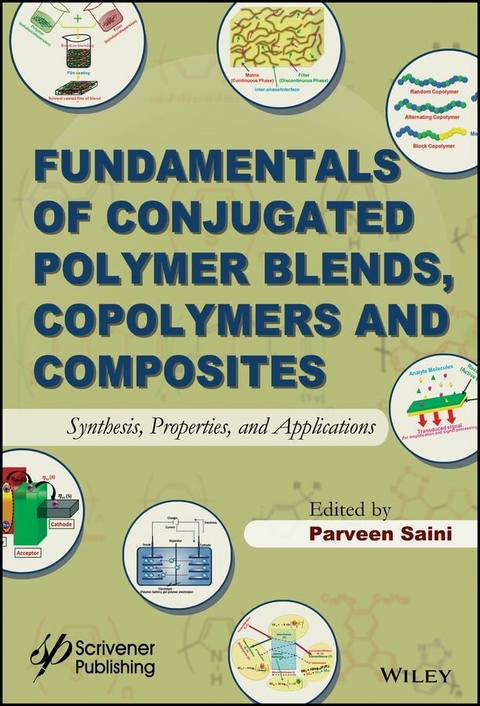
Fundamentals of Conjugated Polymer Blends, Copolymers and Composites (eBook)
John Wiley & Sons (Verlag)
978-1-119-13710-8 (ISBN)
Parveen Saini has been a scientist at the National Physical Laboratory, New Delhi, India since 2004. He obtained his PhD in Polymers and Engineering from the Indian Institute of Technology, New Delhi, India, and thereafter, he worked as an engineer at the Sriram Institute for Industrial Research, New Delhi. His research interests include conducting polymers, carbon nanotubes, graphene, conducting polymer nanocomposites for electromagnetic interference (EMI) shielding, microwave absorption, antistatic/electrostatic dissipation (ESD), anticorrosive, and battery applications. He has authored more than 50 scientific publications, book chapters, and patents. He is the recipient of the prestigious CSIR Young Scientist Award-2013 in the area of Engineering Science.
Foreword xv
Preface xvi
Part 1: Multiphase Systems: Synthesis, Properties and Applications 1
1 Conjugated Polymer-based Blends, Copolymers, and Composites: Synthesis, Properties, and Applications 3
Parveen Saini
1.1 Introduction 4
1.2 CPs/ICPs-Based Blends 7
1.3 CPs/ICPs-Based Copolymers (CCPs) 11
1.4 CPs/ICPs-Based Composites/Nanocomposites/Hybrids 23
1.5 Interpenetrating/Semi-Interpenetrating Polymer Network (IPN/SIPN) 29
1.6 Synthesis of CPs/ICPs-Based BLNs, CCPs, and CMPs/NCs/HYBs 30
1.7 Applications of CPs/ICPs-Based BLNs, CCPs, and CMPs/NCS/HYBs 63
1.8 Conclusions 79
Acknowledgments 80
References 80
2 Progress in Polyaniline Composites with Transition Metal Oxides 119
Gordana Ciric-Marjanovic
2.1 Introduction 119
2.2 PANI/Transition Metal Oxide Composites 120
2.3 Conclusions and Outlook 151
Abbreviations 152
References 153
3 Conjugated-Polymer/Quantum-Confined Nanomaterials Hybrids for Optoelectronic Applications 163
Anuushka Pal, Parveen Saini, and Sameer Sapra
3.1 Introduction 163
3.2 Quantum-Confined Nanomaterials (QCNs) 165
3.3 Synthetic Approaches for Quantum-Confined Nanomaterials (QCNs) 168
3.4 Optoelectronic Applications of Hybrids 190
3.5 Outlook and Perspective: Current Challenges and Future Scope/Prospects 210
Acknowledgments 211
References 211
4 Graphene/Conjugated Polymer Nanocomposites for Optoelectronic and Biological Applications 229
Tapas Kuila, Yu Dong Sheng, and Naresh Chandra Murmu
4.1 Introduction 230
4.2 Graphene/Conjugated Polymer Nanocomposites 231
4.3 Applications of Graphene/Conjugated Polymer Nanocomposites 263
4.4 Conclusions and Future Scope 270
Acknowledgements 271
References 271
Part 2: Energy Harvesting and Storage Materials 281
5 Conjugated Polymers-Based Blends, Composites and Copolymers for Photovoltaics 283
Ashish Dubey, Parveen Saini, Vikram Kumar, and Qiquan Qiao
5.1 Introduction 284
5.2 Organic Photovoltaic (OPV) Cells 284
5.3 OPV Device Architecture and Working Mechanism 287
5.4 Solar Cell Terminologies and Characterization Parameters 290
5.5 CPs-Based Blends, Composites and Copolymers for OPVs 295
5.6 Conjugated Copolymers for PVs 314
5.7 Conclusions: Current Challenges and Prospects 326
Acknowledgements 327
References 327
6 Conducting Polymer-Based Nanocomposites for Thermoelectric Applications 339
Qin Yao, Lidong Chen, and Sanyin Qu
6.1 Introduction 340
6.2 Synthesis Methods 346
6.3 TE Properties of CP/Inorganic Nanocomposites 361
6.4 Summary 376
References 377
7 Conjugated-Polymer/Inorganic Nanocomposites as Electrode Materials for Li-Ion Batteries 379
Qingsheng Gao, Lichun Yang, and Ning Liu
7.1 Introduction 379
7.2 Nanocomposites of Conjugated Polymer/Inorganic as Cathode Materials 383
7.3 Nanocomposites of Conjugated Polymers/Inorganic as Anode Materials 402
7.4 Conclusion 412
Acknowledgments 413
References 413
8 Polypyrrole/Inorganic Nanocomposites for Supercapacitors 419
Peng Liu
8.1 Introduction 419
8.2 Polypyrrole/Carbon Nanocomposites 420
8.3 Polypyrrole/Metal Oxide Nanocomposites 432
8.4 Polypyrrole/Clay Nanocomposites 437
8.5 Other Polypyrrole/Inorganic Nanocomposites 438
8.6 Polypyrrole Ternary Composites 439
8.7 Conclusion and Perspectives 443
Acknowledgments 444
References 444
Part 3: Advanced Materials for Environmental Applications 449
9 Intrinsically Conducting Polymer-Based Blends and Composites for Electromagnetic Interference Shielding: Theoretical and Experimental Aspects
Parveen Saini
9.1 Introduction 451
9.2 Shielding Phenomenon 453
9.3 Conclusions 507
References 508
10 Anticorrosion Coatings Based on Conjugated Polymers 519
M. Federica De Riccardis
10.1 Introduction 519
10.2 Basic Concepts of Corrosion 522
10.3 Corrosion Prevention 524
10.4 Corrosion Tests 527
10.5 Conjugated Polymers as Anticorrosion Layers 538
10.6 Conjugated Polymers Nanocomposite as Anticorrosion Layers 552
10.7 Conclusions 574
References 575
11 Conjugated Polymer-Based Composites for Water Purification 581
Jiaxing Li, Yongshun Huang, and Dadong Shao
11.1 Introduction 582
11.2 Adsorption Phenomenon 583
11.3 PANI-Related Composites in Water Purification 591
11.4 PPy-Related Composites in Water Purification 601
11.5 Miscellaneous Conjugated Polymer Composites in Water Purification 606
11.6 Conclusion 609
Acknowledgment 609
References 609
Part 4: Sensing and Responsive Materials 619
12 Conjugated Polymer Nanocomposites-Based Chemical Sensors 621
Pradip Kar, Arup Choudhury, and Sushil Kumar Verma
12.1 Introduction 622
12.2 Conjugated Polymer Nanocomposites as Chemical Receptor 626
12.3 General Methods for Preparation of Conjugated Polymer Nanocomposite 631
12.4 Influence of Properties of Conjugated Polymer by Interaction with Nano-Filler 644
12.5 Fabrication of Conjugated Polymer Nanocomposite Layer/Film for Sensor 647
12.6 Chemical Sensing Performance of Conjugated Polymer-Based Nanocomposites 656
12.7 Mechanism of Chemical Sensing by Conjugated Polymer Nanocomposite 670
12.8 Challenges and Prospects 679
References 681
13 Conjugated Polymer Nanocomposites for Biosensors 687
Deepshikha Saini
13.1 Introduction 687
13.2 Synthesis of Conducting Polymer Nanocomposites 690
13.3 Current and Emerging Applications of Conducting Polymer Nanocomposites in Biosensors 706
13.4 Conclusions and Outlook 719
References 722
14 Polyaniline Nanocomposites for Smart Electrorheological Fluid Applications 731
Jianbo Yin and Xiaopeng Zhao
14.1 Introduction 731
14.2 PANI as Filler for ER Fluids 734
14.3 Core/Shell-Structured PANI Nanocomposites for ER Fluids 737
14.4 Pani-Intercalated Nanocomposites for ER Fluids 747
14.5 Conclusions 752
Acknowledgments 752
References 752
Preface
The conjugated polymers (CPs) are considered as path-breaking discovery, a Serendipity indeed!!!, that has not only revolutionized the area of material science but also changed the face of nanotechnology. It is apt to highlight and worth mentioning here that though their discovery has been rewarded with Year 2000’s Chemistry Nobel Prize to the discoverers Prof. Heeger, Prof. Shirakawa, and Late Prof. MacDiarmid, their wealth of prevalent applications that were actually based on strategic combination of CPs with a variety of organic/inorganic materials (bulk- or nano-size) in the form of blends (BLNs), conjugated copolymers (CCPs), composites (CMPs) [bulk or nanocomposites (NCs)], or hybrids (HYBs) have played a pivotal role in demonstrating and advancing their techno-commercial utility. Interestingly, the above area is the best example of power of interdisciplinary research, cross-country collaborations, and industrial partnership, for successful implementation of knowledge and ideas into life-changing products. Therefore, I strongly feel that an interdisciplinary research-oriented dedicated book covering the elementary concepts and recent advancements in the area is necessary to expose current challenges, highlight future perspectives, and stimulate thought process for evolution of novel materials and technologies. This edited book is the first of its own kind that provides a single-source solution to specifically address the fundamentals and applications of CP-based mixed systems, i.e., BLNs, CCPs, and CMPs with special focus on interdisciplinary and application-oriented research and comprehensive literature account. Accordingly, the book is organized into 14 chapters that are subdivided into four sections viz. Multiphase Systems: Synthesis, Properties, and Applications (Chapters 1–4); Energy Harvesting and Storage Materials (Chapters 5–8); Advanced Materials for Environmental Applications (Chapters 9–11); and Sensing and Responsive Materials (Chapters 12–14).
The first section highlights the fundamental aspects of mixed system constituted by strategic combination of doped and undoped CPs with a variety of organic/inorganic materials (bulk- or nano-size) to form BLNs, CCPs, and CMPs/NCs/HYBs. These advanced materials have been demonstrated for techno-commercial utility in diverse areas including electronics and optoelectronics; energy harvesting and storage, environmental pollution, and corrosion control; biology and biomedicals; sensing and responsive materials, etc. Chapter 1 deals with their definitions, types, importance, synthetic routes, and practical applications including the state of the art in the area. The special emphasis has been given to the combination of CPs with a variety of materials like carbonaceous fillers [e.g., fullerene derivatives like PCBM, carbon nanotubes (CNTs), nanofibers (CNFs), graphene analogs, carbon dots (C-Dots), graphene quantum dots (GQDs)]; inorganic nanofillers (e.g., silica or various clays); metal/inorganic nanoparticles (NPs) (e.g., Au/Ag NPs, dielectric/magnetic/redox-active particles like ZnO, V2O5, MnO2, Co3O4, Cu2O, Y2O3, Nb2O5, RuO2, WO3, TiO2, BaTiO3, γ-Fe2O3, BaTiO3, Fe3O4, etc.); semiconductors [quantum confined nanomaterials (QCNs) and nanocrystals (NCRs) like quantum dots (QDs), nanorods (NRs), nanowires (NWs), nanotubes (NTs), tripods, tetrapods, multipods, etc.] to form advanced BLNs, CCPs, and CMPs/NCs/HYBs. Chapter 2 provides a comprehensive account of the transition metal oxides-filled polyaniline (PANI) matrix-based NCs, including their synthesis, properties, and applications. Chapter 3 focuses on the organic/inorganic NCs/HYBs based on strategic combination of various CPs with QCNs (like inorganic semiconducting NPs/NCRs and carbonaceous analogues, e.g., GQDs or C-Dots). The specific advantages of such systems, various synthesis strategies, and their optoelectronic properties have also been discussed. The applicability of these NCs has been demonstrated and discussed for optoelectronic applications [like solar cells (both photovoltaic and dye-sensitized solar cells) and light-emitting diodes (LEDs)], via suitable examples from open literature. Finally, Chapter 4 highlights the graphene-based CP NCs and gives brief account of their optoelectronic and biological applications.
The second section discusses the energy harvesting and storage possibilities with above systems with special reference to organic photovoltaics (OPVs), thermoelectrics (TEs), Li-ion batteries (LIBs), and supercapacitors (SCs). In particular, Chapter 5 highlights the promise of CPs-based BLNs, CCPs, and CMPs/NCs/HYBs as an active material for solar cells and reviews the performance of related OPV devices. The inherent advantages of these systems (in terms of panchromatic solar absorption, phase segregation driven bulk-heterojunction morphology, efficient charge separation and improved transport, leading to efficient PV action) and various material combinations have also been discussed with suitable examples. Chapter 6 outlines the specific advantages of doped CPs (ICPs)-based TE materials (e.g., low density, solution processability, low thermal conductivity, tunable conductivity, and Seeback coefficient) over conventional inorganic TE materials. Particularly, the ICP/inorganic NCs (containing inorganic NPs, CNTs, graphene, metals, and their compounds), their TE properties, and actual TE performances have been comprehensively discussed via suitable examples. Chapter 7 sheds light on ICP/inorganic NCs [based on combination of ICPs like PANI, polypyrrole (PPy), or polythiophene (PTh) with inorganics like LiFePO4, MnO2, V2O5, Si, SnO2, Fe2O3, etc.] as high-performance cathodic and anodic materials for LIBs. It has been systematically highlighted that ICPs-based matrices act as soft cushion for inorganic fillers to accommodate for drastic volume changes and to mitigate mechanical stress, thereby preventing the electrode failure and improving cyclability. In addition, they improve the conductivity of the system and facilitate Li+ insertion/extraction rates, resulting in enhancement of rate capacity of LIBs. Finally, Chapter 8 talks about SCs, which are most promising energy storage alternative for portable electronics and HYB electric vehicles (HEVs). In particular, the PPy/inorganic NCs for electrochemical SCs are reviewed, with emphasis on required structural, chemical, and physical requirements, potential materials, important device parameters and SC performance, well supported by related literature examples.
The third section outlines the environmental applications of above systems including their utility in electromagnetic interference (EMI) shielding, water purification, and corrosion protection of metals. In particular, Chapter 9 covers overview of fundamentals of EMI shielding, theoretical aspects of shielding, and experimental techniques for measurement of shielding effectiveness, followed by detailed discussion on potential EMI shielding materials with main emphasis on ICP-based BLNs and CMPs. Chapter 10 explains corrosion phenomenon, possible solutions, and characterization techniques, in context of ICPs/CP-based NCs, which limit the corrosion by providing the anodic protection, ennobling the surface, and by exerting barrier effect toward a variety of corrodants. The superior anticorrosion performances of organic/inorganic filler-loaded NCs have been highlighted via appropriate examples and data. Chapter 11 emphasizes the pollutant adsorption capabilities of ICPs/CPs-based CMPs/NCs/HYBs and demonstrates their potential for wastewater treatment. Proper attention has been given to adsorption phenomenon, governing equations, and important parameters, with parallel comparison of purification capabilities of PANI-, PPy-, and PTh-based systems.
The fourth and final section is based on the redox property, electroactivity, and polarizability of CPs/ICPs-based systems. More specifically, it deals with the advanced sensing and responsive materials covering applications in the areas of chemical sensors, biosensors, and electrorheological (ER) fluids. Chapter 12 provides current trends in chemical sensor research particularly, where CPs/ICPs-based NCs are exploited as detecting elements. In particular, the device architecture, active layer forming methods, sensing mechanism, important performance indices (sensitivity, selectivity, response/recovery time, performance stability), sensing performance in the presence of various analytes, and specific advantages have been highlighted and thoroughly discussed via suitable examples. Chapter 13 overviews recent works dealing with synthesis and characterization of CP/CP NCs and highlights their applications related to biosensors including catalytic biosensors and bio-affinity biosensors. The last contribution, i.e., Chapter 14, focuses on the recent R&D and state of the art of the PANI NCs-based suspensions and ER fluids based on the same. Especially, the advantages of using anisotropic nanostructured PANI as ER dispersal phase have been highlighted, and performance of related NCs has been compared.
The above chapters cover all perspectives of these multiphase systems, including their relevance, synthetic routes, and practical applications that have been complemented by comprehensive literature account covering past and present research, key developments, and state of the art in the area. Extra care has been taken to simplify the matter and to facilitate the understanding via the specifically designed and selected graphics, i.e., illustrations, schematics, and figures; tabulated information, case studies, and many more literature examples. Due attention has also been given at the end of specific chapters to address the current challenges and future aspects and to stimulate the grey matter and ignite though process. I feel that a...
| Erscheint lt. Verlag | 30.4.2015 |
|---|---|
| Sprache | englisch |
| Themenwelt | Naturwissenschaften ► Chemie ► Organische Chemie |
| Naturwissenschaften ► Chemie ► Technische Chemie | |
| Technik ► Umwelttechnik / Biotechnologie | |
| Schlagworte | Applications • blns • Categorization • classification • Composites • copolymers • cps • cpsbased • friend • Linear • Materials Science • Materialwissenschaften • Multiphase • Nanomaterialien • nanomaterials • Nanostrukturiertes Material • Nanotechnologie • nanotechnology • Part • polymerbased • Polymergemisch • Polymer Science & Technology • Polymerwissenschaft u. -technologie • Properties • Richard • SIR • subclassification • synthesis • Systems • Types • undoped • Verbundwerkstoff • Verbundwerkstoffe • XVI |
| ISBN-10 | 1-119-13710-1 / 1119137101 |
| ISBN-13 | 978-1-119-13710-8 / 9781119137108 |
| Informationen gemäß Produktsicherheitsverordnung (GPSR) | |
| Haben Sie eine Frage zum Produkt? |
 EPUB (Adobe DRM)
Kopierschutz: Adobe-DRM
Adobe-DRM ist ein Kopierschutz, der das eBook vor Mißbrauch schützen soll. Dabei wird das eBook bereits beim Download auf Ihre persönliche Adobe-ID autorisiert. Lesen können Sie das eBook dann nur auf den Geräten, welche ebenfalls auf Ihre Adobe-ID registriert sind.
Details zum Adobe-DRM
Dateiformat: EPUB (Electronic Publication)
EPUB ist ein offener Standard für eBooks und eignet sich besonders zur Darstellung von Belletristik und Sachbüchern. Der Fließtext wird dynamisch an die Display- und Schriftgröße angepasst. Auch für mobile Lesegeräte ist EPUB daher gut geeignet.
Systemvoraussetzungen:
PC/Mac: Mit einem PC oder Mac können Sie dieses eBook lesen. Sie benötigen eine
eReader: Dieses eBook kann mit (fast) allen eBook-Readern gelesen werden. Mit dem amazon-Kindle ist es aber nicht kompatibel.
Smartphone/Tablet: Egal ob Apple oder Android, dieses eBook können Sie lesen. Sie benötigen eine
Geräteliste und zusätzliche Hinweise
Buying eBooks from abroad
For tax law reasons we can sell eBooks just within Germany and Switzerland. Regrettably we cannot fulfill eBook-orders from other countries.
aus dem Bereich