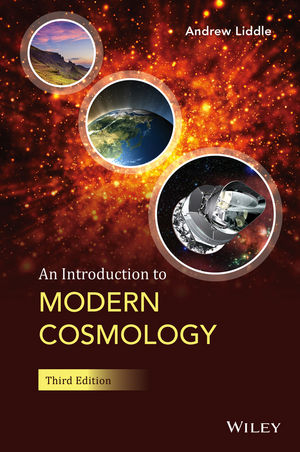
An Introduction to Modern Cosmology (eBook)
John Wiley & Sons (Verlag)
978-1-118-69025-3 (ISBN)
An Introduction to Modern Cosmology Third Edition is an accessible account of modern cosmological ideas. The Big Bang Cosmology is explored, looking at its observational successes in explaining the expansion of the Universe, the existence and properties of the cosmic microwave background, and the origin of light elements in the universe. Properties of the very early Universe are also covered, including the motivation for a rapid period of expansion known as cosmological inflation. The third edition brings this established undergraduate textbook up-to-date with the rapidly evolving observational situation.
This fully revised edition of a bestseller takes an approach which is grounded in physics with a logical flow of chapters leading the reader from basic ideas of the expansion described by the Friedman equations to some of the more advanced ideas about the early universe. It also incorporates up-to-date results from the Planck mission, which imaged the anisotropies of the Cosmic Microwave Background radiation over the whole sky. The Advanced Topic sections present subjects with more detailed mathematical approaches to give greater depth to discussions. Student problems with hints for solving them and numerical answers are embedded in the chapters to facilitate the reader's understanding and learning.
Cosmology is now part of the core in many degree programs. This current, clear and concise introductory text is relevant to a wide range of astronomy programs worldwide and is essential reading for undergraduates and Masters students, as well as anyone starting research in cosmology.
The accompanying website for this text, http://booksupport.wiley.com, provides additional material designed to enhance your learning, as well as errata within the text.
Andrew Liddle
Institute for Astronomy, University of Edinburgh, UK
Andrew Liddle Institute for Astronomy, University of Edinburgh, UK
Chapter 2
Observational Overview
For most of history, astronomers have had to rely on light in the visible part of the spectrum in order to study the Universe. One of the great astronomical achievements of the 20th century was the exploitation of the full electromagnetic spectrum for astronomical measurements. We now have instruments capable of making observations of radio waves, microwaves, infrared light, visible light, ultraviolet light, X-rays and gamma rays, which all correspond to light waves of different (in this case increasing) frequency. We are even entering an epoch where we can go beyond the electromagnetic spectrum and receive information of other types. A remarkable feature of observations of a nearby supernova in 1987 was that it was also seen through detection of neutrinos, an extraordinarily weakly interacting type of particle normally associated with radioactive decay. Very high energy cosmic rays, consisting of highly-relativistic elementary particles, are now routinely detected, though as yet there is no clear understanding of their astronomical origin. And as I write, experiments appear close to the goal of directly detecting gravitational waves, ripples in space–time itself, and ultimately of using them to observe astronomical events such as colliding stars.
The advent of large ground-based and satellite-based telescopes operating in all parts of the electromagnetic spectrum has revolutionized our picture of the Universe. While there are probably gaps in our knowledge, some of which may be important for all we know, we do seem to have a consistent picture, based on the cosmological principle, of how material is distributed in the Universe. My discussion here is brief; for a much more detailed discussion of the observed Universe, see Rowan-Robinson’s book Cosmology (full reference in the Bibliography). A set of images, including full-colour versions of the figures in this chapter, can be found via the book’s Home Page as given in the Preface.
2.1 In visible light
Historically, our picture of the Universe was built up through ever more careful observations using visible light.
Stars: The main source of visible light in the Universe is nuclear fusion within stars. The Sun is a fairly typical star, with a mass of about 2 × 1030 kilograms. This is known as a solar mass, indicated M⊙, and is a convenient unit for measuring masses. The nearest stars to us are a few light years away, a light year being the distance (about 1016 metres) that light can travel in a year. For historical reasons, an alternative unit, known as the parsec and denoted ‘pc’,1 is more commonly used in cosmology. A parsec equals 3.261 light years. In cosmology, one seldom considers individual stars, instead preferring to adopt as the smallest considered unit the conglomerations of stars known as …
Galaxies: Our Solar System lies some way off-centre in a giant disk structure known as the Milky Way galaxy. It contains a staggering hundred thousand million (1011) or so stars, with masses ranging from about a tenth that of our Sun to tens of times larger. It consists of a central bulge, plus a disk of radius 12.5 kiloparsecs (kpc, equal to 103 pc) and a thickness of only about 0.3 kpc. We are located in the disk about 8 kpc from the centre. The disk rotates slowly (and also differentially, with the outer edges moving more slowly, just as more distant planets in the Solar System orbit more slowly). At our radius, the galaxy rotates with a period of 200 million years. Because we are within it, we can’t get an image of our own galaxy, but it probably looks not unlike the M100 galaxy shown in Figure 2.1.
Figure 2.1 If viewed from above the disk, our own Milky Way galaxy would probably resemble the M100 galaxy, imaged here by the Hubble Space telescope. (Figure courtesy NASA.)
Our galaxy is surrounded by smaller collections of stars, known as globular clusters. These are distributed more or less symmetrically about the bulge, at distances of 5–30 kpc. Typically they contain a million stars, and are thought to be remnants of the formation of the galaxy. As we shall discuss later, it is believed that the entire disk and globular cluster system is embedded in a larger spherical structure known as the Galactic halo.
Galaxies are the most visually striking and beautiful astronomical objects in the Universe, exhibiting a wide range of properties. However, in cosmology the detailed structure of a galaxy is usually irrelevant, and galaxies are normally thought of as point-like objects emitting light, often broken into sub-classes according to colours, luminosities and morphologies.
The local group: Our galaxy resides within a small concentrated group of galaxies known as the local group. The nearest galaxy is a small irregular galaxy known as the Large Magellanic Cloud (LMC), which is 50 kpc away from the Sun. The nearest galaxy of similar size to our own is the Andromeda Galaxy, at a distance of 770 kpc. The Milky Way is one of the largest galaxies in the local group. A typical galaxy group occupies a volume of a few cubic megaparsecs. The megaparsec, denoted Mpc and equal to a million parsecs, is the cosmologist’s favourite unit for measuring distances, because it is roughly the separation between neighbouring galaxies. It equals 3.086 × 10²² metres.
Clusters of galaxies, superclusters and voids: Surveying larger regions of the Universe, say on a scale of hundreds of Mpc, one sees a variety of large-scale structures, as shown in Figure 2.2. This figure is not a photograph, but rather a carefully constructed map of the nearby region of our Universe, on a scale of about 1:1027! In some places galaxies are clearly grouped into clusters of galaxies.
Figure 2.2 A map of galaxy positions in a narrow slice of the Universe, as measured by the Sloan Digital Sky Survey. Our galaxy is located at the centre, and the survey radius is around 600 Mpc. The galaxy positions were obtained by measurement of the shift of spectral lines, as described in Section 2.4. (Figure courtesy M. Blanton and the Sloan Digital Sky Survey, www.sdss3.org.)
A famous example of a cluster of galaxies is the Coma cluster, which is about 100 Mpc away from our own Galaxy. The upper panel of Figure 2.3 shows a combined optical/infrared image of Coma; although the image resembles a star field, almost every source is a distinct galaxy (the main exception being two bright stars in the upper right quadrant). Coma contains perhaps 10 000 galaxies, mostly too faint to show in this image, orbiting in their common gravitational field.
Figure 2.3 Images of the Coma cluster of galaxies in visible/infrared light (top) and in X-rays (bottom), the latter being on a larger angular scale. Colour versions can be found on the book’s WWW site. (Images courtesy of NASA/Spitzer satellite and ESA/U. Briel/MPE Garching/XMM-Newton satellite.)
However, most galaxies, sometimes called field galaxies, are not part of a cluster. Galaxy clusters are the largest gravitationally-collapsed objects in the Universe, and they themselves are grouped into superclusters, joined by filaments and walls of galaxies. In between this ‘foamlike’ structure lie large voids, some as large as 50 Mpc across. Structures in the Universe will be further described in Advanced Topic 5. Figure 2.4 shows an example of a computer simulation aiming to model the distribution of material within the Universe.
Figure 2.4 A computer simulation showing the predicted distribution of matter in the Universe on large scales. (Image courtesy V. Springel and the Virgo Consortium.)
Large-scale smoothness: Only once we get to scales of hundreds of megaparsecs or more does the Universe begin to appear smooth, as revealed by extremely large galaxy surveys such as the 2dF galaxy redshift survey and the Sloan Digital Sky Survey. Such surveys do not find any huge structures on scales greater than those described above; the galaxy superclusters and voids are believed to be the biggest structures in the present Universe.
The belief that the Universe does indeed become smooth on the largest scales, the cosmological principle, is the underpinning of modern cosmology. It is interesting that while the smoothness of the matter distribution on large scales has been a key assumption of cosmology for decades now, it is only fairly recently that it has been possible to provide a convincing observational demonstration.
2.2 In other wavebands
Observations using visible light provide us with a good picture of what’s going on in the present-day Universe. However, many other wavebands make vital contributions to our understanding, and in particular our best knowledge of cosmology comes not from visible light but from microwaves.
Microwaves: For cosmology, this is by far the most important waveband. Penzias & Wilson’s accidental discovery in 1965 that the Earth is bathed in microwave radiation, with a black-body spectrum at a temperature of around 3 Kelvin, was and is one of the most powerful pieces of information in support of the Big Bang theory, around which cosmology is based. This is now known as the cosmic microwave background or simply CMB. Observations by the FIRAS (Far InfraRed Absolute Spectrometer) experiment on board the COBE (COsmic Background Explorer) satellite have confirmed that the radiation is extremely close to...
| Erscheint lt. Verlag | 27.4.2015 |
|---|---|
| Sprache | englisch |
| Themenwelt | Naturwissenschaften ► Physik / Astronomie ► Astronomie / Astrophysik |
| Technik | |
| Schlagworte | Astronomie • Astronomie u. Astrophysik • Astronomy & Astrophysics • astrophysics • Cosmic microwave background • Cosmology • Inflation • Kosmologie • Physics • Physik • Universe |
| ISBN-10 | 1-118-69025-7 / 1118690257 |
| ISBN-13 | 978-1-118-69025-3 / 9781118690253 |
| Informationen gemäß Produktsicherheitsverordnung (GPSR) | |
| Haben Sie eine Frage zum Produkt? |
 EPUB (Adobe DRM)
Kopierschutz: Adobe-DRM
Adobe-DRM ist ein Kopierschutz, der das eBook vor Mißbrauch schützen soll. Dabei wird das eBook bereits beim Download auf Ihre persönliche Adobe-ID autorisiert. Lesen können Sie das eBook dann nur auf den Geräten, welche ebenfalls auf Ihre Adobe-ID registriert sind.
Details zum Adobe-DRM
Dateiformat: EPUB (Electronic Publication)
EPUB ist ein offener Standard für eBooks und eignet sich besonders zur Darstellung von Belletristik und Sachbüchern. Der Fließtext wird dynamisch an die Display- und Schriftgröße angepasst. Auch für mobile Lesegeräte ist EPUB daher gut geeignet.
Systemvoraussetzungen:
PC/Mac: Mit einem PC oder Mac können Sie dieses eBook lesen. Sie benötigen eine
eReader: Dieses eBook kann mit (fast) allen eBook-Readern gelesen werden. Mit dem amazon-Kindle ist es aber nicht kompatibel.
Smartphone/Tablet: Egal ob Apple oder Android, dieses eBook können Sie lesen. Sie benötigen eine
Geräteliste und zusätzliche Hinweise
Buying eBooks from abroad
For tax law reasons we can sell eBooks just within Germany and Switzerland. Regrettably we cannot fulfill eBook-orders from other countries.
aus dem Bereich