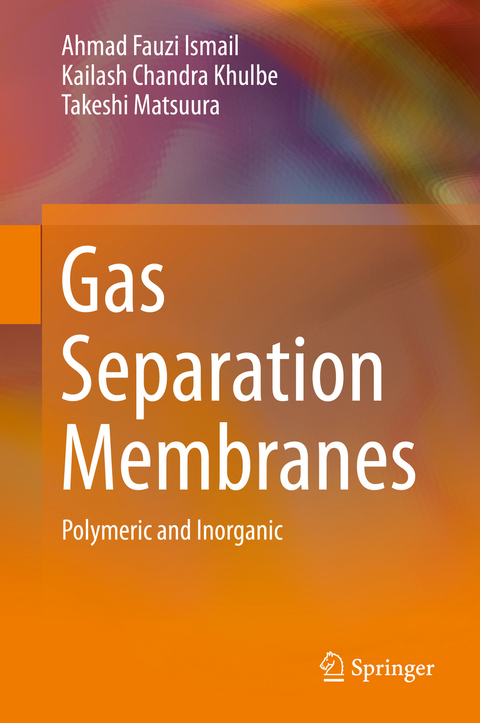
Gas Separation Membranes (eBook)
X, 331 Seiten
Springer International Publishing (Verlag)
978-3-319-01095-3 (ISBN)
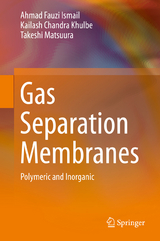
This book describes the tremendous progress that has been made in the development of gas separation membranes based both on inorganic and polymeric materials. Materials discussed include polymer inclusion membranes (PIMs), metal organic frameworks (MOFs), carbon based materials, zeolites, as well as other materials, and mixed matrix membranes (MMMs) in which the above novel materials are incorporated. This broad survey of gas membranes covers material, theory, modeling, preparation, characterization (for example, by AFM, IR, XRD, ESR, Positron annihilation spectroscopy), tailoring of membranes, membrane module and system design, and applications. The book is concluded with some perspectives about the future direction of the field.
Professor Ahmad Fauzi Ismail is the Founding Director of Advanced Membrane Technology Research Center (AMTEC) and also the Dean of Research for Materials and Manufacturing Research Alliance of Universiti Teknologi Malaysia (UTM). Professor Fauzi obtained a PhD. in Chemical Engineering in 1997 from University of Strathclyde and MSc. and BSc. from Universiti Teknologi Malaysia in 1992 and 1989 respectively. He is the author and co-author of over 350 refereed journals. He has authored 3 books, 25 book chapters and 3 edited books, 3 Patents granted 17 Patents pending. He has won more than 120 awards. Professor Fauzi's research focuses on development of polymeric, inorganic and novel mixed matrix membranes for water desalination, waste water treatment, gas separation processes, membrane for palm oil refining, photocatalytic membrane for removal of emerging contaminants and polymer electrolyte membrane for fuel cell applications. Professor Fauzi has involved extensively in R&D&C for multinational companies related to membrane-based processes for industrial application.
Professor Takeshi Matsuura studied at the University of Tokyo and the Institute of Chemical Technology of the Technical University of Berlin. He was appointed to Professor Emeritus of the University of Ottawa upon his retirement in 2002 after serving as professor of the Department of Chemical Engineering (currently Department of Chemical and Biological Engineering) and the director of the Industrial Membrane Research Institute (IMRI). He also served at University Technology Malaysia (UTM), Skudai, Malaysia (currently at the Advanced Membrane Technology Research Centre (AMTEC) of UTM), as a distinguished visiting professor, in years 2007, 2009-2014. He delivered many lectures at overseas research institutions and international conferences. He has published about 450 papers in refereed journals, authored and co-authored 6 books and edited 8 books.
Kailash C. Khulbe is a graduate of Agra University, India where he obtained the BSc, MSc and PhD. Degree. His doctoral thesis was on the kinetics of the oxidation of aldehydes, ketones and other related compounds by persulphate catalyzed by Ag+ ion. He joined Ottawa University (Chemical Engineering Department) in late 1960's and worked on different projects related with catalysts, bitumen, Oil, ESR, IR, X-ray analysis, Chromatography etc. He joined the Dr. T. Matsuura group (Industrial Membrane Research Institute (IMRI)) in the middle of 1990's and started work on synthetic membranes. His main interests are AFM, Synthetic Membranes (Polymeric/Inorganic), Water treatment etc. He published more than 350 articles, one book (AFM for synthetic membranes) and many chapters for different books.
Professor Ahmad Fauzi Ismail is the Founding Director of Advanced Membrane Technology Research Center (AMTEC) and also the Dean of Research for Materials and Manufacturing Research Alliance of Universiti Teknologi Malaysia (UTM). Professor Fauzi obtained a PhD. in Chemical Engineering in 1997 from University of Strathclyde and MSc. and BSc. from Universiti Teknologi Malaysia in 1992 and 1989 respectively. He is the author and co-author of over 350 refereed journals. He has authored 3 books, 25 book chapters and 3 edited books, 3 Patents granted 17 Patents pending. He has won more than 120 awards. Professor Fauzi’s research focuses on development of polymeric, inorganic and novel mixed matrix membranes for water desalination, waste water treatment, gas separation processes, membrane for palm oil refining, photocatalytic membrane for removal of emerging contaminants and polymer electrolyte membrane for fuel cell applications. Professor Fauzi has involved extensively in R&D&C for multinational companies related to membrane-based processes for industrial application. Professor Takeshi Matsuura studied at the University of Tokyo and the Institute of Chemical Technology of the Technical University of Berlin. He was appointed to Professor Emeritus of the University of Ottawa upon his retirement in 2002 after serving as professor of the Department of Chemical Engineering (currently Department of Chemical and Biological Engineering) and the director of the Industrial Membrane Research Institute (IMRI). He also served at University Technology Malaysia (UTM), Skudai, Malaysia (currently at the Advanced Membrane Technology Research Centre (AMTEC) of UTM), as a distinguished visiting professor, in years 2007, 2009-2014. He delivered many lectures at overseas research institutions and international conferences. He has published about 450 papers in refereed journals, authored and co-authored 6 books and edited 8 books. Kailash C. Khulbe is a graduate of Agra University, India where he obtained the BSc, MSc and PhD. Degree. His doctoral thesis was on the kinetics of the oxidation of aldehydes, ketones and other related compounds by persulphate catalyzed by Ag+ ion. He joined Ottawa University (Chemical Engineering Department) in late 1960’s and worked on different projects related with catalysts, bitumen, Oil, ESR, IR, X-ray analysis, Chromatography etc. He joined the Dr. T. Matsuura group (Industrial Membrane Research Institute (IMRI)) in the middle of 1990’s and started work on synthetic membranes. His main interests are AFM, Synthetic Membranes (Polymeric/Inorganic), Water treatment etc. He published more than 350 articles, one book (AFM for synthetic membranes) and many chapters for different books.
Preface 6
Contents 8
Chapter 1: Introduction 12
1.1 Membrane Separation Processes 12
1.2 Membrane-Based Gas Separation 13
1.2.1 Historical Background 14
1.2.2 Scientific and Commercial Development of Membrane Processes 14
1.3 Advantages of Membrane Processes 18
References 19
Chapter 2: Fundamentals of Gas Permeation Through Membranes 22
2.1 Gas Permeation Through Membranes 22
2.1.1 Technical Terms Used in Gas Permeation Membrane Science 22
2.1.2 Membrane Separation Principles 26
2.1.3 Gas Permeation Through Porous Membranes 27
2.1.4 Gas Permeation Through Nonporous Membranes 30
2.1.5 Gas Permeation Through Asymmetric Membranes 31
2.2 Diffusion Theory of Small Molecules in Nonporous Polymer Membranes 32
2.3 Diffusion Models for Rubbery Polymers 34
2.4 Diffusion Models for Glassy Polymers 37
2.5 General Membrane Transport Equations 38
2.6 Models for Gas Transport in Nanocomposite Membranes 41
2.6.1 Maxwell’s Model 41
2.6.2 Free-Volume Increase Mechanism 41
2.6.3 Solubility Increase Mechanism 42
2.6.4 Nanogap Hypothesis 42
2.7 Facilitated Transport Membranes 43
References 45
Chapter 3: Gas Separation Membrane Materials and Structures 47
3.1 Membrane Materials for Gas Separation 48
3.1.1 Polymeric Membranes 49
3.1.1.1 Silicone Rubber 51
3.1.1.2 Cellulose Acetate 56
3.1.1.3 Polycarbonate (PC) 58
3.1.1.4 Poly(norbornene)s 59
3.1.1.5 Poly(2,6-Dimethyl-1,4-Diphenyl Oxide) (PPO) 60
3.1.1.6 Polyimides (PI) 62
3.1.1.7 Polyetherimide 69
3.1.1.8 Perfluoropolymers 71
3.1.1.9 Poly(Ether Ether Ketone) (PEEK) 73
3.1.1.10 Polyurethane (PU) 73
3.1.1.11 Polyaniline (PANi) 75
3.1.1.12 Polysulfone (PSf) and Polyethersulfone (PES) 76
3.1.1.13 Polybenzimidazole (PBI) 82
3.1.1.14 Polyvinylidene Fluoride (PVDF) 84
3.1.1.15 Poly(1-Trimethylsilyl-1-Propyne) (PTMSP) 84
3.1.1.16 Polysaccharide 87
Cellulose 87
Chitosan 88
3.1.1.17 Polyvinyl Alcohol (PVA) 88
3.1.2 Copolymers and Polymer Blends 89
3.1.3 Other Polymers 95
3.1.3.1 Polymers of Intrinsic Microporosity (PIMS) 95
3.1.3.2 Cross-linking of Polymers and Other Techniques for Modification 97
3.2 Inorganic Membranes 99
3.2.1 Ceramic Membranes 100
3.2.2 Silica Glass Membranes 101
3.2.3 Zeolites 105
3.2.3.1 Preparation of Zeolite Membrane by Crystallization and Seeding 107
3.2.3.2 LTA Zeolite 111
3.2.3.3 NaA Zeolite 113
3.2.3.4 DDR Type Zeolite 113
3.2.3.5 SAPO-34 117
3.2.3.6 AlPO-18 118
3.2.3.7 Beta Zeolite or ZSM Zeolite (MFI Zeolite Membranes (ZSM-5)) 118
3.2.3.8 FAU-Type Zeolite 122
3.2.3.9 Hydroxy-Sodalite Zeolite Membrane (HDS-zeolite) 122
3.2.3.10 Zeolite T 123
3.2.3.11 Zeolite L 124
3.2.3.12 ITQ-29 zeolite 124
3.2.3.13 UZM Zeolites 125
3.2.3.14 Zeolite W 125
3.2.3.15 Zeolitic Imidazole Frameworks (ZIFs) 126
3.2.3.16 Other Zeolitic Type or Ceramic/Inorganic Membranes 127
3.3 Metal–Organic Framework Membranes for Gas Separations 133
3.4 Mixed Matrix Membranes (MMMs) 139
3.4.1 Preparation of MMMs 145
3.5 Other Materials 146
3.5.1 Metallic Membranes 146
3.5.2 Carbon-Based Membranes 147
3.5.2.1 Carbon Molecular Sieve Membranes (CMSMs) and Adsorption Selective Carbon Membranes (ASCMs) 147
3.5.2.2 Carbon Molecular Sieve Membranes (CMSMs) 148
3.5.2.3 Carbon Nanotubes 158
3.5.2.4 Graphene Membranes 160
3.6 Gas Separation Membrane Structures 164
3.6.1 Homogeneous Dense Membranes or Symmetric Membranes 165
3.6.2 Asymmetric Membranes 166
3.6.2.1 Integrally Skinned Bilayer Membranes 166
3.6.2.2 Integrally Skinned Trilayer Membranes 168
3.6.2.3 Thin Film Composite Membranes (TFC) 169
3.7 Liquid Membranes for Gas Separation 172
3.7.1 Supported Liquid Membranes (SLM) or Immobilized Liquid Membranes (ILM) 173
References 183
Chapter 4: Membrane Fabrication/Manufacturing Techniques 203
4.1 Polymeric Membranes 203
4.1.1 Phase Inversion Membranes 203
4.1.2 Precipitation by Solvent Evaporation 205
4.1.3 Preparation of Hollow Fiber Membranes 206
4.1.3.1 Methods for Spinning 207
4.1.3.2 Thermally Induced Phase Separation (TIPs) 212
4.1.4 Other Techniques 212
4.1.4.1 Coating 212
Dip Coating 213
4.1.4.2 Interfacial Polymerization 213
4.1.4.3 Plasma Polymerization 214
4.1.4.4 Graft Polymerization 215
4.1.4.5 Particle Leaching 215
4.1.4.6 Track Etching 216
4.1.5 Polyelectrolyte Multilayer Membranes 216
4.2 Inorganic Membranes 217
4.2.1 Preparation of Inorganic Membranes 217
4.2.1.1 Chemical Vapor Deposition 218
4.2.1.2 Thin-Layer Metallic Membranes 219
4.2.2 Silica Membranes 220
4.3 Composite Membrane Preparation/Mixed Matrix Membranes 221
4.4 Preparation of Metal-Organic Framework Membranes (MOFs) 222
4.4.1 Growth/Deposition from Solvothermal Mother Solutions 223
4.4.2 Microwave-Induced Thermal Deposition (MITD) 224
4.4.3 Stepwise Layer-by-Layer Growth onto the Substrate 225
4.4.4 Electrochemical Deposition of Thin MOF-Films on Metal Substrates 225
4.4.5 Deposition of MOF Thin Films Using a Gel-Layer Approach 225
4.5 Ultrathin Membranes 226
References 227
Chapter 5: Membrane Modules and Process Design 231
5.1 Membrane Modules 232
5.1.1 Plate and Frame 232
5.1.2 Spiral Wound 233
5.1.3 Tubular 234
5.1.4 Capillary 235
5.1.5 Hollow Fiber 236
5.1.6 Membrane Contactors 239
5.2 Comparison of the Module Configuration 242
5.3 System Design 243
5.4 Process Parameter 245
5.5 Energy Requirements 247
References 248
Chapter 6: Application of Gas Separation Membranes 251
6.1 Large-Scale Applications 252
6.1.1 Air Separation (Nitrogen and Oxygen Production) 252
6.1.2 Hydrogen Recovery 256
6.1.3 Acid Gas Removal from Natural Gas and Syn Gas 261
6.1.4 Hydrocarbon/Carbon Dioxide Separation 267
6.1.5 Vapor Permeation/Pervaporation Gas Separation 269
6.2 Present and Emerging Large-Scale Applications of Membrane Technology 270
6.3 Dew Pointing of Natural Gas 272
6.4 Olefin–Paraffin Separations 272
6.4.1 Polymeric Membranes 273
6.4.2 Inorganic Membranes 274
6.4.3 Facilitated Transport Membranes 275
6.5 Membrane/Pressure Swing Adsorption Process 278
6.6 Membrane/Distillation Process 282
6.7 Membrane Contactor 282
References 292
Chapter 7: Characterization of Membranes 298
7.1 Introduction 298
7.2 Mass Transport 299
7.3 Membrane Morphology 303
7.3.1 Microscopic Method 303
7.3.1.1 Atomic Force Microscopy 303
7.3.2 Observation of Nodules 306
7.3.2.1 Electron Spectroscopy for Chemical Analysis (ESCA) and Scanning Electron Microscopy (SEM) 309
7.3.3 Spectroscopic Method 315
7.3.3.1 Infrared (IR) and Fourier Transform Infrared (FTIR) Spectroscopy 315
7.3.3.2 Positron Annihilation Spectroscopy (PALS) 316
7.3.3.3 X-ray Analysis 319
7.3.3.4 X-ray Photoelectron Spectroscopy (XPS) 321
7.3.3.5 Small Angle Neutron Scattering (SANS) 322
7.3.3.6 Raman Spectroscopy (RS) 322
7.3.3.7 Electron Spinning Resonance (ESR) 324
7.3.3.8 Nuclear Magnetic Resonance 328
7.4 Other Techniques 328
7.4.1 Optical Technique 328
7.5 Thermal Properties 329
7.5.1 Differential Scanning Calorimeter (DSC) and Differential Thermal Analysis (DTA) 329
7.6 Mechanical Properties 330
7.6.1 Tensile Strength 330
7.6.2 Young’s Modulus or Tensile Modulus of Elasticity 331
References 333
Index 338
| Erscheint lt. Verlag | 28.4.2015 |
|---|---|
| Zusatzinfo | X, 331 p. 169 illus., 33 illus. in color. |
| Verlagsort | Cham |
| Sprache | englisch |
| Themenwelt | Naturwissenschaften ► Chemie |
| Technik ► Maschinenbau | |
| Wirtschaft | |
| Schlagworte | Gas Membrane • Gas Membrane Design • Gas Separation • Inorganic Membrane • MEMBRANE CHARACTERIZATION • Membrane Manufacturing • Membrane Module and Process Design • NOTT201 • NOTT220 • Polymer Membrane |
| ISBN-10 | 3-319-01095-6 / 3319010956 |
| ISBN-13 | 978-3-319-01095-3 / 9783319010953 |
| Informationen gemäß Produktsicherheitsverordnung (GPSR) | |
| Haben Sie eine Frage zum Produkt? |
 PDF (Wasserzeichen)
DRM: Digitales Wasserzeichen
Dieses eBook enthält ein digitales Wasserzeichen und ist damit für Sie personalisiert. Bei einer missbräuchlichen Weitergabe des eBooks an Dritte ist eine Rückverfolgung an die Quelle möglich.
Dateiformat: PDF (Portable Document Format)
Mit einem festen Seitenlayout eignet sich die PDF besonders für Fachbücher mit Spalten, Tabellen und Abbildungen. Eine PDF kann auf fast allen Geräten angezeigt werden, ist aber für kleine Displays (Smartphone, eReader) nur eingeschränkt geeignet.
Systemvoraussetzungen:
PC/Mac: Mit einem PC oder Mac können Sie dieses eBook lesen. Sie benötigen dafür einen PDF-Viewer - z.B. den Adobe Reader oder Adobe Digital Editions.
eReader: Dieses eBook kann mit (fast) allen eBook-Readern gelesen werden. Mit dem amazon-Kindle ist es aber nicht kompatibel.
Smartphone/Tablet: Egal ob Apple oder Android, dieses eBook können Sie lesen. Sie benötigen dafür einen PDF-Viewer - z.B. die kostenlose Adobe Digital Editions-App.
Buying eBooks from abroad
For tax law reasons we can sell eBooks just within Germany and Switzerland. Regrettably we cannot fulfill eBook-orders from other countries.
aus dem Bereich