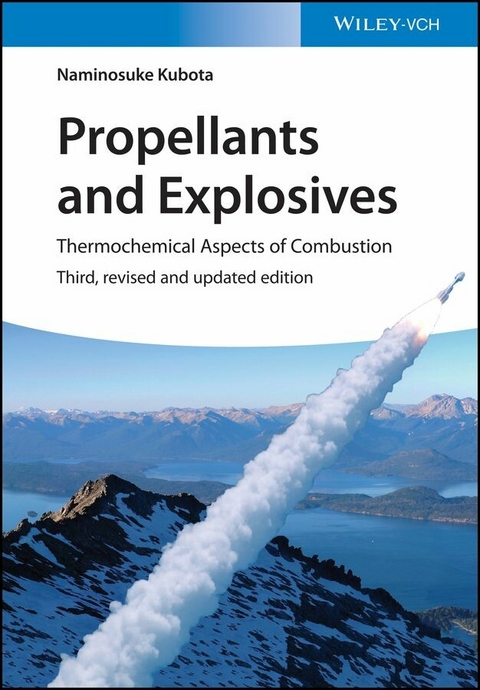
Propellants and Explosives (eBook)
Wiley-VCH (Verlag)
978-3-527-69350-4 (ISBN)

Clearly structured, the first half of the book presents an introduction to pyrodynamics, describing fundamental aspects of the combustion of energetic materials, while the second part highlights applications of energetic materials, such as propellants, explosives and pyrolants, with a focus on the phenomena occurring in rocket motors. Finally, an appendix gives a brief overview of the fundamentals of aerodynamics and heat transfer, which is a prerequisite for the study of pyrodynamics.
A detailed reference for readers interested in rocketry or explosives technology.
Prof. Kubota works as scientific advisor at the National Institute of Industrial Science and Technology (Tsukuba, Japan). In 1973 he received his Doctorate from Princeton University, majoring in 'Solid Propellant Combustion' and 'Rocket Propulsion including Ducted Rocket Engine'. During his career he was Director of the Third Research Center of the Technical Research and Development Institute (TRDI, Japan Defense Agency), which is responsible for aircraft and missile research. Afterwards, Prof. Kubota held a position as Senior Research Scientist in the Propellant Combustion Laboratory at Asahi Kasei Chemicals (Japan).
Prof. Kubota works as scientific advisor at the National Institute of Industrial Science and Technology (Tsukuba, Japan). In 1973 he received his Doctorate from Princeton University, majoring in "Solid Propellant Combustion" and "Rocket Propulsion including Ducted Rocket Engine". During his career he was Director of the Third Research Center of the Technical Research and Development Institute (TRDI, Japan Defense Agency), which is responsible for aircraft and missile research. Afterwards, Prof. Kubota held a position as Senior Research Scientist in the Propellant Combustion Laboratory at Asahi Kasei Chemicals (Japan).
Thermodynamics of Energy Conversion
Thermochemistry of Combustion
Combustion Wave Propagation
Energetics of Propellants and Explosives
Combustion of Crystalline and Polymeric Materials
Combustion of Double-Base Propellants
Combustion of Composite Propellants
Combustion of Explosives
Formation of Energetic Pyrolants
Combustion Propagation of Pyrolants
Emission from Combustion Products
Transient Combustion
Rocket Thrust Modulation
Ducted Rocket Propulsion
Appendix A: List of Abbreviation of Energetic Materials
Appendix B: Measurements of Burning Rate and Combustion Wave Structure
Appendix C: Dynamics in Flow Field
Appendix D: Shock Wave Propagation
Appendix E: List of Mathematical Symbols
Index 1. Foundations of Pyrodynamics
2. Thermochemistry of Combustion
3. Combustion Wave Propagation
4. Energetics of Propellants and Explosives
5. Combustion of Crystalline and Polymeric Materials
6. Combustion of Double-Base Propellants
7. Combustion of Composite Propellants
8. Combustion of CMDB Propellants
9. Combustion of Explosives
10. Formation of Energetic Pyrolants
11. Combustion Propagation of Pyrolants
12. Emission from Combustion Products
13. Transient Combustion of Propellants and Explosives
14. Rocket Thrust Modulation
15. Ducted Rocket Propulsion
Appendix A: List of Abbreviation of Energetic Materials
Appendix B: Mass and Heat Transfer in a Combustion Wave
Appendix C: Shock Wave Propagation in a Two-Dimensional Flow Field
Appendix D: Supersonic Air-Intake
Appendix E: Measurement of Burning Rate and Combustion Wave Structure
Index
Chapter 1
Foundations of Pyrodynamics
Pyrodynamics describes the process of energy conversion from chemical energy to mechanical energy through combustion phenomena, including thermodynamic and fluid dynamic changes. Propellants and explosives are energetic condensed materials composed of oxidizer-fuel components that produce high-temperature molecules. Propellants are used to generate high-temperature and low-molecular combustion products that are converted into propulsive forces. Explosives are used to generate high-pressure combustion products accompanied by a shock wave that yields destructive forces. This chapter presents the fundamentals of the thermodynamics and fluid dynamics needed to understand the pyrodynamics of propellants and explosives.
1.1 Heat and Pressure
1.1.1 First Law of Thermodynamics
The first law of thermodynamics relates the energy conversion produced by chemical reaction of an energetic material to the work acting on a propulsive or explosive system. The heat produced by chemical reaction () is converted into the internal energy of the reaction product () and the work done to the system () according to
The work is done by the expansion of the reaction product, as given by
where is the pressure, is the specific volume (volume per unit mass) of the reaction product, and is the density defined as . Enthalpy is defined by
Substituting Eqs. (1.1) and (1.2) into Eq. (1.3), one gets
The equation of state for one mole of a perfect gas is represented by
where T is the absolute temperature and is the gas constant. The gas constant is given by
where is the molecular mass and is the universal gas constant, . In the case of moles of a perfect gas, the equation of state is represented by
1.1.2 Specific Heat
Specific heat is defined as
where is the specific heat at constant volume and is the specific heat at constant pressure. Both specific heats represent conversion parameters between energy and temperature. Using Eqs. (1.3) and (1.5a), one obtains the relationship
The specific heat ratio is defined by
Using Eq. (1.9), one obtains the relationships
Specific heat is an important parameter for energy conversion from heat energy to mechanical energy through temperature, as defined in Eqs. (1.7) and (1.4). Hence, the specific heat of gases is discussed to understand the fundamental physics of the energy of molecules based on kinetic theory [1, 2]. The energy of a single molecule, , is given by the sum of the internal energies, which comprise the translational energy , rotational energy , vibrational energy , electronic energy , and their interaction energy :
A molecule containing atoms has degrees of freedom of motion in space:
| Molecular structure | Degrees of freedom | Translational | Rotational | Vibrational |
| Monatomic | 3 | = 3 |
| Diatomic | 6 | = 3 | + 2 | + 1 |
| Polyatomic linear | 3n | = 3 | + 2 | + (3n−5) |
| Polyatomic nonlinear | 3n | = 3 | + 3 | + (3n−6) |
A statistical theorem on the equipartition of energy shows that an energy amounting to is given to each degree of freedom of the translational and rotational modes, and that an energy is given to each degree of freedom of the vibrational modes. The Boltzmann constant is . The universal gas constant defined in Eq. (1.5b) is given by , where is Avogadro's number, .
When the temperature of a molecule is increased, rotational and vibrational modes are excited and the internal energy is increased. The excitation of each degree of freedom as a function of temperature can be calculated through statistical mechanics. Though the translational and rotational modes of a molecule are fully excited at low temperatures, the vibrational modes become excited only above room temperature. The excitation of electrons and interaction modes usually occurs only well above combustion temperatures. Nevertheless, dissociation and ionization of molecules can occur when the combustion temperature is very high.
When the translational, rotational, and vibrational modes of monatomic, diatomic, and polyatomic molecules are fully excited, the energies of the molecules are given by
- ;
- ;
- ;
- .
Since the specific heat at constant volume is given by the temperature derivative of the internal energy as defined in Eq. (1.7), the specific heat of a molecule, , is represented by
Thus, one obtains the specific heats of gases composed of monatomic, diatomic, and polyatomic molecules as follows:
- ;
- ;
- ;
- .
The specific heat ratio defined by Eq. (1.9) is 5/3 for monatomic molecules and 9/7 for diatomic molecules. Since the excitations of rotational and vibrational modes occur only at certain temperatures, the specific heats determined by kinetic theory are different from those determined experimentally. Nevertheless, the theoretical results are valuable for understanding the behavior of molecules and the process of energy conversion in the thermochemistry of combustion. Figure 1.1 shows the specific heats of real gases encountered in combustion as a function of temperature [3]. The specific heats of monatomic gases remain constant with increasing temperature, as determined by kinetic theory. However, the specific heats of diatomic and polyatomic gases increase with increasing temperature as the rotational and vibrational modes are excited.
Figure 1.1 Specific heats of gases at constant volume as a function of temperature.
1.1.3 Entropy Change
Entropy is defined according to
Substituting Eqs. (1.4), (1.5a), and (1.7) into Eq. (1.11), one gets
In the case of isentropic change, , and Eq. (1.12) is integrated as
where the subscript 1 indicates the initial state 1. Using Eqs. (1.10), (1.5a), and (1.13), one gets
When a system involves dissipative effects, such as friction caused by molecular collisions or turbulence caused by a nonuniform molecular distribution, even under adiabatic conditions, becomes a positive value, and then Eqs. (1.13) and (1.14) are no longer valid. However, when these physical effects are very small and heat loss from the system or heat gain by the system is also small, the system is considered to undergo an isentropic change.
1.2 Thermodynamics in a Flow Field
1.2.1 One-Dimensional Steady-State Flow
1.2.1.1 Sonic Velocity and Mach Number
The sonic velocity propagating in a perfect gas, , is given by
Using the equation of state, Eq. (1.8), and the expression for adiabatic change (Eq. (1.14)), one gets
The Mach number is defined as
where is the local flow velocity in a flow field. Mach number is an important parameter in characterizing a flow field.
1.2.1.2 Conservation Equations in a Flow Field
Let us consider a simplified flow, that is, a one-dimensional steady-state flow without viscous stress or a gravitational force. The conservation equations of continuity, momentum, and energy are represented by
- , that is
- , that is,
- , that is
Combining Eqs. (1.20) and (1.4), one obtains the relationship for the enthalpy change due to a change of flow velocity as
1.2.1.3 Stagnation Point
If one can assume that the process in the flow field is adiabatic and that dissipative effects are negligibly small, the flow in the system is isentropic , and then Eq. (1.21) becomes
Integration of Eq. (1.22) gives
where is the stagnation enthalpy at of a stagnation flow point. Substituting Eq. (1.7) into Eq. (1.23), one gets
where is the stagnation temperature at .
The changes in temperature, pressure, and density in a flow field are expressed as a function of Mach number as follows:
| Erscheint lt. Verlag | 22.4.2015 |
|---|---|
| Sprache | englisch |
| Themenwelt | Naturwissenschaften ► Chemie |
| Technik | |
| Schlagworte | Chemie • Chemistry • energetic pyrolant pyrodynamics rocket thermochemistry • Explosives and Propellants • Explosivstoff • Explosiv- und Treibstoffe • Kraftstoff • Maschinenbau • Materials Science • Materialwissenschaften • mechanical engineering • Physical Chemistry • Physikalische Chemie • Sprengstoff • Thermochemie • thermodynamics • Thermodynamik • Verbrennung |
| ISBN-10 | 3-527-69350-5 / 3527693505 |
| ISBN-13 | 978-3-527-69350-4 / 9783527693504 |
| Informationen gemäß Produktsicherheitsverordnung (GPSR) | |
| Haben Sie eine Frage zum Produkt? |
 EPUB (Adobe DRM)
Kopierschutz: Adobe-DRM
Adobe-DRM ist ein Kopierschutz, der das eBook vor Mißbrauch schützen soll. Dabei wird das eBook bereits beim Download auf Ihre persönliche Adobe-ID autorisiert. Lesen können Sie das eBook dann nur auf den Geräten, welche ebenfalls auf Ihre Adobe-ID registriert sind.
Details zum Adobe-DRM
Dateiformat: EPUB (Electronic Publication)
EPUB ist ein offener Standard für eBooks und eignet sich besonders zur Darstellung von Belletristik und Sachbüchern. Der Fließtext wird dynamisch an die Display- und Schriftgröße angepasst. Auch für mobile Lesegeräte ist EPUB daher gut geeignet.
Systemvoraussetzungen:
PC/Mac: Mit einem PC oder Mac können Sie dieses eBook lesen. Sie benötigen eine
eReader: Dieses eBook kann mit (fast) allen eBook-Readern gelesen werden. Mit dem amazon-Kindle ist es aber nicht kompatibel.
Smartphone/Tablet: Egal ob Apple oder Android, dieses eBook können Sie lesen. Sie benötigen eine
Geräteliste und zusätzliche Hinweise
Buying eBooks from abroad
For tax law reasons we can sell eBooks just within Germany and Switzerland. Regrettably we cannot fulfill eBook-orders from other countries.
aus dem Bereich