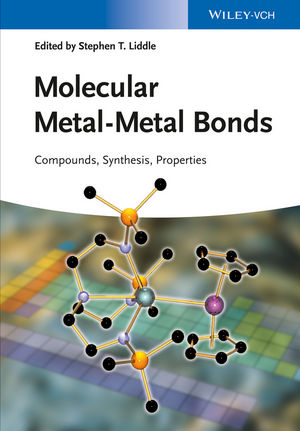
The chapters follow a uniform, coherent structure for a clear overview, allowing readers easy access to the information. The text covers such topics as synthesis, properties, structures, notable features, reactivity and examples of applications of the most important compounds in each group with metal-metal bonding throughout the periodic table.
With its general remarks at the beginning of each chapter, this is a must-have reference for all molecular inorganic chemists, including PhD students and postdocs, as well as more experienced researchers.
Stephen Liddle obtained his BSc Hons (1997) and PhD (2000) from Newcastle University. After postdoctoral fellowships at Edinburgh, Newcastle, and Nottingham Universities he took up a Royal Society University Research Fellowship at Nottingham (2007) and was promoted to Associate Professor and Reader (2010). He has been awarded an ERC Starting Investigators Grant (2009, uranium-metal bonds), the RSC Sir Edward Frankland Fellowship and Bill Newton awards (2011), and he was a co-recipient of the IChemE Petronas prize for education and training (2008). He was elected as a Fellow of the Royal Society of Chemistry in 2011. He is Chairman of COST Action CM1006 and was recently elected as a Vice President of the executive committee of the European Rare Earth and Actinide Society. He is a member of the Board of Editors for Philosophical Transactions A of the Royal Society and has published over 100 primary-research and review articles to date.
Stephen Liddle obtained his BSc Hons (1997) and PhD (2000) from Newcastle University. After postdoctoral fellowships at Edinburgh, Newcastle, and Nottingham Universities he took up a Royal Society University Research Fellowship at Nottingham (2007) and was promoted to Associate Professor and Reader (2010). He has been awarded an ERC Starting Investigators Grant (2009, uranium-metal bonds), the RSC Sir Edward Frankland Fellowship and Bill Newton awards (2011), and he was a co-recipient of the IChemE Petronas prize for education and training (2008). He was elected as a Fellow of the Royal Society of Chemistry in 2011. He is Chairman of COST Action CM1006 and was recently elected as a Vice President of the executive committee of the European Rare Earth and Actinide Society. He is a member of the Board of Editors for Philosophical Transactions A of the Royal Society and has published over 100 primary-research and review articles to date.
PREFACE
FOREWORD
GENERAL SURVEY AND INTRODUCTION
History, genesis, general overview, general bonding considerations
S-BLOCK METAL-METAL BONDS
Group 1 homobimetallics, Group 2 homobimetallics, Group 2 heterobimetallics
GROUP 3, THE LANTHANIDES, AND ACTINIDE METAL-METAL BONDS
Group 3 heterobimetallics, Lanthanide heterobimetallics, Actinide heterobimetallics
GROUP 4 METAL-METAL BONDS
Group 4 heterobimetallics
GROUP 5 METAL-METAL BONDS
Group 5 homobimetallics, Group 5 heterobimetallics
GROUP 6 METAL-METAL BONDS
Group 6 homobimetallics, Group 6 heterobimetallics
GROUP 7 METAL-METAL BONDS
Group 7 homobimetallics, Group 7 heterobimetallics
GROUP 8 METAL-METAL BONDS
Group 8 homobimetallics, Group 8 heterobimetallics
GROUP 9 METAL-METAL BONDS
Group 9 homobimetallics, Group 9 heterobimetallics
GROUP 10 METAL-METAL BONDS
Group 10 homobimetallics, Group 10 heterobimetallics
GROUP 11 METAL-METAL BONDS
Group 11 homobimetallics, Group 11 heterobimetallics
GROUP 12 METAL-METAL BONDS
Group 12 homobimetallics, Group 12 heterobimetallics
GROUP 13 METAL-METAL BONDS
Group 13 homobimetallics, Group 13 heterobimetallics
GROUP 14 METAL-METAL BONDS
Group 14 homobimetallics, Group 14 heterobimetallics
GROUP METAL-METAL BONDS
Group 15 homobimetallics, Group 15 heterobimetallics
Index
Glossary
1
Introduction and General Survey of Metal–Metal Bonds
John E. McGrady
1.1 Introduction
The interactions between metal ions continue to challenge our understanding of the nature of the chemical bond. The first decade of the new millennium has been a particularly productive period, with a number of landmark discoveries including the ultrashort CrI–CrI bonds [1], the MgI–MgI and ZnI–ZnI dimers of Jones [2] and Carmona [3], respectively, and the distannynes [4] and diplumbynes [5], the heavier analogs of acetylene. Moreover, metal–metal bonded systems are increasingly finding applications in fields as diverse as molecular electronics [6], organometallic catalysis [7], and even in enzyme-mediated transformations [8]. The pioneering work in the field dates back almost exactly half a century and is inevitably associated with Cotton and the quadruple bond in [Re2Cl8]2− [9–11]. Since that time, the three transition series have proved the most fertile source of metal–metal bonds, largely because the presence of (n + 1)s, (n + 1)p, and nd orbitals in the valence region offers an unrivaled potential for strong interactions. Nevertheless, the transition metals make up fewer than half of the know “metallic” elements, and metal–metal bonds in discrete molecular systems are becoming increasingly well established for the s-, p-, and even the f-block elements [12].
In general, the formation of bonds between metals is a delicate balancing act: on the one hand the valence orbitals involved must be sufficiently diffuse to afford substantial diatomic overlap, on the other, competitive binding of additional ligands must be avoided. In fact, much of the recent progress in the field has come through the elegant design of sterically encumbered ligands that block access of additional ligands to the metal coordination sphere. The intrinsic strength of the bond between two metals depends on many factors, including the number of available electrons and the radial and angular properties of the valence orbitals involved. The angular properties determine the local symmetry of the overlap between metal-based orbitals: σ, π, δ, the latter being unique to systems with valence orbitals with l > 1 (i.e., d or f orbitals, Figure 1.1). While undoubtedly iconic in the context of metal–metal interactions, δ bonding is typically very weak and the components with σ and π symmetry dominate the overall bond strength. The radial properties of the orbitals control many of the important periodic trends: radial distribution functions for the valence orbitals in exemplary s-, p-, d-, and f-block elements (Mg, Sn, Cr, and Eu, respectively) are collected in Figure 1.2. In the main groups, the valence ns and/or np orbitals are generally well extended relative to core orbitals and so the equilibrium geometry affords near-optimal overlap. The more diffuse nature of orbitals with higher principal quantum number then leads to reduced overlap and hence to relatively weaker bonds in the heavier members of the group: the multiple bonds in distannenes and distannynes are classic examples. The inert-pair effect also means that metal–metal bonding in the heavier post transition metals is increasingly dominated by np orbitals, the ns character accumulating in nonbonding lone pairs. In the transition series (exemplified by Cr in Figure 1.2), in contrast, the radial maxima of the valence nd orbitals lie in the same region as those of the filled ns and np core, and so diatomic overlap is intrinsically small. In this case, an increase in principal quantum causes a greater fraction of the nd orbital to protrude outside the core and so d-d overlap increases, rather than decreases, down a group. The trend in bond strengths is therefore precisely the opposite of that in the main group: metal–metal bonding becomes stronger in the heavier transition metal elements. The lanthanide and actinide series (Eu in Figure 1.2.) can be regarded as extreme versions of the transition elements, with the nf orbitals now lying almost entirely inside the radial maxima of filled (n + 1)s and (n + 1)p and unavailable to participate in effective bonding interactions.
Figure 1.1 σ, π, and δ overlap of d orbitals between two arbitrary metal centers.
Figure 1.2 Radial distribution functions of the valence orbitals in the (a) s-(Mg), (b) p-(Sn), (c) d-(Cr), and (d) f-(Eu) blocks of the periodic table. Black lines correspond to the core density.
It is important to emphasize from the outset that metal–metal bonds present a substantial challenge to electronic structure theory, particularly where diatomic overlap is weak and the electrons are highly correlated. The chromium dimer, Cr2, for example, is a notoriously difficult case and has been the subject of debate for decades [13]. Some progress toward a quantitative understanding of these correlation effects has been made through Complete Active Space Self Consistent Field (CASSCF) and related wavefunction-based techniques, but much of our qualitative understanding of metal–metal bond remains based on single determinant methods. While such methods are necessarily deficient in the limit of weak overlap, they have the considerable advantage of affording a transparent molecular orbital–based picture. Density functional theory (DFT) is the tool of choice in most modern research laboratories, but the early contributions made using Extended Hückel theory, most notably by the Hoffmann school, should be acknowledged [14]. The emphasis in this introduction is firmly on qualitative overlap arguments that have, typically, followed hard on the heels of the synthesis of new types of compound. The coverage reflects the structure of the periodic table, with metal–metal bonds mediated primarily by s orbitals discussed first, followed by the d, f, and p blocks. The purpose of this introductory chapter is to provide a periodic framework for the discussion of specific classes of metal–metal bonds that appear in subsequent chapters.
1.2 Metal–Metal Bonds Involving s Orbitals
The chemistry of groups 1 and 2 is characterized almost exclusively by the +1 and +2 oxidation states, respectively, leaving little scope for direct covalent interactions between the metals. Exceptions occur in the relatively electronegative lighter elements, Li and Be, where the occupied bonding orbitals carry substantial metallic character. A textbook case is the electron-deficient Li4Me4 tetramer, where the bonding orbitals have both Li–Li and Li–C bonding character and the Li–Li distance is rather short at 2.56 Å [15]. Examples of unsupported metal–metal bonds in subvalent MgI species emerged only in the 1980s when species such as HMg–MgH and ClMg–MgCl were characterized in inert matrices [16]. The first species containing direct MgI–MgI bonds (Mg–Mg = 2.8508(12), 2.8457(8) Å) to be isolated were reported only in 2007 by Jones and Stasch (Figure 1.3) [2]. The Mg–Mg bonding is dominated by the Mg 3s orbital (>90%), with homolytic bond dissociation energies in the region of ∼45 kcal mol−1. The radial disparity between the very diffuse 3s valence orbital and a relatively compact [1s22s22p6] core (shown in Figure 1.2) means that the electron density in the bond is somewhat isolated from the nuclei [17–19], and these dimers are very effective two-electron reducing agents [20].
Figure 1.3 HOMOs of ((Ar)NC(NiPr2)N(Ar))Mg–Mg((Ar)NC(NiPr2)N(Ar)) and Cp*Zn–ZnCp*.
The potential for extending this chemistry to heavier members of group 2 seems rather limited, primarily because the high energy of the ns orbitals makes the interception of the MI oxidation state increasingly challenging. Moreover, the radial maxima become even more diffuse, making the putative M–M bonds very weak. For example, Ca–Ca bonds have been computed to be almost 1 Å longer than their Mg counterparts, with bond dissociation energies lowered by 50% [21]. On the opposite side of the first transition series in group 12, however, penetration through the nd10 core stabilizes the (n + 1)s orbital and contracts its radial maximum, making bonds mediated by the s orbitals accessible once again. Prior to 2004, the chemistry of Zn–Zn bonded species was limited to reports of the Zn22+ cation in Zn/ZnCl2 melts [22] and the spectroscopic characterization of the dihydride HZn–ZnH in inert matrices [23]. Carmona's report of the structure of dizincocene (Cp*Zn–ZnCp*), with a Zn–Zn separation of 2.3050(3) Å and two parallel Cp* rings, represents the first structurally characterized example of its kind (Figure 1.3) [3]. The nature of the Zn–Zn bond in Zn22+ and related species had been extensively discussed well before Carmona's seminal discovery [24], but the realization that Cp*Zn–ZnCp* was a stable chemical entity prompted a number of theoretical investigations [25]. Much like the Mg–Mg bond, the Zn–Zn bond in dizincocene is mediated primarily by overlap of the s orbitals (4s in this case), which make up ∼90% of the character of the HOMO: symmetry allowed mixing with the and orbitals is minimal [26]. Compared to the Mg–Mg bonds,...
| Erscheint lt. Verlag | 30.3.2015 |
|---|---|
| Sprache | englisch |
| Themenwelt | Naturwissenschaften ► Chemie ► Anorganische Chemie |
| Technik | |
| Schlagworte | Chemie • Chemistry • Coordination Chemistry • intermetallic bonds bonding synthesis properties applications • Koordinationschemie • Metallorganische Verbindungen • Organometallchemie • Organometallic Chemistry • Quantenchemie • Quantum Chemistry |
| ISBN-10 | 3-527-67337-7 / 3527673377 |
| ISBN-13 | 978-3-527-67337-7 / 9783527673377 |
| Informationen gemäß Produktsicherheitsverordnung (GPSR) | |
| Haben Sie eine Frage zum Produkt? |
 EPUB (Adobe DRM)
Kopierschutz: Adobe-DRM
Adobe-DRM ist ein Kopierschutz, der das eBook vor Mißbrauch schützen soll. Dabei wird das eBook bereits beim Download auf Ihre persönliche Adobe-ID autorisiert. Lesen können Sie das eBook dann nur auf den Geräten, welche ebenfalls auf Ihre Adobe-ID registriert sind.
Details zum Adobe-DRM
Dateiformat: EPUB (Electronic Publication)
EPUB ist ein offener Standard für eBooks und eignet sich besonders zur Darstellung von Belletristik und Sachbüchern. Der Fließtext wird dynamisch an die Display- und Schriftgröße angepasst. Auch für mobile Lesegeräte ist EPUB daher gut geeignet.
Systemvoraussetzungen:
PC/Mac: Mit einem PC oder Mac können Sie dieses eBook lesen. Sie benötigen eine
eReader: Dieses eBook kann mit (fast) allen eBook-Readern gelesen werden. Mit dem amazon-Kindle ist es aber nicht kompatibel.
Smartphone/Tablet: Egal ob Apple oder Android, dieses eBook können Sie lesen. Sie benötigen eine
Geräteliste und zusätzliche Hinweise
Buying eBooks from abroad
For tax law reasons we can sell eBooks just within Germany and Switzerland. Regrettably we cannot fulfill eBook-orders from other countries.
aus dem Bereich