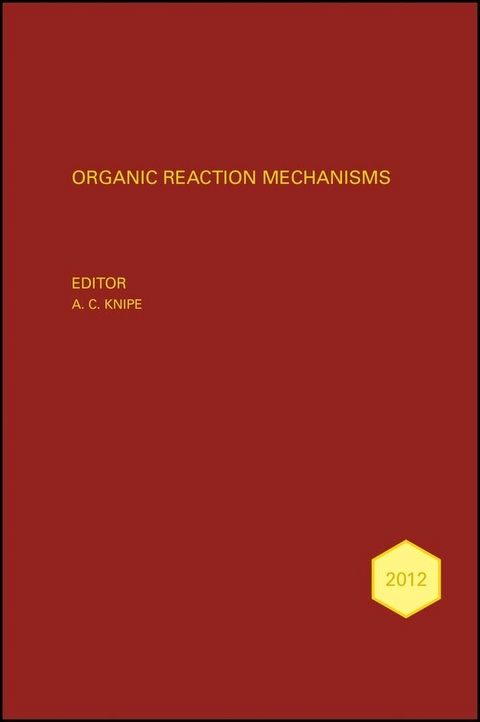
Organic Reaction Mechanisms 2012 (eBook)
John Wiley & Sons (Verlag)
978-1-118-93076-2 (ISBN)
Professor A.C. Knipe, School of BMS, The University of Ulster, Northern Ireland.
1. Reactions of Aldehydes and Ketones and their Derivatives by A. C. Knipe 1
2. Reactions of Carboxylic, Phosphoric, and Sulfonic Acids and their Derivatives by C. T. Bedford 51
3. Oxidation and Reduction by K. K. Banerji 91
4. Carbenes and Nitrenes by E. Gras and S. Chassaing 171
5. Aromatic Substitution by M. R. Crampton 209
6. Carbocations by R. A. McClelland 251
7. Nucleophilic Aliphatic Substitution by K. C. Westaway 267
8. Carbanions and Electrophilic Aliphatic Substitution by M. L. Birsa 307
9. Elimination Reactions by M. L. Birsa 325
10. Addition Reactions: Polar Addition by P. Kocovsky 333
11. Addition Reactions: Cycloaddition by N. Dennis 433
12. Molecular Rearrangements by J. M. Coxon 469
Author Index 541
Subject Index 579
Chapter 1
Reactions of Aldehydes and Ketones and their Derivatives
A.C. Knipe
Faculty of Life and Health Sciences, University of Ulster, Coleraine, Northern Ireland
- Formation and Reactions of Acetals and Related Species
- Reactions of Glucosides and Nucleosides
- Reactions of Ketenes and Ketenimines
- Formation and Reactions of Nitrogen Derivatives
- Imines: Synthesis, Tautomerism, and Catalysis
- The Mannich and Nitro-Mannich reactions
- Addition of organometallics
- Other alkenylations, allylations, and arylations of imines
- Oxidation and reduction of imines
- Iminium species
- Imine cycloadditions
- Other reactions of imines
- Oximes, Hydrazones, and Related Species
- C–C Bond Formation and Fission: Aldol and Related Reactions
- Reviews of Organocatalysts
- Asymmetric Aldols Catalysed by Proline, Its Derivatives, and Related Catalysts
- Other Asymmetric and Diastereoselective Aldols
- Mukaiyama and Vinylogous Aldols
- Other Aldol and Aldol-type Reactions
- The Henry (Nitroaldol) Reaction
- The Baylis–Hillman Reaction and Its Morita Variant
- Allylation and related reactions
- Alkynylations
- Michael Additions
- Miscellaneous Condensations
- Other Addition Reactions
- Enolization and Related Reactions
- Oxidation and Reduction of Carbonyl Compounds
- Cycloadditions
- Other Reactions
- References
Formation and Reactions of Acetals and Related Species
Mechanisms and energetics for Brønsted-acid-catalysed glucose condensations, dehydration, and isomerization reactions have been reviewed.1 Recent developments in the asymmetric synthesis of spiroketals have been reviewed and the potential for further application of transition metal catalysis and organocatalysis has been highlighted.2
Hemiacetal formation from formaldehyde and methanol has been studied by intrinsic reactivity analysis at the B3LYP/6-311++G(d,p) level and the beneficial combined assistance of watermolecules and Brønsted acids has been quantified.3 Theoretical study of hemiacetal formation from methanol with derivatives of CH3CHO (X = H, F, Cl, Br, and I) has shown that the energy barrier can be reduced by a catalytic molecule (MeOH or hemiacetal product).4
A combined experimental and density functional theory (DFT) study of the thermal decomposition of 2-methyl-1,3-dioxolane, 2,2-dimethyl-1,3-dioxolane, and cyclopentanone ethylene ketal, in the gas phase, has established that acetaldehyde and the corresponding ketone are formed by a unimolecular stepwise mechanism; concerted nonsynchronous formation of a four-centred cyclic transition state is rate determining and leads to unstable intermediates that then decompose rapidly through a concerted cyclic six-centred transition state.5
Real-time ultrafast 2D NMR observations of an acetal hydrolysis at 13C natural abundance have enabled observation of the reactive hemiacetal intermediate.6 Mutual kinetic enantioselection (MKE) and enantioselective kinetic resolution (KR) have been explored for aldol coupling reactions of ketal- and dithioketal-protected β-ketoaldehydes expected to have high Felkin diastereoface selectivity with a chiral ketone enolate.7
The quantitative transacetalization of 2-formylpyrrole found in RONa/ROH may involve highly reactive azafulvene intermediates.8
Baldwin's rules can account for the unprecedented ring expansion, whereby polyoxygenated eight- and nine-membered rings are formed regioselectively by rhodium-catalysed reaction of cyclic acetals with α-diazo β-ketoesters and diketones under mild conditions.9
It has been found that if an acetal OR group is first displaced to form a pyridinium-type salt, then the resulting electrophile can be reacted with various nucleophiles under mild (non-acidic) conditions.10
An intermediate 1-methoxyfulvene is believed to form through a cyclization–cycloaddition cascade on reaction of allenyl acetals with nitrones catalysed by a gold complex and a silver salt (Scheme 1).11
A kinetic study of intermolecular hydroamination of allylic amines by N-alkylhydroxylamines has revealed a first-order dependence on aldehyde catalyst. This is a consequence of advantageous formation of a mixed aminal intermediate, which is able to undergo intramolecular Cope-type hydroamination, thereby leading to high yield of the required hydroamination product (Scheme 2).12
Coupling of alkenyl ethers (Ene–OR) with ketene silyl acetals R1R2C=C(OR3)OSiMe3, catalysed by GaBr3, forms α-alkenylated esters Ene–C (R1R2)CO2R3.13
Reactions of Glucosides and Nucleosides
Recent advances in transition-metal-catalysed glycosylations have been reviewed.14, 15 Plausible transition states for such reactions have been discussed16 and primary 13C isotope effects have been determined as a guide to the mechanism of formation of α-manno- and gluco-pyranosides.17 The influence of protecting groups on the reactivity and selectivity of glycosylation chemistry of 4,6-O-benzylidene-protected mannopyranosyl donors and related species has been reviewed.18
A commentary on diastereoselectivity in chemical glycosylation reactions has dismissed molecular orbital explanations that invoke stereoelectronic effects analogous to the anomeric effect in kinetically controlled reactions.19
A reversal of the usual anomeric selectivity for glycosidation methods with thiols as acceptors has been observed for O-glycosyl trichloroacetimidates as donors and PhBF2 as catalyst; the reaction proceeds without anchimeric assistance to form mainly β-thioglycosides, apparently through direct displacement by a PhBF2–HSR adduct.20 α-Glycosylation of protected galactals to form 2-deoxygalactosides, promoted by a thiourea organocatalyst, occurs by syn-addition.21 Cyclopropenium-cation-promoted α-selective dehydrative glycosylations have been initiated using 3,3-dibromo-1,2-diphenylcyclopropene to generate 2-deoxy sugar donors from stable hemiacetals.22 The yield obtained on α-glycosidation of α-thioglycosides in the presence of bromine is undermined by partial anomerization of the intermediate β-bromide to the unreactive α-isomer.23
High diastereoselectivity, giving α- and β-C-glycosides, respectively, has been reported for reaction of C-nucleophiles with 2-O-benzyl-4,6-O-benzylidene-protected 3-deoxy gluco- and manno-pyranoside donors. This does not parallel the preferential formation of β-O-glycosides on reaction with alcohols, for which nucleophilic attack by Osp3 on oxocarbenium ions should be less sterically hindered than for Csp2 attack by a typical carbon nucleophile.24
A 2,4-O-di-t-butylsilylene group induces strict β-controlled glycuronylations, without classical neighbouring group participation, by hindering approach of ROH to intermediate oxocarbenium ion.25
A kinetic study of acid hydrolysis of methyl α- and β-d-glucopyranosides has revealed direct participation by the counterion (Br− or Cl−), which becomes more pronounced as the proportion of 1,4-dioxane is increased.26
Cyclodextrins carboxymethylated at the secondary rim have been evaluated as chemzymes for glycoside hydrolysis.27
A DFT investigation of the mechanism of alkaline hydrolysis of nitrocellulose dimer and trimer in the gas phase and in bulk water has indicated that, following a C(3) to C(6) to C(2) denitration route, peeling-off will be preferred to ring cleavage of the ring C–O bond.28 A DFT study of the kinetics and thermodynamics of N-glycosidic bond cleavage in 5-substituted-2′-deoxycitidines has provided insight into the role of thymine DNA glycolase in active cytosine demethylation.29 A real-time 1H NMR study of the acidic hydrolysis of various carbohydrates has revealed that for insulin the activation energy decreases with chain length.30 Concentrated aqueous ZnCl2 is found to convert carbohydrates into 5-hydroxymethylfurfural.31
Reactions of Ketenes and Ketenimines
The thriving chemistry of ketenimines has been reviewed32 and an overview of the development of silyl ketene imines and...
| Erscheint lt. Verlag | 16.4.2015 |
|---|---|
| Reihe/Serie | Organic Reaction Mechanisms |
| Organic Reaction Mechanisms | Organic Reaction Mechanisms |
| Sprache | englisch |
| Themenwelt | Naturwissenschaften ► Chemie ► Organische Chemie |
| Technik | |
| Schlagworte | Carbanions and Electrophilic Aliphatic Substitution • Carbenes and Nitrenes • Carbocations • Chemie • Chemistry • Cycloaddition Reactions • electrophilic aromatic substitution • elimination reactions • Kristallographie • Molecular Rearrangements • nucleophilic aliphatic substitution • Nucleophilic Aromatic • Organic Chemistry • Organic Reaction Mechanisms 2012 • Organische Chemie • oxidation and reduction • Phosphoric and Sulfonic Acids • Physical Chemistry • Physical Organic Chemistry • Physikalische Chemie • Physikalische Organische Chemie • Polar Addition Reactions • Reaction of Aldehydes and Ketones and their Derivatives • Reactions of Carboxylic • Substitution |
| ISBN-10 | 1-118-93076-2 / 1118930762 |
| ISBN-13 | 978-1-118-93076-2 / 9781118930762 |
| Informationen gemäß Produktsicherheitsverordnung (GPSR) | |
| Haben Sie eine Frage zum Produkt? |
 EPUB (Adobe DRM)
Kopierschutz: Adobe-DRM
Adobe-DRM ist ein Kopierschutz, der das eBook vor Mißbrauch schützen soll. Dabei wird das eBook bereits beim Download auf Ihre persönliche Adobe-ID autorisiert. Lesen können Sie das eBook dann nur auf den Geräten, welche ebenfalls auf Ihre Adobe-ID registriert sind.
Details zum Adobe-DRM
Dateiformat: EPUB (Electronic Publication)
EPUB ist ein offener Standard für eBooks und eignet sich besonders zur Darstellung von Belletristik und Sachbüchern. Der Fließtext wird dynamisch an die Display- und Schriftgröße angepasst. Auch für mobile Lesegeräte ist EPUB daher gut geeignet.
Systemvoraussetzungen:
PC/Mac: Mit einem PC oder Mac können Sie dieses eBook lesen. Sie benötigen eine
eReader: Dieses eBook kann mit (fast) allen eBook-Readern gelesen werden. Mit dem amazon-Kindle ist es aber nicht kompatibel.
Smartphone/Tablet: Egal ob Apple oder Android, dieses eBook können Sie lesen. Sie benötigen eine
Geräteliste und zusätzliche Hinweise
Buying eBooks from abroad
For tax law reasons we can sell eBooks just within Germany and Switzerland. Regrettably we cannot fulfill eBook-orders from other countries.
aus dem Bereich