


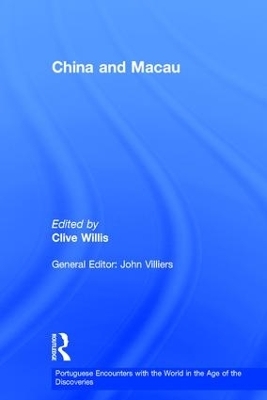
China and Macau
Seiten
2002
Routledge (Verlag)
978-0-7546-0190-6 (ISBN)
Routledge (Verlag)
978-0-7546-0190-6 (ISBN)
- Titel z.Zt. nicht lieferbar
- Versandkostenfrei
- Auch auf Rechnung
- Artikel merken
In 1513 the Portuguese established a maritime route to China. Their motives were a combination of a quest for trade and territory, and a desire to promote Christianity. This is a selection of accounts by contemporary travellers, merchants, missionaries and officials.
In 1513 the Portuguese became the first Europeans to establish a maritime route to China. Their motives were a combination of a quest for trade and territory, and a desire to promote Christianity in the region. This anthology of translated extracts of first-hand accounts by contemporary travellers, merchants, missionaries and officials, includes writings by Joaõ de Barros, one of the most prominent chroniclers of the Portuguese overseas endeavours. The importance of the Macau peninsula as a point of exchange in trade between China and Japan is charted in extracts from, amongst others, the journals of the Italian Jesuit Father Matteo Ricci. As this collection of writings shows, the formation of the Dutch East India Company in 1602 heralded the gradual erosion of Portuguese influence in China. Their imprint on Macau was more long-lasting, with their disengagement from the peninsula finally taking place in 1999.
In 1513 the Portuguese became the first Europeans to establish a maritime route to China. Their motives were a combination of a quest for trade and territory, and a desire to promote Christianity in the region. This anthology of translated extracts of first-hand accounts by contemporary travellers, merchants, missionaries and officials, includes writings by Joaõ de Barros, one of the most prominent chroniclers of the Portuguese overseas endeavours. The importance of the Macau peninsula as a point of exchange in trade between China and Japan is charted in extracts from, amongst others, the journals of the Italian Jesuit Father Matteo Ricci. As this collection of writings shows, the formation of the Dutch East India Company in 1602 heralded the gradual erosion of Portuguese influence in China. Their imprint on Macau was more long-lasting, with their disengagement from the peninsula finally taking place in 1999.
Clive Willis, University of Manchester, UK
Contents: Introduction; First contacts, 1513-57: the arrival of the ’barbarian devils’ from the West; A civilization observed: Imperial Ming China in the 16th century; The Portuguese settle in Macau: the early years; The Jesuit missions in China: the Portuguese contribution; The quest for Cathay: the odyssey of Brother Bento de Góis; Macau in the late 1630s: three complementary accounts; Macau and Manchu China; Glossary; Bibliography; Index.
| Erscheint lt. Verlag | 20.5.2002 |
|---|---|
| Reihe/Serie | Portuguese Encounters with the World in the Age of the Discoveries |
| Verlagsort | London |
| Sprache | englisch |
| Maße | 156 x 234 mm |
| Gewicht | 362 g |
| Themenwelt | Geschichte ► Allgemeine Geschichte ► Neuzeit (bis 1918) |
| Geschichte ► Teilgebiete der Geschichte ► Wirtschaftsgeschichte | |
| Naturwissenschaften ► Geowissenschaften ► Geografie / Kartografie | |
| ISBN-10 | 0-7546-0190-0 / 0754601900 |
| ISBN-13 | 978-0-7546-0190-6 / 9780754601906 |
| Zustand | Neuware |
| Informationen gemäß Produktsicherheitsverordnung (GPSR) | |
| Haben Sie eine Frage zum Produkt? |
Mehr entdecken
aus dem Bereich

aus dem Bereich
Geschichte einer wilden Handlung
Buch | Hardcover (2024)
C.H.Beck (Verlag)
CHF 47,60


