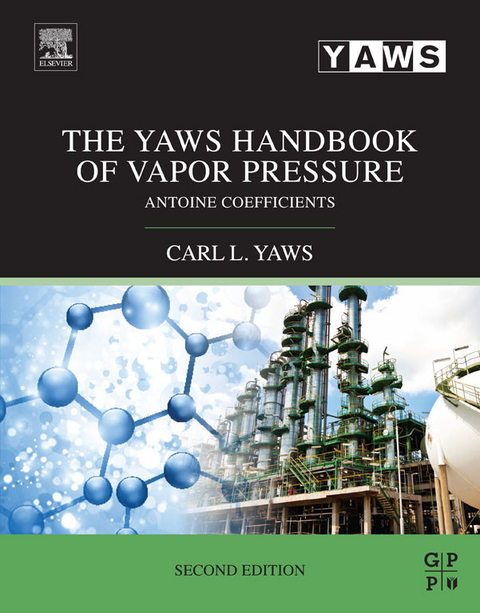
Increased to include over 25,000 organic and inorganic compounds, The Yaws Handbook of Vapor Pressure: Antoine Coefficients, Second Edition delivers the most comprehensive and practical database source for today's petrochemical. Understanding antoine coefficients for vapor pressure leads to numerous critical engineering applications such as pure components in storage vessels, pressure relief valve design, flammability limits at the refinery, as well as environmental emissions from exposed liquids, making data to efficiently calculate these daily challenges a fundamental need. Written by the world's leading authority on chemical and petrochemical data, The Yaws Handbook of Vapor Pressure simplifies the guesswork for the engineer and reinforces the credibility of the engineer's calculations with a single trust-worthy source. This data book is a must-have for the engineer's library bookshelf. - Increase compound coverage from 8,200 to over 25,000 organic and inorganic compounds, including sulfur and hydrocarbons - Solve process design questions quickly from a single reliable data source - Locate answers easily for multiple petrochemical related questions such as bubble point, dew point temperatures, and vapor-liquid equilibrium
Carl L. Yaws, PhD is Professor of chemical engineering (retired) at Lamar University, in Beaumont, Texas. He has industrial experience in process engineering, development, modeling, and design at Exxon, Ethyl, and Texas Instruments. He is the author of 36 books and more than 1000 technical publications (papers, presentations, and chapters in books) in process engineering, property data, and pollution prevention. He is a leading authority on property data of chemical compounds for use by practicing engineers and scientists.
Increased to include over 25,000 organic and inorganic compounds, The Yaws Handbook of Vapor Pressure: Antoine Coefficients, Second Edition delivers the most comprehensive and practical database source for today's petrochemical. Understanding antoine coefficients for vapor pressure leads to numerous critical engineering applications such as pure components in storage vessels, pressure relief valve design, flammability limits at the refinery, as well as environmental emissions from exposed liquids, making data to efficiently calculate these daily challenges a fundamental need. Written by the world's leading authority on chemical and petrochemical data, The Yaws Handbook of Vapor Pressure simplifies the guesswork for the engineer and reinforces the credibility of the engineer's calculations with a single trust-worthy source. This data book is a must-have for the engineer's library bookshelf. - Increase compound coverage from 8,200 to over 25,000 organic and inorganic compounds, including sulfur and hydrocarbons- Solve process design questions quickly from a single reliable data source- Locate answers easily for multiple petrochemical related questions such as bubble point, dew point temperatures, and vapor-liquid equilibrium
Chapter 1
Vapor Pressure – Organic Compounds
Carl L. Yaws
Marco A. Satyro
Abstract
The results for Antoine coefficients for vapor pressure as a function of temperature are given in Table 1 for organic compounds. The tabulation is arranged by carbon number (C, C2, C3,…….., C100) to provide ease of use in quickly locating the data by using the chemical formula. The compound name, chemical abstracts registry number (CAS No), and Antoine coefficients are provided in the adjacent columns. The range of application is denoted by minimum and maximum temperatures (TMIN and TMAX). Temperatures outside the range of application should not be used. The next column provides the code for the tabulation, which is based on both experimental data and estimated values.
Keywords
organic compounds
Antoine coefficients for vapor pressure
chemical formula
compound name
CAS No (chemical abstracts registry number)
range of application
minimum and maximum temperatures (TMIN and TMAX)
experimental data
estimated values
Tabulation results
The tabulation is arranged by carbon number (C, C2, C3,…….., C100) to provide ease of use in quickly locating the data by using the chemical formula. The compound name, chemical abstracts registry number (CAS No), and Antoine coefficients are provided in the adjacent columns. The range of application is denoted by minimum and maximum temperatures (TMIN and TMAX). Temperatures outside the range of application should not be used. The next column provides the code for the tabulation, which is based on both experimental data and estimated values.
In preparing the tabulation, a literature search was conducted to identify data source publications (1–52). Both experimental values for the property under consideration and parameter values for estimation of the property are included in the source publications. The publications were screened and copies of appropriate data were made. These data were then keyed into the computer to provide a database of values for compounds for which experimental data are available. The database also served as a basis to check the accuracy of the estimation methods. Upon completion of data collection, estimation of values for the remaining compounds was performed.
The estimates are primarily based on literature methods and empirical procedures developed by the author. If initial analysis using the estimates is favorable, follow-up experimental determination is recommended. This is especially true for highly polar and high molecular weight compounds.
A code of 1 in the tabulation is based on experimental data. A code of 2 indicates an estimate. The estimates with a code of 3 should be considered rough approximations. The estimates with a code of 2 are more accurate. For those substances which undergo decomposition (such as nitro compounds with explosive decomposition and very large compounds with thermal decomposition) prior to attaining the boiling point temperature, the boiling point temperature is a hypothetical value.
A comparison of calculated and data values is shown in
Figure 1 for a representative compound. The graph discloses favorable agreement of equation and data.
Figure 1 Vapor Pressure of Acetone
Example
Calculate the vapor pressure of acetone (C3H6O) at 47.35°C.
Substitution of the Antoine coefficients from the table and temperature into the equation for vapor pressure yields:
g 10 P = 7.31742 − 1315.6735 / 47.35 + 240.479 = 2.7464 P = 10 2.7646 = 557.70 mmHg
Table 1
Vapor Pressure – Organic Compounds
| log10 P = A - B/(T + C) (P - mmHg, T - C) |
| NO | FORMULA | NAME | CAS No | A | B | C | TMIN | TMAX | code |
| 1 | CAsCl2F3 | dichloro(trifluoro-methyl)arsine | 421-32-9 | 6.44199 | 1078.1800 | 222.610 | -48.15 | 108.11 | 3 |
| 2 | CBrClF2 | bromochlorodifluoromethane | 353-59-3 | 6.96434 | 1008.7093 | 249.569 | -80.45 | 153.00 | 1,2 |
| 3 | CBrCl2F | bromodichlorofluoromethane | 353-58-2 | 7.53163 | 1515.7000 | 273.150 | -41.09 | 75.30 | 1,2 |
| 4 | CBrCl3 | bromotrichloromethane | 75-62-7 | 7.17536 | 1468.7621 | 238.507 | -21.00 | 131.16 | 1,2 |
| 5 | CBrFO | carbonic bromide fluoride | 753-56-0 | 7.61850 | 1196.7000 | 273.150 | -92.34 | -3.42 | 3 |
| 6 | CBrF3 | bromotrifluoromethane | 75-63-8 | 6.96895 | 800.4823 | 253.656 | -119.55 | 67.00 | 1,2 |
| 7 | CBrN | cyanogen bromide | 506-68-3 | 7.67970 | 1211.2170 | 190.995 | -13.00 | 78.42 | 1,2 |
| 8 | CBr2ClF | dibromochlorofluoromethane | 353-55-9 | 7.68319 | 1697.4000 | 273.150 | -19.17 | 103.94 | 1,2 |
| 9 | CBr2F2 | dibromodifluoromethane | 75-61-6 | 7.13810 | 1187.3002 | 254.436 | -61.01 | 45.67 | 1,2 |
| 10 | CBr3Cl | tribromochloromethane | 594-15-0 | 7.88553 | 1889.0287 | 273.150 | 1.20 | 128.49 | 1,2 |
| 11 | CBr3F | tribromofluoromethane | 353-54-8 | 7.59674 | 1790.4000 | 273.150 | -1.74 | 132.39 | 1,2 |
| 12 | CBr4 | carbon tetrabromide | 558-13-4 | 8.36395 | 2539.1862 | 273.540 | 71.27 | 216.45 | 1,2 |
| 13 | CClFO | carbonyl chloride fluoride | 353-49-1 | 8.10490 | 1187.2000 | 273.150 | -108.15 | -32.00 | 3 |
| 14 | CClF2NO | difluorocarbamoyl chloride | 16847-30-6 | 7.91171 | 1347.3400 | 273.150 | -84.15 | 11.71 | 3 |
| 15 | CClF3 | chlorotrifluoromethane | 75-72-9 | 7.05630 | 746.7453 | 260.340 | -137.04 | 28.85 | 1,2 |
| 16 | CClF3O | trifluoromethyl hypochlorite | 22082-78-6 | 7.41310 | 1025.0000 | 273.150 | -131.15 | -30.90 | 3 |
| 17 | CClF3O2 | chloroperoxytrifluoromethane | 32755-26-3 | 7.74210 | 1221.0000 | 273.150 | -92.05 | -5.40 | 3 |
| 18 | CClF3O3S | fluorosulphuric acid, chlorodifluoromethyl ester | 6069-31-4 | 6.71727 | 965.4680 | 214.792 | -46.15 | 58.29 | 3 |
| 19 | CClF3O4 | perchloric acid, trifluoromethyl ester | 52003-45-9 | 7.48280 | 1301.0000 | 273.150 | -72.47 | 29.34 | 3 |
| 20 | CClF3S | trifluoromethanesulfenyl chloride | 421-17-0 | 6.13058 | 639.8900 | 197.500 | -72.78 | 19.51 | 3 |
| 21 | CClF4N | difluoro(difluoro-chloromethyl)amine | 13880-71-2 | 7.71462 | 1388.7700 | 273.150 | -66.32 | 33.23 | 3 |
| 22 | CClF4NO2S | chloro(trifluoro-methyl)sulfamoyl fluoride | 19419-95-5 | 7.77610 | 1503.0000 | 273.150 | -51.34 | 54.00 | 3 |
| 23 | CClF7S | chlorotetrafluoro-(trifluoromethyl)sulfur | 42179-04-4 | 7.49010 | 1352.0000 | 273.150 | -64.83 | 40.67 | 3 |
| 24 | CClN | cyanogen chloride | 506-77-4 | 7.04917 | 913.9610 | 206.412 | -55.32 | 29.92 | 1,2 |
| 25 | CCl2FI | dichlorofluoroiodo-methane | 420-48-4 | 7.71448 | 1708.8600 | 273.150 | -18.65 | 103.86 | 3 |
| 26 | CCl2F2 | dichlorodifluoromethane | 75-71-8 | 6.92200 | 865.3109 | 243.873 | -97.75 | 111.97 | 1,2 |
| 27 | CCl2F3N | N,N-dichloro-1,1,1-trifluoromethylamine | 13880-73-4 | 7.53148 | 1347.3700 | 273.150 | -66.86 | 36.62 | 3 |
| 28 | CCl2F3NS | trifluoromethyl-imidosulfurous... |
 EPUB (Adobe DRM)
Kopierschutz: Adobe-DRM
Adobe-DRM ist ein Kopierschutz, der das eBook vor Mißbrauch schützen soll. Dabei wird das eBook bereits beim Download auf Ihre persönliche Adobe-ID autorisiert. Lesen können Sie das eBook dann nur auf den Geräten, welche ebenfalls auf Ihre Adobe-ID registriert sind.
Details zum Adobe-DRM
Dateiformat: EPUB (Electronic Publication)
EPUB ist ein offener Standard für eBooks und eignet sich besonders zur Darstellung von Belletristik und Sachbüchern. Der Fließtext wird dynamisch an die Display- und Schriftgröße angepasst. Auch für mobile Lesegeräte ist EPUB daher gut geeignet.
Systemvoraussetzungen:
PC/Mac: Mit einem PC oder Mac können Sie dieses eBook lesen. Sie benötigen eine Adobe-ID und die Software Adobe Digital Editions (kostenlos). Von der Benutzung der OverDrive Media Console raten wir Ihnen ab. Erfahrungsgemäß treten hier gehäuft Probleme mit dem Adobe DRM auf.
eReader: Dieses eBook kann mit (fast) allen eBook-Readern gelesen werden. Mit dem amazon-Kindle ist es aber nicht kompatibel.
Smartphone/Tablet: Egal ob Apple oder Android, dieses eBook können Sie lesen. Sie benötigen eine Adobe-ID sowie eine kostenlose App.
Geräteliste und zusätzliche Hinweise
Buying eBooks from abroad
For tax law reasons we can sell eBooks just within Germany and Switzerland. Regrettably we cannot fulfill eBook-orders from other countries.