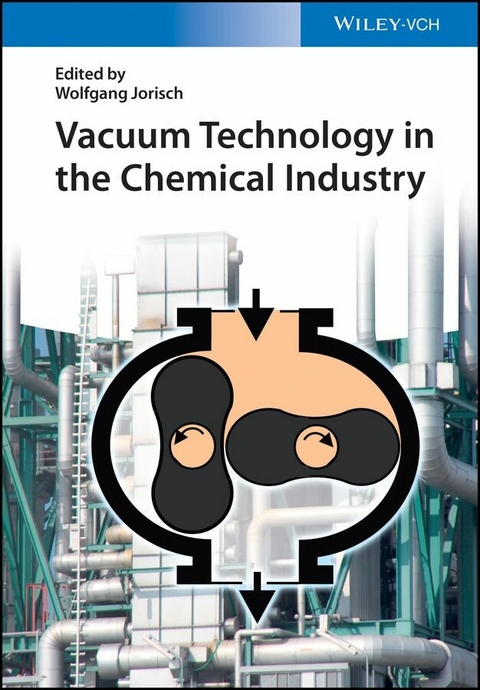
All of the authors work or did work at a selection of the most important German companies involved in vacuum technology, and their expertise is disseminated here for engineers working in vacuum technology, chemical process design, plant operation, and mechanical engineering.
Wolfgang Jorisch, age group 1946, studied chemistry at RWTH Aachen University, and gained his doctorate from the University of Essen. He worked at RWTÜV in Essen from 1980-87, before taking up a position in technical sales and distribution at the chemistry applications segment of Leybold Vacuum in Cologne, Germany. In 2000 he switched to the same occupation at Graham Precision Pumps Ltd, UK, at this time a subsidiary of Graham Corporation, Batavia, NY, USA., now-a-days a company of Dr.-Ing. K. Busch UK, until 2005, when he began IVPT Industrielle Vakuumprozesstechnik, seat in works of Oerlikon Leybold Vacuum in Cologne (Germany). Dr. Jorisch has been a member of the board of 'Vakuum in Forschung und Praxis (VIP)' from the year of the journal`s start in 1987 up to 2012. Since end of 2011 he is in retirement.
Wolfgang Jorisch, age group 1946, studied chemistry at RWTH Aachen University, and gained his doctorate from the University of Essen. He worked at RWTÜV in Essen from 1980-87, before taking up a position in technical sales and distribution at the chemistry applications segment of Leybold Vacuum in Cologne, Germany. In 2000 he switched to the same occupation at Graham Precision Pumps Ltd, UK, at this time a subsidiary of Graham Corporation, Batavia, NY, USA., now-a-days a company of Dr.-Ing. K. Busch UK, until 2005, when he began IVPT Industrielle Vakuumprozesstechnik, seat in works of Oerlikon Leybold Vacuum in Cologne (Germany). Dr. Jorisch has been a member of the board of "Vakuum in Forschung und Praxis (VIP)" from the year of the journal`s start in 1987 up to 2012. Since end of 2011 he is in retirement.
FUNDAMENTALS OF VACUUM TECHNOLOGY
Introduction
Fundamentals of Vacuum Technology
CONDENSATION UNDER VACUUM
What Is Condensation?
Condensation under Vacuum without Inert
Condensation with Inert Gases
Saturated Inert Gas - Vapour Mixtures
Vapour - Liquid Equilibrium
Types of Condensers
Heat Transfer and Condensation Temperature in a Surface Condenser
Vacuum Control in Condensers
Installation of Condensers
Special Condenser Types
LIQUID RING VACUUM PUMPS IN INDUSTRIAL PROCESS APPLICATIONS
Design and Functional Principle of Liquid Ring Vacuum Pumps
Operating Behaviour and Design of Liquid Ring Vacuum Pumps
Vibration and Noise Emission with Liquid Ring Vacuum Pumps
Selection of Suitable Liquid Ring Vacuum Pumps
Process Connection and Plant Construction
Main Damage Symptoms
Table of Symbols
STEAM JET VACUUM PUMPS
Design and Function of a Jet Pump
Operating Behaviour and Characteristic
Cntrol of Jet Compresors
Multi-Stage Steam Jet Vacuum Pumps
Comparison of Steam, Air and Other Motive Media
MECHANICAL VACUUM PUMPS
Introduction
The Different Types of Mechanical Vacuum Pumps
When Using Various Vacuum Pump Designs in the Chemical or Pharmaceutical Process Industry, the Following Must Be Observed
BASICS OF THE EXPLOSION PROTECTION AND SAFETY-TECHNICAL REQUIREMENTS ON VACUUM PUMPS FOR MANUFACTURERS AND OPERATING COMPANIES
Introduction
Explosion Protection
Directive 99/92/EC
Directive 94/9/EC
Summary
MEASUREMENT METHODS FOR GROSS AND FINE VACUUM
Pressure Units and Vacuum Ranges
Directly and Indirectly Measuring Vacuum Gauges and Their Measurement Ranges
Hydrostatic Manometers
Mechanical and Electromechanical Vacuum Gauges
LEAK DETECTION METHODS
Definition of Leakage Rates
Acceptable Leakage Rate of Chemical Plants
Methods of Leak Detection
Helium as a Tracer Gas
Leak Detection of Systems in the Medium-Vacuum Range
Leak Detection on Systems in the Rough Vacuum Range
Leak Detection and Signal Rsponse Time
Properties and Specifications of Helium Leak Detectors
Helium Leak Detection in Industrial Rough Vacuum Applications without Needs of a Mass Spectrometer
VACUUM CRYSTALLISATION
Introduction
Crystallisation Theory for Practice
Types of Crystallisers
Periphery
Process Particularities
Example - Crystallisation of Sodium Chloride
WHY EVAPORATION UNDER VACUUM?
Introduction
Thermodynamics of Evaporation
Pressure/Vacuum Evaporation Comparison
Possibility of Vapour Utilization
EVAPORATORS FOR COARSE VACUUM
Introduction
Criteria for the Selection of an Evaporator
Evaporator Types
BASICS OF DRYING TECHNOLOGY
Basics of Solids-Liquid Separation Technology
Basics of Drying Technology
Discontinuous Vacuum Drying
Continuous Vacuum Drying
Dryer Designs
VACUUM TECHNOLOGY BED
Introduction to Fluidized Bed Technology
Vacuum Fluidized Bed Technology
PHARMACEUTICAL FREEZE-DRYING SYSTEMS
General Information
Phases of a Freeze-Drying Process
Production Freeze-Drying Systems
Final Comments
SHORT PATH AND MOLECULAR DISTILLATION
Introduction
Some History
Outlook
RECTIFICATION UNDER VACUUM
Fundamentals of Distillation and Rectification
Vacuum Rectification Design
Structured Packings for Vacuum Rectification
VACUUM CONVEYING OF POWDERS AND BULK MATERIALS
Introduction
Basic Theory
Principle Function and Design of a Vacuum Conveying System
Continuous Vacuum Conveying
Reactor- and Stirring Vessel Loading in the Chemical Industry
Conveying, Weighing, Dosing and Big-Bag Filling and Discharging
Application Parameters
VACUUM FILTRATION - SYSTEM AND EQUIPMENT TECHNOLOGY, RANGE AND EXAMPLES OF APPLICATIONS, DESIGNS
Vacuum Filtration, a Mechanical Separation Process
Design of an Industrial Vacuum Filter Station
Methods of Continuous Vacuum Filtration, Types of Design and Examples of Appplication
Index FUNDAMENTALS OF VACUUM TECHNOLOGY
Introduction
Fundamentals of Vacuum Technology
CONDENSATION UNDER VACUUM
What Is Condensation?
Condensation under Vacuum without Inert
Condensation with Inert Gases
Saturated Inert Gas - Vapour Mixtures
Vapour - Liquid Equilibrium
Types of Condensers
Heat Transfer and Condensation Temperature in a Surface Condenser
Vacuum Control in Condensers
Installation of Condensers
Special Condenser Types
LIQUID RING VACUUM PUMPS IN INDUSTRIAL PROCESS APPLICATIONS
Design and Functional Principle of Liquid Ring Vacuum Pumps
Operating Behaviour and Design of Liquid Ring Vacuum Pumps
Vibration and Noise Emission with Liquid Ring Vacuum Pumps
Selection of Suitable Liquid Ring Vacuum Pumps
Process Connection and Plant Construction
Main Damage Symptoms
Table of Symbols
STEAM JET VACUUM PUMPS
Design and Function of a Jet Pump
Operating Behaviour and Characteristic
Cntrol of Jet Compresors
Multi-Stage Steam Jet Vacuum Pumps
Comparison of Steam, Air and Other Motive Media
MECHANICAL VACUUM PUMPS
Introduction
The Different Types of Mechanical Vacuum Pumps
When Using Various Vacuum Pump Designs in the Chemical or Pharmaceutical Process Industry, the Following Must Be Observed
BASICS OF THE EXPLOSION PROTECTION AND SAFETY-TECHNICAL REQUIREMENTS ON VACUUM PUMPS FOR MANUFACTURERS AND OPERATING COMPANIES
Introduction
Explosion Protection
Directive 99/92/EC
Directive 94/9/EC
Summary
MEASUREMENT METHODS FOR GROSS AND FINE VACUUM
Pressure Units and Vacuum Ranges
Directly and Indirectly Measuring Vacuum Gauges and Their Measurement Ranges
Hydrostatic Manometers
Mechanical and Electromechanical Vacuum Gauges
LEAK DETECTION METHODS
Definition of Leakage Rates
Acceptable Leakage Rate of Chemical Plants
Methods of Leak Detection
Helium as a Tracer Gas
Leak Detection of Systems in the Medium-Vacuum Range
Leak Detection on Systems in the Rough Vacuum Range
Leak Detection and Signal Rsponse Time
Properties and Specifications of Helium Leak Detectors
Helium Leak Detection in Industrial Rough Vacuum Applications without Needs of a Mass Spectrometer
VACUUM CRYSTALLISATION
Introduction
Crystallisation Theory for Practice
Types of Crystallisers
Periphery
Process Particularities
Example - Crystallisation of Sodium Chloride
WHY EVAPORATION UNDER VACUUM?
Introduction
Thermodynamics of Evaporation
Pressure/Vacuum Evaporation Comparison
Possibility of Vapour Utilization
EVAPORATORS FOR COARSE VACUUM
Introduction
Criteria for the Selection of an Evaporator
Evaporator Types
BASICS OF DRYING TECHNOLOGY
Basics of Solids-Liquid Separation Technology
Basics of Drying Technology
Discontinuous Vacuum Drying
Continuous Vacuum Drying
Dryer Designs
VACUUM TECHNOLOGY BED
Introduction to Fluidized Bed Technology
Vacuum Fluidized Bed Technology
PHARMACEUTICAL FREEZE-DRYING SYSTEMS
General Information
Phases of a Freeze-Drying Process
Production Freeze-Drying Systems
Final Comments
SHORT PATH AND MOLECULAR DISTILLATION
Introduction
Some History
Outlook
RECTIFICATION UNDER VACUUM
Fundamentals of Distillation and Rectification
Vacuum Rectification Design
Structured Packings for Vacuum Rectification
VACUUM CONVEYING OF POWDERS AND BULK MATERIALS
Introduction
Basic Theory
Principle Function and Design of a Vacuum Conveying System
Continuous Vacuum Conveying
Reactor- and Stirring Vessel Loading in the Chemical Industry
Conveying, Weighing, Dosing and Big-Bag Filling and Discharging
Application Parameters
VACUUM FILTRATION - SYSTEM AND EQUIPMENT TECHNOLOGY, RANGE AND EXAMPLES OF APPLICATIONS, DESIGNS
Vacuum Filtration, a Mechanical Separation Process
Design of an Industrial Vacuum Filter Station
Methods of Continuous Vacuum Filtration, Types of Design and Examples of Appplication
Index
1
Fundamentals of Vacuum Technology
Wolfgang Jorisch
1.1 Introduction
Vacuum technology is being used widely in many chemistry applications. Here it is not used in the same way as in physics applications. In physics applications, it is the objective to perform experiments in volumes (vacuum chambers) which are as pure as possible, that is, which contain as few particles as possible as these particles generally impair the physical process.
Vacuum technology is used in the area of chemistry applications for the purpose of performing basic thermal and mechanical operations to reprocess reaction products under conditions which preserve the product. Typical applications for thermal separating processes in a vacuum are distillation, drying or sublimation at reduced pressures as well as applications which accelerate the reaction itself when reaction products from the reaction mixture need to be removed for the purpose of shifting the equilibrium in the desired direction, for example. An example of this is the process of esterification.
A mechanical process performed in a vacuum is that of vacuum filtration where the pressure difference created between vacuum and atmospheric pressure is utilised as the driving force for the filtration process.
The planning process engineer or the consulting engineer of a chemical plant not only faces questions how to properly dimension a vacuum system so as to comply with the demanded process specifications, but he needs to solve in a satisfactory way, problems relating to operating costs which shall be as low as possible and questions as to the minimisation of emissions in the discharged air and waste water. The wide variety of vacuum pumps used in the area of chemistry technology reflects this. The responsible planning engineer or plant chemist will have to select, in consideration of the process engineering questions which differ from process to process, vacuum generators which promise to offer the best possible solution for the specific case.
For this reason, this book covers besides vacuum process engineering fundamentals, above all also the different types of vacuum pumps.
1.2 Fundamentals of Vacuum Technology
Also for the vacuum technology used in chemistry applications, the underlying fundamental laws of physics apply.
The standard DIN 28400 Part 1 defines the vacuum state as
Vacuum is the state of a gas, the particle number density of which is below that of the atmosphere at the Earth's surface. Since the particle number density is within certain limits time and location dependent, it is not possible to state a general upper limit for the vacuum. Here the gas particles exert a pressure on all bodies which surround them, this pressure being the result of their temperature dependent motion. The pressure is defined as a force per unit of area, with the unit of measurement being the Pascal.
In the area of vacuum process engineering, frequently not Pascal is used as the unit of measurement for pressures but instead also the allowed unit ‘bar’ or ‘mbar’.
Owing to the differing behaviour of the particles within the considered volume (particle number density) which is dependent on the number of particles which are present, different pressure (vacuum) ranges have been defined with respect to their flow characteristics, for example:
| Pressure range (mbar) |
| Rough vacuum |
| Medium vacuum |
| High vacuum |
| Ultrahigh vacuum |
| Remark: |
| New definition of beginning rough vacuum: |
| Lowest pressure on Earth surface | 300 mbar (Mount Everest) |
The pressure
When gas particles impinge on a wall (surface) they are subjected to a change in impulse, whereby they transfer an impulse to this wall. This impulse is the cause for the pressure exerted on the wall:
since the force is equivalent to the change in impulse of over time:
p = pressure; F = force; A = area; m = mass; v = velocity; and t = time.
When now considering a surface onto which particles impinge from a hemisphere and when integrating the transferred impulse over time, then one obtains for ideal gases
= particle number density; k = Boltzmann constant and T = absolute temperature.
That is, the exerted pressure is only dependent on the number of gas molecules n in the volume but is not dependent on the type of gas [1].
This statement ultimately confirms also Dalton's Law, which states that the total pressure of a gas atmosphere is equal to the sum of all partial pressures of this gas mixture:
or
= total pressure; = particle number density of all gas particles (types); and = particle number density of the particle type i.
Given as an example is in the following the composition of air at atmospheric pressure [2] (Table 1.1).
Table 1.1 Composition of atmospheric air
| Constituent | Volume share (%) | Partial pressure (mbar) |
| Nitrogen | — | 78.09 |
| — | 780.9 |
| Oxygen | — | 20.95 |
| — | 209.5 |
| Argon | — | 0.93 |
| — | 9.3 |
| Carbon dioxide | — | 0.03 |
| — | 3.10−1 |
| Water vapour | 2.3 | — |
| — |
Remainder: noble gases, hydrogen, methane, ozone, and so on.
1.2.1 Fundamentals of Gas Kinetics
The individual molecules or gas particles contained in a volume are in constant motion and collide with each other. In doing so, the particles change their velocity each time they collide. From a statistical point of view, all velocities are possible but with differing probability.
Maxwell and Boltzmann found the following relationship for the velocity distribution of the gas particles [3]:
| = | mass of each particle |
| = | temperature in Kelvin |
| = | number of particles |
| = | Boltzmann constant |
| = | velocity of the particles. |
Figure 1.1 depicts the velocity distribution between velocity and based on the example of air at 0, 25 and 400 °C [3].
Figure 1.1 Velocity distribution of air molecules (nitrogen and oxygen) at 0, 25 and at 400 °C.
From this, it is apparent that there does not exist a molecule with a velocity of ‘zero’ or with an infinitely high velocity. The location of the most probable velocity (maximum, ) is a function of the mean gas temperature. Moreover, the molecule velocity depends on the molar mass. The most likely velocity can be stated through
and the arithmetic mean velocity can be stated through
Figure 1.2 depicts the velocity of the gas molecules as a function of the type of gas.
Figure 1.2 Gas molecule velocity as a function of the type of gas.
1.2.1.1 Mean Free Path
The fact that the molecules move at different velocities allows for the conclusion that they will move within a specific unit of time over a different distance (free path) before colliding with another particle. The mean free path , resulting from the kinetic gas theory is
where = collision radius in [mm] of an ideal point-like particle and is the particle number density (number of molecules per volume).
Since the particle number density, as already derived, depends on the pressure, also the mean free path of the gas molecules is pressure dependent (at constant temperature), the product of the prevailing pressure and the mean free path is, at a given temperature, a constant (gas-type dependent).
For nitrogen at 20 °C, this product amounts to , that is at a prevailing pressure of there results at a temperature of 20 °C a mean free path of 6.5 mm [4].
Moreover, kinetic gas theory states the distribution of the mean free paths as follows:
| = | number of molecules in the volume |
| = | number... |
| Erscheint lt. Verlag | 27.2.2015 |
|---|---|
| Sprache | englisch |
| Themenwelt | Naturwissenschaften ► Chemie |
| Technik | |
| Schlagworte | chemical engineering • chemical reaction • Chemie • Chemische Industrie • Chemische Verfahrenstechnik • Chemische Verfahrenstechnik / Theorie, Planung u. Management • Chemistry • Distillation • drying • Energie • Energietechnik • Energy • evaporation • Filtration • Industrial Chemistry • Maschinenbau • mechanical engineering • pharmaceutical freeze-drying • Pharmazeutische Industrie • Physics • Physik • Power Technology & Power Engineering • Rectification • short path distillation • Technische u. Industrielle Chemie • Theory, Planning & Management • Transport • vacuum crystallization • Vacuum technology • Vakuumtechnik |
| ISBN-10 | 3-527-65391-0 / 3527653910 |
| ISBN-13 | 978-3-527-65391-1 / 9783527653911 |
| Informationen gemäß Produktsicherheitsverordnung (GPSR) | |
| Haben Sie eine Frage zum Produkt? |
 EPUB (Adobe DRM)
Kopierschutz: Adobe-DRM
Adobe-DRM ist ein Kopierschutz, der das eBook vor Mißbrauch schützen soll. Dabei wird das eBook bereits beim Download auf Ihre persönliche Adobe-ID autorisiert. Lesen können Sie das eBook dann nur auf den Geräten, welche ebenfalls auf Ihre Adobe-ID registriert sind.
Details zum Adobe-DRM
Dateiformat: EPUB (Electronic Publication)
EPUB ist ein offener Standard für eBooks und eignet sich besonders zur Darstellung von Belletristik und Sachbüchern. Der Fließtext wird dynamisch an die Display- und Schriftgröße angepasst. Auch für mobile Lesegeräte ist EPUB daher gut geeignet.
Systemvoraussetzungen:
PC/Mac: Mit einem PC oder Mac können Sie dieses eBook lesen. Sie benötigen eine
eReader: Dieses eBook kann mit (fast) allen eBook-Readern gelesen werden. Mit dem amazon-Kindle ist es aber nicht kompatibel.
Smartphone/Tablet: Egal ob Apple oder Android, dieses eBook können Sie lesen. Sie benötigen eine
Geräteliste und zusätzliche Hinweise
Buying eBooks from abroad
For tax law reasons we can sell eBooks just within Germany and Switzerland. Regrettably we cannot fulfill eBook-orders from other countries.
aus dem Bereich