


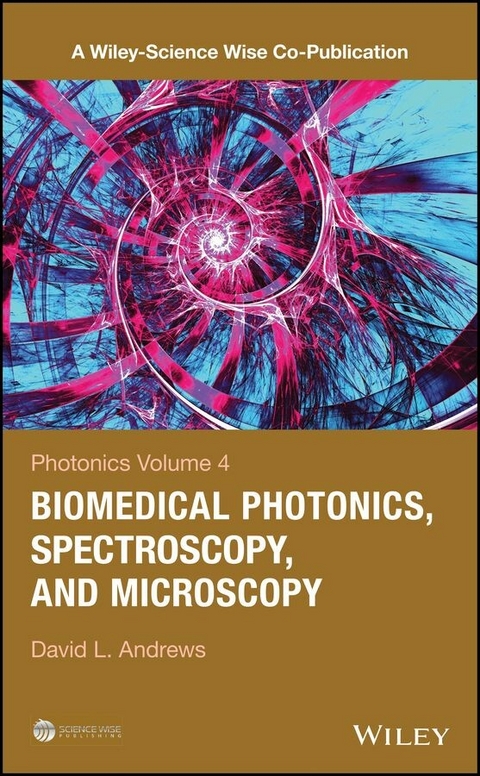
Photonics, Volume 4 (eBook)
John Wiley & Sons (Verlag)
978-1-119-01179-8 (ISBN)
This volume discusses biomedical photonics, spectroscopy and microscopy, the basic physical principles underlying the technology and its applications. The topics discussed in this volume are: Biophotonics; Fluorescence and Phosphorescence; Medical Photonics; Microscopy; Nonlinear Optics; Ophthalmic Technology; Optical Tomography; Optofluidics; Photodynamic Therapy; Image Processing; Imaging Systems; Sensors; Single Molecule Detection; Futurology in Photonics.
- Comprehensive and accessible coverage of the whole of modern photonics
- Emphasizes processes and applications that specifically exploit photon attributes of light
- Deals with the rapidly advancing area of modern optics
- Chapters are written by top scientists in their field
Written for the graduate level student in physical sciences; Industrial and academic researchers in photonics, graduate students in the area; College lecturers, educators, policymakers, consultants, Scientific and technical libraries, government laboratories, NIH.
David L. Andrews leads research on fundamental molecular photonics and energy transport, optomechanical forces and nonlinear optical phenomena. He has over 160 research papers and also eight books to his name - including the widely adopted textbook Lasers in Chemistry. The current focus of his research group is on novel mechanisms for optical nanomanipulation and switching, and light-harvesting in nanostructured molecular systems. The group enjoys strong international links, particularly with groups in Canada, Lithuania, New Zealand and the United States. Andrews is a Fellow of the Royal Society of Chemistry, and a Fellow of the Institute of Physics, and he is the inaugural Chair of the SPIE Nanotechnology Technical Group.
Discusses the basic physical principles underlying Biomedical Photonics, spectroscopy and microscopy This volume discusses biomedical photonics, spectroscopy and microscopy, the basic physical principles underlying the technology and its applications. The topics discussed in this volume are: Biophotonics; Fluorescence and Phosphorescence; Medical Photonics; Microscopy; Nonlinear Optics; Ophthalmic Technology; Optical Tomography; Optofluidics; Photodynamic Therapy; Image Processing; Imaging Systems; Sensors; Single Molecule Detection; Futurology in Photonics. Comprehensive and accessible coverage of the whole of modern photonics Emphasizes processes and applications that specifically exploit photon attributes of light Deals with the rapidly advancing area of modern optics Chapters are written by top scientists in their field Written for the graduate level student in physical sciences; Industrial and academic researchers in photonics, graduate students in the area; College lecturers, educators, policymakers, consultants, Scientific and technical libraries, government laboratories, NIH.
DAVID L. ANDREWS leads research on fundamental molecular photonics and energy transport, optomechanical forces, and nonlinear optical phenomena. He has over 300 research papers and a dozen of books to his name--including the widely adopted textbook, Lasers in Chemistry. The current focus of his research group is on optical vortices, novel mechanisms for optical nanomanipulation and switching, and light harvesting in nanostructured molecular systems. The group enjoys strong international links, particularly with groups in Canada, Lithuania, New Zealand, and the United States. Andrews is a Fellow of the Royal Society of Chemistry, a Fellow of the Institute of Physics, and a Fellow of SPIE, the international society for optics and photonics.
"Even though the book was written by a number of authors, they succeeded in making it interesting, clear and up-to-date." (Optics and Photonics 2016)
1
FLUORESCENCE
David J. S. Birch, Yu Chen, and Olaf J. Rolinski
Photophysics Group, Department of Physics,Strathclyde University, Glasgow, UK
1.1 INTRODUCTION
Within the wide range of spectroscopic techniques facilitated by photonics, fluorescence sits alongside the likes of spectrophotometry, Raman, FTIR, circular dichroism, and ultrafast in providing complementary and unique information. Although fluorescence can hardly be called a new phenomenon, there can be little doubt that it continues to facilitate many important new observations and techniques across a whole range of disciplines. Just as photonics has become an enabling technology so too fluorescence has become an enabling phenomenon. Fluorescence has made, and continues to make, particular impact in the biosciences and in healthcare. This has been dramatically demonstrated in recent years by the key role played by fluorescence in the complete sequencing of the human genome and in the displacement of radioactive markers by fluorescence probes in disease diagnostics. Underpinning the impact of fluorescence is a research base founded upon the fact that the nanosecond timescales and nanometer distances, in which the properties of fluorescence can be influenced, are ideally matched to many physiological processes and structures.
Originating from a spin-allowed singlet−singlet transition, fluorescence has a much higher quantum yield and is usually easier to study than its photophysical counterpart, phosphorescence, which involves a spin-forbidden triplet–singlet transition. Reflecting its more generic usage, and greater range of materials and conditions that facilitate fluorescence, here we concentrate on fluorescence rather than phosphorescence. Fluorescence is traditionally associated with aromatic molecules, of which there is a vast number, but recently there has been the emergence of a whole new range of complementary luminescent nanoparticle emitters fabricated from semiconductors, gold and diamond.
When the readily accessible properties of fluorescence are combined with the high sensitivity afforded by photon counting photonics, fluorescence has enabled the ultimate limit of single molecule detection to be realized and this in turn is helping to open up new frontiers, such as molecular pathology, whereby metabolism, disease, and pharmacology can be studied at the most fundamental level. Taking the perspective of fluorescence as an enabling phenomenon, we have chosen in this chapter to survey the main techniques and measurements it “enables.” We cover spectra, quantum yield, lifetime, quenching, anisotropy, and microscopy, in each case citing topical review articles, many of the original references, underlying theory and modern day applications. The applications are also supported by descriptions of the context, theory, instrumentation, and techniques. Throughout we focus on the methods which are in most widespread use, while highlighting many of the most recent developments. There are already plenty of excellent general texts that survey fluorescence in the wider context of photophysics, and its related techniques, and in more depth than we do here [1–4]. Nevertheless, we hope our approach will provide a useful introduction for readers seeking to learn the basics through to the current state of the field by means of examples of what fluorescence might be able to do for them.
1.2 SPECTRA
Measuring absorption and fluorescence spectra is usually the first place to start in any fluorescence study. The origins of many of the fundamentals of fluorescence lie within spectra and although at times they might lack specificity, the importance of spectra in providing supporting information should not be overlooked when more advanced implementations of fluorescence are being undertaken.
1.2.1 Background and Theory
Fluorescence can be viewed as a multidimensional contour of intensity, wavelength, quantum yield, decay time, polarization, and position that together characterize the emitting species. Fluorescence spectra are today quite simple to measure and reveal information on the energy levels of a fluorophore, in terms of electronic (∼2–3 eV) and vibrational (∼0.01 eV) properties, that are superimposed on what is effectively a rotational continuum. All of these are capable of being influenced by the local environment, and hence, fluorescence spectra are not only a fingerprint of a molecule, but also can be used as a probe of local interactions.
The fluorescence spectroscopy of aromatic molecules is predominantly in the near ultraviolet (UV) to near-infrared (IR) (∼250–900 nm) as it is due to the excitation of weakly bound -electrons rather than the more strongly bound -electrons. In general, where -electron delocalization increases with the size of the molecule, the absorption and fluorescence spectra shift to longer wavelengths in the manner of a particle in a box [2]. This can often lead to a useful intuitive expectation of where spectra occur for different molecules in respect to each other before any measurement is performed.
Figure 1.1 illustrates some of the basics of fluorescence spectroscopy. Unlike the measurement of absorption spectra, which by necessity requires the incident light and transmitted light to be detected in-line, fluorescence is usually detected off-axis in order to minimize the detection of the excitation light as this would otherwise swamp the much smaller fluorescence signal. In general, fluorescence is isotropic and is usually detected at 90° to the excitation as illustrated. The energy level scheme shown in Figure 1.1 just relates to the singlet manifold and is a simplified version of the Jablonski scheme [2]. The spectra shown illustrate the fact that in condensed media fluorescence occurs from the lowest vibrational level of the lowest electronic excited state S1 to vibrational levels of the S0 electronic ground state (Kasha's rule [2]). Therefore, whereas absorption spectra contain information on the vibrational spacing of the excited state, fluorescence spectra contain information on the vibrational spacing of ground state. The fact that vibrational levels, although quantized, are not well resolved is due to the spectral smearing generated by rotational modes of lower energy. Taken together these properties result in fluorescence being shifted to longer wavelengths as compared to absorption, the so-called Stokes shift, with both spectra often displaying mirror image symmetry across their overlap [1].
FIGURE 1.1 Geometries for the measurement of (a) absorption (I0 – I) and (b) fluorescence (If) spectra. (c) Simplified Jablonski energy level scheme for singlet states involved in fluorescence and (d) corresponding spectra measured in condensed media. PPO refers to the scintillator 2,5-diphenyloxazole, NATA is N-acetyl-L-tryptophanamide, a derivative of the fluorescent amino acid tryptophan, and HSA is the protein human serum albumin, which contains a single tryptophan.
1.2.2 Experimental
Figure 1.2 shows the common L-format configuration of a fluorimeter for recording fluorescence spectra. It comprises a xenon source, excitation monochromator (e.g., Seya-Namioka geometry as shown here or Czerny-Turner), sample compartment, emission monochromator, and photomultiplier detector. Further optical components, either lenses or mirrors, for focusing are required in order to match the cone angles of the excitation and fluorescence to the monochromator f number. Polarizers, either dichroic for the visible or quartz prisms to extend down to the UV, are sometimes added (e.g., for use in anisotropy studies—see Section 1.6). Fluorescence spectra are usually corrected for the spectral response of the emission monochromator and detecting photomultiplier, by division of this combined instrumental function.
FIGURE 1.2 Typical fluorimeter schematic for recording excitation and fluorescence spectra.
This configuration can also be used to record excitation spectra by keeping the monochromator tuned to an emission wavelength while scanning the excitation monochromator wavelength λ. For an optically dilute sample, the excitation spectrum is equivalent to the sample's absorption spectrum. From the Beer–Lambert law,
where I is the transmitted intensity after sample absorption, I0 the incident intensity, c the molar concentration in mol L−1 (M), d the sample path length in cm, and ϵ(λ) the decadic molar extinction coefficient in mol−1 L cm−1, the ordinate in an absorption spectrum and the molecular fingerprint which is described by the spectral shape. ϵ(λ)cd is defined as the optical density or absorbance of the sample.
In the limit of dilute solution, defined as ϵ(λ)cd 1, and defining the fluorescence quantum yield Φf as the ratio of the rate of total fluorescence emission If to the rate of absorption:
we obtain [5]
Because Φf is usually independent of excitation wavelength for aromatic molecules in condensed media, Eq. (1.3) shows how detecting fluorescence (even at only one...
| Erscheint lt. Verlag | 27.2.2015 |
|---|---|
| Reihe/Serie | A Wiley-Science Wise Co-Publication |
| A Wiley-Science Wise Co-Publication | A Wiley-Science Wise Co-Publication |
| Sprache | englisch |
| Themenwelt | Medizin / Pharmazie ► Pflege |
| Medizin / Pharmazie ► Physiotherapie / Ergotherapie ► Orthopädie | |
| Naturwissenschaften ► Chemie ► Analytische Chemie | |
| Technik ► Elektrotechnik / Energietechnik | |
| Schlagworte | Biophotonics • Cavity Photonics • Chemie • Chemistry • Cold Atoms and Bose-Einstein Condensates • Communication Networks • Data Buffers • Defense and Security Applications • detectors • Displays • Electrical & Electronics Engineering • Elektrotechnik u. Elektronik • e-Paper • Fiber Optics and Amplifiers • Fluorescence and Phosphorescence • Futurology in Photonics • Graphene • Green photonics • Image Processing • Imaging Systems • Instrumentation and Metrology • Integrated Photonics • Interferometers • Light-Harvesting Materials • liquid crystals • Logic Devices • Medical Photonics • metamaterials • Micro-and Nanostructure Fabrication • Microscopy • nanomaterials • nanotubes • Nonlinear Optics • Ophthalmic Technology • Optical Communications • optical tomography • Optics & Photonics • Optik u. Photonik • Optofluidics • photodynamic therapy • Photonics & Lasers • Photonik u. Laser • Physics • Physik • plasmonics • Quantum dots • Remote Sensing • sensors • single molecule detection • Solar energy • solid-state lighting • spectroscopy • Spektroskopie • Spintronics • Thin Film Optics • Wavelength conversion |
| ISBN-10 | 1-119-01179-5 / 1119011795 |
| ISBN-13 | 978-1-119-01179-8 / 9781119011798 |
| Informationen gemäß Produktsicherheitsverordnung (GPSR) | |
| Haben Sie eine Frage zum Produkt? |
 EPUB (Adobe DRM)
Kopierschutz: Adobe-DRM
Adobe-DRM ist ein Kopierschutz, der das eBook vor Mißbrauch schützen soll. Dabei wird das eBook bereits beim Download auf Ihre persönliche Adobe-ID autorisiert. Lesen können Sie das eBook dann nur auf den Geräten, welche ebenfalls auf Ihre Adobe-ID registriert sind.
Details zum Adobe-DRM
Dateiformat: EPUB (Electronic Publication)
EPUB ist ein offener Standard für eBooks und eignet sich besonders zur Darstellung von Belletristik und Sachbüchern. Der Fließtext wird dynamisch an die Display- und Schriftgröße angepasst. Auch für mobile Lesegeräte ist EPUB daher gut geeignet.
Systemvoraussetzungen:
PC/Mac: Mit einem PC oder Mac können Sie dieses eBook lesen. Sie benötigen eine
eReader: Dieses eBook kann mit (fast) allen eBook-Readern gelesen werden. Mit dem amazon-Kindle ist es aber nicht kompatibel.
Smartphone/Tablet: Egal ob Apple oder Android, dieses eBook können Sie lesen. Sie benötigen eine
Geräteliste und zusätzliche Hinweise
Buying eBooks from abroad
For tax law reasons we can sell eBooks just within Germany and Switzerland. Regrettably we cannot fulfill eBook-orders from other countries.


