Forensic Archaeology (eBook)
John Wiley & Sons (Verlag)
978-1-118-74594-6 (ISBN)
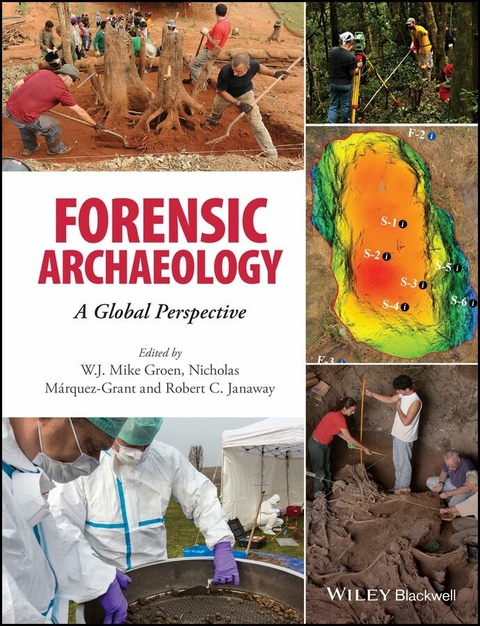
Forensic archaeology is mostly defined as the use of archaeological methods and principles within a legal context. However, such a definition only covers one aspect of forensic archaeology and misses the full potential this discipline has to offer. This volume is unique in that it contains 57 chapters from experienced forensic archaeological practitioners working in different countries, intergovernmental organisations or NGO’s. It shows that the practice of forensic archaeology varies worldwide as a result of diverse historical, educational, legal and judicial backgrounds. The chapters in this volume will be an invaluable reference to (forensic) archaeologists, forensic anthropologists, humanitarian and human rights workers, forensic scientists, police officers, professionals working in criminal justice systems and all other individuals who are interested in the potential forensic archaeology has to offer at scenes of crime or places of incident. This volume promotes the development of forensic archaeology worldwide. In addition, it proposes an interpretative framework that is grounded in archaeological theory and methodology, integrating affiliated behavioural and forensic sciences.
Mike Groen is a Forensic Archaeologist at the Netherlands Forensic Institute (NFI), the Netherlands, and lectures in Forensic Archaeology, Human OsteoArchaeology and Taphonomy at several Dutch universities. He is currently (2015) Chair of the Forensic Archaeology Project Group within the European Network of Forensic Science Institutes (ENFSI).
Nicholas Márquez-Grant is Course Director in Forensic Archaeology and Anthropology at Cranfield Forensic Institute, Cranfield University, UK. He is also a Research Fellow at the School of Anthropology and Museum Ethnography, University of Oxford, UK. As a forensic practitioner, he has acted as an expert witness in Forensic Anthropology and Archaeology.
Robert Janaway is a Lecturer in Forensic and Archaeological Sciences and Course Director for Forensic Archaeology and Crime Scene Investigation at Bradford University, UK. He has acted as a forensic archaeologist and has conducted research in forensic taphonomy for over 25 years and is currently (2015) Chair of the Chartered Institute for Archaeologists (CIfA) Forensic Archaeology Expert Panel.
Forensic archaeology is mostly defined as the use of archaeological methods and principles within a legal context. However, such a definition only covers one aspect of forensic archaeology and misses the full potential this discipline has to offer. This volume is unique in that it contains 57 chapters from experienced forensic archaeological practitioners working in different countries, intergovernmental organisations or NGO s. It shows that the practice of forensic archaeology varies worldwide as a result of diverse historical, educational, legal and judicial backgrounds. The chapters in this volume will be an invaluable reference to (forensic) archaeologists, forensic anthropologists, humanitarian and human rights workers, forensic scientists, police officers, professionals working in criminal justice systems and all other individuals who are interested in the potential forensic archaeology has to offer at scenes of crime or places of incident. This volume promotes the development of forensic archaeology worldwide. In addition, it proposes an interpretative framework that is grounded in archaeological theory and methodology, integrating affiliated behavioural and forensic sciences.
Mike Groen is a Forensic Archaeologist at the Netherlands Forensic Institute (NFI), the Netherlands, and lectures in Forensic Archaeology, Human OsteoArchaeology and Taphonomy at several Dutch universities. He is currently (2015) Chair of the Forensic Archaeology Project Group within the European Network of Forensic Science Institutes (ENFSI). Nicholas Márquez-Grant is Course Director in Forensic Archaeology and Anthropology at Cranfield Forensic Institute, Cranfield University, UK. He is also a Research Fellow at the School of Anthropology and Museum Ethnography, University of Oxford, UK. As a forensic practitioner, he has acted as an expert witness in Forensic Anthropology and Archaeology. Robert Janaway is a Lecturer in Forensic and Archaeological Sciences and Course Director for Forensic Archaeology and Crime Scene Investigation at Bradford University, UK. He has acted as a forensic archaeologist and has conducted research in forensic taphonomy for over 25 years and is currently (2015) Chair of the Chartered Institute for Archaeologists (CIfA) Forensic Archaeology Expert Panel.
Biographies of contributors
Alexey Abramov, PhD, works at the Department of Forensic Medical Criminology, Moscow Regional State Bureau of Forensic Medicine, Russia. In 2003, he graduated from the Russian State Medical University, majoring in Paediatrics. After his graduation, he specialised in the fields of Forensic Medicine and Criminalistics. Dr Abramov has participated, as a forensic anthropologist, in several mass disaster incidents in Russia and abroad.
Rafael de Abreu e Souza, MSc, is a doctoral student at the Public Archaeology Laboratory, University of Campinas, Brazil, with a special focus on historical archaeology and archaeology of the contemporary past. He is a member of the Archaeology of Repression and Resistance Research Group at the National Council for Scientific and Technological Development, Brazil. He has developed programmes in forensic archaeology and coordinated archaeological excavations on sites related to the Brazilian dictatorship, human rights violations and political disappearances. He is also a member of two Brazilian archaeological teams: the Araguaia Working Group (GTA) and the Forensic Archaeology and Anthropology Group (GAAF).
Anil Aggrawal, MD, PhD, is Director Professor of Forensic Medicine and Toxicology at the Maulana Azad Medical College, New Delhi, India. He holds a medical degree in forensic medicine from the All India Institute of Medical Sciences, New Delhi. In 1996, he was awarded a WHO fellowship, under which he taught at Shiga University of Medical Sciences, Japan, and the Armed Forces Institute of Pathology, Washington, DC, US. Professor Aggrawal is Founder and Editor-in-Chief of the Anil Aggrawal’s Internet Journal of Forensic Medicine and Toxicology (available at: http://www.anilaggrawal.com/ij/indexpapers.html) and has published several books and numerous scientific articles on medical and forensic topics.
Amin Attia Alemam, BDS, is one of the first promoters for the use of dental sciences in the Libyan legal sector (forensic odontology). He submitted, starting in 2005, related proposals to the Libyan Ministry of Justice and the Libyan Ministry of Higher Education. During the Libyan revolution (2011), he cooperated with the Centre of Expert Witnesses to the Court of Laws and Research in Benghazi and was, as forensic odontologist, co-responsible for the identification of victims. He is attached, as an instructor in forensic odontology, to the Department of Forensic Sciences, University of Benghazi, Libya, and founded the Libyan Society of Forensic Odontology (LSFO). Currently, he is pursuing a Masters’ degree in the United Kingdom.
Khudooma Saeed Al Naimi, MSc, holds a Masters’ degree in forensic anthropology from the University of Central Lancashire, UK. Since 2001, he has been employed at the Forensic Biology Section of the General Directorate of Abu Dhabi Police, UAE. His duties include crime scene investigation, laboratory examination of evidence and training of new staff. His research interests include, among other things, forensic anthropology (e.g. the effect of firearms on human bone), forensic biology and forensic entomology. He is a member of the American Academy of Forensic Sciences (AAFS) and the International Association of Identification (IAI). In 2005, he participated, as a forensic anthropologist, in the identification of war victims in Bosnia and Herzegovina.
Susan Appleyard, MA, is an independent human rights researcher. She has worked for the UN Office of the High Commissioner for Human Rights, the UN Department of Political Affairs, the International Commission of Jurists, Human Rights Watch and Child Soldiers International in Nepal and throughout Asia-Pacific for over 10 years. She is currently completing a Masters’ degree in forensic anthropology and archaeology at Cranfield University, UK.
Edward Ashby, MA, is an independent consulting archaeologist. He holds a Masters’ degree in archaeology and a PgDip in forensic science from Auckland University, New Zealand. His research is focused around cultural resource management and forensic archaeology. Edward has worked with the Chief Coroner of New Zealand in developing protocols for the recovery of skeletal remains, and has published in the Australian Journal of Forensic Sciences.
José Pablo Baraybar, MA, MSc, has consulted and trained on the use of forensics in cases of human rights violations in the Americas, Africa and South East Asia. He is a founding member of the Peruvian Forensic Anthropology Team (EPAF) and has worked as a forensic anthropologist for the International Criminal Tribunal for Rwanda (ICTR) in 1996 and as chief forensic anthropologist/archaeologist for the International Criminal Tribunal for the former Yugoslavia (ICTY) from 1996 to 2002. In 2002, he created the Office of Missing Persons and Forensics (OMPF) in Kosovo and served as its Head until 2007. During his tenure as Head of OMPF, he was awarded the UN 21 Award. In 2011, he was awarded the Judith Lee Stronach Human Rights prize by the Centre for Justice and Accountability in San Francisco, US.
Radoslav Beňuš, PhD, is Associate Professor at the Department of Anthropology, Comenius University, Slovakia, and a court expert in forensic anthropology. His professional interests include physical and forensic anthropology. The main field of his research in physical anthropology lies in palaeopathology and the epidemiology of diseases of historical populations. In forensic anthropology, his main interests are the taphonomic changes in the human body, the distinction between peri-mortal and post-mortal skeletal alterations, the determination of biological profile and the identification of unknown persons. Dr Beňuš is a member of the Main Committee of the Slovak Anthropological Society, the European Anthropological Association (EAA) and the Palaeopathology Association (PPA).
Soren Blau, PhD, is the senior forensic anthropologist at the Victorian Institute of Forensic Medicine, Melbourne, Australia, where she has been employed since 2005. Additionally, she is an adjunct senior lecturer at the Department of Forensic Medicine, Monash University, Australia, and a founding fellow of the Royal College of Pathologists of Australasia (RCPA). In addition to numerous journal publications, she co-edited a book titled Handbook of Forensic Anthropology and Archaeology (2009). Dr Blau undertakes domestic and international forensic anthropology casework, as well as contributing to international training courses on aspects of DVI and the application of forensic anthropology and archaeology to the investigation of human rights violations.
Tomasz Borkowski, PhD, works at the Wrocław Museum of Archaeology, Poland, where he specialises in the late Middle Ages and post-medieval periods. Additionally, Dr Borkowski lectures in postgraduate studies in forensic archaeology at the University of Wrocław, Poland.
Matteo Borrini, PhD, holds a doctorate in evolutionary biology and ecology from the University of Rome ‘Tor Vergata’, Italy. He is a principal lecturer and programme manager of the BSc (Hons) forensic anthropology programme at Liverpool John Moores University, UK. Currently, he is the only expert witness in forensic archaeology and forensic anthropology for the Italian State Prosecutor Office (registered at the Criminal Court of La Spezia). He has led dozens of archaeological and bioarchaeological excavations and was a scientific consultant for the National Geographic Society (Vampire Forensic Project). He is involved in the search, recovery and identification of missing people and murder victims, and is also devoted to the study of forensic archaeology and anthropology in the context of WWII. For his contribution to the location and identification of missing army soldiers, Dr Borrini was designated as an honorary member of the Commonwealth-Italian Joint Committee of the Commonwealth War Graves Commission (CWGC).
Ilian Boyanov, PhD, is a senior lecturer at the Department of Archaeology, New Bulgarian University, where he has been employed since 2008. Additionally, he is an adjunct lecturer at the Faculty of Law, University of National and World Economy, Bulgaria, where he has lectured in forensic archaeology since 2009. In addition to numerous journal publications, he has edited a book titled Forensic Archaeology: A Brief Training Course (2010). Dr Boyanov undertakes domestic and international archaeology and forensic archaeology fieldwork and casework.
Eileen Buitrago Pérez, BA, has studied anthropology at the Externado de Colombia University. She has trained in forensic anthropology since joining the Colombian Interdisciplinary Team on Forensic Work and Psychosocial Assistance (EQUITAS) in 2010. She has worked with victims’ families that have suffered serious human rights violations, in particular extra-legal executions. She is experienced in working in interdisciplinary teams and with minority groups.
Luis L. Cabo, MSc, is the Director of the Bioarchaeology and Forensic Laboratory at the Mercyhurst Archaeological Institute, Mercyhurst University, US. With a background in biology and anthropology, before joining Mercyhurst’s forensic team in 2003, he took part in more than a dozen major archaeological and paleontological projects in Europe and the Americas, with chronologies from middle Palaeolithic to late Middle Ages. Mercyhurst’s team processes an average of more than 100 cases per year, including outdoor recoveries, fatal fire scenes, burials and mass...
| Erscheint lt. Verlag | 17.2.2015 |
|---|---|
| Sprache | englisch |
| Themenwelt | Geisteswissenschaften ► Archäologie |
| Geschichte ► Allgemeine Geschichte ► Vor- und Frühgeschichte | |
| Naturwissenschaften ► Biologie | |
| Naturwissenschaften ► Chemie | |
| Recht / Steuern ► EU / Internationales Recht | |
| Recht / Steuern ► Strafrecht ► Kriminologie | |
| Technik | |
| Schlagworte | Analytische Chemie / Forensik • Archäologie • archaeological • Archaeological Methods & Theory • archaeology • Archäologie • Aspect • Biowissenschaften • Chapters • Chemie • Chemistry • Contains • ConText • Countries • Definition • Different • Discipline • experienced • Forensic • Forensics • Forensic Science • Forensik • full • legal • Life Sciences • Methoden u. Theorie der Archäologie • Methoden u. Theorie der Archäologie • Methods • One • Potential • Practitioners • Unique • use • Volume |
| ISBN-10 | 1-118-74594-9 / 1118745949 |
| ISBN-13 | 978-1-118-74594-6 / 9781118745946 |
| Informationen gemäß Produktsicherheitsverordnung (GPSR) | |
| Haben Sie eine Frage zum Produkt? |
 EPUB (Adobe DRM)
Kopierschutz: Adobe-DRM
Adobe-DRM ist ein Kopierschutz, der das eBook vor Mißbrauch schützen soll. Dabei wird das eBook bereits beim Download auf Ihre persönliche Adobe-ID autorisiert. Lesen können Sie das eBook dann nur auf den Geräten, welche ebenfalls auf Ihre Adobe-ID registriert sind.
Details zum Adobe-DRM
Dateiformat: EPUB (Electronic Publication)
EPUB ist ein offener Standard für eBooks und eignet sich besonders zur Darstellung von Belletristik und Sachbüchern. Der Fließtext wird dynamisch an die Display- und Schriftgröße angepasst. Auch für mobile Lesegeräte ist EPUB daher gut geeignet.
Systemvoraussetzungen:
PC/Mac: Mit einem PC oder Mac können Sie dieses eBook lesen. Sie benötigen eine
eReader: Dieses eBook kann mit (fast) allen eBook-Readern gelesen werden. Mit dem amazon-Kindle ist es aber nicht kompatibel.
Smartphone/Tablet: Egal ob Apple oder Android, dieses eBook können Sie lesen. Sie benötigen eine
Geräteliste und zusätzliche Hinweise
Buying eBooks from abroad
For tax law reasons we can sell eBooks just within Germany and Switzerland. Regrettably we cannot fulfill eBook-orders from other countries.
aus dem Bereich