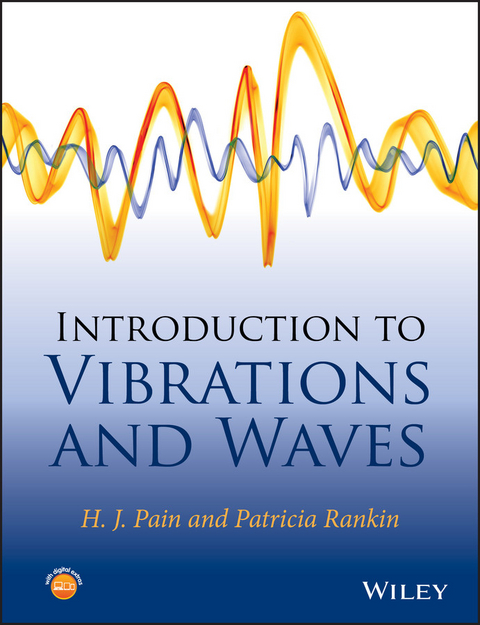
Introduction to Vibrations and Waves (eBook)
John Wiley & Sons (Verlag)
978-1-118-69838-9 (ISBN)
Based on the successful multi-edition book 'The Physics of Vibrations and Waves' by John Pain, the authors carry over the simplicity and logic of the approach taken in the original first edition with its focus on the patterns underlying and connecting so many aspects of physical behavior, whilst bringing the subject up-to-date so it is relevant to teaching in the 21st century.
The transmission of energy by wave propagation is a key concept that has applications in almost every branch of physics with transmitting mediums essentially acting as a continuum of coupled oscillators. The characterization of these simple oscillators in terms of three parameters related to the storage, exchange, and dissipation of energy forms the basis of this book. The text moves naturally on from a discussion of basic concepts such as damped oscillations, diffraction and interference to more advanced topics such as transmission lines and attenuation, wave guides, diffusion, Fourier series, and electromagnetic waves in dielectrics and conductors. Throughout the text the emphasis on the underlying principles helps readers to develop their physics insight as an aid to problem solving.
This book provides undergraduate students of physics and engineering with the mathematical tools required for full mastery of the concepts. With worked examples presented throughout the text, as well as the Problem sets concluding each chapter, this textbook will enable students to develop their skills and measure their understanding of each topic step-by-step.
A companion website is also available, which includes solutions to chapter problems and PowerPoint slides.
Review of 'The Physics of Vibrations and Waves 6e'
This is an excellent textbook, full of interesting material clearly explained and fully worthy of being studied by future contributors ...' Journal of Sound and Vibration
H. J. Pain Emeritus, Department of Physics, Imperial College London, UK
Patricia Rankin Department of Physics, University of Colorado, USA
Based on the successful multi-edition book The Physics of Vibrations and Waves by John Pain, the authors carry over the simplicity and logic of the approach taken in the original first edition with its focus on the patterns underlying and connecting so many aspects of physical behavior, whilst bringing the subject up-to-date so it is relevant to teaching in the 21st century. The transmission of energy by wave propagation is a key concept that has applications in almost every branch of physics with transmitting mediums essentially acting as a continuum of coupled oscillators. The characterization of these simple oscillators in terms of three parameters related to the storage, exchange, and dissipation of energy forms the basis of this book. The text moves naturally on from a discussion of basic concepts such as damped oscillations, diffraction and interference to more advanced topics such as transmission lines and attenuation, wave guides, diffusion, Fourier series, and electromagnetic waves in dielectrics and conductors. Throughout the text the emphasis on the underlying principles helps readers to develop their physics insight as an aid to problem solving. This book provides undergraduate students of physics and engineering with the mathematical tools required for full mastery of the concepts. With worked examples presented throughout the text, as well as the Problem sets concluding each chapter, this textbook will enable students to develop their skills and measure their understanding of each topic step-by-step.A companion website is also available, which includes solutions to chapter problems and PowerPoint slides. Review of The Physics of Vibrations and Waves 6e This is an excellent textbook, full of interesting material clearly explained and fully worthy of being studied by future contributors ..."e; Journal of Sound and Vibration
H. J. Pain Emeritus, Department of Physics, Imperial College London, UK Patricia Rankin Department of Physics, University of Colorado, USA
1
Simple Harmonic Motion
Notes to the students
After reading this chapter and completing the problems, you will understand:
- What a simple harmonic oscillator is.
- How a simple harmonic oscillator is described mathematically.
- How to use the equations describing simple harmonic motion to extract quantities of physical interest.
- The wide variety of physical systems that behave as simple harmonic oscillators. This will include all the oscillators and waves in this book except those in the last chapter.
- One of the most important things to learn as a physicist is that many seemingly different systems can be described in the same mathematical terms.
At first sight the eight physical systems in Figure 1.1 appear to have little in common.
- 1.1(a) is a mass fixed to a wall via a spring of stiffness s sliding to and fro in the x direction on a frictionless plane.
- 1.1(b) is a simple pendulum, a mass m swinging at the end of a light rigid rod of length l.
- 1.1(c) is a flat disc supported by a rigid wire through its centre and oscillating through small angles in the plane of its circumference.
- 1.1(d) is a mass m at the centre of a light string of length 2l fixed at both ends under a constant tension T. The mass vibrates in the plane of the paper.
- 1.1(e) is a frictionless U-tube of constant cross-sectional area containing a length l of liquid, density ρ, oscillating about its equilibrium position of equal levels in each limb.
- 1.1(f) is an open flask of volume V and a neck of length l and constant cross-sectional area A in which the air of density ρ vibrates as sound passes across the neck.
- 1.1(g) is a hydrometer, a body of mass m floating in a liquid of density ρ with a neck of constant cross-sectional area cutting the liquid surface. When depressed slightly from its equilibrium position it performs small vertical oscillations.
- 1.1(h) is an electrical circuit, an inductance L connected across a capacitance C carrying a charge q.
Figure 1.1 Simple harmonic oscillators with their equations of motion and angular frequencies ω of oscillation. (a) A mass on a frictionless plane connected by a spring to a wall. (b) A simple pendulum. (c) A torsional pendulum. (d) A mass at the centre of a string under constant tension T. (e) A fixed length of non-viscous liquid in a U-tube of constant cross-section. (f) An acoustic Helmholtz resonator. (g) A hydrometer mass m in a liquid of density ρ. (h) An electrical L C resonant circuit.
All of these systems are simple harmonic oscillators which, when slightly disturbed from their equilibrium or rest postion, will oscillate with simple harmonic motion. This is the most fundamental vibration of a single particle or one-dimensional system. A small displacement x from its equilibrium position sets up a restoring force which is proportional to x acting in a direction towards the equilibrium position.
Thus, this restoring force F in Figure 1.1(a) may be written
where s, the constant of proportionality, is called the stiffness and the negative sign shows that the force is acting against the direction of increasing displacement and back towards the equilibrium position. A constant value of the stiffness restricts the displacement x to small values (this is Hooke’s Law of Elasticity). The stiffness s is obviously the restoring force per unit distance (or displacement) and has the dimensions
The equation of motion of such a disturbed system is given by the dynamic balance between the forces acting on the system, which by Newton’s Law is
or
where the acceleration
This gives
or
where the dimensions of
Here T is a time, or period of oscillation, the reciprocal of ν which is the frequency with which the system oscillates.
However, when we solve the equation of motion we shall find that the behaviour of x with time has a sinusoidal or cosinusoidal dependence, and it will prove more appropriate to consider, not ν, but the angular frequency ω = 2πν so that the period
where s/m is now written as ω2. Thus the equation of simple harmonic motion
becomes
1.1 Displacement in Simple Harmonic Motion
The behaviour of a simple harmonic oscillator is expressed in terms of its displacement x from equilibrium, its velocity , and its acceleration at any given time. If we try the solution
where A is a constant with the same dimensions as x, we shall find that it satisfies the equation of motion
for
and
Another solution
is equally valid, where B has the same dimensions as A, for then
and
The complete or general solution of equation (1.1) is given by the addition or superposition of both values for x so we have
with
where A and B are determined by the values of x and at a specified time. If we rewrite the constants as
where φ is a constant angle, then
so that
and
The maximum value of sin(ωt + φ ) is unity so the constant a is the maximum value of x, known as the amplitude of displacement. The limiting values of sin(ωt + φ ) are ±1 so the system will oscillate between the values of x = ±a and we shall see that the magnitude of a is determined by the total energy of the oscillator.
The angle φ is called the ‘phase constant’ for the following reason. Simple harmonic motion is often introduced by reference to ‘circular motion’ because each possible value of the displacement x can be represented by the projection of a radius vector of constant length a on the diameter of the circle traced by the tip of the vector as it rotates in a positive anticlockwise direction with a constant angular velocity ω. Each rotation, as the radius vector sweeps through a phase angle of 2π rad, therefore corresponds to a complete vibration of the oscillator. In the solution
the phase constant φ, measured in radians, defines the position in the cycle of oscillation at the time t = 0, so that the position in the cycle from which the oscillator started to move is
The solution
defines the displacement only of that system which starts from the origin x = 0 at time t = 0 but the inclusion of φ in the solution
where φ may take all values between zero and 2π allows the motion to be defined from any starting point in the cycle. This is illustrated in Figure 1.2 for various values of φ.
Figure 1.2 Sinusoidal displacement of simple harmonic oscillator with time, showing variation of starting point in cycle in terms of phase angle φ.
Worked Examples
Show that may be written as .
The pendulum in Figure 1.1(b) swings with a displacement amplitude a. If its starting point from rest is what are the values of φ in the solution x = a sin(ωt + φ)?
at t = 0 requires
at t = 0 requires
If x = a at t = 0 with , at what values of ωt will , and x = 0?
Answers: .
1.2 Velocity and Acceleration in Simple Harmonic Motion
The values of the velocity and acceleration in simple harmonic motion for
are given by
and
The maximum value of the velocity aω is called the velocity amplitude and the acceleration amplitude is given by aω2.
From Figure 1.2 we see that a positive phase angle of π /2 rad converts a sine into a cosine curve. Thus the velocity
leads the displacement
by a phase angle of π / 2 rad and its maxima and minima are...
| Erscheint lt. Verlag | 13.2.2015 |
|---|---|
| Sprache | englisch |
| Themenwelt | Naturwissenschaften ► Physik / Astronomie ► Theoretische Physik |
| Technik ► Maschinenbau | |
| Schlagworte | coupled oscillators • forced oscillators • Industrial Engineering • Industrielle Verfahrenstechnik • Maths tools • non-linear waves • optical diffraction • optical interference • Physics • Physik • Schwingung • Simple Oscillators • theoretical physics • Theoretische Physik • Transmission Lines • Transverse and Longitudinal Waves • Welle |
| ISBN-10 | 1-118-69838-X / 111869838X |
| ISBN-13 | 978-1-118-69838-9 / 9781118698389 |
| Informationen gemäß Produktsicherheitsverordnung (GPSR) | |
| Haben Sie eine Frage zum Produkt? |
 EPUB (Adobe DRM)
Kopierschutz: Adobe-DRM
Adobe-DRM ist ein Kopierschutz, der das eBook vor Mißbrauch schützen soll. Dabei wird das eBook bereits beim Download auf Ihre persönliche Adobe-ID autorisiert. Lesen können Sie das eBook dann nur auf den Geräten, welche ebenfalls auf Ihre Adobe-ID registriert sind.
Details zum Adobe-DRM
Dateiformat: EPUB (Electronic Publication)
EPUB ist ein offener Standard für eBooks und eignet sich besonders zur Darstellung von Belletristik und Sachbüchern. Der Fließtext wird dynamisch an die Display- und Schriftgröße angepasst. Auch für mobile Lesegeräte ist EPUB daher gut geeignet.
Systemvoraussetzungen:
PC/Mac: Mit einem PC oder Mac können Sie dieses eBook lesen. Sie benötigen eine
eReader: Dieses eBook kann mit (fast) allen eBook-Readern gelesen werden. Mit dem amazon-Kindle ist es aber nicht kompatibel.
Smartphone/Tablet: Egal ob Apple oder Android, dieses eBook können Sie lesen. Sie benötigen eine
Geräteliste und zusätzliche Hinweise
Buying eBooks from abroad
For tax law reasons we can sell eBooks just within Germany and Switzerland. Regrettably we cannot fulfill eBook-orders from other countries.
aus dem Bereich