
Freshwater Algae (eBook)
John Wiley & Sons (Verlag)
978-1-118-91714-5 (ISBN)
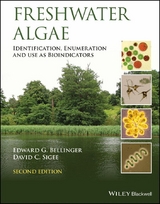
This is the second edition of Freshwater Algae; the popular guide to temperate freshwater algae. This book uniquely combines practical information on sampling and experimental techniques with an explanation of basic algal taxonomy plus a key to identify the more frequently-occurring organisms. Fully revised, it describes major bioindicator species in relation to key environmental parameters and their implications for aquatic management.
This second edition includes:
the same clear writing style as the first edition to provide an easily accessible source of information on algae within standing and flowing waters, and the problems they may cause
the identification of 250 algae using a key based on readily observable morphological features that can be readily observed under a conventional light microscope
up-to-date information on the molecular determination of taxonomic status, analytical microtechniques and the potential role of computer analysis in algal biology
upgrades to numerous line drawings to include more detail and extra species information, full colour photographs of live algae - including many new images from the USA and China
Bridging the gap between simple identification texts and highly specialised research volumes, this book is
used both as a comprehensive introduction to the subject and as a laboratory manual. The new edition will be invaluable to aquatic biologists for algal identification, and for all practitioners and researchers working within aquatic microbiology in industry and academia.
Edward G. Bellinger, Department Environmental Sciences & Policy, Central European University, Hungary
David C. Sigee, School of Earth, Atmospheric and Environmental Sciences, University of Manchester, UK
This is the second edition of Freshwater Algae; the popular guide to temperate freshwater algae. This book uniquely combines practical information on sampling and experimental techniques with an explanation of basic algal taxonomy plus a key to identify the more frequently-occurring organisms. Fully revised, it describes major bioindicator species in relation to key environmental parameters and their implications for aquatic management. This second edition includes: the same clear writing style as the first edition to provide an easily accessible source of information on algae within standing and flowing waters, and the problems they may cause the identification of 250 algae using a key based on readily observable morphological features that can be readily observed under a conventional light microscope up-to-date information on the molecular determination of taxonomic status, analytical microtechniques and the potential role of computer analysis in algal biology upgrades to numerous line drawings to include more detail and extra species information, full colour photographs of live algae including many new images from the USA and China Bridging the gap between simple identification texts and highly specialised research volumes, this book is used both as a comprehensive introduction to the subject and as a laboratory manual. The new edition will be invaluable to aquatic biologists for algal identification, and for all practitioners and researchers working within aquatic microbiology in industry and academia.
Edward G. Bellinger, Department Environmental Sciences & Policy, Central European University, Hungary David C. Sigee, School of Earth, Atmospheric and Environmental Sciences, University of Manchester, UK
1
Introduction to Freshwater Algae
1.1 General introduction
Algae are widely present in freshwater environments, such as lakes and rivers, where they are typically present as microorganisms – visible only with the aid of a light microscope. Although relatively inconspicuous, they have a major importance in the freshwater environment, both in terms of fundamental ecology and in relation to human use of natural resources.
This book considers the diversity of algae in freshwater environments and gives a general overview of the major groups of these organisms (Chapter 1), methods of collection and enumeration (Chapter 2) and keys to algal groups and major genera (Chapter 4). Algae are considered as indicators of environmental conditions (bioindicators) in terms of individual species (Chapter 1) and as communities (Chapter 3).
1.1.1 Algae – an overview
The word ‘algae’ originates from the Latin word for seaweed and is now applied to a broad assemblage of organisms that can be defined both in terms of morphology and general physiology. They are simple organisms, without differentiation into roots, stems and leaves – and their sexual organs are not enclosed within protective coverings. In terms of physiology, they are fundamentally autotrophic (obtaining all their materials from inorganic sources) and photosynthetic – generating complex carbon compounds from carbon dioxide and light energy. Some algae have become secondarily heterotrophic, taking up complex organic molecules by organotrophy or heterotrophy (Tuchman, 1996), but still retaining fundamental genetic affinities with their photosynthetic relatives (Pfandl et al., 2009).
The term ‘algae’ (singular alga) is not strictly a taxonomic term but is used as an inclusive label for a number of different phyla that fit the broad description noted earlier. These organisms include both prokaryotes (cells lacking a membrane-bound nucleus; see Section 1.3) and eukaryotes (cells with a nucleus plus typical membrane-bound organelles).
Humans have long made use of algal species, both living and dead. Fossil algal diatomite deposits, for example, in the form of light but strong rocks, have been used as building materials and filtration media in water purification and swimming pools. Some fossil algae, for example Botryococcus, can give rise to oil-rich deposits. Certain species of green algae are cultivated for the purpose of extracting key biochemicals for use in medicine and cosmetics. Even blue-green algae have beneficial uses. Particularly, Spirulina, which was harvested by the Aztecs of Mexico, is still used by the people around Lake Chad as a dietary supplement. Spirulina tablets may still be obtained in some health food shops. Blue-green algae are, however, better known in the freshwater environment as nuisance organisms, forming dense blooms. These can have adverse effects in relation to toxin build-up and clogging filters/water courses – affecting the production of drinking water and recreational activities.
1.1.2 Algae as primary producers
As fixers of carbon and generators of biomass, algae are one of three major groups of photosynthetic organism within the freshwater environment. They are distinguished from higher plants (macrophytes) in terms of size and taxonomy and from photosynthetic bacteria in terms of their biochemistry. Unlike algae (eukaryotic algae and cyanophyta), photosynthetic bacteria are strict anaerobes and do not evolve oxygen as part of the photosynthetic process (Sigee, 2004).
The level of primary production by algae in freshwater bodies can be measured as fixed carbon per unit area with time (mg C m−3 h−1) and varies greatly from one environment to another. This is seen, for example, in different lakes – where primary production varies with trophic status and with depth in the water column (Fig. 1.1). Eutrophic lakes, containing high levels of available nitrogen and phosphorus, have very high levels of productivity in surface waters, decreasing rapidly with depth due to light absorption by algal biomass. In contrast, mesotrophic and oligotrophic lakes have lower overall productivity – but this extends deep into the water column due to greater light penetration.
Figure 1.1 Examples of algal primary production in lakes of different trophic status, showing how rates of production typically change with depth. Examples of each lake type include (a) highly eutrophic; Lake George (Uganda). (b) eutrophic; Blelham Tarn (English Lake District), Clear Lake (USA), Erken (Sweden). (c) mesotrophic; Grasmere (English Lake District), Castle Lake (USA). (d) oligotrophic; Lake Tahoe (USA), Lake Baikal in part (Russia), Wastwater (English Lake District). Adapted from Horne and Goldman (1994)
Although algae are fundamentally autotrophic (photosynthetic), some species have become secondarily heterotrophic – obtaining complex organic compounds by absorption over their outer surface or by active ingestion of particulate material. Although such organisms often superficially resemble protozoa in terms of their lack of chlorophyll, vigorous motility and active ingestion of organic material, they may still be regarded as algae due to their phylogenetic affinities.
1.1.3 Freshwater environments
Aquatic biology can be divided into two major disciplines – limnology (water bodies within continental boundaries) and oceanography (dealing with oceans and seas, occurring between continents). This book focuses on aquatic algae present within continental boundaries, where water is typically fresh (non-saline), and where water bodies are of two main types:
- Standing (lentic) waters – particularly lakes and wetlands.
- Running (lotic) waters - including streams and rivers.
The distinction between lentic and lotic systems is not absolute, since many ‘standing waters’ such as lakes have a small but continuous flow-through of water, and many large rivers have a relatively low rate of flow at certain times of year. Although the difference between standing and running waters is not absolute, it is an important distinction in relation to the algae present, since lentic systems are typically dominated by planktonic algae and lotic systems by benthic organisms.
Although this volume deals primarily with algae present within ‘conventional freshwater systems’ such as lakes and rivers, it also considers algae present within more extreme freshwater environments such as hot springs, algae present in semi-saline (brackish) and saline conditions (e.g. estuaries and saline lakes) and algae present within snow (where the water is in a frozen state for most of the year).
1.1.4 Planktonic and benthic algae
Within freshwater ecosystems, algae occur as either free-floating (planktonic) or substrate-associated (largely benthic) organisms. Planktonic algae drift freely within the main body of water (with some species able to regulate their position within the water column), while substrate-associated organisms are either fixed in position (attached) or have limited movement in relation to their substrate. These substrate-associated algae are in dynamic equilibrium with planktonic organisms (Fig. 2.1), with the balance depending on two main factors – the depth of water and the rate of water flow. Build-up of phytoplankton populations requires a low rate of flow (otherwise they flush out of the system) and adequate light levels, so they tend to predominate at the surface of lakes and slow-moving rivers. Benthic algae require adequate light (shallow waters) and can tolerate high rates of water flow, so predominate over phytoplankton in fast-flowing rivers and streams. Benthic algae also require adequate attachment sites – which include inorganic substrate, submerged water plants and emergent water plants at the edge of the water body. The distinction between planktonic and non-planktonic algae is ecologically important and is also relevant to algal sampling and enumeration procedures (see Chapter 2).
Planktonic algae
Planktonic algae dominate the main water body of standing waters, occurring as a defined seasonal succession of species in temperate lakes. The temporal sequence depends on lake trophic status (see Section 3.2.3; Table 3.3) with algae forming dense blooms in eutrophic lakes of diatoms (Fig. 1.16), colonial blue-green algae (Fig. 1.5) and late populations of dinoflagellates (Fig. 1.10). During the annual cycle, phytoplankton blooms correspond to peaks in algal biovolume and chlorophyll-a concentration and troughs in `Secchi depth' – the inverse of turbidity (Fig. 2.8).
Benthic algae
Benthic algae occur at the bottom of the water column in lakes and rivers and are directly associated with sediments – including rocks, mud and organic debris. These algae (usually attached) may form major growths on inorganic surfaces or on organic debris, where they are frequently present in mixed biofilms (bacteria, fungi and invertebrates also present). Under high light conditions, the biofilm may become dominated by extensive growths of filamentous algae – forming a periphyton community (Fig. 2.23). Attached algae may also be fixed to...
| Erscheint lt. Verlag | 6.2.2015 |
|---|---|
| Sprache | englisch |
| Themenwelt | Naturwissenschaften ► Biologie ► Botanik |
| Naturwissenschaften ► Biologie ► Limnologie / Meeresbiologie | |
| Naturwissenschaften ► Biologie ► Ökologie / Naturschutz | |
| Technik | |
| Schlagworte | Ãkologie / SüÃwasser • Algenkunde • Benthic algae • Bioindicators • Biowissenschaften • Botanik • Collection • Enumeration • freshwater algae • Freshwater Ecology • Identification • Lakes • Life Sciences • microscopic examination • Ökologie / Süßwasser • phycology • Phytoplankton • plant science • rivers |
| ISBN-10 | 1-118-91714-6 / 1118917146 |
| ISBN-13 | 978-1-118-91714-5 / 9781118917145 |
| Informationen gemäß Produktsicherheitsverordnung (GPSR) | |
| Haben Sie eine Frage zum Produkt? |
 EPUB (Adobe DRM)
Kopierschutz: Adobe-DRM
Adobe-DRM ist ein Kopierschutz, der das eBook vor Mißbrauch schützen soll. Dabei wird das eBook bereits beim Download auf Ihre persönliche Adobe-ID autorisiert. Lesen können Sie das eBook dann nur auf den Geräten, welche ebenfalls auf Ihre Adobe-ID registriert sind.
Details zum Adobe-DRM
Dateiformat: EPUB (Electronic Publication)
EPUB ist ein offener Standard für eBooks und eignet sich besonders zur Darstellung von Belletristik und Sachbüchern. Der Fließtext wird dynamisch an die Display- und Schriftgröße angepasst. Auch für mobile Lesegeräte ist EPUB daher gut geeignet.
Systemvoraussetzungen:
PC/Mac: Mit einem PC oder Mac können Sie dieses eBook lesen. Sie benötigen eine
eReader: Dieses eBook kann mit (fast) allen eBook-Readern gelesen werden. Mit dem amazon-Kindle ist es aber nicht kompatibel.
Smartphone/Tablet: Egal ob Apple oder Android, dieses eBook können Sie lesen. Sie benötigen eine
Geräteliste und zusätzliche Hinweise
Buying eBooks from abroad
For tax law reasons we can sell eBooks just within Germany and Switzerland. Regrettably we cannot fulfill eBook-orders from other countries.
aus dem Bereich