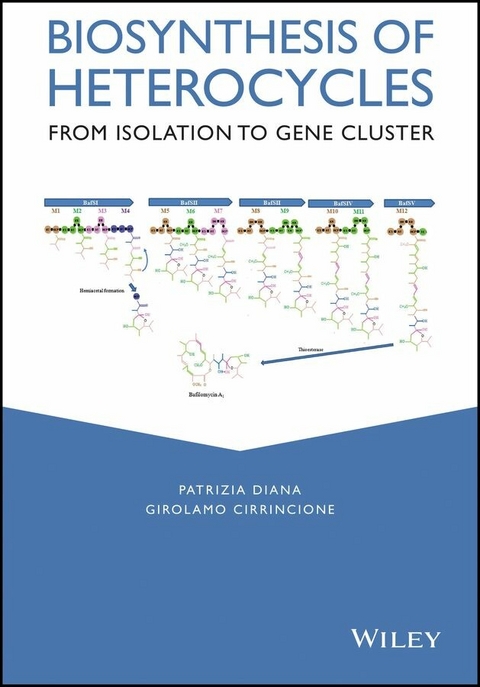
Biosynthesis of Heterocycles (eBook)
John Wiley & Sons (Verlag)
978-1-118-96062-2 (ISBN)
• Covers methods and techniques: isotopic labelling,enzymes and mutants, and pathway identification
• Provides a thorough resource of informationspecifically on heterocyclic natural products and their practicalbiosynthetic relevance
• Explains the role of natural products in chemistry andtheir formation
• Discusses gene cluster identification and the use ofbiogenetic engineering in pharmaceutical application
Patrizia Diana is full Professor of Medicinal Chemistryat the University of Palermo. She is currently coordinator of theMedicinal and Biological Section of the Department of Science andTechnology: Chemical, Biological, and Pharmaceutical (STEBICEF);and is a member of the Italian Chemical Society and InternationalSociety of Heterocyclic Chemistry.
Girolamo Cirrincione is full Professor of MedicinalChemistry at the University of Palermo. He is a member of the DrugDiscovery Committee of the Pharmacology and Molecular Mechanisms(PAMM)Group of the European Organization for Research and Treatmentof Cancer; the Italian Chemical Society, where he is currentlyserving as President of the Medicinal Chemistry Division; and theInternational Society of Heterocyclic Chemistry, where he served as vice president for 2004–05
This book describes biosynthetic methods to synthesize heterocyclic compounds, offering a guide for the development of new drugs based on natural products. The authors explain the role of natural products in chemistry and their formation along with important analytical methods and techniques for working with heterocycles. Covers methods and techniques: isotopic labelling, enzymes and mutants, and pathway identification Provides a thorough resource of information specifically on heterocyclic natural products and their practical biosynthetic relevance Explains the role of natural products in chemistry and their formation Discusses gene cluster identification and the use of biogenetic engineering in pharmaceutical application
Patrizia Diana is full Professor of Medicinal Chemistry at the University of Palermo. She is currently coordinator of the Medicinal and Biological Section of the Department of Science and Technology: Chemical, Biological, and Pharmaceutical (STEBICEF); and is a member of the Italian Chemical Society and International Society of Heterocyclic Chemistry. Girolamo Cirrincione is full Professor of Medicinal Chemistry at the University of Palermo. He is a member of the Drug Discovery Committee of the Pharmacology and Molecular Mechanisms (PAMM)Group of the European Organization for Research and Treatment of Cancer; the Italian Chemical Society, where he is currently serving as President of the Medicinal Chemistry Division; and the International Society of Heterocyclic Chemistry, where he served as vice president for 2004-05
CHAPTER 1
INTRODUCTION
Throughout human history, natural products, compounds that are derived from natural sources such as plants, animals, or microorganisms, have played a very important role in health care and prevention of diseases. For example, some of the first records on the use of natural products in medicine were written in cuneiform in Mesopotamia on clay tablets and date to approximately 2600 BC; Chinese herb guides document the use of herbaceous plants as far back in time as 2000 BC; Egyptians have been found to have documented the uses of various herbs in 1500 BC.
However, it's only in the nineteenth century that scientists isolated active components from various medicinal plants. The first commercial pure natural product introduced for therapeutic use is considered to be the narcotic morphine, in 1826. Natural products still play a very important role in modern medicine; in fact, they are increasingly the primary sources in drug discovery.
The pathways for generally modifying and synthesizing carbohydrates, proteins, fats, and nucleic acids are found to be essentially the same in all organisms, except for minor variations. Metabolism encompasses a wide variety of reactions for building molecules that are necessary to the life of the organism and for disruption of others for energy or secondary metabolites.
Primary metabolites are compounds that are essential for an organism's survival, growth, and replication. Secondary metabolites, such as alkaloids, glycosides, flavonoids, and so on, which are biosynthetically derived from primary metabolites, are substances that are often present only in certain types of specialized cells, and are not directly involved in the normal growth, development, or reproduction of an organism. They represent chemical adaptations to environmental stresses, or serve as defensive, protective, or offensive chemicals against microorganisms, insects, and higher herbivorous predators. They are sometimes considered as waste or secretory products of metabolism and are of pharmaceutical importance.
The building blocks for secondary metabolites are derived from primary metabolism. In fact, the biosynthesis of secondary metabolites is derived from the fundamental processes of photosynthesis, glycolysis, and the Krebs cycle to afford biosynthetic intermediates, which, ultimately, results in the formation of secondary metabolites also known as natural products. The most important building blocks employed in the biosynthesis of secondary metabolites are those derived from the intermediates: acetyl-coenzyme A (acetyl-CoA), shikimic acid, mevalonic acid, and 1-deoxyxylulose-5-phosphate (Figure 1.1).
Figure 1.1 Building blocks employed in the biosynthesis of secondary metabolites.
Acetyl-CoA is formed by the oxidative decarboxylation of the glycolytic pathway product pyruvic acid. Shikimic acid is produced from a combination of phosphoenolpyruvate, a glycolytic pathway intermediate, and erythrose 4-phosphate, obtained from the pentose phosphate pathway. Mevalonic acid is itself formed from three molecules of acetyl-CoA. Deoxyxylulose phosphate originates from a combination of pyruvic acid and glyceraldehyde-3-phosphate (GAP). Moreover, other building blocks based on amino acids (e.g., phenylalanine, tyrosine, tryptophan, lysine, ornithine) (Figure 1.2) are frequently employed in natural product synthesis (e.g., proteins, alkaloids, antibiotics). Though the number of building blocks is limited, the number of novel secondary metabolites formed is infinite.
Figure 1.2 Building blocks based on amino acids.
Biosynthesis of secondary metabolites involves numerous different mechanisms and reactions that are enzymatically catalyzed using several common mechanisms such as acylation, alkylation, decarboxylation, phosphorylation, hydride transfer, oxidation, elimination, reduction, condensation, rearrangement, and so on. The biosynthetic pathway may undergo changes due to natural causes (e.g., viruses or environmental changes) or unnatural causes (e.g., chemical or radiation) in an attempt to adapt or provide long life to the organism.
The elucidation of the biosynthetic pathway for the production of various metabolites has been extensively examined through the use of techniques that use isotopic labeling (stable isotopes and radioactive isotopes). Initially, radiolabeled precursors were introduced into plants and the resultant radioactive compounds were chemically degraded to identify the positions of the label. As the development of analytical instrumentation advanced, the isotopically labeled natural products were analyzed by mass spectrometry (MS) and nuclear magnetic resonance (NMR) spectroscopy instead of chemical degradation.
The biosynthesis of each secondary metabolite is catalyzed by a number of enzymes, usually encoded by a gene cluster. The disclosure of biosynthetic gene clusters has great potential for the identification of entire biosynthetic pathways for bioactive compounds of pharmaceutical interest.
Genome sequence analysis provides a source of the information necessary for predicting the biosynthesis pathways for secondary metabolites because the sequence analysis could reveal all the enzymes specific to each organism from their genes coded on the genome.
However, the gene information is not always described in a comprehensive manner and the related information is not always integrated. The database BIoSynthesis clusters CUrated and InTegrated (DoBISCUIT) integrates the latest literature information and provides standardized gene/module/domain descriptions related to the gene clusters [1].
The explanation of the biosynthetic pathway may also be possible through molecular biology techniques that use mutants. The use of tandem analytical instrumentation (e.g., GC/MS (gas chromatography/mass spectrometry), NMR/MS, LC/MS (liquid chromatography/mass spectrometry)) has improved the identifications of primary and secondary metabolites.
1.1 NATURAL PRODUCTS: PRIMARY AND SECONDARY METABOLITES
Primary metabolites can originate from fundamental processes: photosynthesis, glycolysis, and the citric acid cycle (Krebs cycle). They represent biosynthetic intermediates useful as building blocks for the synthesis of secondary metabolites. The latter can be synthesized through a combination of various building blocks (Figure 1.3):
- a single carbon atom (C1), usually in the form of a methyl group, obtained from l-methionine;
- a two-carbon unit (C2), an acetyl group, derived from acetyl-CoA or from the more active malonyl-CoA;
- a branched chain (C5), the isoprene moiety, formed from mevalonic acid or methylerythritol phosphate;
- a phenylpropyl moiety (C6C3) and a (C6C2N) fragment, both originating from l-phenylalanine or l-tyrosine;
- an indole C2N group, obtained from l-tryptophan;
- C4N and C5N portions, generated from l-ornithine and l-lysine, respectively.
Figure 1.3 (a–f) Biosynthetic intermediates useful as building blocks for the synthesis of secondary metabolites.
Secondary metabolites can be synthesized by combining several building blocks of the same type, or by using a mixture of different building blocks.
Some examples of secondary metabolites are antibiotics, alkaloids, anthraquinones, coumarines, flavonoids, xanthones, and terpenoids.
1.2 COMMON REACTIONS IN SECONDARY METABOLITES
The building blocks used in the biosynthesis of secondary products are assembled through biochemical reactions and catalyzed by enzymes, including alkylation reactions (nucleophilic substitutions and electrophilic additions); Wagner–Meerwein rearrangements; aldol and Claisen reactions; Schiff base (SB) formation and Mannich reactions; transaminations, decarboxylations, oxidation, and reduction reactions (hydrogenation/dehydrogenation reactions); monooxygenase and dioxygenase reactions; Baeyer–Villiger reactions; oxidative deamination reactions; dehalogenation–halogenation reactions; and glycosylations.
1.2.1 Alkylations
The alkylation reactions are classified, based on the character of the alkylating agent, into nucleophilic substitutions and electrophilic additions. Natural alkylating agents are S-adenosyl-L-methionine (SAM) and dimethylallyl diphosphate (DMAPP).
In nucleophilic substitutions, SAM is commonly used as methyl donor in numerous methylation reactions. The 3-amino-3-carboxypropyl (acp) group of SAM can also be transferred to different acceptor molecules. SAM-dependent acp-transfer reactions are relatively rare compared to methyl-transfer ones.
The positively charged sulfonium ion in SAM makes the three carbon atoms that are bonded to the sulfur atom prone to attack by nucleophiles. When the alkyl acceptor is a heteroatom (most commonly O, N), the methyl- or the acp-transfer reactions occur via simple nucleophilic mechanism (SN2): O-methyl or O-acp and N-methyl or N-acp linkages may be generated using hydroxyl and amino functions as nucleophiles (Figure 1.4). Some examples of O-methylation in the presence of SAM as the donor methyl group are depicted in Figure 1.5.
Figure 1.4 O- and N-alkylation using SAM.
Figure 1.5 Examples of SAM O-methylations. (a) 3-Alkyl-2-hydroxypyrazine, (b) mycophenolic acid, (c) furocoumarins (khellin, visnagin, and xanthotoxin), and (d) alkaloids (anhalonine and...
| Erscheint lt. Verlag | 6.2.2015 |
|---|---|
| Sprache | englisch |
| Themenwelt | Naturwissenschaften ► Biologie ► Biochemie |
| Naturwissenschaften ► Biologie ► Genetik / Molekularbiologie | |
| Naturwissenschaften ► Chemie ► Organische Chemie | |
| Technik | |
| Schlagworte | Biochemie • Biochemie u. Chemische Biologie • Biochemistry (Chemical Biology) • Biosynthese • Chemie • Chemistry • Heterocycles, biosynthesis, natural products, isolation, pathway identification, bioactive molecules, gene cluster • Heterocyclische Verbindungen • Natural Products • Naturstoffchemie • Pharmaceutical & Medicinal Chemistry • Pharmazeutische u. Medizinische Chemie |
| ISBN-10 | 1-118-96062-9 / 1118960629 |
| ISBN-13 | 978-1-118-96062-2 / 9781118960622 |
| Informationen gemäß Produktsicherheitsverordnung (GPSR) | |
| Haben Sie eine Frage zum Produkt? |
 EPUB (Adobe DRM)
Kopierschutz: Adobe-DRM
Adobe-DRM ist ein Kopierschutz, der das eBook vor Mißbrauch schützen soll. Dabei wird das eBook bereits beim Download auf Ihre persönliche Adobe-ID autorisiert. Lesen können Sie das eBook dann nur auf den Geräten, welche ebenfalls auf Ihre Adobe-ID registriert sind.
Details zum Adobe-DRM
Dateiformat: EPUB (Electronic Publication)
EPUB ist ein offener Standard für eBooks und eignet sich besonders zur Darstellung von Belletristik und Sachbüchern. Der Fließtext wird dynamisch an die Display- und Schriftgröße angepasst. Auch für mobile Lesegeräte ist EPUB daher gut geeignet.
Systemvoraussetzungen:
PC/Mac: Mit einem PC oder Mac können Sie dieses eBook lesen. Sie benötigen eine
eReader: Dieses eBook kann mit (fast) allen eBook-Readern gelesen werden. Mit dem amazon-Kindle ist es aber nicht kompatibel.
Smartphone/Tablet: Egal ob Apple oder Android, dieses eBook können Sie lesen. Sie benötigen eine
Geräteliste und zusätzliche Hinweise
Buying eBooks from abroad
For tax law reasons we can sell eBooks just within Germany and Switzerland. Regrettably we cannot fulfill eBook-orders from other countries.
aus dem Bereich