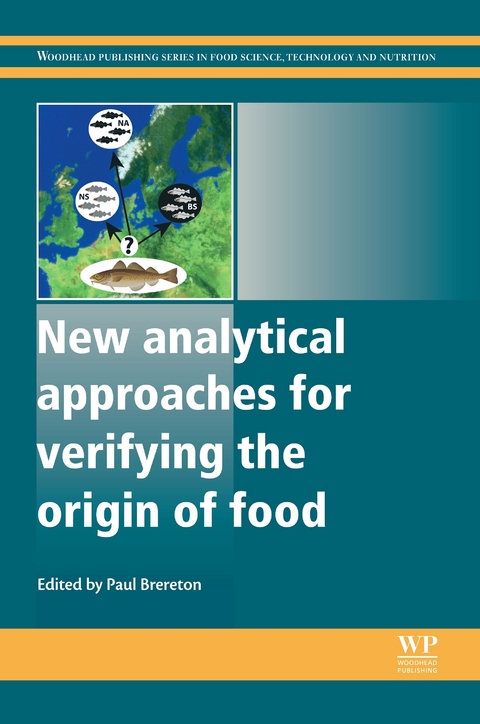
New Analytical Approaches for Verifying the Origin of Food (eBook)
272 Seiten
Elsevier Science (Verlag)
978-0-85709-759-0 (ISBN)
Food and beverage labels often specify a product's geographical origin, species, variety and method of production. These claims can significantly influence an item's economic value, but their verification is not always straightforward. New analytical approaches for verifying the origin of food reviews new analytical methods in this area together with applications to key commodities.Part one introduces the concept of food origin and provides supporting information on labelling legislation and standards. Part two moves on to explore new approaches for verifying the geographical origin of food using geospatial models and verifying species and varietal components of the food we eat. Holistic methods of verification methods using vibrational spectroscopy and associated chemometrics are also discussed. Finally, part three highlights the applications of new analytical methods to verify the origin of particular food commodities: fish, honey and wine.New analytical approaches for verifying the origin of food is a standard reference for professionals working in analytical laboratories testing food authenticity and for researchers, in the food industry, analytical laboratories and academia, working on the development of analytical methods for food authenticity. - Includes a chapter on origin labelling legislation and standards- Chapters address the applications of both established and novel methods in key product sectors- Reviews new analytical methods and their applications in the food industry
| Erscheint lt. Verlag | 31.7.2013 |
|---|---|
| Sprache | englisch |
| Themenwelt | Naturwissenschaften ► Chemie ► Analytische Chemie |
| Technik ► Lebensmitteltechnologie | |
| ISBN-10 | 0-85709-759-8 / 0857097598 |
| ISBN-13 | 978-0-85709-759-0 / 9780857097590 |
| Informationen gemäß Produktsicherheitsverordnung (GPSR) | |
| Haben Sie eine Frage zum Produkt? |
 EPUB (Adobe DRM)
Kopierschutz: Adobe-DRM
Adobe-DRM ist ein Kopierschutz, der das eBook vor Mißbrauch schützen soll. Dabei wird das eBook bereits beim Download auf Ihre persönliche Adobe-ID autorisiert. Lesen können Sie das eBook dann nur auf den Geräten, welche ebenfalls auf Ihre Adobe-ID registriert sind.
Details zum Adobe-DRM
Dateiformat: EPUB (Electronic Publication)
EPUB ist ein offener Standard für eBooks und eignet sich besonders zur Darstellung von Belletristik und Sachbüchern. Der Fließtext wird dynamisch an die Display- und Schriftgröße angepasst. Auch für mobile Lesegeräte ist EPUB daher gut geeignet.
Systemvoraussetzungen:
PC/Mac: Mit einem PC oder Mac können Sie dieses eBook lesen. Sie benötigen eine
eReader: Dieses eBook kann mit (fast) allen eBook-Readern gelesen werden. Mit dem amazon-Kindle ist es aber nicht kompatibel.
Smartphone/Tablet: Egal ob Apple oder Android, dieses eBook können Sie lesen. Sie benötigen eine
Geräteliste und zusätzliche Hinweise
Buying eBooks from abroad
For tax law reasons we can sell eBooks just within Germany and Switzerland. Regrettably we cannot fulfill eBook-orders from other countries.
aus dem Bereich