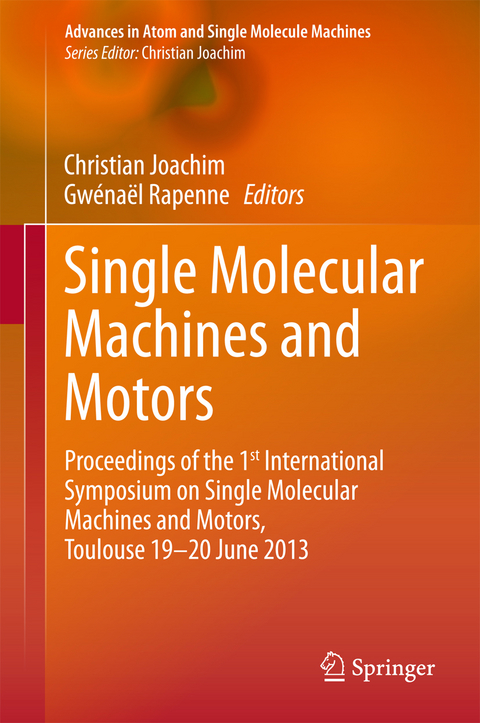
Single Molecular Machines and Motors (eBook)
VIII, 196 Seiten
Springer International Publishing (Verlag)
978-3-319-13872-5 (ISBN)
Single Molecular Machines and Motors brings together different approaches and strategies to design, synthesize and study single molecular machines and motors in a multidisciplinary way. Written by leading international experts, this book summarizes the advances in the field through a number of disciplines. Some contributions describe molecular chemistry such as organic, aromatics, and coordination chemistry while others address theoretical chemistry in a predictive way or through post-experimental modelling. Experimental physics with extensive use of scanning probe microscopy (STM and AFM) is discussed for examining one single molecule. This book is aimed at those who are interested in the rapidly growing field of molecular machines and motors acting and studied at the single-molecule scale. The goal of the authors and editors is to provide the reader with an up-to-date summary while also offering future perspectives on the field.
Gwénaël Rapenne obtained his PhD in 1998 from Louis Pasteur University of Strasbourg under the supervision of Dr Jean-Pierre Sauvage and Dr Christiane Dietrich-Buchecker (molecular and supramolecular chemistry). After spending one year as Lavoisier postdoctoral fellow working on Fullerenes with Prof. François Diederich at ETH Zürich (Switzerland), he joined the NanoSciences Group at CEMES (CNRS). He is now full professor at the University Paul Sabatier of Toulouse. He is the author of more than 50 publications (h=23). His research focuses on the design and synthesis of molecular machines (nanovehicles, motors, gears ...) for their study and manipulation at the single molecular scale.
Christian Joachim is CNRS Director of Research, Nanosciences group at CEMES/CNRS and adjunct Professor of Quantum Physics at Sup'Aero (ISAE) Toulouse. In Singapore, he is A*STAR VIP at IMRE on atom technology and head of the WPI MANA-NIMS satellite in Toulouse. He coordinated European projects like 'Bottom-up Nanomachines' and 'Pico-Inside'. He is currently coordinating the large European integrated project AtMol (2011-2014) to build the first ever molecular chip. He is the author of more than 200 scientific publications (h=49) and has presented over 300 invited talks on electron transfer through a molecule, STM and Atomic Force Microscopy (AFM) image calculations, tunnel transport through a molecule, molecular devices, nanolithography and single molecule machines. His book: 'Nanosciences, the invisible revolution' (World Scientific, 2009) is presenting the history of Nanosciences and its political drawbacks to a general public.
Gwénaël Rapenne obtained his PhD in 1998 from Louis Pasteur University of Strasbourg under the supervision of Dr Jean-Pierre Sauvage and Dr Christiane Dietrich-Buchecker (molecular and supramolecular chemistry). After spending one year as Lavoisier postdoctoral fellow working on Fullerenes with Prof. François Diederich at ETH Zürich (Switzerland), he joined the NanoSciences Group at CEMES (CNRS). He is now full professor at the University Paul Sabatier of Toulouse. He is the author of more than 50 publications (h=23). His research focuses on the design and synthesis of molecular machines (nanovehicles, motors, gears …) for their study and manipulation at the single molecular scale.Christian Joachim is CNRS Director of Research, Nanosciences group at CEMES/CNRS and adjunct Professor of Quantum Physics at Sup’Aero (ISAE) Toulouse. In Singapore, he is A*STAR VIP at IMRE on atom technology and head of the WPI MANA-NIMS satellite in Toulouse. He coordinated European projects like "Bottom-up Nanomachines" and “Pico-Inside”. He is currently coordinating the large European integrated project AtMol (2011-2014) to build the first ever molecular chip. He is the author of more than 200 scientific publications (h=49) and has presented over 300 invited talks on electron transfer through a molecule, STM and Atomic Force Microscopy (AFM) image calculations, tunnel transport through a molecule, molecular devices, nanolithography and single molecule machines. His book: “Nanosciences, the invisible revolution” (World Scientific, 2009) is presenting the history of Nanosciences and its political drawbacks to a general public.
Single Molecule Measurements of Synthetic Molecular Machines at Work.- An Atomistic View of DNA Dynamics and its Interaction with Small Binders: Insights from Molecular Dynamics and Principal Component Analysis.- Recent Advances in the Chemical Synthesis of Lasso Molecular Switches.- Triptycene or Subphthalocyanine Wheels and Polyaromatic Hydrocarbon Nanovehicles.- The Design of a Single Molecule Motor.- The Einstein- de Haas Effect and its Application to Spin-Drin Molecular Motors.- Single Molecular Motors and Gears Based on Star-Shaped Ruthenium Complexes.- Assembling Supramolecular Rotors on Surfaces under Ambient Conditions.- Single Molecular Machines on Semiconductor Surfaces.- Driving Molecular Machines Using the Tip of a Scanning Tunneling Microscope.- Nanogears Mechanics: From a Single Molecule to Solid State Nanogears on a Surface.
| Erscheint lt. Verlag | 17.1.2015 |
|---|---|
| Reihe/Serie | Advances in Atom and Single Molecule Machines | Advances in Atom and Single Molecule Machines |
| Zusatzinfo | VIII, 196 p. 122 illus., 85 illus. in color. |
| Verlagsort | Cham |
| Sprache | englisch |
| Themenwelt | Naturwissenschaften ► Chemie ► Physikalische Chemie |
| Technik | |
| Schlagworte | 1st Single Molecular Machines • DNA-Ligand Complexes • Double-Lasso • molecular machines • molecular motor • molecular nanotechnology • Molecular Spinners • Molecular Walker • Nanogears Mechanics • Nanomachines • Nanovehicles • Subphthalocyanine Wheels • Supramolecular Rotor |
| ISBN-10 | 3-319-13872-3 / 3319138723 |
| ISBN-13 | 978-3-319-13872-5 / 9783319138725 |
| Informationen gemäß Produktsicherheitsverordnung (GPSR) | |
| Haben Sie eine Frage zum Produkt? |
 PDF (Wasserzeichen)
DRM: Digitales Wasserzeichen
Dieses eBook enthält ein digitales Wasserzeichen und ist damit für Sie personalisiert. Bei einer missbräuchlichen Weitergabe des eBooks an Dritte ist eine Rückverfolgung an die Quelle möglich.
Dateiformat: PDF (Portable Document Format)
Mit einem festen Seitenlayout eignet sich die PDF besonders für Fachbücher mit Spalten, Tabellen und Abbildungen. Eine PDF kann auf fast allen Geräten angezeigt werden, ist aber für kleine Displays (Smartphone, eReader) nur eingeschränkt geeignet.
Systemvoraussetzungen:
PC/Mac: Mit einem PC oder Mac können Sie dieses eBook lesen. Sie benötigen dafür einen PDF-Viewer - z.B. den Adobe Reader oder Adobe Digital Editions.
eReader: Dieses eBook kann mit (fast) allen eBook-Readern gelesen werden. Mit dem amazon-Kindle ist es aber nicht kompatibel.
Smartphone/Tablet: Egal ob Apple oder Android, dieses eBook können Sie lesen. Sie benötigen dafür einen PDF-Viewer - z.B. die kostenlose Adobe Digital Editions-App.
Buying eBooks from abroad
For tax law reasons we can sell eBooks just within Germany and Switzerland. Regrettably we cannot fulfill eBook-orders from other countries.
aus dem Bereich