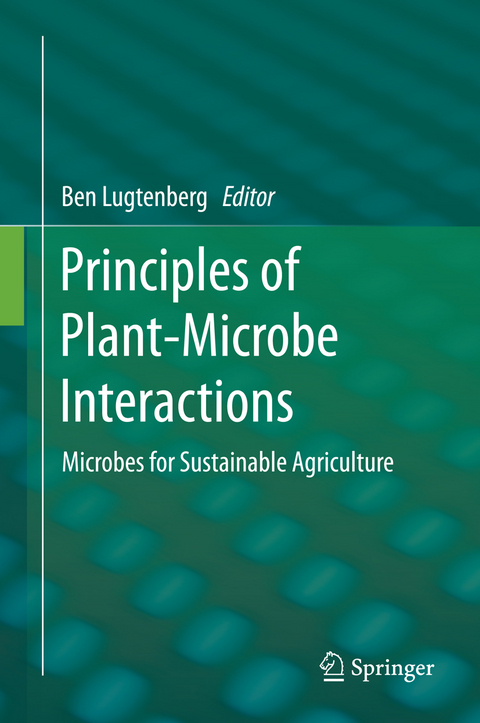
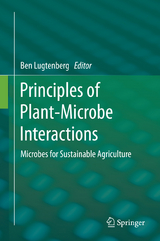
Principles of Plant-Microbe Interactions (eBook)
XXIV, 448 Seiten
Springer International Publishing (Verlag)
978-3-319-08575-3 (ISBN)
Prof. Lugtenberg is well-known expert in his field (beneficial bacteria which kill plant-pathogenic fungi or promote plant growth), appreciated for publication record and editing job, with a significant network. Used to play several important roles within the community, e.g. President of the International Society of Molecular Plant-Microbe Interactions.
Prof. Lugtenberg is well-known expert in his field (beneficial bacteria which kill plant-pathogenic fungi or promote plant growth), appreciated for publication record and editing job, with a significant network. Used to play several important roles within the community, e.g. President of the International Society of Molecular Plant-Microbe Interactions.
1. Introduction to Plant-Microbe Interactions; Ben LugtenbergPart I. Introductory Chapters2. The Importance of Microbiology in Sustainable Agriculture; Thomas Schäfer and Tom Adams3. Life of Microbes in the Rhizosphere; Ben Lugtenberg4. Life of Microbes on Aerial Plant Parts; Johan H.J. Leveau5. Life of Microbes Inside the Plant; Jesús Mercado-Blanco6. Microbial Cell Surfaces and Secretion Systems; Jan Tommassen and Han A.B. Wösten7. Microbial Biofilms and Quorum Sensing; Aurelien Carlier, Gabriella Pessi, and Leo Eberl8. Bacterial Volatiles as Airborne Signals for Plants and Bacteria; Choong-Min RyuPart II. Phytopathogens and Pest Insects9. Phytopathogenic Bacteria; Jan van der Wolf and Solke H. De Boer10. Plant Pathogenic Fungi and Oomycetes; Pierre J.G.M. de Wit11. Phytopathogenic Nematodes; Johannes Helder, Mariëtte Vervoort, Hanny van Megen, Katarzyna Rybarczyk Mydłowska, Casper Quist, Geert Smant, and Jaap Bakker12. Herbivorous Insects - a Threat for Crop Production; Eddy van der Meijden13. Phytopathogenic Viruses; Carmen Büttner, Susanne von Bargen, and Martina Bandte14. Induced Disease Resistance; Corné M.J. Pieterse and Saskia C.M. Van Wees15. Apologies to the Planet – Can we Restore the Damage?; Dulce Eleonora de Oliveira and Marc Van Montagu16. Will the Public ever Accept Genetically Engineered Plants?; Inge BroerPart III. Control of Plant Diseases and Pests using Beneficial Microbes17. Microbial Control of Phytopathogenic Nematodes; Xiaowei Huang, Keqin Zhang, Zefen Yu, and Guohong Li18. Microbial Control of Root-Pathogenic Fungi and Oomycetes; Linda Thomashow and Peter A.H.M. Bakker19. Control of Insect Pests by Entomopathogenic Nematodes; Vladimír Půža20. Bacillus thuringiensis-based Products for Insect Pest Control; Ruud A. de Maagd21. Post Harvest Control; Emilio Montesinos, Jesús Francés, Esther Badosa, and Anna BonaterraPart IV. Plant Growth Promotion by Microbes22. The Nitrogen Cycle; Martine A.R. Kox and Mike S.M. Jetten23. Biological Nitrogen Fixation; Frans J. de Bruijn24. Phosphate Mobilisation by Soil Microorganisms; José-Miguel Barea and, Alan E Richardson25. Arbuscular Mycorrhizas: the Lives of Beneficial Fungi and their Plant Host; Paola Bonfante and Alessandro Desirò26. Plant Hormones Produced by Microbes; Stijn Spaepen27. Stress Control and ACC Deaminase; Bernard R. Glick28. Plant-Microbe Interactions and Water Management in Arid and Saline Soils; Daniele Daffonchio, Heribert Hirt, and Gabriele Berg29. Rhizoremediation; Sofie Thijs and Jaco VangronsveldPart V. Important Technologies30. Microbial Communities in the Rhizosphere Analyzed by Cultivation-independent; DNA-based Methods; Susanne Schreiter, Namis Eltlbany, and Kornelia Smalla31. Visualization of Plant-Microbe Interactions; Massimiliano Cardinale and Gabriele BergPart VI. Products for Plant Growth-promotion and Disease Suppression32. Commercialisation of Microbes: Present Situation and Future Prospects; Willem J. Ravensberg33. Commercialization of Microbes: Manufacturing, Inoculation, Best Practice for Objective Field Testing, and Registration; Faina Kamilova, Yaacov Okon , Sandra de Weert, and Katja Hora34. Towards a New Generation of Commercial Microbial Disease Control and Plant -Growth Promotion Products; Rainer Borriss35. Important Organizations and Companies; Ben LugtenbergPart VII. Paradigms in Plant-Microbe Interactions36. Trichoderma: a Multi-Purpose Tool for Integrated Pest Management; Matteo Lorito and Sheridan L. Woo37. Agrobacterium, the Genetic Engineer; Paul J.J. Hooykaas38. Take-All Decline and Beneficial Pseudomonads; David M. Weller39. The Oomycete Phytophthora infestans, the Irish Potato Famine Pathogenl; Charikleia Schoina and Francine Govers40. , a Plant-Beneficial Bacterium; Rainer Borriss41. Soybean Production in the Americas; Woo-Suk Chang, Hae-In Lee, and Mariangela HungriaPart VIII. Future Prospects and Dreams42. Exploring the Feasibility of Transferring Nitrogen Fixation to Cereal Crops; Muthusubramanian Venkateshwaran43. The Minimal Rhizosphere Microbiome; Jos M. Raaijmakers44. The Edible Plant Microbiome: Importance and Health Issues; Gabriele Berg, Armin Erlacher, Martin Grube45. From Nodulation to Antibiotics; Eva Kondorosi
| Erscheint lt. Verlag | 4.12.2014 |
|---|---|
| Zusatzinfo | XXIV, 448 p. 200 illus., 100 illus. in color. |
| Verlagsort | Cham |
| Sprache | englisch |
| Themenwelt | Naturwissenschaften ► Biologie ► Botanik |
| Naturwissenschaften ► Biologie ► Ökologie / Naturschutz | |
| Technik | |
| Schlagworte | Microbiology • plant pathology • Plant Physiology • Plant sciences |
| ISBN-10 | 3-319-08575-1 / 3319085751 |
| ISBN-13 | 978-3-319-08575-3 / 9783319085753 |
| Informationen gemäß Produktsicherheitsverordnung (GPSR) | |
| Haben Sie eine Frage zum Produkt? |
 PDF (Wasserzeichen)
DRM: Digitales Wasserzeichen
Dieses eBook enthält ein digitales Wasserzeichen und ist damit für Sie personalisiert. Bei einer missbräuchlichen Weitergabe des eBooks an Dritte ist eine Rückverfolgung an die Quelle möglich.
Dateiformat: PDF (Portable Document Format)
Mit einem festen Seitenlayout eignet sich die PDF besonders für Fachbücher mit Spalten, Tabellen und Abbildungen. Eine PDF kann auf fast allen Geräten angezeigt werden, ist aber für kleine Displays (Smartphone, eReader) nur eingeschränkt geeignet.
Systemvoraussetzungen:
PC/Mac: Mit einem PC oder Mac können Sie dieses eBook lesen. Sie benötigen dafür einen PDF-Viewer - z.B. den Adobe Reader oder Adobe Digital Editions.
eReader: Dieses eBook kann mit (fast) allen eBook-Readern gelesen werden. Mit dem amazon-Kindle ist es aber nicht kompatibel.
Smartphone/Tablet: Egal ob Apple oder Android, dieses eBook können Sie lesen. Sie benötigen dafür einen PDF-Viewer - z.B. die kostenlose Adobe Digital Editions-App.
Buying eBooks from abroad
For tax law reasons we can sell eBooks just within Germany and Switzerland. Regrettably we cannot fulfill eBook-orders from other countries.
aus dem Bereich