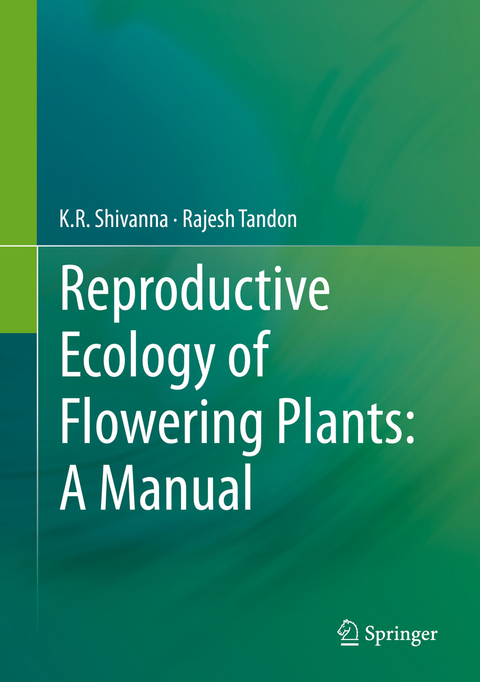
Reproductive Ecology of Flowering Plants: A Manual (eBook)
XV, 170 Seiten
Springer India (Verlag)
978-81-322-2003-9 (ISBN)
Successful reproduction is the basis not only for the stability of the species in their natural habitat but also for productivity of our crop plants. Therefore, knowledge on reproductive ecology of wild and cultivated plants is important for effective management of our dwindling biodiversity and for the sustainability and improvement of the yield in crop species. Conservation and management of our plant diversity is going to be a major challenge in the coming decades, particularly in the tropical countries which are rich in biodiversity. Reproductive failure is the main driver for pushing a large number of tropical species to vulnerable category. Available data on reproductive ecology on tropical species is very limited and there is an urgent need to initiate research on these lines. A major limitation for the beginners to take up research is the absence of simple concise work manuals that provide step-wise procedures to study all aspects of reproductive ecology.
The Manual fills this void. Over 60 protocols described in the manual cover the whole spectrum of reproductive ecology - study sites and species, phenology, floral morphology and sexuality, pollen and pistil biology, pollination ecology, breeding system, seed biology, seed dispersal and seedling recruitment. Each chapter gives a concise conceptual account of the topic before describing the protocols. The Manual caters to researchers, teachers and students who are interested in any aspect of reproductive ecology of flowering plants -- botanists, ecologists, agri-horticulturists, foresters, entomologists, plant breeders and conservation biologists.
K.R. Shivanna, formerly Professor and Head, Department of Botany, University of Delhi is now associated with Ashoka Trust for Research in Ecology and the Environment, Bangalore as INSA Honorary Scientist and Honorary Senior Fellow. He has been doing research on reproductive biology of flowering plants for over 50 years. He has published over 150 original research papers in refereed journals and authored/edited five books on pollen biology and biotechnology. He has worked at the Royal Botanic Gardens, Kew, UK, Welsh Plant Breeding Station, Wales, UK, University of Melbourne, Australia, University of Siena, Italy and University of Saskatchewan, Saskatoon, Canada as a Visiting Scientist/Professor. He is a recipient of many awards including Panchanan Maheshwari Medal, and a Fellow of the Indian National Science Academy, Indian Academy of Sciences, National Academy of Agricultural Sciences and National Academy of Sciences, India. Rajesh Tandon is currently working as Associate Professor at Department of Botany in University of Delhi. He did his Ph.D. in 1998 from the University of Delhi. Since then he has been teaching and conducting research at the Department of Botany, University of Delhi, and his research interests have been plant reproduction, developmental biology and conservation biology. He has published over 30 research papers in reputed international journals and contributed chapters to several books. He is a recipient of Dr Y.S. Murthy Young Scientist Award by the Indian Botanical Society.
Successful reproduction is the basis not only for the stability of the species in their natural habitat but also for productivity of our crop plants. Therefore, knowledge on reproductive ecology of wild and cultivated plants is important for effective management of our dwindling biodiversity and for the sustainability and improvement of the yield in crop species. Conservation and management of our plant diversity is going to be a major challenge in the coming decades, particularly in the tropical countries which are rich in biodiversity. Reproductive failure is the main driver for pushing a large number of tropical species to vulnerable category. Available data on reproductive ecology on tropical species is very limited and there is an urgent need to initiate research on these lines. A major limitation for the beginners to take up research is the absence of simple concise work manuals that provide step-wise procedures to study all aspects of reproductive ecology.The Manual fills this void. Over 60 protocols described in the manual cover the whole spectrum of reproductive ecology - study sites and species, phenology, floral morphology and sexuality, pollen and pistil biology, pollination ecology, breeding system, seed biology, seed dispersal and seedling recruitment. Each chapter gives a concise conceptual account of the topic before describing the protocols. The Manual caters to researchers, teachers and students who are interested in any aspect of reproductive ecology of flowering plants -- botanists, ecologists, agri-horticulturists, foresters, entomologists, plant breeders and conservation biologists.
K.R. Shivanna, formerly Professor and Head, Department of Botany, University of Delhi is now associated with Ashoka Trust for Research in Ecology and the Environment, Bangalore as INSA Honorary Scientist and Honorary Senior Fellow. He has been doing research on reproductive biology of flowering plants for over 50 years. He has published over 150 original research papers in refereed journals and authored/edited five books on pollen biology and biotechnology. He has worked at the Royal Botanic Gardens, Kew, UK, Welsh Plant Breeding Station, Wales, UK, University of Melbourne, Australia, University of Siena, Italy and University of Saskatchewan, Saskatoon, Canada as a Visiting Scientist/Professor. He is a recipient of many awards including Panchanan Maheshwari Medal, and a Fellow of the Indian National Science Academy, Indian Academy of Sciences, National Academy of Agricultural Sciences and National Academy of Sciences, India. Rajesh Tandon is currently working as Associate Professor at Department of Botany in University of Delhi. He did his Ph.D. in 1998 from the University of Delhi. Since then he has been teaching and conducting research at the Department of Botany, University of Delhi, and his research interests have been plant reproduction, developmental biology and conservation biology. He has published over 30 research papers in reputed international journals and contributed chapters to several books. He is a recipient of Dr Y.S. Murthy Young Scientist Award by the Indian Botanical Society.
1. Introduction.- 2. Study Plants and Sites.- 3. Phenology.- 4. Floral Morphology and Sexuality.- 5. Pollen Biology.- 6. Pistil Biology.- 7. Pollination Ecology.- 8. Pollen-Pistil Interaction.- 9. Breeding Systems.- 10. Fruit and Seed Biology.- 11. Seed Dispersal.- 12. Seedling Recruitment.- 13. Appendices.
| Erscheint lt. Verlag | 1.9.2014 |
|---|---|
| Zusatzinfo | XV, 170 p. 23 illus., 18 illus. in color. |
| Verlagsort | New Delhi |
| Sprache | englisch |
| Themenwelt | Naturwissenschaften ► Biologie ► Botanik |
| Technik | |
| Schlagworte | Breeding System • Fruit and Seed Biology • Pollen and Pistil Biology • pollination ecology • Seedling Recruitment |
| ISBN-10 | 81-322-2003-X / 813222003X |
| ISBN-13 | 978-81-322-2003-9 / 9788132220039 |
| Informationen gemäß Produktsicherheitsverordnung (GPSR) | |
| Haben Sie eine Frage zum Produkt? |
 PDF (Wasserzeichen)
Größe: 8,0 MB
DRM: Digitales Wasserzeichen
Dieses eBook enthält ein digitales Wasserzeichen und ist damit für Sie personalisiert. Bei einer missbräuchlichen Weitergabe des eBooks an Dritte ist eine Rückverfolgung an die Quelle möglich.
Dateiformat: PDF (Portable Document Format)
Mit einem festen Seitenlayout eignet sich die PDF besonders für Fachbücher mit Spalten, Tabellen und Abbildungen. Eine PDF kann auf fast allen Geräten angezeigt werden, ist aber für kleine Displays (Smartphone, eReader) nur eingeschränkt geeignet.
Systemvoraussetzungen:
PC/Mac: Mit einem PC oder Mac können Sie dieses eBook lesen. Sie benötigen dafür einen PDF-Viewer - z.B. den Adobe Reader oder Adobe Digital Editions.
eReader: Dieses eBook kann mit (fast) allen eBook-Readern gelesen werden. Mit dem amazon-Kindle ist es aber nicht kompatibel.
Smartphone/Tablet: Egal ob Apple oder Android, dieses eBook können Sie lesen. Sie benötigen dafür einen PDF-Viewer - z.B. die kostenlose Adobe Digital Editions-App.
Buying eBooks from abroad
For tax law reasons we can sell eBooks just within Germany and Switzerland. Regrettably we cannot fulfill eBook-orders from other countries.
aus dem Bereich