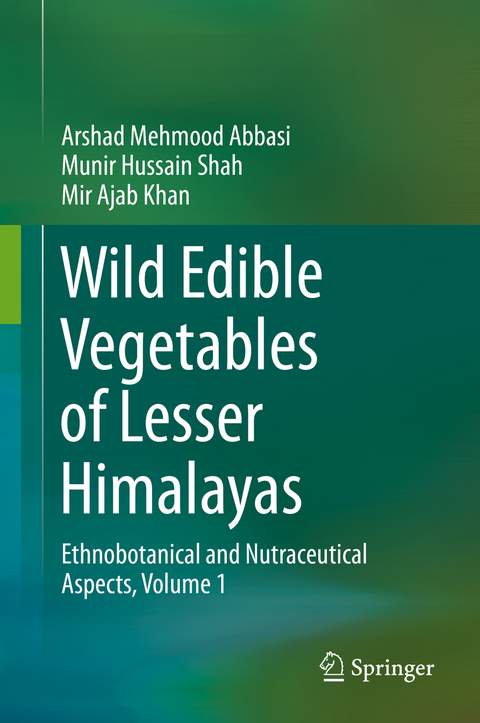
Wild Edible Vegetables of Lesser Himalayas (eBook)
XVII, 360 Seiten
Springer International Publishing (Verlag)
978-3-319-09543-1 (ISBN)
Our intention with this book was to present the reader with the most accurate, significant, and up-to-date background and knowledge in the areas of ethnomedicinal and nutraceutical vegetation for the Lesser Himalayas in a comprehensive text. Wild Edible Vegetables of Lesser Himalayas provides a complete review of over 50 important plants of this region and details each species including photographs, botanical name, local name, family, flowering and fruiting period, status and habitat, parts used, distribution, ethnobotanical uses, cultural aspects, medicinal uses, and nutraceutical aspects. Medicinal uses include mode of preparation, method of application and diseases studied; cultural aspects and index; nutraceutical data provides analysis of fats, proteins, fibers, carbohydrates, ash, moisture content, dry matter, and energy value; elemental analysis includes various essential and toxic metals; phytochemical screening includes total phenolics, flavonoids, flavonols and ascorbic acid, and antioxidant potential in terms of DPPH scavenging activity, hydroxyl radical scavenging activity, H2O2 scavenging activity, Fe2+ chelating activity, ferric reducing antioxidant power, and phosphomolybdenum assay for each species.
Wild Edible Vegetables of Lesser Himalayas is a concise and handy guide for scientists, scholars, and students interested in the study of agriculture, food science, nutraceutical science, bioscience, biodiversity, applied ethnobotany, ethnoecology, and ecology.
1. Arshad Mehmood Abbasi (Ph.D.)
Arshad Mehmood Abbasi is an Assistant Professor of Environmental Sciences at COMSATS Institute of Information Technology, in Abbottabad, Pakistan since 2013. He received his PhD in Plant Sciences with specialization in Ethnobotanical and Nutraceutical aspects of wild edible fruits and vegetables of Lesser Himalayas, Pakistan from Quaid-i-Azam University in Islamabad, Pakistan in 2013. His primary research and professional activities have been in Ethnobotany, Ethnomedicines, Medicinal Plants, Biodiversity, Forest Food Resources, Phytochemistry, Nutraceuticals and Functional Foods. He is the editor of the Journal of Ethnobiology and Ethnomedicines and also authored the book entitled, Medicinal Plant Biodiversity of Lesser Himalayas-Pakistan published by Springer, USA in 2012. He has been the recipient of the Outstanding Research Award in the 'Best Research Paper' category for the years 2010-2011, from the Higher Education Commission of Pakistan.
2. Muhnir H. Shah (Ph.D.)
Munir H. Shah is an Associate Professor of Chemistry at Quaid-i-Azam University in Islamabad, Pakistan since 2004, and also received his PhD in Analytical/Environmental Chemistry in 2007. His primary research and professional activities have been in Hydrogeochemistry, Atmospheric Chemistry, Clinical Chemistry, Toxicological Chemistry and Chemometrics and has published several research articles on these topics. He was the recipient of the 'Young Scientist in Chemistry' award, from the Third World Academy of Sciences in 2010 and the 'Best Young Research Scholar' award, from the Higher Education Commission of Pakistan in 2011.
3. Mir Ajab Khan (Ph.D.)
Mir Ajab Khan is a Professor of Plant Sciences at Quaid-i-Azam University in Islamabad, Pakistan. He received his PhD in Biosystematics from Leicester University, England in 1984. His research and professional activities have been in Biosystematics, Chemotaxonomy, Taxonomy, Palynology, Anatomy, Medicinal Plants, Biofuels and Oil Yielding Plants, Ethnobotany, and Plant Biodiversity. He has published more than 300 research articles in journals of international repute in these areas and also authored a number of national and international books. He is also the recipient of a number of outstanding achievement and research awards by the Higher Education Commission of Pakistan.
1. Arshad Mehmood Abbasi (Ph.D.)Arshad Mehmood Abbasi is an Assistant Professor of Environmental Sciences at COMSATS Institute of Information Technology, in Abbottabad, Pakistan since 2013. He received his PhD in Plant Sciences with specialization in Ethnobotanical and Nutraceutical aspects of wild edible fruits and vegetables of Lesser Himalayas, Pakistan from Quaid-i-Azam University in Islamabad, Pakistan in 2013. His primary research and professional activities have been in Ethnobotany, Ethnomedicines, Medicinal Plants, Biodiversity, Forest Food Resources, Phytochemistry, Nutraceuticals and Functional Foods. He is the editor of the Journal of Ethnobiology and Ethnomedicines and also authored the book entitled, Medicinal Plant Biodiversity of Lesser Himalayas-Pakistan published by Springer, USA in 2012. He has been the recipient of the Outstanding Research Award in the "Best Research Paper" category for the years 2010-2011, from the Higher Education Commission of Pakistan. 2. Muhnir H. Shah (Ph.D.)Munir H. Shah is an Associate Professor of Chemistry at Quaid-i-Azam University in Islamabad, Pakistan since 2004, and also received his PhD in Analytical/Environmental Chemistry in 2007. His primary research and professional activities have been in Hydrogeochemistry, Atmospheric Chemistry, Clinical Chemistry, Toxicological Chemistry and Chemometrics and has published several research articles on these topics. He was the recipient of the "Young Scientist in Chemistry" award, from the Third World Academy of Sciences in 2010 and the "Best Young Research Scholar" award, from the Higher Education Commission of Pakistan in 2011. 3. Mir Ajab Khan (Ph.D.)Mir Ajab Khan is a Professor of Plant Sciences at Quaid-i-Azam University in Islamabad, Pakistan. He received his PhD in Biosystematics from Leicester University, England in 1984. His research and professional activities have been in Biosystematics, Chemotaxonomy, Taxonomy, Palynology, Anatomy, Medicinal Plants, Biofuels and Oil Yielding Plants, Ethnobotany, and Plant Biodiversity. He has published more than 300 research articles in journals of international repute in these areas and also authored a number of national and international books. He is also the recipient of a number of outstanding achievement and research awards by the Higher Education Commission of Pakistan.
Chapter 1PAKISTAN AND PAKISTANI HIMALAYAS Chapter 2ETHNOBOTANY AND ETHNOMEDICINE Chapter 3PHYTOCHEMICALS AND NUTRACEUTICALS Chapter 4ETHNOBOTANICAL ASPECTS OF WILD EDIBLE VEGETABLES Chapter 5NUTRITIONAL CONTENTS OF WILD EDIBLE VEGETABLES Chapter 6METAL LEVELS IN WILD EDIBLE VEGETABLES Chapter 7PHYTOCHEMICAL CONTENTS OF WILD EDIBLE VEGETABLES Chapter 8ANTIOXIDANT PROPERTIES OF WILD EDIBLE VEGETABLES
| Erscheint lt. Verlag | 15.10.2014 |
|---|---|
| Zusatzinfo | XVII, 360 p. 251 illus. in color. |
| Verlagsort | Cham |
| Sprache | englisch |
| Themenwelt | Naturwissenschaften ► Biologie ► Botanik |
| Technik | |
| Schlagworte | Antioxidant activity • Heavy metal concentrations • Himalayas • Medicinal plants • Phytochemical content • systematic botany |
| ISBN-10 | 3-319-09543-9 / 3319095439 |
| ISBN-13 | 978-3-319-09543-1 / 9783319095431 |
| Informationen gemäß Produktsicherheitsverordnung (GPSR) | |
| Haben Sie eine Frage zum Produkt? |
 PDF (Wasserzeichen)
DRM: Digitales Wasserzeichen
Dieses eBook enthält ein digitales Wasserzeichen und ist damit für Sie personalisiert. Bei einer missbräuchlichen Weitergabe des eBooks an Dritte ist eine Rückverfolgung an die Quelle möglich.
Dateiformat: PDF (Portable Document Format)
Mit einem festen Seitenlayout eignet sich die PDF besonders für Fachbücher mit Spalten, Tabellen und Abbildungen. Eine PDF kann auf fast allen Geräten angezeigt werden, ist aber für kleine Displays (Smartphone, eReader) nur eingeschränkt geeignet.
Systemvoraussetzungen:
PC/Mac: Mit einem PC oder Mac können Sie dieses eBook lesen. Sie benötigen dafür einen PDF-Viewer - z.B. den Adobe Reader oder Adobe Digital Editions.
eReader: Dieses eBook kann mit (fast) allen eBook-Readern gelesen werden. Mit dem amazon-Kindle ist es aber nicht kompatibel.
Smartphone/Tablet: Egal ob Apple oder Android, dieses eBook können Sie lesen. Sie benötigen dafür einen PDF-Viewer - z.B. die kostenlose Adobe Digital Editions-App.
Buying eBooks from abroad
For tax law reasons we can sell eBooks just within Germany and Switzerland. Regrettably we cannot fulfill eBook-orders from other countries.
aus dem Bereich