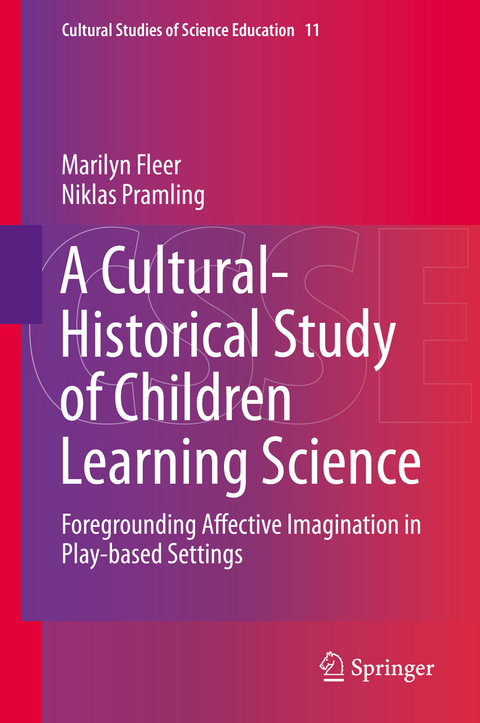
A Cultural-Historical Study of Children Learning Science (eBook)
213 Seiten
Springer Netherland (Verlag)
978-94-017-9370-4 (ISBN)
This book moves beyond the traditional constructivist and social-constructivist view of learning and development in science. It draws upon cultural-historical theory in order to theorise early childhood science education in relation to our currently globalised education contexts. The book argues that concept development in science for young children can be better theorised by using Vygotsky's concept of Imagination and creativity, Vygotsky's theory of play, and his work on higher mental functions, particularly the concept of inter and intrapsychological functioning. Key concepts are extracted from the theoretical section of the book and used as categories for analysis in presenting evidence and new ideas in the second section of the book. In this second part of the book, the authors examine how science knowledge has been constructed within particular countries around the globe, where empirical research in early childhood science education has occurred. The third part of the book examines the nature of the encounter between the teacher and the child during science learning and teaching. In the final part of the book the authors look closely at the range of models and approaches to the teaching of early childhood science that have been made available to early childhood teachers to guide their planning and teaching. They conclude the book with a theoretical discussion of the cultural-historical foundation for early childhood science education, followed by a model of teaching scientific concepts to young children in play-based settings, including homes and community contexts.
Section 1: Theoretical foundations for learning science in early childhood.- Learning science in everyday life – a cultural-historical framework.- How preschools environments afford science learning.- Imagination and its contributions to learning in science.- Theoretical and conceptual insights – the young learner in science.- Section 2: Knowledge construction in science.- Knowledge construction in early childhood science: The human invention of empirical, narrative and theoretical.- Knowledge construction is culturally situated.- Positioning children in research and the implications for our images of their competence.- Section 3: The pedagogical construction of learning science.- Learning and metaphor: Bridging the gap between the familiar and the unfamiliar.- Simile, metaphor and learning to perceive the world in functional and culturally relevant ways.- Learning to ‘read’ and produce graphical representations.- The nature of educational encounters.- Theoretical and conceptual insights – representations in science.- Section 4: Models of early childhood teaching.- A cultural-historical model of early childhood science education.
| Erscheint lt. Verlag | 1.10.2014 |
|---|---|
| Reihe/Serie | Cultural Studies of Science Education | Cultural Studies of Science Education |
| Zusatzinfo | XIX, 213 p. 13 illus., 11 illus. in color. |
| Verlagsort | Dordrecht |
| Sprache | englisch |
| Themenwelt | Geisteswissenschaften ► Psychologie ► Pädagogische Psychologie |
| Naturwissenschaften | |
| Sozialwissenschaften ► Pädagogik ► Erwachsenenbildung | |
| Sozialwissenschaften ► Pädagogik ► Vorschulpädagogik | |
| Schlagworte | Bruner narrative knowledge • Chat • cultural-historical theory • Davydov theoretical knowledge and dialectical thinking • early childhood science education • Learning and Instruction • play-based early childhood education • play-based settings • Slowmation • teaching & learning and developmental psychology • Vygotsky • Vygotsky imagination and play • Vygotsky theory of play |
| ISBN-10 | 94-017-9370-0 / 9401793700 |
| ISBN-13 | 978-94-017-9370-4 / 9789401793704 |
| Informationen gemäß Produktsicherheitsverordnung (GPSR) | |
| Haben Sie eine Frage zum Produkt? |
 PDF (Wasserzeichen)
Größe: 2,8 MB
DRM: Digitales Wasserzeichen
Dieses eBook enthält ein digitales Wasserzeichen und ist damit für Sie personalisiert. Bei einer missbräuchlichen Weitergabe des eBooks an Dritte ist eine Rückverfolgung an die Quelle möglich.
Dateiformat: PDF (Portable Document Format)
Mit einem festen Seitenlayout eignet sich die PDF besonders für Fachbücher mit Spalten, Tabellen und Abbildungen. Eine PDF kann auf fast allen Geräten angezeigt werden, ist aber für kleine Displays (Smartphone, eReader) nur eingeschränkt geeignet.
Systemvoraussetzungen:
PC/Mac: Mit einem PC oder Mac können Sie dieses eBook lesen. Sie benötigen dafür einen PDF-Viewer - z.B. den Adobe Reader oder Adobe Digital Editions.
eReader: Dieses eBook kann mit (fast) allen eBook-Readern gelesen werden. Mit dem amazon-Kindle ist es aber nicht kompatibel.
Smartphone/Tablet: Egal ob Apple oder Android, dieses eBook können Sie lesen. Sie benötigen dafür einen PDF-Viewer - z.B. die kostenlose Adobe Digital Editions-App.
Zusätzliches Feature: Online Lesen
Dieses eBook können Sie zusätzlich zum Download auch online im Webbrowser lesen.
Buying eBooks from abroad
For tax law reasons we can sell eBooks just within Germany and Switzerland. Regrettably we cannot fulfill eBook-orders from other countries.
aus dem Bereich