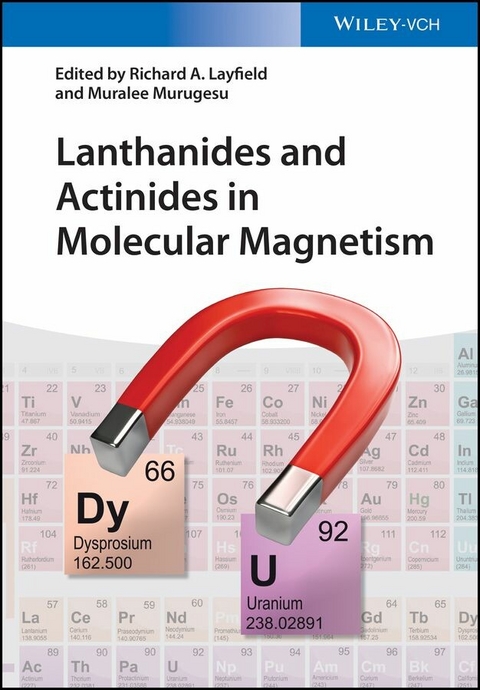
A group of international experts has been carefully selected by the editors to cover all the central aspects, with a focus on molecular species while also including industrial applications.
The resulting unique overview is a must-have for researchers, both in academia and industry, who are entering or already working in the field.
Richard Layfield is a Reader in Inorganic Chemistry at The University of Manchester, UK. He obtained his undergraduate degree in Chemistry at the University of Leeds, UK, and his PhD in Inorganic Chemistry at the University of Cambridge, UK. He has received several awards, including an Alexander von Humboldt Foundation Fellowship for Experienced Researchers, and the Royal Society of Chemistry Meldola Medal and the Sir Edward Frankland Fellowship.
Muralee Murugesu is an Associate Professor at the University of Ottawa, Canada. He studied Chemistry at the University of Paris 7 Jussieu, France. Afterwards he obtained his MSc in Chemistry at the University of East Anglia, UK, and PhD in Chemistry at the University of Karlsruhe, Germany. His first postdoctoral appointment was at University of Florida with Prof. George Christou, followed by a postdoctoral position working jointly between the University of California, Berkeley and the University of California, San Francisco under the supervision of Prof. Jeffrey Long and the Nobel Laureate Prof. Stanley Prusiner.
Richard Layfield is a Reader in Inorganic Chemistry at The University of Manchester, UK. He obtained his undergraduate degree in Chemistry at the University of Leeds, UK, and his PhD in Inorganic Chemistry at the University of Cambridge, UK. He has received several awards, including an Alexander von Humboldt Foundation Fellowship for Experienced Researchers, and the Royal Society of Chemistry Meldola Medal and the Sir Edward Frankland Fellowship. Muralee Murugesu is an Associate Professor at the University of Ottawa, Canada. He studied Chemistry at the University of Paris 7 Jussieu, France. Afterwards he obtained his MSc in Chemistry at the University of East Anglia, UK, and PhD in Chemistry at the University of Karlsruhe, Germany. His first postdoctoral appointment was at University of Florida with Prof. George Christou, followed by a postdoctoral position working jointly between the University of California, Berkeley and the University of California, San Francisco under the supervision of Prof. Jeffrey Long and the Nobel Laureate Prof. Stanley Prusiner.
Preface
ELECTRONIC STRUCTURE AND MAGNETIC PROPERTIES OF LANTHANIDE MOLECULAR COMPLEXES
Introduction
Free Ion Electronic Structure
Electronic Structure of Lanthanide Ions in a Ligand Field
Magnetic Properties of Isolated Lanthanide Ions
Exchange Coupling in Systems Containing Orbitally Degenerate Lanthanides
MONONUCLEAR LANTHANIDE COMPLEXES: USE OF THE CRYSTAL FIELD THEORY TO DESIGN SINGLE-ION MAGNETS AND SPIN QUBITS
Introduction
Modelling the Magnetic Properties of Lanthanide Single-Ion Magnets:TheUse of the Crystal FieldModel
Magneto-Structural Correlations for Some Typical Symmetries
Impact of Lanthanide Complexes in Quantum Computing
Conclusions
POLYNUCLEAR LANTHANIDE SINGLE MOLECULE MAGNETS
Introduction
Synthetic Strategies
Conclusion
LANTHANIDES IN EXTENDED MOLECULAR NETWORKS
Introduction
Extended Networks Based on Gd3+
Extended Networks Based on Anisotropic Ions
Conclusions
EXPERIMENTAL ASPECTS OF LANTHANIDE SINGLE-MOLECULE MAGNET PHYSICS
Introduction
Manifestation of Single-Molecule Magnet Behaviour
Quantifying the Magnetic Anisotropy
Splitting of the Ground Multiplet
Observation of the Signatures of Exchange Coupling
Concluding Remarks and Perspectives
COMPUTATIONAL MODELLING OF THE MAGNETIC PROPERTIES OF LANTHANIDE COMPOUNDS
Introduction
Ab Initio Description of Lanthanides and its Relation to Other Methods
Ab Initio Calculation of Anisotropic Magnetic Properties of Mononuclear Complexes
Ab Initio Calculation of Anisotropic Magnetic Properties of Polynuclear Complexes
Conclusions
LANTHANIDE COMPLEXES AS REALIZATION OF QUBITS AND QUGATES FOR QUANTUM COMPUTING
Introduction to Quantum Computation
Quantum Computing with Electron Spin Qubits
Single Lanthanide Ions as Spin Qubits
Lanthanide Molecules as Prototypes of Two-Qubit Quantum Gates
Conclusions and Outlook
BIS(PHTHALOCYANINATO) LANTHANIDE(III) COMPLEXES - FROM MOLECULAR MAGNETISM TO SPINTRONIC DEVICES
Introduction
Synthesis and Structure of LnPc2 Complexes
Bulk Magnetism of LnPc2 Complexes
Surface Magnetism of LnPc2 Complexes
Molecular Spintronic Devices on the Base of [TbPc2]0 SIMs
Conclusion and Outlook
LANTHANIDES AND THE MAGNETOCALORIC EFFECT
Applications of Magnets
Cold Reasoning
Current Technologies
How Paramagnets Act as Refrigerants
More Parameters
Aims
Important Concepts for a Large Magnetocaloric Effect
High-Performance MCE Materials
Outlook
ACTINIDE SINGLE-MOLECULE MAGNETS
Introduction
Literature Survey of Published Actinide Single-Molecule Magnets
Magnetic Coupling in Actinides
Conclusions
Index
1
Electronic Structure and Magnetic Properties of Lanthanide Molecular Complexes
Lorenzo Sorace and Dante Gatteschi
1.1 Introduction
The first studies on the magnetic and electronic properties of compounds containing lanthanide ions date back to the beginning of the twentieth century [1]. However, detailed investigation on these systems only began in the and helped set up an appropriate theoretical framework for the analysis of their properties [2–5]. Most of the studies reported in the early literature, which involved optical spectroscopy, magnetism, or electron paramagnetic resonance (EPR), were however concerned with inorganic systems in which the lanthanide occupied high symmetry sites, and paramagnetic ions were often doped in diamagnetic host lattices [6, 7].
On the other hand, the number of molecular complexes (which usually show a low point symmetry at the lanthanide site) whose magnetic properties had been well characterized remained quite small even in 1993, when Kahn [8] wrote his landmark book entitled Molecular Magnetism. The field of lanthanide molecular magnetism has indeed really boomed only in the last 15 years, when the availability of powerful theoretical and experimental techniques allowed deep insight into these systems. As a result, some more specific applications of the theory that was developed for inorganic systems to the molecular magnets case were needed. The purpose of this chapter is to describe the fundamental factors affecting the electronic structure of lanthanide complexes, with some specific focus on the symmetry, and the way this is related to their static magnetic properties (dynamic magnetic properties being the focus of a subsequent chapter).
Lanthanide atoms in the electronic ground state are characterized by the progressive filling of 4f shells, with the general configuration (with the exception of La, Ce, Gd, Lu, for which the ground configuration is ). For this reason, the most stable lanthanide ions are the tripositive ones, obtained by loss of the 5d and 6s electrons (notable exceptions are , and , which have stable electronic configurations). In the following, we discuss the paramagnetic properties of rare earth compounds arising from the unpaired 4f electrons: since these are effectively shielded by the completely filled 5s and 5p orbitals, their behaviour is much less affected by the coordination environment of the ion compared to the 3d transition metal series. Consequently, optical spectra consist of very sharp, weak lines due to formally forbidden 4f–4f transitions, while the magnetic properties can, to a first approximation, be expressed as those of a free ion. This means that rare earth ions present an essentially unquenched orbital momentum, since the core-like character of 4f orbitals (compared, e.g. to 3d ones) prevents the crystal field (CF) from quenching the orbital momentum.1 For this reason, in the early days of magnetochemistry, lanthanides were studied as a model of free ions, much more accessible than the paramagnetic gases [9].
The first attempts to rationalize the magnetic properties of rare earth compounds date back to Hund [10], who analysed the magnetic moment observed at room temperature in the framework of the ‘old’ quantum theory, finding a remarkable agreement with predictions, except for and compounds. The inclusion by Laporte [11] of the contribution of excited multiplets for these ions did not provide the correct estimate of the magnetic properties at room temperature, and it was not until Van Vleck [12] introduced second-order effects that agreement could be obtained also for these two ions.
The effect of the coordinating ligands over the magnetic properties of lanthanides becomes important in lowering the temperature, as the ground multiplets are split by an amount comparable to thermal energy: as a consequence, depopulation of the sublevels occurs, and deviation from the Curie law is observed. This, in turn, complicates the interpretation of magnetic properties of systems in which the lanthanide(III) ion interacts with another paramagnetic species. Indeed, effects due to the magnetic exchange are very small – because the unpaired electrons are in the well-shielded f orbitals – and may be hidden by ligand field effects at low temperature. It is, then, of paramount importance to appropriately determine the split components of the lowest lying multiplet and to understand the factors on which this depends.
In the following sections, we start by discussing in some detail the electronic structure of the free ion, following the classic treatment of Wybourne [3], and we successively analyse the effect of the ligand field. The relation between the Stevens' formalism [2], to which the molecular magnetism community is more used, and Wybourne's notation is presented. Indeed, the latter takes more easily into account the effect of the excited multiplets, and its use might facilitate interchange and data comparison with results from luminescence and absorption spectroscopy. The resulting magnetic properties and EPR spectra are discussed, with some examples from more recent literature. Finally, we briefly discuss the way exchange coupling effects are treated in molecular systems containing anisotropic lanthanides.
1.2 Free Ion Electronic Structure
We start our description of the electronic structure of complexes of lanthanides by the analysis of the free ion energy structure. The relevant Hamiltonian is written as
In Equation 1.1, the first term is the sum of hydrogen-like terms for single electrons and the second one is the sum of the single-electron spin–orbit interaction, while the third term contains the interelectronic repulsion. By applying the central field approximation [13], each single electron can be considered as moving in an average, spherically symmetric field due to the nucleus and to the remaining electrons:
This allows separation of the corresponding Schrödinger equation in n independent equations, one for each electron, so that the solution of Equation 1.2 will be a product of functions of the type:
In Equation 1.3, the radial function is defined by the quantum numbers and and the spherical harmonics depend on the quantum numbers and . When the spin of the electron is taken into account, the normalized antisymmetric function is written as a Slater determinant. The corresponding eigenvalues depend only on and of each single electron, which determine the electronic configuration of the system.
The difference between the Hamiltonians (1.1) and (1.2):
can now be treated as a perturbation, the first term of which only causes a global shift of the energies without affecting the relative differences. Both the second and the third terms split each configuration into separate multiplets, since their effect is different for different states of the same configuration.
Within this framework it is assumed that the energy differences between each configuration are much higher than the splitting induced through Equation 1.4, so that each configuration is treated separately. The calculation of the matrix element of is obtained after defining a set of basis states in a specified angular momenta coupling scheme: this corresponds to assigning a different relative importance to the second and third terms of Equation 1.4, that is, respectively the spin–orbit and the interelectronic repulsion interactions. If the former dominates over the latter, the j–j coupling scheme is applied, in which the spin and the angular momenta of each electron are first coupled to provide a global momentum . This is done following the rules of angular momentum addition, so that . After this, the values of each electron are coupled to obtain a global J.
The former scheme is usually applied to heavy atoms, while for rare-earth ions the LS coupling scheme (also known as Russell–Saunders coupling) is normally used. In this approach, interelectronic repulsion is considered to be dominant over spin–orbit coupling. As a consequence, the spins of all the electrons are first coupled together to obtain a global spin , and the same is done with angular momenta . The corresponding matrix elements of the interelectronic repulsion Hamiltonian are then diagonal with respect to S, L, , and are independent of the latter, providing a -fold degenerate set of states. This set of states is called a term, and is characterized by , , S and L quantum numbers (where the first two values are fixed to 4 and 3 for 4f electrons), and the term is indicated by a symbol, with S, P, D, F,…etc. corresponding to …etc. However, terms characterized by the same may appear more than once in a given configuration, so that this set of quantum numbers is not always sufficient to characterize the term unambiguously. For this purpose, Racah introduced the irreducible representations of the groups and , indicated by W and U, respectively [14].
The interelectronic repulsion Hamiltonian also commutes with , so that its matrices are diagonal also with respect to J and , the corresponding eigenvalues being independent of . Since states of are linear combinations of states with the same S, L in the scheme the energy is also...
| Erscheint lt. Verlag | 20.1.2015 |
|---|---|
| Sprache | englisch |
| Themenwelt | Naturwissenschaften ► Chemie ► Anorganische Chemie |
| Technik | |
| Schlagworte | Actinoide • Anorganische Strukturen • Chemie • Chemistry • Inorganic Structures • Lanthanoide • magnetic materials • magnetische Materialien • magnetism • magnetism lanthanides actinides • Magnetismus • Materials Science • Materialwissenschaften • Molekularer Magnetismus • Nanomaterialien • nanomaterials • Nanotechnologie • nanotechnology • Physics • Physik |
| ISBN-10 | 3-527-67349-0 / 3527673490 |
| ISBN-13 | 978-3-527-67349-0 / 9783527673490 |
| Informationen gemäß Produktsicherheitsverordnung (GPSR) | |
| Haben Sie eine Frage zum Produkt? |
 EPUB (Adobe DRM)
Kopierschutz: Adobe-DRM
Adobe-DRM ist ein Kopierschutz, der das eBook vor Mißbrauch schützen soll. Dabei wird das eBook bereits beim Download auf Ihre persönliche Adobe-ID autorisiert. Lesen können Sie das eBook dann nur auf den Geräten, welche ebenfalls auf Ihre Adobe-ID registriert sind.
Details zum Adobe-DRM
Dateiformat: EPUB (Electronic Publication)
EPUB ist ein offener Standard für eBooks und eignet sich besonders zur Darstellung von Belletristik und Sachbüchern. Der Fließtext wird dynamisch an die Display- und Schriftgröße angepasst. Auch für mobile Lesegeräte ist EPUB daher gut geeignet.
Systemvoraussetzungen:
PC/Mac: Mit einem PC oder Mac können Sie dieses eBook lesen. Sie benötigen eine
eReader: Dieses eBook kann mit (fast) allen eBook-Readern gelesen werden. Mit dem amazon-Kindle ist es aber nicht kompatibel.
Smartphone/Tablet: Egal ob Apple oder Android, dieses eBook können Sie lesen. Sie benötigen eine
Geräteliste und zusätzliche Hinweise
Buying eBooks from abroad
For tax law reasons we can sell eBooks just within Germany and Switzerland. Regrettably we cannot fulfill eBook-orders from other countries.
aus dem Bereich