Particle Adhesion and Removal (eBook)
John Wiley & Sons (Verlag)
978-1-118-83154-0 (ISBN)
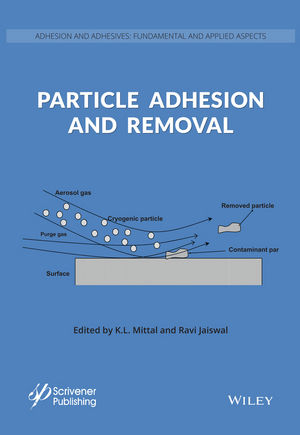
The book provides a comprehensive and easily accessible reference source covering all important aspects of particle adhesion and removal. The core objective is to cover both fundamental and applied aspects of particle adhesion and removal with emphasis on recent developments.
Among the topics to be covered include:
1. Fundamentals of surface forces in particle adhesion and removal.
2. Mechanisms of particle adhesion and removal.
3. Experimental methods (e.g. AFM, SFA,SFM,IFM, etc.) to understand particle-particle and particle-substrate interactions.
4. Mechanics of adhesion of micro- and nanoscale particles.
5. Various factors affecting particle adhesion to a variety of substrates.
6. Surface modification techniques to modulate particle adhesion.
7. Various cleaning methods (both wet & dry) for particle removal.
8. Relevance of particle adhesion in a host of technologies ranging from simple to ultra-sophisticated.
The book provides a comprehensive and easily accessible reference source covering all important aspects of particle adhesion and removal. The core objective is to cover both fundamental and applied aspects of particle adhesion and removal with emphasis on recent developments. Among the topics to be covered include: 1. Fundamentals of surface forces in particle adhesion and removal. 2. Mechanisms of particle adhesion and removal. 3. Experimental methods (e.g. AFM, SFA,SFM,IFM, etc.) to understand particle-particle and particle-substrate interactions. 4. Mechanics of adhesion of micro- and nanoscale particles. 5. Various factors affecting particle adhesion to a variety of substrates. 6. Surface modification techniques to modulate particle adhesion. 7. Various cleaning methods (both wet & dry) for particle removal. 8. Relevance of particle adhesion in a host of technologies ranging from simple to ultra-sophisticated.
Kashmiri Lal Mittal was employed by the IBM Corporation from 1972 through 1993. Currently, he is teaching and consulting worldwide in the broad areas of adhesion as well as surface cleaning. He has received numerous awards and honors including the title of doctor honoris causa from Maria Curie-SkBodowska University, Lublin, Poland. He is the editor of more than 115 books dealing with adhesion measurement, adhesion of polymeric coatings, polymer surfaces, adhesive joints, adhesion promoters, thin films, polyimides, surface modification, surface cleaning, and surfactants. Dr. Mittal is also the Founding Editor of the journal Reviews of Adhesion and Adhesives. Ravi Jaiswal is a chemical engineer and an active researcher in the field of surface and interfacial science. He has authored more than 10 original research publications in the field of particle adhesion and removal. He has delivered more than 10 technical talks in the national and international conferences covering topics relevant to particle adhesion. He is a regular reviewer of the research manuscripts published in the journal of IEEE Transactions on Semiconductor Manufacturing. He has been awarded 'Leighton H. Peebles Award' by The Adhesion Society in 2009 in the recognition to his outstanding graduate research contribution in the field of adhesion science and technology. Ravi completed his bachelor degree in chemical engineering from Indian Institute of Technology (IIT) Kanpur, India in 2004. He graduated with PhD in chemical engineering from Purdue University, W. Lafayette, IN, USA in 2008. He is currently employed at Sun Edison (formerly MEMC Electronic Materials), St. Peters, MO as a research scientist.
Chapter 1
Fundamental Forces in Particle Adhesion
Stephen Beaudoin1, Priyanka Jaiswal2, Aaron Harrison1, Jennifer Laster1, Kathryn Smith1, Melissa Sweat1, and Myles Thomas1
1School of Chemical Engineering, Purdue University, W. Lafayette, IN, USA,
2Department of Applied Chemistry & Polymer Technology, Delhi Technological University (formerly Delhi College of Engineering), New Delhi, India
*Corresponding author: sbeaudoi@purdue.edu
Abstract
van der Waals, capillary, and electrostatic forces acting at the interface between a particle and a surface drive the adhesion behavior of the particles. If one can describe the nature and the strength of these forces as a function of the properties of the two interacting solids and the intervening medium, it is possible to predict and, in many cases, to control particle adhesion. This chapter focuses on the factors that influence the nature and strength of the forces, the fundamental theories that describe them, and the relevant mathematical expressions required to quantify them, with a caveat that the analysis presented is limited to systems with ideal geometry. Specifically, more advanced analysis, which may account for aspects such as roughness, non-uniform shape, deformation, and other complicating aspects, is not treated.
Keywords: Particle adhesion, van der Waals force, Hamaker constant, electrostatic force, double layer, capillary force, surface tension, surface energy.
1.1 Introduction
Particle adhesion influences many areas of science and engineering, including semiconductor fabrication, pharmaceuticals, cosmetics, mining, separations, petroleum production, surface coating, and food processing, to name a few. In the context of this chapter, adhesion is an interfacial phenomenon which appears when two solid bodies, one of which is of colloidal dimensions, approach each other closely. As the two surfaces approach, a complex interplay of van der Waals, electrostatic, and capillary forces drives the resulting behavior. Thorough knowledge of these surface forces is essential to understanding particle adhesion.
1.2 Various Forces in Particle Adhesion
In most applications of practical interest, the forces that control the adhesion between solid particles and solid surfaces are van der Waals (dipole) forces, electrostatic forces, and forces resulting from any liquid bridges due to capillaries or adsorbed molecular water between the two solids. Depending on the composition of the particle, the solid, and the ambient medium (air of varying relative humidity or aqueous solution are of interest here), the relative importance of these may change. This chapter provides an overview of these varying forces.
1.2.1 Capillary Forces
When a solid particle of characteristic dimension on the order of 100 micrometers or smaller is in contact with a solid surface in a gaseous medium (air), the relative humidity (RH) of the air is a critical factor in the relative importance of the forces that will influence the adhesion between the particle and surface [1,2]. Specifically, water molecules in humid air will minimize their free energy by adsorbing on surfaces at low humidity and by condensing onto surfaces at higher humidity, if the surfaces of interest are sufficiently hydrophilic [3–8]. If condensed moisture forms liquid bridges between a particle and a surface, the capillary forces resulting from these liquid bridges will generally be the controlling forces in the particle adhesion [9]. The behavior of adsorbed water molecules has been studied using gravimetric methods, ellipsometry, nuclear magnetic resonance (NMR), atomic force microscopy (AFM) and the surface force apparatus (SFA), among others [3–8, 10–19].
1.2.1.1 Forces Across a Curved Liquid Interface
When a solid surface comes in contact with a liquid medium, the difference in the magnitude of the net cohesive forces between the liquid molecules (i.e., Fl-l), and the net adhesion force between the liquid and the solid molecules (i.e., Fs-l) initiates the formation of a liquid meniscus at the solid/liquid interface. The nature of the curvature of the liquid meniscus (concave or convex) depends on which force, Fs-l (concave) or Fl-l (convex) is dominant. This leads to the phenomenon of wetting or de-wetting of the surface. Figure 1.1 shows an example of a liquid climbing on a solid plate. In this case, Fs-l > Fl-l. Solid surfaces which have Fs-l > Fl-l are known as high energy surfaces. If the liquid is an aqueous solution, these are known as hydrophilic surfaces. If the liquid is non-aqueous, they are known as lyophilic surfaces. Such surfaces facilitate wetting. Mica, silicon dioxide, metals, and oxidized surfaces in general are typically hydrophilic. Solid surfaces in which Fs-l < Fl-l are known as low energy surfaces. If the liquid is an aqueous solution, these are the hydrophobic surfaces. If the liquid is non-aqueous, they are the lyophobic surfaces. They facilitate de-wetting. Most organic surfaces, including most polymers, are hydrophobic. The surface energy of such materials can be increased by surface modifications (e.g., surface oxidation achieved via ultraviolet radiation, plasma discharge, laser irradiation, etc.) to enhance their hydrophilicity [20].
Figure 1.1 Meniscus formation on a solid plate partially immersed in a wetting liquid.
1.2.1.1.1 Surface Tension Force Acting at a Solid/Liquid Interface
The origin of surface tension is the unbalanced intermolecular force acting on the liquid molecules at the surface. The molecules present in the bulk of the liquid experience no net intermolecular force as they are surrounded by molecules of similar properties and hence are in a low energy state. However, the liquid molecules present at a liquid/solid or liquid/air interface are in an unbalanced or high energy state as they experience a net intermolecular force resulting from the difference in properties of the molecules in the different media. This leads to the development of the surface tension force. The surface tension (γ) is quantified as the net surface tension force acting on a unit length of the liquid/solid or liquid/air interface. Figure 1.2 is a schematic of a spherical particle in contact with a solid surface through a liquid medium. The surface tension force, Fst, acting on the solid/liquid boundary (the dotted line) can be obtained as
where α is the angle of inclination of the liquid meniscus from the vertical, and lwetted is the perimeter of the meniscus boundary on the solid surface.
Figure 1.2 Schematic showing surface tension force acting at the solid/liquid interface.
1.2.1.1.2 Capillary Pressure Force Acting Across a Curved Liquid Interface
The micro-/nano-contacts between two solid surfaces act as active sites for condensation in a humid environment if the RH is above a critical value. When condensed moisture comes in contact with the solid surfaces, a liquid meniscus is formed in the contact region bridging the two solid surfaces, as shown in Figure 1.3.
Figure 1.3 A liquid bridge surrounding a solid particle in contact with a flat substrate.
Menisci form through two methods on solid surfaces: the spontaneous condensation of a vapor in a confined space (otherwise known as capillary condensation) and, for non-volatile liquids, the combination of adsorbed layers (on the two adhering surfaces) merged into a meniscus. A meniscus induces a pressure difference across the liquid-vapor interface, as shown in Figure 1.4, where the pressure on the liquid side of the meniscus is lower than that in the surrounding vapor. This pressure difference is described by the Young-Laplace equation
(1.2)
where ΔP is the pressure difference across the meniscus (the Laplace pressure), γl is the surface tension of the liquid condensate, and rn and rp are the two principal radii of curvature (ROC) of the liquid bridge between the surfaces [21]. The Laplace pressure acts over an area, A, and induces a force that pulls the two surfaces together increasing the total adhesion force [9]. The normal surface tension force around the circumference of the meniscus (Equation 1.1) also contributes to the force, but it is usually small compared to the pressure-induced force and is often not considered for micro-scale particles [9].
Figure 1.4 A spherical particle adhering onto a flat substrate with a liquid bridge formed at the solid-solid interface. The meniscus geometry is shown on the right.
The following relations can be obtained for the geometry shown:
(1.3)
where d is the height of the particle inside the liquid bridge, and D is the separation distance, as shown in Figure 1.4, θ1 and θ2 are the contact angles of the liquid with the sphere (1) and the flat substrate (2), and φ is the half angle subtended at the center of the sphere by the wetted area of the sphere (this is also known as the embracing’ or ‘filling’ angle).
The ROC, rn, can also be obtained from the geometry shown in Figure 1.4:
where R is the particle radius. The equilibrium capillary pressure force,...
| Erscheint lt. Verlag | 6.1.2015 |
|---|---|
| Reihe/Serie | Adhesion and Adhesives - Fundamental and Applied Aspects |
| Adhesion and Adhesives - Fundamental and Applied Aspects | Adhesion and Adhesives: Fundamental and Applied Aspects |
| Sprache | englisch |
| Themenwelt | Naturwissenschaften ► Chemie ► Technische Chemie |
| Technik ► Maschinenbau | |
| Schlagworte | Adhesion • beaudoin • Behavior • Chemie • Chemistry • Contact • Dünne Schichten, Oberflächen u. Grenzflächen • Dünne Schichten, Oberflächen u. Grenzflächen • Forces • fundamental • Joining, Welding and Adhesion • Katja • maderarndt • Materials Science • Materialwissenschaften • melissa • Metalle u. Legierungen / Verbinden, SchweiÃen u. Kleben • Metalle u. Legierungen / Verbinden, Schweißen u. Kleben • Microscopic • Models • Oberflächen- u. Kolloidchemie • Oberflächen- u. Kolloidchemie • particle • part particle • References • references mechanics • Stephen • Surface & Colloid Chemistry • surface modified • Thin Films, Surfaces & Interfaces |
| ISBN-10 | 1-118-83154-3 / 1118831543 |
| ISBN-13 | 978-1-118-83154-0 / 9781118831540 |
| Informationen gemäß Produktsicherheitsverordnung (GPSR) | |
| Haben Sie eine Frage zum Produkt? |
 EPUB (Adobe DRM)
Kopierschutz: Adobe-DRM
Adobe-DRM ist ein Kopierschutz, der das eBook vor Mißbrauch schützen soll. Dabei wird das eBook bereits beim Download auf Ihre persönliche Adobe-ID autorisiert. Lesen können Sie das eBook dann nur auf den Geräten, welche ebenfalls auf Ihre Adobe-ID registriert sind.
Details zum Adobe-DRM
Dateiformat: EPUB (Electronic Publication)
EPUB ist ein offener Standard für eBooks und eignet sich besonders zur Darstellung von Belletristik und Sachbüchern. Der Fließtext wird dynamisch an die Display- und Schriftgröße angepasst. Auch für mobile Lesegeräte ist EPUB daher gut geeignet.
Systemvoraussetzungen:
PC/Mac: Mit einem PC oder Mac können Sie dieses eBook lesen. Sie benötigen eine
eReader: Dieses eBook kann mit (fast) allen eBook-Readern gelesen werden. Mit dem amazon-Kindle ist es aber nicht kompatibel.
Smartphone/Tablet: Egal ob Apple oder Android, dieses eBook können Sie lesen. Sie benötigen eine
Geräteliste und zusätzliche Hinweise
Buying eBooks from abroad
For tax law reasons we can sell eBooks just within Germany and Switzerland. Regrettably we cannot fulfill eBook-orders from other countries.
aus dem Bereich