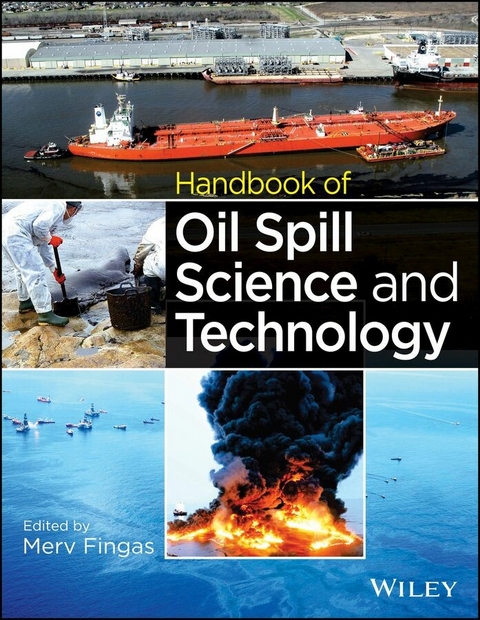
Handbook of Oil Spill Science and Technology (eBook)
John Wiley & Sons (Verlag)
978-1-118-98997-5 (ISBN)
- Enables Non-scientific officers to understand the science they use on a daily basis
- Multi-disciplinary approach covering fields as diverse as biology, microbiology, chemistry, physics, oceanography and toxicology
- Covers the science of oil spills from risk analysis to cleanup and through the effects on the environment
- Includes case studies examining and analyzing spills, such as Tasman Spirit oil spill on the Karachi Coast, and provides lessons to prevent these in the future
Merv Fingas has 40 years of experience in oil and chemical spill research. He has authored over 850 technical publications and papers including books, manuals and over 500 peer-reviewed papers. He has won over 20 awards for research and papers from the United States Government, Canadian Government and international conferences. Dr. Fingas has also collaborated on studies with over 25 organizations around the world, coordinated studies for over 30 years through 6 internationally-attended committees and developed co-operative projects with many international groups.
Provides a scientific basis for the cleanup and for the assessment of oil spills Enables Non-scientific officers to understand the science they use on a daily basis Multi-disciplinary approach covering fields as diverse as biology, microbiology, chemistry, physics, oceanography and toxicology Covers the science of oil spills from risk analysis to cleanup and through the effects on the environment Includes case studies examining and analyzing spills, such as Tasman Spirit oil spill on the Karachi Coast, and provides lessons to prevent these in the future
Merv Fingas has 40 years of experience in oil and chemical spill research. He has authored over 850 technical publications and papers including books, manuals and over 500 peer-reviewed papers. He has won over 20 awards for research and papers from the United States Government, Canadian Government and international conferences. Dr. Fingas has also collaborated on studies with over 25 organizations around the world, coordinated studies for over 30 years through 6 internationally-attended committees and developed co-operative projects with many international groups.
Risk Analysis
1. Risk Analysis and Prevention
Dr. Dagmar Schmidt-Etkin
Oil Properties
2. Oil Physical Properties: Measurement and Correlation
Dr. Bruce Hollebone
Oil Properties and Properties
3 Introduction to Oil Chemistry and Properties
Dr. Merv Fingas
4 Vegetable Oil Spills: Oil Properties and Behaviour
Dr. Merv Fingas
Oil Analysis
5 Chromatographic Fingerprinting Analysis of Crude Oils andPetroleum Products
Dr. Chunn Yang
6 Oil Spill Identification
Dr. Joan Albaiges
Oil Behaviour
7 Oil and Petroleum Evaporation
Dr. Merv Fingas
8 Water-in-Oil Emulsions: Formation andPrediction
Dr. Merv Fingas and Ben Fieldhouse
9 Oil Behaviour in Ice-Infested Waters
Dr. Merv Fingas and Dr. Bruce Hollebone
Modelling
10 Introduction to Spill Modeling
Dr. M Fingas
11 Oceanographic and meteorological effects on spilledoil
Dr. C.J. Beegle-Krause and Dr. Bill Lehr
Detection, tracking and remote sensing
12 Oil Spill Remote Sensing
Dr. Merv Fingas and Dr. Carl Brown
13 Detection, tracking and remote sensing
Drs. K. Topouzelis, D.Tarchi, M. Vespe, O. Muellenhoff, G.Ferraro, and M. Posada
14 Detection of Oil in, with and under Ice and Snow
Dr. Merv Fingas and Dr. Carl Brown
Oil Spills on Land
15 Bioremediation of oil spills on land
Drs. L.D. Brown and Ania Ulrich
16 Microbe-Assisted Phytoremediation of PetroleumImpacted Soil: A Scientifically Proven Green
Technology
Drs. K.E. Gerhardt, P.D. Gerwing, X.D. Huang, and B.M.Greenberg
Effects of Oil
17 Overview of Efforts to Document and Reduce Impacts of OilSpills on Seabirds
Drs. Roger C. Helm, Harry R. Carter, R. Glenn Ford, D. MichaelFry, Roc¡o L. Moreno, Carolina Sanpera, and Flo S. Tseng
18 Overview of Effects of Oil Spills on Marine Mammals
Drs. Roger C. Helm, Daniel P. Costa, Terry D. DeBruyn, Thomas J.O'Shea, Randall S. Wells, and Terrie M. Williams
19 Oil Spill Impact and Recovery of Coastal MarshVegetation
Dr. Qianxin Lin
Natural Dispersion
20 A Review of Natural Dispersion Models
Dr. Merv Fingas
Cold Region Spills
21 Arctic and Antarctic Spills
Drs. D.M. Filler, M.C. Kennicutt II, I. Snape, S.T. Sweet, andA.G. Klein
Case Studies
22 The Prestige Oil Spill
Drs. J. Albaiges, A. Bernabeu, S. Castanedo, N. Jimenez, C. Morales-Caselles, A. Puente, and L.Vinas
23 The Grounding of the Bahia Paraiso, Arthur Harbor,Antarctica. Distribution and Fate of Oil Spill RelatedHydrocarbons
Drs. S.T. Sweet, M.C. Kennicutt, II, and A.G. Klein
24 Tasman Spirit Oil Spill on the Karachi Coast, Pakistan
Hina A. Siddiqi and Alia Bano Munshi
Appendix
25 The Oil Properties Data Appendix
Dr. Bruce Hollebone
26 Conversions
27 Ice Nomenclature
Author Biographies
Dr. Joan Albaigés is Emeritus professor of the Spanish Research Council (CSIC). He established in 1979 at the CSIC (Barcelona), the Department of Environmental Chemistry, where pioneering and internationally well-known research activities on environmental organic chemistry, biogeochemistry of continental and marine waters, and ecotoxicology of organic pollutants started to develop. He spent 10 years as a consultant for the UNEP Regional Seas Program, keeping a personal engagement in promoting marine monitoring programs with developing countries, particularly in Latin America. He was appointed vice-chairman of the Scientific Advisory Committee on the Prestige accident (2002), coordinator of the European Network on Accidental Marine Pollution (Ampera) (2004) and, since 2010, of the ERA-Net “Towards integrated European marine research strategy and programs” (SEAS-ERA), which groups 20 countries. He is also member of the oil spill identification expert group (OSINET) and responsible for the Spanish reference laboratory for oil spill identification. He has contributed over 250 refereed articles to scientific journals, being editor-in-chief of the International Journal of Environmental Analytical Chemistry. Prof. Albaigés has been the recipient of several awards, including the Award for Nature Conservation (Osborne Foundation, 1973), the Award for Mass Spectrometry (Hewlett-Packard, 1986), the Monturiol Award for Science Merit (Government of Catalonia, 1989), and the Spanish Research Award on Coastal and Marine Pollution Studies (2007). He has also been elected member of the European Academy of Sciences and Arts, the Academia Europaea, and the Royal Academy of Sciences and Arts (Spain).
Dr. C.J. Beegle-Krause is an oceanographer interested in finding better answers for the Decision Support questions. Most interested in Lagrangian drift problems, such as oil spills, marine debris, and larval fish modeling, she sees that the greatest need now is to develop new models for oil-in-ice and to leverage new types of analysis, such as Lagrangian coherent structures. Currently, she is a senior researcher at SINTEF in Norway, and previously she was president of Research4D, a small nonprofit in Seattle, WA, and a senior scientist at RPS ASA. Most of her early career was spent in her first position at the NOAA Office of Response and Restoration. She has worked on over 200 spills and was a lead trajectory modeler for the United States during her last 5 years. In 2010, she was recalled to work on the Deepwater Horizon oil spill. Oil spill issues are inherently interdisciplinary, frequently require decisions among trade-offs, and solutions need to be collaborative. She graduated with a B.S. from Caltech in biology, M.S. from University of Alaska Fairbanks in physical oceanography and Ph.D. from the University of Washington in physical oceanography. She also was a member of the U.S. World Cup Team in Fencing.
Dr. Ana Bernabeu is associate professor at the University of Vigo (Spain). She has a Ph.D. on marine science from the University of Cantabria (Spain). Her field of expertise is marine geology and sedimentary dynamics. She has authored about 80 papers (mostly in international journals) and regularly gives presentations and invited talks on these topics in international venues. She has led OILDEBEACH, an important EU effort for the development of an assessment and cleanup protocol of the oil buried in sandy beaches. At present, she is the vice dean for students’ mobility and international liaisons at the Marine Science Faculty in the University of Vigo and Associated Editor in the Journal of Iberian Geology.
Dr. Carl E. Brown is the manager of the Emergencies Science and Technology Section in the Water Science and Technology Directorate of Environment Canada. Dr. Brown has a doctorate degree in physical chemistry from McMaster University and a Bachelor of Technology degree in laboratory science from Ryerson Polytechnical University. Prior to joining Environment Canada, Dr. Brown was a research scientist on Natural Sciences and Engineering Research Council (NSERC) Industrial Fellowship with Intera Information Technologies (now Intermap). Dr. Brown has postdoctoral experience as a research associate with the Organic Reaction Dynamics and the Laser Chemistry Groups at the Steacie Institute for Molecular Sciences, at the National Research Council of Canada, and held a Canadian Government Laboratory Visiting Fellowship in Chemistry, with the Laser Chemistry Group, Division of Chemistry, National Research Council of Canada in Ottawa. His specialities include airborne oil spill sensor development and the application of laser technologies to environmental problems. He has authored over 230 scientific papers and publications. Dr. Brown is the Chemical Science Community of Practise Leader for the Canadian Safety and Security Program (CSSP) led by Defence Research and Development Canada (DRDC) and Public Safety Canada. Dr. Brown is a graduate of the “Government of Canada’s Scientists as Leaders Management Development Program.” He has twice been awarded Environment Canada’s Citation of Excellence in Teamwork, Partnering and Collaboration, in 2010 for the Vancouver Olympic and Paralympic Winter Games Team, and in 2010 for the ESTS Deepwater Horizon Scientific Support Team.
Dr. Lisa D. Brown is an environmental engineer with work experience in reclamation in the Canadian oil sands and in solid waste management, particularly composting. Dr. Brown completed her Ph.D. in geoenvironmental engineering at the University of Alberta, investigating biological treatment options for organic compounds of concern found in oil sands process-affected waters. Dr. Brown is planning to pursue a career in contaminated sites and/or solid waste.
Harry R. Carter is an independent seabird biologist and consultant who has worked widely on the west coast of North America surveying, monitoring, and studying seabird populations, including rare and endangered species. Since the mid-1980s, he has assisted various aspects of work related to oil spills, including injury assessments, determination of population impacts, assessment of survival of rehabilitated birds, and restoration planning and implementation.
Dr. Sonia Castanedo has a Ph.D. in civil engineering. Since 2011, she is associate professor at the University of Cantabria, in the area of hydraulic engineering, and senior researcher at the Environmental Hydraulics Institute (IH Cantabria). To date, her research has focussed primarily on the study of the morphodynamics of estuaries, numerical modeling and hydrodynamic transport of substances (e.g., oil spills and brine), operational oceanography, and coastal hazards assessment. She has been involved in numerous national and international projects and in more than 20 projects for the Spanish ports and coastal administration. She has published more than 20 papers in peer-reviewed international journals.
Dr. Daniel P. Costa is a distinguished professor of ecology and evolutionary biology at the University of California at Santa Cruz (CA, USA) where he focuses on the ecology and physiology of marine mammals and seabirds in almost every habitat from the Galapagos to Antarctica. Dr. Costa conducted some of the earliest studies evaluating the effects of crude oil on sea otters in the laboratory and field and he participated in the damage assessment phase of the 1989 Exxon Valdez and 2010 DeepWater Horizon oil spills.
Dr. Gerhard Dahlmann is senior scientist in section Organic Contaminants of the laboratory of the Federal Maritime and Hydrographic Agency (Bundesamt für Seeschifffahrt und Hydrographie, BSH) in Hamburg, Germany. He has been working in the field of oil spill identification since 1978, when he came from the Institute of Fuel Technique, Clausthal-Zellerfeld, which was closely connected at that time to the Institute of Crude Oil Research, Hannover, in order to establish corresponding analytical techniques in the laboratory. At the beginning of the 1980s, pollution by oil was high in German waters. Patches of oil on beaches were frequently observed. After the analytical method was implemented, and especially after GC/MS was available, cooperation with investigating authorities started. Since then, the number of cases, in which spilled oil had to be compared with oil from suspected sources in the framework of criminal proceedings, decreased from more than 120 to about 10–15 per year. Gerhard Dahlmann has written a first publication about the GC/MS method for forensic investigations in cases of oil pollution in 1985, which was followed by publications about the use of the method in single cases. He was the scientific leader of several bigger national and international projects. Findings of these projects were continuously published. He is/was officially participating in international organizations, such as HELCOM, Bonn-Agreement/OTSOPA, and OSPAR-Offshore Industry Committee. In 2005, he became the convenor of the newly established Oil Spill Identification Network of experts within the Bonn-Agreement (Bonn-OSINET), which has got worldwide acceptance, meanwhile.
Dr. Terry D. DeBruyn has over two decades experience in studying and managing bears and his research and management experience includes all three species of North American bears. Between 2008 and 2013, Dr. DeBruyn served as the Polar Bear Project Leader for the U.S. Fish and Wildlife Service in Alaska. He now works for the U.S. Forest Service as the Ecosystems Team...
| Erscheint lt. Verlag | 29.12.2014 |
|---|---|
| Sprache | englisch |
| Themenwelt | Naturwissenschaften ► Biologie ► Ökologie / Naturschutz |
| Naturwissenschaften ► Geowissenschaften | |
| Technik ► Umwelttechnik / Biotechnologie | |
| Schlagworte | Anorganische Chemie • Chemie • Chemistry • Environmental Chemistry • Environmental Science • Environmental Studies • Inorganic Chemistry • Oil spills, oil spill technology, oil spill science • Umweltchemie • Umweltforschung • Umweltwissenschaften |
| ISBN-10 | 1-118-98997-X / 111898997X |
| ISBN-13 | 978-1-118-98997-5 / 9781118989975 |
| Informationen gemäß Produktsicherheitsverordnung (GPSR) | |
| Haben Sie eine Frage zum Produkt? |
 EPUB (Adobe DRM)
Kopierschutz: Adobe-DRM
Adobe-DRM ist ein Kopierschutz, der das eBook vor Mißbrauch schützen soll. Dabei wird das eBook bereits beim Download auf Ihre persönliche Adobe-ID autorisiert. Lesen können Sie das eBook dann nur auf den Geräten, welche ebenfalls auf Ihre Adobe-ID registriert sind.
Details zum Adobe-DRM
Dateiformat: EPUB (Electronic Publication)
EPUB ist ein offener Standard für eBooks und eignet sich besonders zur Darstellung von Belletristik und Sachbüchern. Der Fließtext wird dynamisch an die Display- und Schriftgröße angepasst. Auch für mobile Lesegeräte ist EPUB daher gut geeignet.
Systemvoraussetzungen:
PC/Mac: Mit einem PC oder Mac können Sie dieses eBook lesen. Sie benötigen eine
eReader: Dieses eBook kann mit (fast) allen eBook-Readern gelesen werden. Mit dem amazon-Kindle ist es aber nicht kompatibel.
Smartphone/Tablet: Egal ob Apple oder Android, dieses eBook können Sie lesen. Sie benötigen eine
Geräteliste und zusätzliche Hinweise
Buying eBooks from abroad
For tax law reasons we can sell eBooks just within Germany and Switzerland. Regrettably we cannot fulfill eBook-orders from other countries.
aus dem Bereich