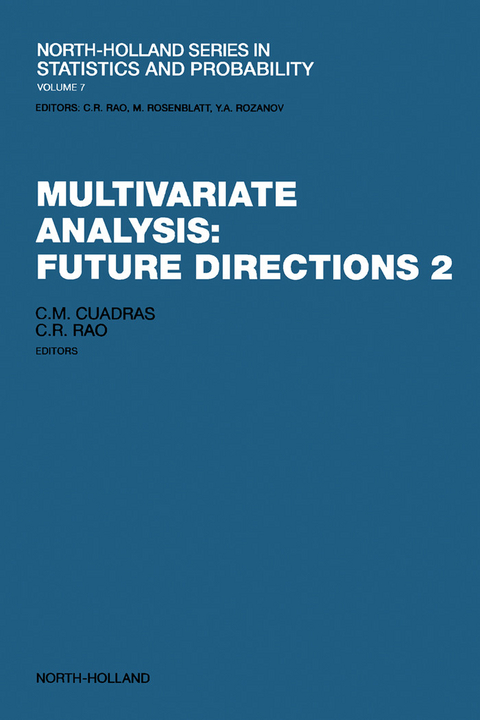
Multivariate Analysis: Future Directions 2 (eBook)
494 Seiten
Elsevier Science (Verlag)
978-1-4832-9756-9 (ISBN)
The contributions in this volume, made by distinguished statisticians in several frontier areas of research in multivariate analysis, cover a broad field and indicate future directions of research. The topics covered include discriminant analysis, multidimensional scaling, categorical data analysis, correspondence analysis and biplots, association analysis, latent variable models, bootstrap distributions, differential geometry applications and others. Most of the papers propose generalizations or new applications of multivariate analysis.This volume will be of great interest to statisticians, probabilists, data analysts and scientists working in the disciplines such as biology, biometry, ecology, medicine, econometry, psychometry and marketing. It will be a valuable guide to professors, researchers and graduate students seeking new and promising lines of statistical research.
Front Cover
1
Multivariate Analysis: Future Directions 2 4
Copyright Page 5
Dedication 6
Preface 8
Table of Contents 10
List of contributors 14
PART 1: Discriminant analysis and scaling 18
Chapter 1. Discriminant analysis for mixed variables: Integrating trees and regression models 20
Abstract 20
1. Introduction 20
2. The RECPAM approach in general 22
3. RECPAM and the multivariate model 25
4. Direct applications 27
5. Discriminant analysis with variables of mixed type 32
6. An example 34
7. Summary and conclusion 35
References 38
Chapter 2. A strong Lagrangian look at profile log likelihood with applications to linear discrimination 40
Abstract 40
1. Introduction 40
2. An example 43
3. Preliminaries 44
4. Relaxation of condition (4) 48
5. Removal of condition (4) 50
6. Application to linear discrimination 52
7. Examples 55
8. Further work 56
9. Appendix 58
References 61
Chapter 3. Continuous metric scaling and prediction 64
Abstract 64
1. Introduction 64
2. Discrete metric scaling 66
3. Distance-based prediction 72
4. Continuous metric scaling 74
5. Continuous prediction 78
6. Conclusions 81
References 81
Chapter 4. A comparison of techniques for finding components with simple structure 84
Abstract 84
Introduction 84
1. Theoretical comparison of techniques for finding simply structuredcomponents 86
2. Empirical comparison of techniques for finding simply structuredcomponents 90
3. Analysis of an empirical data set 100
4. Discussion 101
References 103
Chapter 5. Antedependence modelling in discriminant analysis of high-dimensional spectroscopic data 104
Abstract 104
1. Introduction 104
2. Antedependence modelling 106
3. Computer Implementation 108
4. Applications and comparisons 109
5. Conclusion 111
Acknowledgement 111
References 111
Chapter 6. On scaling of ordinal categorical data 114
Abstract 114
1. Introduction 114
2. Comparison of treatments: ANOVA techniques 116
3. Scaling of categories in a multidimensional contingency table 124
4. Scaling of ordinal categories in a mixed set-up 125
5. Acknowledgement 126
6. Appendix 126
References 126
PART 2: Latent variable models 128
Chapter 7. Instrumental variable estimation for nonlinear factor analysis 130
Abstract 130
1. Introduction 130
2. Identification 132
3. Instrumental variable estimation 134
4. A numerical example 142
5. Derivations 143
References 145
Chapter 8. The analysis of panel data with mean andcovariance structure models for non-metricdependent variables 148
1. Specification and estimation of mean and covariance structures fornon-metric variables 148
2. Models for non-metric panel data 153
3. A state dependence model for employment status 161
References 167
Chapter 9. The geometry of mean or covariance structuremodels in multivariate normal distributions:A unified approach 170
Abstract 170
1. Introduction 170
2. Review and notation 171
3. Regression model 173
4. Covariance structure model 176
5. Discussion 186
References 186
Chapter 10. Structured latent curve models 188
Abstract 188
1. Introduction 188
2. The latent curve model 189
3. Characteristics of the data 190
4. Development of structured latent curve models 193
5. Specific structured latent curve models 195
6. Effect of reparametrization 199
7. Joint model for trials and concomitant variables 201
8. Fitting the model 203
9. Application 205
10. Robustness considerations 210
11. Acknowledgement 212
References 212
Chapter 11. Latent variable modeling of growth with missing dataand multilevel data 216
Abstract 216
1. Introduction 216
2. A general latent variable framework 217
3. A motivating example 218
4. Modeling of individual differences in growth 219
5. Modeling of missing data 221
6. Modeling of multilevel data 223
7. Discussion 226
References 226
Chapter 12. Asymptotic robust inferences in multi-sampleanalysis of augmented-moment structures 228
Abstract 228
1. Introduction 228
2. Multi-sample analysis of second-order moment structures: asymptotictheory 230
3. Asymptotic robustness 237
4. Illustration 241
References 244
PART 3: Correspondence analysis and relatedtopics 248
Chapter 13. Multiple Correspondence Analysis on panel data 250
Abstract 250
1. Introduction 250
2. The panel data 251
3. Analysis by concatenation of tables 252
4. Analysis of the average table 254
5. Analysis of the tendency 255
6. Local Multiple Correspondence Analysis 255
7. LMCA to panel data 258
8. Equivalence with Conditional Multiple Correspondence Analysis 259
References 261
Chapter 14. Analysing dependence in largecontingency tables: Dimensionality and patternsin scatter-plots 262
Abstract 262
1. Introduction 262
2. Models 263
3. Estimation 266
4. Biplots 268
5. Example 269
6. Latent normal distribution and association models 272
7. Latent normal distribution and correlation models 274
References 278
Chapter 15. Correspondence analysis, association analysis, andgeneralized nonindependence analysis of contingencytables: Saturated and unsaturated models, andappropriate graphical displays 282
Abstract 282
1. Introduction and summary 283
2. Correspondence analysis 284
3. Unweighted and weighted association analysis 286
4. Generalized nonindependence analysis 289
5. Graphical displays 296
6. Saturated models and unsaturated models 307
Appendix 309
References 310
Chapter 16. Recent advances in biplot methodology 312
Abstract 312
1. Introduction 312
2. The geometry of linear biplots 317
3. Non-linear biplots 324
4. Generalised biplots and categorical variables 330
5. Relationship of non-linear to generalised biplots 334
6. Conclusion 335
Appendix. Derivation of algebraic formulae and other results forback-projection 337
References 341
Chapter 17. Multivariate generalisations of correspondenceanalysis 344
Abstract 344
1. Introduction 344
2. Simple correspondence analysis 345
3. CA of concatenated tables 347
4. CA of super-indicator matrix and Burt matrix 349
5. CA of modified Burt matrices 350
6. CA of Burt matrix with diagonal matrices missing 351
7. Rescaled MCA 352
8. An example 354
9. Discussion and conclusion 356
References 356
Chapter 18. Correspondence analysis and classification 358
1. Introduction 358
2. Some links between the two approaches 359
3. Eigenvalues and indices 365
4. Some hybrid methods 369
5. Complementarity from a practical point of view 371
References 372
Chapter 19. Some generalizations of correspondence analysis 376
Abstract 376
1. Introduction 376
2. Formalism 378
3. Linearizing the regressions 379
4. Maximizing the correlation 380
5. More than two variables 381
6. Strained multinomials 382
7. Some questions 383
8. LPV diagonalization 383
9. Functions of correlation coefficients 386
10. Consequences of bi-linearizability 387
11. Model oriented approach 388
12. Two-step techniques 388
References 390
PART 4: Differential geometry applications 394
Chapter 20. Differential geometry of estimating functions 396
Abstract 396
1. Estimating functions 396
2. Decomposition of tangent bundles 397
3. Answers to fundamental questions 398
References 400
Chapter 21. Statistical inference and differential geometry —Some recent developments 402
Abstract 402
1. Introduction 402
2. An adjusted profile likelihood and embedding curvature 404
3. Yokes and symplectic geometry 407
4. Orthogeodesic models 411
References 412
Chapter 22. Random variables, integral curves and estimation of probabilities 414
Abstract 414
1. Introduction 414
2. Random variables and integral curves 415
3. Modification of probabilities 417
4. Density functions 421
5. Acknowledgement 422
References 422
Chapter 23. Sufficient geometrical conditions for Cramer-Raoinequality 424
Abstract 424
1. Introduction 424
2. Frechet differentiability on Lebesgue spaces 425
3. Regular models 428
4. The mean value theorem 431
5. The Cramer-Rao inequality 434
References 437
Chapter 24. On an intrinsic analysis of statistical estimation 438
Abstract 438
1. Introduction 438
2. The Riemannian geometry of statistical models 444
3. Lower bound of mean square Rao distance for intrinsically unbiasedestimators 447
4. Conditional mean values of manifold valued random objects 449
5. Global estimator efficiency 450
6. Discussion 452
References 453
PART 5: Bootstrap, conditional models anddivergences 456
Chapter 25. Conditionally specified models: Structure andinference 458
Abstract 458
1. Conditionally specified models 458
2. Alternative conditional specification paradigms 462
3. Parameter estimation in unconditionally specified models 465
4. Multivariate extensions 466
References 467
Chapter 26. Multivariate analysis in the computer age 468
Abstract 468
1. Introduction 468
2. Bootstrap methods 469
3. BCa intervals 471
4. ABC intervals 474
5. Calibration 477
6. Missing data 481
7. Bayes and likelihood calculations 484
8. Appendix 487
References 487
Chapter 27. Chapter New parametric measures of information based ongeneralized ^-divergences 490
Abstract 490
1. Introduction 490
2. Information matrices associated to parameter perturbance 492
3. Information matrices associated to differential metrics 496
4. Parametric measures of information 499
5. Asymptotic distribution 501
References 504
| Erscheint lt. Verlag | 21.5.2014 |
|---|---|
| Sprache | englisch |
| Themenwelt | Mathematik / Informatik ► Mathematik ► Algebra |
| Mathematik / Informatik ► Mathematik ► Angewandte Mathematik | |
| Mathematik / Informatik ► Mathematik ► Statistik | |
| Naturwissenschaften | |
| Technik | |
| ISBN-10 | 1-4832-9756-X / 148329756X |
| ISBN-13 | 978-1-4832-9756-9 / 9781483297569 |
| Informationen gemäß Produktsicherheitsverordnung (GPSR) | |
| Haben Sie eine Frage zum Produkt? |
 PDF (Adobe DRM)
Kopierschutz: Adobe-DRM
Adobe-DRM ist ein Kopierschutz, der das eBook vor Mißbrauch schützen soll. Dabei wird das eBook bereits beim Download auf Ihre persönliche Adobe-ID autorisiert. Lesen können Sie das eBook dann nur auf den Geräten, welche ebenfalls auf Ihre Adobe-ID registriert sind.
Details zum Adobe-DRM
Dateiformat: PDF (Portable Document Format)
Mit einem festen Seitenlayout eignet sich die PDF besonders für Fachbücher mit Spalten, Tabellen und Abbildungen. Eine PDF kann auf fast allen Geräten angezeigt werden, ist aber für kleine Displays (Smartphone, eReader) nur eingeschränkt geeignet.
Systemvoraussetzungen:
PC/Mac: Mit einem PC oder Mac können Sie dieses eBook lesen. Sie benötigen eine
eReader: Dieses eBook kann mit (fast) allen eBook-Readern gelesen werden. Mit dem amazon-Kindle ist es aber nicht kompatibel.
Smartphone/Tablet: Egal ob Apple oder Android, dieses eBook können Sie lesen. Sie benötigen eine
Geräteliste und zusätzliche Hinweise
Buying eBooks from abroad
For tax law reasons we can sell eBooks just within Germany and Switzerland. Regrettably we cannot fulfill eBook-orders from other countries.
aus dem Bereich