Process Analytical Technology for the Food Industry (eBook)
VIII, 301 Seiten
Springer New York (Verlag)
978-1-4939-0311-5 (ISBN)
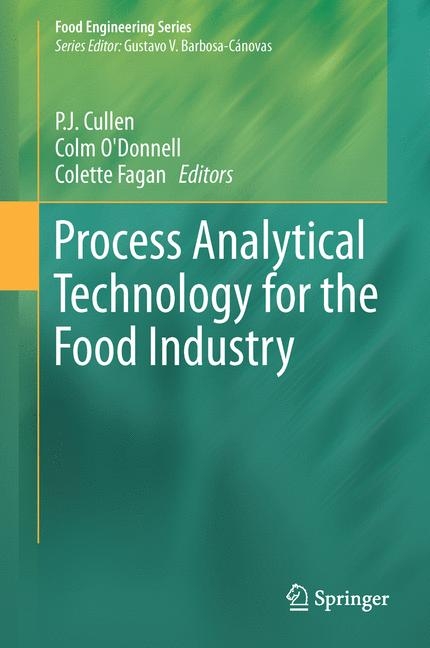
Recently, there have been significant advances in process sensors and in model-based monitoring and control methodologies, leading to enormous opportunities for improved performance of food manufacturing processes and for the quality of food products with the adoption of PAT. Improvements in process efficiency, reduced product variability, enhanced traceability, process understanding, and decreased risk of contamination are some of the benefits arising from the introduction of a PAT strategy in the food industry.
Process Analytical Technology for the Food Industry reviews established and emerging PAT tools with potential application within the food processing industry. The book will also serve as a reference for industry, researchers, educators, and students by providing a comprehensive insight into the objectives, challenges, and benefits of adopting a Process Analytical Technology strategy in the food industry.
Dr PJ Cullen lectures and co-ordinates process engineering research in Dublin Institute of Technology. His current research interests include the development of novel hyperspectral, multipoint and 3D imaging systems for process control. He initiated the 'Food Quality, Safety & Analysis' sessions at IFPAC the world's leading PAT conference and has served on its organising committee since. He has published over 100 journal papers & book chapters.
Professor Colm O'Donnell is Vice Principal of Teaching & Learning in the UCD College of Engineering and Architecture where he leads a research team working on a range of Process Analytical Technology and Novel Processing Technology research projects in the School of Biosystems Engineering. He has published widely in the area of process analytical technology for dairy processing and holds two patents in this area. He is Editor of the International Journal of Food Properties and an Associate Editor (Food Engineering) of Transactions of the American Society of Agricultural and Biological Engineers.
Dr Colette Fagan is a Lecturer in Food Processing Science and Director of the Food Processing Centre at the University of Reading. Her research focuses on Process Analytical Technology and in particular its application to dairy processing. She has published over 40 journal papers & book chapters and holds two patents for novel sensing technologies used in the control of dairy processing.
The Process Analytical Technology (PAT) initiative aims to move from a paradigm of 'testing quality in' to 'building quality in by design'. It can be defined as the optimal application of process analytical technologies, feedback process control strategies, information management tools, and/or product-process optimization strategies.Recently, there have been significant advances in process sensors and in model-based monitoring and control methodologies, leading to enormous opportunities for improved performance of food manufacturing processes and for the quality of food products with the adoption of PAT. Improvements in process efficiency, reduced product variability, enhanced traceability, process understanding, and decreased risk of contamination are some of the benefits arising from the introduction of a PAT strategy in the food industry.Process Analytical Technology for the Food Industry reviews established and emerging PAT tools with potential application within the food processing industry. The book will also serve as a reference for industry, researchers, educators, and students by providing a comprehensive insight into the objectives, challenges, and benefits of adopting a Process Analytical Technology strategy in the food industry.
Dr PJ Cullen lectures and co-ordinates process engineering research in Dublin Institute of Technology. His current research interests include the development of novel hyperspectral, multipoint and 3D imaging systems for process control. He initiated the “Food Quality, Safety & Analysis” sessions at IFPAC the world’s leading PAT conference and has served on its organising committee since. He has published over 100 journal papers & book chapters.Professor Colm O'Donnell is Vice Principal of Teaching & Learning in the UCD College of Engineering and Architecture where he leads a research team working on a range of Process Analytical Technology and Novel Processing Technology research projects in the School of Biosystems Engineering. He has published widely in the area of process analytical technology for dairy processing and holds two patents in this area. He is Editor of the International Journal of Food Properties and an Associate Editor (Food Engineering) of Transactions of the American Society of Agricultural and Biological Engineers.Dr Colette Fagan is a Lecturer in Food Processing Science and Director of the Food Processing Centre at the University of Reading. Her research focuses on Process Analytical Technology and in particular its application to dairy processing. She has published over 40 journal papers & book chapters and holds two patents for novel sensing technologies used in the control of dairy processing.
Benefits and challenges of adopting PAT for the food industry.- Multivariate Data Analysis (Chemometrics).- Management Systems.- Infrared spectroscopy.- Raman Spectroscopy.- Magnetic Resonance Imaging and Nuclear Magnetic Resonance Spectroscopy.- Computer vision.- Thermal imaging.- Hyperspectral Imaging.- Diagnostic ultrasound.- Emerging PAT technologies.- Food industry perspectives on the implementation of a PAT strategy.
| Erscheint lt. Verlag | 3.11.2014 |
|---|---|
| Reihe/Serie | Food Engineering Series | Food Engineering Series |
| Zusatzinfo | VIII, 301 p. 107 illus., 45 illus. in color. |
| Verlagsort | New York |
| Sprache | englisch |
| Themenwelt | Naturwissenschaften ► Chemie |
| Technik ► Lebensmitteltechnologie | |
| ISBN-10 | 1-4939-0311-X / 149390311X |
| ISBN-13 | 978-1-4939-0311-5 / 9781493903115 |
| Informationen gemäß Produktsicherheitsverordnung (GPSR) | |
| Haben Sie eine Frage zum Produkt? |
 PDF (Wasserzeichen)
DRM: Digitales Wasserzeichen
Dieses eBook enthält ein digitales Wasserzeichen und ist damit für Sie personalisiert. Bei einer missbräuchlichen Weitergabe des eBooks an Dritte ist eine Rückverfolgung an die Quelle möglich.
Dateiformat: PDF (Portable Document Format)
Mit einem festen Seitenlayout eignet sich die PDF besonders für Fachbücher mit Spalten, Tabellen und Abbildungen. Eine PDF kann auf fast allen Geräten angezeigt werden, ist aber für kleine Displays (Smartphone, eReader) nur eingeschränkt geeignet.
Systemvoraussetzungen:
PC/Mac: Mit einem PC oder Mac können Sie dieses eBook lesen. Sie benötigen dafür einen PDF-Viewer - z.B. den Adobe Reader oder Adobe Digital Editions.
eReader: Dieses eBook kann mit (fast) allen eBook-Readern gelesen werden. Mit dem amazon-Kindle ist es aber nicht kompatibel.
Smartphone/Tablet: Egal ob Apple oder Android, dieses eBook können Sie lesen. Sie benötigen dafür einen PDF-Viewer - z.B. die kostenlose Adobe Digital Editions-App.
Buying eBooks from abroad
For tax law reasons we can sell eBooks just within Germany and Switzerland. Regrettably we cannot fulfill eBook-orders from other countries.
aus dem Bereich