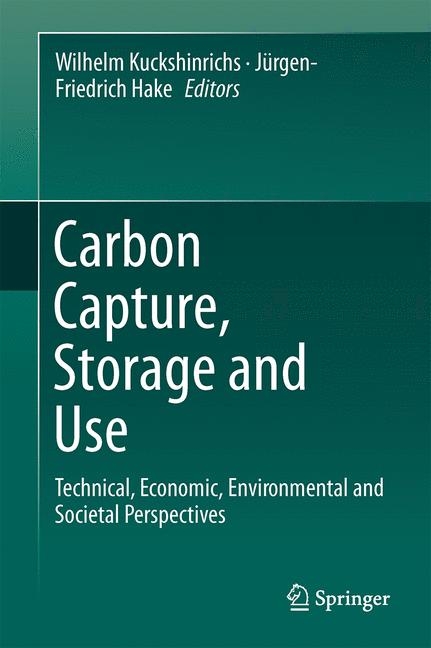
Carbon Capture, Storage and Use (eBook)
XVII, 347 Seiten
Springer International Publishing (Verlag)
9783319119434 (ISBN)
Preface 6
Contents 8
List of Figures 10
List of Tables 14
Contributors 16
Chapter 1: Carbon Capture and Utilization as an Option for Climate Change Mitigation: Integrated Technology Assessment 19
1.1 CCS as an Option for Climate Change Mitigation and CO2 for Industrial Application 19
1.2 Methodological Approach of an Integrated Technology Assessment for CCS and Structure of the Study 22
1.2.1 Technical Potential, RandD Work, and Degree of Technical Maturity 23
1.2.2 Application in Science and Industry 24
1.2.3 Framework for Energy and Climate Policy 25
1.3 Energy and Industrial Policy Implications from a German Perspective 25
References 26
Part I: Technologies: Status and RandD Prospects 28
Chapter 2: Carbon Capture Technologies 29
2.1 Introduction 29
2.2 Carbon Capture Technologies for Use in Coal-Fired Power Plants 31
2.2.1 Post-combustion Processes 32
2.2.1.1 State of the Art 32
2.2.1.2 Efficiency Losses 33
2.2.1.3 Advantages and Disadvantages of Post-combustion Processes 34
2.2.1.4 Second-Generation Post-combustion Processes 34
2.2.2 Oxyfuel Processes 35
2.2.2.1 State of the Art 35
2.2.2.2 Efficiency Losses 36
2.2.2.3 Advantages and Disadvantages of Cryogenic Oxyfuel Processes 37
2.2.2.4 Second-Generation Oxyfuel Processes 37
2.2.3 Pre-combustion Processes 38
2.2.3.1 State of the Art 38
2.2.3.2 Efficiency Losses 39
2.2.3.3 Advantages and Disadvantages of Pre-combustion Processes 39
2.2.3.4 Second-Generation Pre-combustion Processes 40
2.3 Future Framework Conditions and Requirements for the Implementation of Power Plants with Carbon Capture 40
2.3.1 Flexibility of Power Plants 41
2.3.1.1 Post-combustion Processes 42
2.3.1.2 Oxyfuel Processes 43
2.3.1.3 Pre-combustion Processes 43
2.3.2 Retrofitting the Existing Power Plant Fleet 44
2.3.2.1 Excursus: Germany 45
2.3.2.2 Suitability of Carbon Capture Technologies for Retrofitting 45
2.3.2.3 Oxyfuel Processes 46
2.3.2.4 Post-combustion Processes 46
2.4 Carbon Capture Processes for Industrial Applications 47
2.4.1 Steel and Iron Production 50
2.4.2 Cement and Clinker Production 51
2.4.3 Refineries 52
2.4.4 Ammonia Synthesis 53
2.4.5 Ethylene Oxide Production 53
2.4.6 Excursus: Carbon Capture During Biogas Treatment 54
2.5 Summary and Conclusions 56
References 57
Chapter 3: CO2 Transportation 62
3.1 Introduction 63
3.2 Current Situation 63
3.3 Purity Level and Quality Criteria 66
3.4 Risks of CO2 Transportation 69
3.4.1 Dangers of CO2 69
3.4.2 Hazard Potential 70
3.4.3 Operational Experience 70
3.4.4 Measures Minimizing Risks 72
3.4.5 Evaluation of Transportation Risks 72
3.4.6 Estimation of Risk Zones 73
3.4.7 Categorization of Technical Risks 75
3.4.8 Uncertainties in the Assessment 77
3.5 Summary and Conclusions 78
References 79
Chapter 4: Opportunities for Utilizing and Recycling CO2 81
4.1 Motivation and Background 81
4.2 Evaluation Framework and Criteria 82
4.2.1 Potential for the Material Utilization and Recycling of CO2 82
4.2.2 Sources and Purity of CO2 84
4.2.3 Evaluation Criteria for CO2-Utilization 84
4.3 Organochemical Utilization of CO2 85
4.3.1 Applications 86
4.3.1.1 Urea 86
4.3.1.2 Methanol 87
4.3.1.3 Salicylic Acid and p-Hydroxybenzoic Acid 89
4.3.1.4 Formic Acid 89
4.3.1.5 Cyclic Carbonates 90
4.3.1.6 Dimethyl Carbonate 91
4.3.1.7 Polymers (Copolymerization of Reactive Monomers with CO2) 91
4.3.1.8 Further Polymer Building Blocks 92
4.3.1.9 Pharmaceuticals and Fine Chemicals 92
4.3.2 Outlook 93
4.4 Inorganic Substances 94
4.4.1 Calcite 94
4.4.2 Hydrotalcite 94
4.4.3 Other Application Areas 95
4.5 Physical Utilization 95
4.5.1 Enhanced Oil Recovery/Enhanced Gas Recovery 95
4.5.2 Enhanced Coal Bed Methane (ECBM) 96
4.5.3 Methods for the Reversible Adsorption of CO2 96
4.5.4 Application in the Beverage and Food Industry 97
4.5.5 Cleaning Agents and Extractants 98
4.5.6 Use as an Impregnating Agent 98
4.5.7 Inert Gas 99
4.5.8 Potential as a Solvent and Replacement of Volatile Organic Compounds 99
4.6 Evaluation of Especially Innovative Solution Approaches 100
4.6.1 Material CO2-Utilization and Innovative Products 100
4.6.1.1 Polymers from Technically Fixated CO2 (Duromers, Polycarbonates, Polycondensates) 100
4.6.1.2 Fine Chemicals 102
4.6.1.3 Production of Methanol by Direct Hydrogenation of CO2 103
4.6.1.4 Oxalic Acid 103
4.6.2 Innovative Technologies for Material CO2-Utilization 103
4.6.2.1 Polymers from CO2 104
4.6.2.2 CO2-Hydrogenation 104
4.6.2.3 Electrochemical Activation of CO2 105
4.6.2.4 Photocatalytic Activation of CO2 105
4.7 Conclusions 106
References 108
Chapter 5: Environmental Aspects of CCS 115
5.1 Introduction 115
5.2 Life Cycle Assessment as an Ecological Evaluation Method 116
5.3 Environmental Effects of Conventional Capture Technologies 117
5.3.1 Technology-Related Differences 117
5.3.1.1 Capture Technologies 117
5.3.1.2 CO2 Transportation and Storage 120
5.3.1.3 Origin and Composition of Fuels 122
5.3.2 Differences Arising from the LCA Methodology 122
5.3.2.1 Impact Categories 122
5.3.2.2 Time Horizon 123
5.3.2.3 Spatial Representation 123
5.3.2.4 Upstream and Downstream Process Chains 124
5.3.3 CCS Technologies and Their Environmental Impacts 126
5.3.3.1 Hard Coal and Lignite 127
5.3.3.2 Natural Gas 130
5.4 Environmental Aspects of Future Capture Technologies of the 2nd Generation 131
5.4.1 Power Plant Concepts 131
5.4.1.1 Reference Power Plant (RPP SC) Without CCS 132
5.4.1.2 Oxyfuel Concept 132
5.4.1.3 Cryogenic Air Separation (C ASU) 132
5.4.1.4 Membrane-Based Air Separation (HTM ASU) 133
5.4.2 Results of the Life Cycle Inventory 134
5.4.3 Results of the Impact Assessment 135
5.4.4 Interpretation 137
5.5 Summary and Conclusions 137
References 138
Chapter 6: Safe Operation of Geological CO2 Storage Using the Example of the Pilot Site in Ketzin 141
6.1 Introduction and Motivation 141
6.2 Processes of Retaining CO2 in Porous Reservoir Rocks 142
6.3 Potential Leakage from CO2 Storage 144
6.4 Safety of the Geological Storage of CO2 146
6.5 Monitoring of CO2 Storage 147
6.6 Experience from the Pilot Site in Ketzin 149
6.6.1 Storage of CO2 Is Safe and Reliable 150
6.6.2 Combination of Geochemical and Geophysical Monitoring Methods for Detecting Small Amounts of CO2 151
6.6.3 Fluid Rock Interactions Do Not Impact the Storage Integrity 151
6.6.4 Numerical Simulations Depict the Temporal and Spatial Behaviour of Injected CO2 151
6.7 CO2 Storage as a Component of Energy Storage for a Closed Carbon Cycle 153
6.8 Summary and Conclusions 154
References 155
Part II: Economic and Social Perspectives 158
Chapter 7: Economic Analysis of Carbon Capture in the Energy Sector 159
7.1 Introduction and Motivation 159
7.2 Demonstration Plants 160
7.2.1 Demonstration Plants for Electricity Generation 160
7.2.2 Learning Rates 162
Preliminary Conclusions 163
7.3 Commercial Use of CCS 163
7.3.1 Cost and Process Parameters 163
7.3.2 Electricity Generation and CO2 Avoidance Costs 167
7.3.3 Sensitivity Calculations 168
Preliminary Conclusions 171
7.4 Electricity Production and Power Exchange Price for CCS Power Plant Usage in Germany 172
7.4.1 Pricing on the Electricity Market 172
7.4.2 Use of CCS Power Plants 173
Preliminary Conclusions 177
7.5 Summary and Conclusions 178
Appendix 179
LCOE 179
CAC 180
Learning Curves 180
Methodological Approach for Merit Order Analyses 181
References 181
Chapter 8: Cost Analysis for CCS in Selected Carbon-Intensive Industries 184
8.1 Introduction and Motivation 184
8.2 Methodology of Cost Analysis 185
8.2.1 Methodological Approach 185
8.2.2 Model Plants and Baseline Data for Cost Analysis 187
8.3 Results 187
8.3.1 Levelized Production Costs and CO2 Avoidance Costs 187
8.3.2 Sensitivity Calculations 189
8.4 Summary 192
References 192
Chapter 9: CCS Transportation Infrastructures: Technologies, Costs, and Regulation 194
9.1 Introduction 194
9.2 Optimal CCS Infrastructures and Costs 197
9.3 One-Dimensional Infrastructure Model 202
9.4 A Welfare-Maximizing Infrastructure Taking into Account Long-Term Business Decisions 205
9.5 Regulation 207
9.6 Summary and Conclusions 208
References 209
Chapter 10: The System Value of CCS Technologies in the Context of CO2 Mitigation Scenarios for Germany 211
10.1 Introduction 211
10.2 Methodological Approach and Scenario Design 213
10.2.1 System Value 213
10.2.2 The IKARUS Energy System Model 214
10.2.3 Scenario Structure, Underlying Data and Basic Assumptions 215
10.3 Energy Economics Results 219
10.3.1 Energy and CO2 Balances 219
10.3.1.1 Primary Energy 219
10.3.1.2 End-Use Energy 219
10.3.1.3 Installed Net Capacity 221
10.3.1.4 Net Electricity Generation 222
10.3.1.5 Installed Net CCS Capacity and CCS Electricity Generation 223
10.3.1.6 CO2 Emissions 223
10.3.1.7 Comparison of CO2 Reduction Scenarios 225
10.3.2 Cost of Reduction Strategies 225
10.3.2.1 CO2 Reduction Costs 225
10.3.2.2 CCS System Value 227
10.4 Summary and Conclusions 228
References 229
Chapter 11: Public Acceptance 231
11.1 Introduction 231
11.2 Public Acceptance of CCS as a Subject of Research 232
11.2.1 Definition and Delimitation of the Subject of Research 232
11.2.2 Methods of CCS Acceptance Research 234
11.2.3 Key Findings of CCS Acceptance Research 237
11.3 Public Acceptance of CCS in Germany 242
11.3.1 Awareness and Knowledge of CCS 243
11.3.2 Initial Attitudes Towards CCS 246
11.3.3 Perception of the Risks and Benefits of CCS 248
11.3.4 Factors Influencing Initial Attitudes Towards CCS 250
11.4 Summary and Conclusions 255
References 256
Part III: Framework for Energy and Climate Policy 262
Chapter 12: No CCS in Germany Despite the CCS Act? 263
12.1 Introduction 263
12.2 The EU Sets the Framework and the Deadlines 264
12.3 Political Parties Attempt a Balancing Act 267
12.4 The Federal States Have Conflicting Interests 270
12.5 Social Actors Fail to Find Agreement 274
12.6 The Legislative Process Is Tedious and Contentious 277
12.7 A Future for CCS? 285
References 288
Chapter 13: CCS Policy in the EU: Will It Pay Off or Do We Have to Go Back to Square One? 295
13.1 Introduction - Why Does the EU Need CCS? 295
13.2 CCS - A Cornerstone of the EU´s Integrated Climate and Energy Policy 297
13.2.1 Integrated Energy and Climate Change Package in 2007 - Determination of Strategic Orientation for CCS 297
13.2.2 Climate and Energy Package 2008 - Definition of Long-Term Prospects for CCS 300
13.2.2.1 EU Directive on Emissions Trading and EU Guidelines on State Aid for Environmental Protection 301
13.2.2.2 European Legal Framework for Carbon Storage 302
13.3 Funding of Research and Development 306
13.4 Support for the Demonstration of CCS: Instruments and Their Implementation 307
13.4.1 The European Energy Programme for Recovery 308
13.4.2 NER300 310
13.5 CCS in the EU - An Initial Assessment 312
References 314
Chapter 14: International Cooperation in Support of CCS 318
14.1 Introduction 318
14.2 International Cooperation: Priorities and Discussion 319
14.2.1 International Cooperation Supporting Competitiveness 320
14.2.2 International Cooperation Supporting the Demonstration of CCS Technologies 322
14.2.3 International Cooperation and Knowledge Sharing 328
14.3 Germany´s Role in International Collaboration 330
14.4 Summary and Outlook 331
References 332
Part IV: Conclusion 335
Chapter 15: Evaluation Index of Carbon Capture and Utilization: A German Perspective and Beyond 336
15.1 Introduction and Motivation 337
15.2 Key Conclusions of the Integrated Technology Evaluation 338
15.2.1 Challenges for Technology and Actors 339
15.2.1.1 Demonstration on an Industrial Scale and Commercial Availability 339
15.2.1.2 Environmental and Safety Requirements 340
15.2.1.3 Cost Efficiency and Economic Viability 341
15.2.1.4 Coordination of Energy and Climate Policy 343
15.2.1.5 Public Acceptance 346
15.2.2 The Big Picture: Where Do We Stand? 347
15.3 Possible Implications for Implementation in Europe 349
Appendix: Survey 351
References 352
| Erscheint lt. Verlag | 17.11.2014 |
|---|---|
| Zusatzinfo | XVII, 347 p. 71 illus., 1 illus. in color. |
| Verlagsort | Cham |
| Sprache | englisch |
| Themenwelt | Sachbuch/Ratgeber ► Natur / Technik ► Natur / Ökologie |
| Geisteswissenschaften | |
| Naturwissenschaften ► Geowissenschaften | |
| Naturwissenschaften ► Physik / Astronomie | |
| Technik | |
| Wirtschaft | |
| Schlagworte | carbon capture and storage (CCS) • CO2 utilization • energy-related and process-induced CO2 • evaluation index • integrated technology assessment |
| ISBN-13 | 9783319119434 / 9783319119434 |
| Informationen gemäß Produktsicherheitsverordnung (GPSR) | |
| Haben Sie eine Frage zum Produkt? |
 PDF (Wasserzeichen)
DRM: Digitales Wasserzeichen
Dieses eBook enthält ein digitales Wasserzeichen und ist damit für Sie personalisiert. Bei einer missbräuchlichen Weitergabe des eBooks an Dritte ist eine Rückverfolgung an die Quelle möglich.
Dateiformat: PDF (Portable Document Format)
Mit einem festen Seitenlayout eignet sich die PDF besonders für Fachbücher mit Spalten, Tabellen und Abbildungen. Eine PDF kann auf fast allen Geräten angezeigt werden, ist aber für kleine Displays (Smartphone, eReader) nur eingeschränkt geeignet.
Systemvoraussetzungen:
PC/Mac: Mit einem PC oder Mac können Sie dieses eBook lesen. Sie benötigen dafür einen PDF-Viewer - z.B. den Adobe Reader oder Adobe Digital Editions.
eReader: Dieses eBook kann mit (fast) allen eBook-Readern gelesen werden. Mit dem amazon-Kindle ist es aber nicht kompatibel.
Smartphone/Tablet: Egal ob Apple oder Android, dieses eBook können Sie lesen. Sie benötigen dafür einen PDF-Viewer - z.B. die kostenlose Adobe Digital Editions-App.
Buying eBooks from abroad
For tax law reasons we can sell eBooks just within Germany and Switzerland. Regrettably we cannot fulfill eBook-orders from other countries.
aus dem Bereich