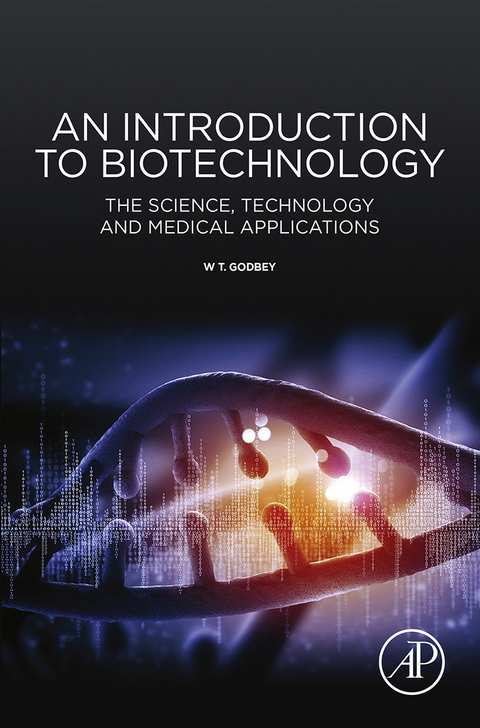
Introduction to Biotechnology (eBook)
436 Seiten
Elsevier Science (Verlag)
978-1-908818-48-5 (ISBN)
W. T. Godbey is the Paul H. and Donna D. Assistant Professor in the Department of Chemical and Bimolecular Engineering at Tulane University. He received his B.S. in Mathematics from Southern Methodist University in 1988. After a successful period that involved starting his own software design and development company in Dallas, Texas, he joined the fields of science and engineering and earned his PhD as a National Science Foundation Graduate Fellow from the Institute for Biosciences and Bioengineering at Rice University in 2000. From 2000-2003 he was a postdoctoral fellow at Childrens Hospital, Boston and Harvard Medical School. He joined the Tulane University faculty in 2003.
An Introduction to Biotechnology is a biotechnology textbook aimed at undergraduates. It covers the basics of cell biology, biochemistry and molecular biology, and introduces laboratory techniques specific to the technologies addressed in the book; it addresses specific biotechnologies at both the theoretical and application levels.Biotechnology is a field that encompasses both basic science and engineering. There are currently few, if any, biotechnology textbooks that adequately address both areas. Engineering books are equation-heavy and are written in a manner that is very difficult for the non-engineer to understand. Numerous other attempts to present biotechnology are written in a flowery manner with little substance. The author holds one of the first PhDs granted in both biosciences and bioengineering. He is more than an author enamoured with the wow-factor associated with biotechnology; he is a practicing researcher in gene therapy, cell/tissue engineering, and other areas and has been involved with emerging technologies for over a decade. Having made the assertion that there is no acceptable text for teaching a course to introduce biotechnology to both scientists and engineers, the author committed himself to resolving the issue by writing his own. - The book is of interest to a wide audience because it includes the necessary background for understanding how a technology works. - Engineering principles are addressed, but in such a way that an instructor can skip the sections without hurting course content- The author has been involved with many biotechnologies through his own direct research experiences. The text is more than a compendium of information - it is an integrated work written by an author who has experienced first-hand the nuances associated with many of the major biotechnologies of general interest today.
Front Cover 1
An Introduction to Biotechnology: The science, technology and medical applications 4
Copyright 5
Contents 6
List of Figures 10
List of Tables 16
Preface 18
About the Author 20
Chapter 1. Membranes 22
1.1 . Membrane Lipids 22
1.2 . Cholesterol 26
1.3 . Membrane Proteins 27
Questions 28
Chapter 2. Proteins 30
2.1 . Amino Acids 30
2.1.1 . p K a 33
2.2 . Protein Structure 36
2.2.1 . Primary Structure 36
2.2.2 . Secondary Structure 37
2.2.2.1 . Supersecondary Structure 40
2.2.3 . Tertiary Structure 41
2.2.4 . Quaternary Structure 41
2.3 . The Hydrophobic Effect 42
2.4 . A Return to Membranes 44
2.4.1 . Protein Movement Within the Plasma Membrane 45
2.4.2 . Restriction of Protein Movement Within the Plasma Membrane 47
2.4.3 . Protein Isolation Often Involves Detergents 47
Questions 53
Related Reading 54
Chapter 3: Cellular Transport 56
3.1 . Membrane Transporters 56
3.1.1 . The Sodium/Glucose Symporter 58
3.1.2 . Transporters That Control pH 58
3.1.2.1 . Examples of Passive Transport to Control pH 58
3.1.2.2 . Examples of Active Transport to Control pH: The Proton ATPases 61
3.1.2.3 . Lysosomes 63
3.1.3 . Another Active Transporter: The Sodium/Potassium ATPase 64
3.1.4 . Transporters can be Coupled: The Sodium-Driven Calcium Exchanger 65
3.1.5 . ABC Transporters 66
3.1.6 . Hydrophilic Molecule Transport and Electrochemical Gradients 66
3.1.6.1 . The Nernst Equation 67
3.2 . Vesicular Transporters: Endocytosis 68
3.2.1 . Phagocytosis 68
3.2.2 . Pinocytosis 72
3.2.3 . Endocytosis via Clathrin-Coated Pits 72
3.3 . Receptor Fates 75
3.3.1 . Receptor Recycling: The LDL Receptor 75
3.3.2 . Receptor and Ligand Recycling: The Transferrin Receptor 80
3.3.3 . Neither Receptor nor Ligand are Recycled: The Opioid Receptor 81
3.3.4 . Transcytosis 81
3.4 . Lysosomes Are for Degradation, But Are They Safe? 83
3.4.1 . Identification of Intracellular Vesicles 83
Questions 84
Related Reading 85
Chapter 4. Genes: The Blueprints for Proteins 86
4.1 . Nucleotides and Nucleic Acids 86
4.1.1 . The Phosphoribose Backbone 86
4.1.2 . Nucleotide Bases, Nucleosides, and Nucleotides 89
4.1.3 . DNA Is the Genetic Material 92
4.1.4 . Genomic DNA Is Double-stranded 95
4.1.5 . DNA Replication Is Semiconservative 97
4.2 . From Genes to Proteins 98
4.2.1 . Introduction to the Genetic Code 98
4.2.1.1 . Degeneracy and Wobble 99
4.2.1.1.1 . Ribosomes and Translation 99
4.2.1.1.2 . Back to Wobble 103
4.2.1.2 . Mutations and Their Effect on Translation 103
4.2.2 . Genes 103
4.2.2.1 . How Many Genes Are in the Human Genome? 105
4.2.2.2 . Phenotypes 106
4.2.3 . Transcription 109
4.2.3.1 . The Start of Transcription: RNA Polymerase Binds to DNA 109
4.2.3.1.1 . Prokaryotes 109
4.2.3.1.2 . Eukaryotes 110
4.2.3.1.2.1 . The Eukaryotic 5 ' mRNA Cap 111
4.2.3.1.2.2 . Splicing 111
4.2.3.1.2.3 . The Eukaryotic Poly(A) Tail 113
4.2.3.2 . Regulation of Transcription 115
4.2.3.2.1 . Promoters and Promoter Elements 116
4.2.3.2.1.1 . TATA Box 116
4.2.3.2.1.2 . CpG Islands 117
4.2.3.2.1.3 . GC Box 118
4.2.3.2.1.4 . CAAT Box 118
4.2.3.2.2 . Enhancers 119
4.2.3.2.3 . Silencers and Operators 121
4.2.4 . Translation 122
4.2.4.1 . Initiation of Translation in Eukaryotes 122
4.2.4.2 . Initiation of Translation in Prokaryotes 124
Questions 125
Related Reading 126
Chapter 5. Cell Growth 128
5.1 . The Eukaryotic Cell Cycle 128
5.1.1 . Phases of Mitosis 129
5.1.2 . Control of the Cell Cycle 132
5.2 . Growth Curves and Their Phases 135
5.2.1 . Growth Curve State—A Biotech Company Example 138
5.2.2 . Be Aware of the Lag Phase 139
5.2.3 . Cryptic Growth 140
5.2.4 . Diauxic Growth 141
5.3 . Mathematics of the Growth Curve 142
5.3.1 . Exponential Phase (Early Log) 142
5.3.1.1 . Doubling time, indicated by t ½, is it the amount of time that it takes for cell mass (or cell number) t ... 142
5.3.2 . Deceleration Phase (Late Log) 143
5.3.3 . Plateau Phase 145
5.3.4 . Death Phase 146
5.4 . Counting Cell Numbers 147
5.4.1 . Hemacytometer 147
5.4.2 . Agar Plates 150
5.4.3 . Cell Counters and Flow Cytometers 150
5.5 . Counting Cell Mass 151
5.5.1 . Packed Cell Volume 151
5.5.2 . Wet and Dry Weight 151
5.5.3 . Optical Density 153
5.6 . Scale-Up 153
Questions 158
Related Reading 163
Chapter 6. Microbial Killing 164
6.1 . The Gram Stain 164
6.2 . Microbial Resistance to Killing 167
6.3 . Sterilization, Disinfection, and Sanitization 169
6.3.1 . Sterilization 169
6.3.2 . Disinfection 171
6.3.3 . Sanitization 172
6.3.4 . Antiseptics 172
6.4 . Microbial Cell Death 173
6.4.1 . Death by Alcohol 174
6.4.2 . Antimicrobial Drugs 176
6.4.2.1 . Targeting the Cell Wall 176
6.4.2.2 . Targeting Translation 179
6.4.2.3 . Targeting Nucleic Acid Synthesis 180
6.4.2.4 . Targeting Cell Membranes 181
Questions 183
Related Reading 184
Chapter 7. Cell Culture and the Eukaryotic Cells Used in Biotechnology 186
7.1 . Adherent Cells Versus Nonadherent Cells 186
7.2 . Primary Cells, Cancer Cells, and Cell Lines 186
7.2.1 . Primary Cells 187
7.2.2 . Cancer Cells 190
7.2.3 . Cell Lines 191
Questions 193
Related Reading 193
Chapter 8. Fluorescence 194
8.1 . Stokes' Experiments 194
8.2 . Fluorophore Properties 198
8.2.1 . Excitation and Emission 198
8.2.2 . More Descriptors of a Fluorophore 201
8.3 . Fluorescence Detection 202
8.4 . FRET 204
Questions 206
Related Reading 207
Chapter 9. Locating Transcriptional Control Regions: Deletion Analysis 208
9.1 . An Example of Deletion Analysis 209
Questions 211
Chapter 10. Agarose Gels 214
10.1 . Application of Agarose Gels: Gel Shift 218
10.2 . Application of Agarose Gels: DNA Footprinting 218
10.2.1 . A More-Detailed Example 219
10.3 . Application of Agarose Gels: Restriction Analysis 223
Questions 224
Related Reading 227
Chapter 11. The Polymerase Chain Reaction 228
11.1 . Melt 228
11.2 . Anneal 229
11.3 . Extend 233
11.4 . PCR Loops 234
11.5 . An Application of Traditional PCR 236
11.6 . Traditional Versus Real-Time PCR 240
11.6.1 . Problems Specific to Traditional PCR 241
11.7 . Real-Time PCR 243
11.7.1 . SYBR Green 243
11.7.1.1 . The Fold Difference: What it Means Versus What it Implies 249
11.7.1.2 . Primer Efficiency 251
11.7.2 . Probes 252
Questions 254
Related Reading 257
Chapter 12. Genetic Engineering 258
12.1 . Plasmid Architecture 258
12.2 . Molecular Cloning 260
12.2.1 . Cutting (and Ligating) Sticky Ends 261
12.2.2 . Blunt-End Ligation 266
12.2.3 . Direct Extraction of a Gene from the Genome 270
12.3 . A Single Plasmid Is Not Enough 271
12.3.1 . Plasmid Amplification 273
12.3.2 . The Plasmid Prep Procedure, or, the 12-Step Program for Plasmid Recovery 280
12.4 . Spectrophotometry 286
12.4.1 . Beer’s Law 286
12.4.2 . Determination of DNA Concentration 288
12.4.3 . Determination of DNA Purity 289
12.5 . What We Have Learned so Far 290
Questions 291
Related Reading 295
Chapter 13. Gene Delivery 296
13.1 . Gene Delivery Vehicles: An Overview 297
13.2 . Gene Methods in Greater Detail 298
13.2.1 . Viral Delivery Methods 298
13.2.1.1 . Retrovirus 299
13.2.1.2 . Adenovirus 301
13.2.1.3 . Adeno-Associated Virus 303
13.2.1.4 . Herpes Virus 303
13.2.1.5 . Baculovirus 304
13.2.2 . Physical Delivery Methods 307
13.2.2.1 . Gene Gun 307
13.2.2.2 . Microinjection 308
13.2.2.3 . Electroporation 310
13.2.3 . Chemical Delivery Methods 311
13.2.3.1 . Polymers 311
13.2.3.1.1 . PEI 311
13.2.3.1.2 . Dendrimers 313
13.2.3.1.3 . Chitosan 317
13.2.3.1.4 . PLL 318
13.2.3.2 . Lipids 318
13.2.3.2.1 . Liposome Geometry 319
13.2.3.2.2 . Monovalent Cationic Lipids 319
13.2.3.2.2.1 . DOTMA 319
13.2.3.2.2.2 . DOTAP 322
13.2.3.2.2.3 . DC-Chol 323
13.2.3.2.3 . Multivalent Cationic Lipids 324
13.2.3.2.3.1 . DOSPA 324
13.2.3.2.3.2 . DOGS 324
13.2.3.2.4 . Neutral Helper Lipids 324
13.2.3.2.4.1 . DOPE and DOPC 324
13.3 . Preparation of Nonviral Gene Delivery Complexes 325
Questions 329
General Gene Delivery 330
Cloning 330
Viral Delivery Methods 330
Physical Delivery Methods 331
Chemical Delivery Methods—PEI 331
Chemical Delivery Methods—Dendrimers 331
Chemical Delivery Methods—Chitosan 332
Chemical Delivery Methods—PLL 332
Chemical Delivery Methods—Liposomes 332
Chapter 14. RNAi 334
14.1 . Cosuppression 334
14.2 . RNA Interference 337
14.3 . miRNA 340
Questions 342
Related Reading 342
Chapter 15. DNA Fingerprinting 344
15.1 . Older DNA Fingerprinting Uses RFLPs 344
15.2 . Newer DNA Fingerprinting Uses STRs 346
Questions 350
Related Reading 350
Chapter 16. Fermentation, Beer, and Biofuels 352
16.1 . Glycolysis 352
16.1.1 . The Embden-Meyerhof Pathway 352
16.1.2 . The Entner-Douderoff Pathway 355
16.2 . Fermentation 356
16.3 . The Production of Beer 360
16.3.1 . Malt 360
16.3.2 . Wort 361
16.3.3 . Yeast Cultures 362
16.3.4 . Skunky Beer 365
16.4 . Fermentation to Produce Biofuels 366
16.4.1 . Ethanol: A Biofuel with Problems 366
16.4.2 . Biobutanol 367
16.4.3 . Cellulose 370
Questions 371
Related Reading 372
Chapter 17. Stem Cells and Tissue Engineering 374
17.1 . Potential 376
17.2 . An Alternate View of Stem Cells 377
17.3 . Using Stem Cells 378
17.4 . Tissue Engineering and Regenerative Medicine 379
17.5 . Bioreactors 382
17.5.1 . Incubators 382
17.5.2 . Static and Dynamic Cultures 384
17.6 . Polymeric Scaffolds 386
17.6.1 . Homopolymers 388
17.6.2 . Copolymers 390
17.7 . Bringing it all Together: A Tissue Engineering Application 391
Questions 392
Related Reading 393
Chapter 18. Transgenics 396
18.1 . Ice-Minus Bacteria 396
18.2 . Bt Plants 396
18.3 . Herbicide Resistance 398
18.4 . Tomatoes 400
18.4.1 . The Flavr Savr Tomato 400
18.4.2 . Safeway Double-Concentrated Tomato Puree 402
18.5 . Rice 404
18.5.1 . Miracle Rice 404
18.5.2 . Golden Rice 407
18.6 . Terminators and Traitors 410
18.6.1 . Terminators 410
18.6.2 . Traitors 411
Questions 412
Related Reading 413
Chapter 19. Patents and Licenses 414
19.1 . Types of Patents 414
19.2 . Licenses 417
19.3 . After a License Is Granted 420
19.3.1 . The Inventor Will Work with the Licensee After the Patent Has Been Licensed 420
19.3.2 . Remuneration 420
19.3.3 . If the License Is Released Back to the Inventor 422
Questions 422
Index 424
List of Figures
Figure 1.1 The eukaryotic plasma membrane 2
Figure 1.2 The structure of glycerol 2
Figure 1.3 The structure of phosphatidic acid 3
Figure 1.4 Common phospholipids found in the plasma membrane 3
Figure 1.5 The structure of sphingomyelin 4
Figure 1.6 Distribution of membrane phospholipids 5
Figure 1.7 The structure of cholesterol 6
Figure 1.8 Cholesterol fits between adjacent phospholipids 6
Figure 2.1 General structure of an amino acid 10
Figure 2.2 l- and d-forms of the general amino acid structure 10
Figure 2.3 structures of the 20 common amino acids 11
Figure 2.4 Ionization states of glycine 14
Figure 2.5 Ionization states of lysine 15
Figure 2.6 Amino acid polymerization reaction 16
Figure 2.7 Amino acid placement and interactions in the alpha helix 17
Figure 2.8 Beta pleated sheets 18
Figure 2.9 Beta turn 19
Figure 2.10 Proline in cis and trans conformations 20
Figure 2.11 the hydrophobic effect 21
Figure 2.12 A protein active site 22
Figure 2.13 Transmembrane proteins 23
Figure 2.14 Membrane protein migration 25
Figure 2.15 Barriers to membrane protein migration 27
Figure 2.16 Structures: soap versus detergent 28
Figure 2.17 General structure of a surfactant and a micelle 29
Figure 2.18 The structure of Triton X-100 36
Figure 3.1 Relative membrane permeabilities 36
Figure 3.2 Symport, antiport, active and passive transport 36
Figure 3.3 The mechanism of the sodium/glucose symporter 38
Figure 3.4 Examples of transporters that control cytosolic pH 40
Figure 3.5 Actions of two proton ATPases 41
Figure 3.6 A cell with labeled lysosomes 42
Figure 3.7 The sodium/potassium ATPase 43
Figure 3.8 The sodium-driven calcium exchanger, and an active Ca2 + transporter 44
Figure 3.9 IgG structure 48
Figure 3.10 Phagocytosis 50
Figure 3.11 A triskelion 52
Figure 3.12 Clathrin-coated pits 53
Figure 3.13 Structure of an LDL complex 56
Figure 3.14 Receptor recycling: the LDL receptor 57
Figure 3.15 Reasons for poor cholesterol uptake 58
Figure 3.16 Receptor recycling: the transferrin receptor 59
Figure 3.17 Transcytosis 61
Figure 4.1 The structures of ribose, phosphoribose, and an RNA dinucleotide 66
Figure 4.2 Structures of NMP, dNMP, and NTP 68
Figure 4.3 RNA polymerization 69
Figure 4.4 Structures of the most common nucleotide bases 70
Figure 4.5 The structure of the trinucleotide CTG 72
Figure 4.6 Summary of the Hershey-Chase experiments 73
Figure 4.7 DNA base pairing 74
Figure 4.8 dsDNA melting temperatures 75
Figure 4.9 Summary of the Meselson-Stahl experiments 76
Figure 4.10 The genetic code 79
Figure 4.11 Schematic of a tRNA molecule and its anticodon 80
Figure 4.12 Schematic of the ribosome with E, P, and A sites 80
Figure 4.13 Schematic of ribosomal interactions with tRNA during translation 81
Figure 4.14 Logical components of a gene 83
Figure 4.15 The number of genes in the human genome 85
Figure 4.16 Structures of the H antigen 86
Figure 4.17 Blood types 87
Figure 4.18 Structure of the 5’ RNA cap 91
Figure 4.19 Steps in the creation of the 5’ RNA cap 92
Figure 4.20 Splicing, or the removal of introns from eukaryotic RNA 93
Figure 4.21 The eukaryotic poly(A) tail 94
Figure 4.22 The eukaryotic transcription machinery 99
Figure 4 Aside: Ether, ester, and phosphodiester structures 67
Figure 5.1 Schematic of the cell cycle (S, M, and G phases) 108
Figure 5.2 Schematic of the cell cycle (IPMAT phases) 108
Figure 5.3 Chromosomal locations during mitosis 109
Figure 5.4 Centromere, kinetochore, kinteochore microtubules, and mitotic spindle 110
Figure 5.5 Cell cycle checkpoints 111
Figure 5.6 Quantitation of DNA concentration during the cell cycle 113
Figure 5.7 A growth curve 115
Figure 5.8 Growth curves to consider 118
Figure 5.9 Cryptic growth 119
Figure 5.10 Diauxic growth 120
Figure 5.11 Growth curves for different carbon-source affinities 123
Figure 5.12 A hemacytometer 126
Figure 5.13 A hemacytometer with cells for counting 127
Figure 5.14 Schematic of an agar plate with colonies 129
Figure 5.15 Schematic of a cell counter 131
Figure 5.16 A spinner flask 135
Figure 6.1 Sketch of Gram-positive and Gram-negative bacteria 144
Figure 6.2 The structure of crystal violet 145
Figure 6.3 Crystal violet without and with a mordant 145
Figure 6.4 Gram stain results 146
Figure 6.5 A fly trapped in amber 148
Figure 6.6 Sterile vs. disinfected vs. sanitized 149
Figure 6.7 The structure of ethylene oxide 150
Figure 6.8 A sterilized liquid for drinking? 150
Figure 6.9 The structures of several common alcohols 154
Figure 6.10 Potential targets for antimicrobial drugs 155
Figure 6.11 NAM and NAG structures 156
Figure 6.12 NAM and NAG crosslinking in the prokaryotic cell wall 157
Figure 6.13 How folate is used in purine synthesis 159
Figure 6.14 The structures of PABA, sulfa drugs, and folic acid 160
Figure 6.15 The structure of polymyxin B 161
Figure 7.1 An RGD sequence 166
Figure 7.2 Okazaki fragments 168
Figure 7.3 Telomeres, as detected by FISH 169
Figure 7.4 Normal vs. cancer cells 171
Figure 8.1 Illustration of one of Stokes’ experiments 174
Figure 8.2 Illustration of one of Stokes’ experiments 174
Figure 8.3 Illustration of one of Stokes’ experiments...
| Erscheint lt. Verlag | 8.12.2014 |
|---|---|
| Sprache | englisch |
| Themenwelt | Naturwissenschaften ► Biologie ► Genetik / Molekularbiologie |
| Naturwissenschaften ► Biologie ► Zellbiologie | |
| Technik ► Umwelttechnik / Biotechnologie | |
| Wirtschaft | |
| ISBN-10 | 1-908818-48-4 / 1908818484 |
| ISBN-13 | 978-1-908818-48-5 / 9781908818485 |
| Informationen gemäß Produktsicherheitsverordnung (GPSR) | |
| Haben Sie eine Frage zum Produkt? |
 EPUB (Adobe DRM)
Kopierschutz: Adobe-DRM
Adobe-DRM ist ein Kopierschutz, der das eBook vor Mißbrauch schützen soll. Dabei wird das eBook bereits beim Download auf Ihre persönliche Adobe-ID autorisiert. Lesen können Sie das eBook dann nur auf den Geräten, welche ebenfalls auf Ihre Adobe-ID registriert sind.
Details zum Adobe-DRM
Dateiformat: EPUB (Electronic Publication)
EPUB ist ein offener Standard für eBooks und eignet sich besonders zur Darstellung von Belletristik und Sachbüchern. Der Fließtext wird dynamisch an die Display- und Schriftgröße angepasst. Auch für mobile Lesegeräte ist EPUB daher gut geeignet.
Systemvoraussetzungen:
PC/Mac: Mit einem PC oder Mac können Sie dieses eBook lesen. Sie benötigen eine
eReader: Dieses eBook kann mit (fast) allen eBook-Readern gelesen werden. Mit dem amazon-Kindle ist es aber nicht kompatibel.
Smartphone/Tablet: Egal ob Apple oder Android, dieses eBook können Sie lesen. Sie benötigen eine
Geräteliste und zusätzliche Hinweise
Buying eBooks from abroad
For tax law reasons we can sell eBooks just within Germany and Switzerland. Regrettably we cannot fulfill eBook-orders from other countries.
aus dem Bereich