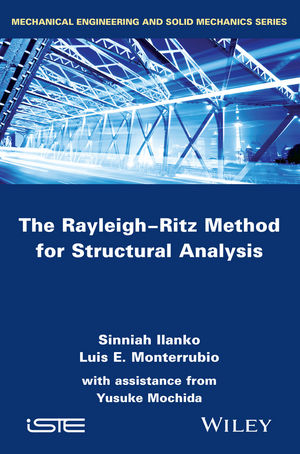
The Rayleigh-Ritz Method for Structural Analysis (eBook)
100 Seiten
Wiley-IEEE Press (Verlag)
978-1-118-98442-0 (ISBN)
A presentation of the theory behind the Rayleigh-Ritz (R-R) method, as well as a discussion of the choice of admissible functions and the use of penalty methods, including recent developments such as using negative inertia and bi-penalty terms. While presenting the mathematical basis of the R-R method, the authors also give simple explanations and analogies to make it easier to understand. Examples include calculation of natural frequencies and critical loads of structures and structural components, such as beams, plates, shells and solids. MATLAB codes for some common problems are also supplied.
Sinniah Ilanko, Professor of Mechanical Engineering, Department of Engineering, The University of Waikato, Te Whare Wananga o Waikato, Hamilton, New Zealand.
PREFACE xi
INTRODUCTION AND HISTORICAL NOTES xiii
CHAPTER 1. PRINCIPLE OF CONSERVATION OF ENERGY AND
RAYLEIGH'S PRINCIPLE 1
CHAPTER 2. RAYLEIGH'S PRINCIPLE AND ITS IMPLICATIONS
11
CHAPTER 3. THE RAYLEIGH-RITZ METHOD AND SIMPLE
APPLICATIONS 21
CHAPTER 4. LAGRANGIAN MULTIPLIER METHOD 33
CHAPTER 5. COURANT'S PENALTY METHOD INCLUDING NEGATIVE
STIFFNESS AND MASS TERMS 39
CHAPTER 6. SOME USEFUL MATHEMATICAL DERIVATIONS AND APPLICATIONS
55
CHAPTER 7. THE THEOREM OF SEPARATION AND ASYMPTOTIC MODELING
THEOREMS 67
CHAPTER 8. ADMISSIBLE FUNCTIONS 81
CHAPTER 9. NATURAL FREQUENCIES AND MODES OF BEAMS 89
CHAPTER 10. NATURAL FREQUENCIES AND MODES OF PLATES OF
RECTANGULAR PLANFORM 113
CHAPTER 11. NATURAL FREQUENCIES AND MODES OF SHALLOW SHELLS OF
RECTANGULAR PLANFORM 133
CHAPTER 12. NATURAL FREQUENCIES AND MODES OF THREE-DIMENSIONAL
BODIES 149
CHAPTER 13. VIBRATION OF AXIALLY LOADED BEAMS AND GEOMETRIC
STIFFNESS 161
CHAPTER 14. THE RRM IN FINITE ELEMENTS METHOD 181
BIBLIOGRAPHY 197
APPENDIX 203
INDEX 229
Introduction and Historical Notes
In many practical engineering problems, it is not possible or convenient to develop exact solutions. A convenient method for solving such problems originated from attempts to calculate natural frequencies and modes of structures. This method is known as the Rayleigh–Ritz method or the Ritz method [RAY 45a, RAY 45b, RIT 08, RIT 09, LEI 05, ILA 09, YOU 50]. In this book we will see how to apply this method for solving a variety of common problems engineers and scientists encounter. We will first provide some historical notes on the development of the method and show how the principle of conservation of energy leads to this procedure. Those who are keen to get on with the application may want to proceed to Chapter 3.
Chapter 1 starts with application of the principle of conservation of energy for a simple pendulum showing how the natural frequency can be found by applying this principle for a system that can vibrate only in one mode or shape. Such systems that can only vibrate in one mode are called single degree of freedom systems, as a single coordinate is sufficient to describe the actual shape of natural vibration and such a natural vibration without any external dynamic force takes place only at one frequency which is its natural frequency. Then we consider a spring-mass vibratory system which has two independent coordinates. It can be easily shown, by applying Newton’s second law of motion, that the system has two natural frequencies with associated modes. Application of the conservation of energy for this system requires an assumption about the shape of vibration. Although the natural frequencies and modes can be calculated conveniently by solving the equations of motion derived from Newton’s second law, application of the principle of conservation energy shows that in this case this the application leads to one value for the frequency which depends on the assumed mode (the assumed ratio of the displacement of two masses) and takes minimum and maximum values when the assumed modes correspond to the actual first and second modes, yielding the respective natural frequencies. In Chapter 2, we proceed to show how this illustrates Rayleigh’s Principle which in Lord Rayleigh’s own words is stated as follows:
The period of a conservative system vibrating in a constrained type about a position of stable equilibrium is stationary in value when the type is normal.
Chapter 2 also presents a well-known proof that for a system with a finite number of degrees of freedom, the frequency obtained by applying the principle of conservation of energy is an upper bound to the fundamental natural frequency, and a lower bound to the highest natural frequency, provided no essential (geometric) constraints are violated. The requirement that the essential conditions are not violated leads to the notion of admissible forms (these could be vector or functions) of displacements. This chapter also deals with what is meant by admissibility.
Lord Rayleigh has shown in several of his papers and books, how a good estimate for the fundamental natural frequency may be obtained by adjusting the shape of a chosen function to seek the lowest possible values for the frequency (or highest value for the period). The expression for the frequency is a quotient with potential energy being the numerator and a kinetic energy function being the denominator. This quotient is called the Rayleigh quotient. However, the credit for introducing a systematic method for performing this minimization should be given to Walter Ritz. For this reason there are some who argue that the method should be called the Ritz method. The arguments and counterarguments for the name are available in literature [LEI 05, ILA 09]. So we will not focus on it here except to say that to be inclusive we are using the name Rayleigh–Ritz method which gives credit to both Rayleigh and Ritz.
Thus, Chapter 3 takes us from the implication of Rayleigh’s principle to the Rayleigh–Ritz method. Typical minimization equations are formulated for a conservative structural system possessing potential and kinetic energy, to the point of developing the eigenvalue equations. A cantilever beam is used as an illustrative example showing how the method is applied to obtain the natural frequencies and modes. The effect of adding partial restraints and rigid body attachments are also explained in this chapter. In addition to natural frequency calculations, static analysis is also demonstrated as a special case. It may be worth noting here that while the origin of the Rayleigh–Ritz method can be traced back to problems of finding natural frequencies and modes, it can also be used to solve boundary value problems. In structural analysis, this corresponds to calculation of displacements using the minimum total potential energy theorem, but the procedure for minimization is the same as the one used in the Rayleigh–Ritz method for vibration analysis.
We have noted that a requirement of the Rayleigh–Ritz method is that the choice of displacement functions for formulating the energy terms is subject to the requirement that they satisfy all geometric conditions. In actual fact, it is not necessary for each function to satisfy the constraints but the series as a whole does need to. A way to relax this requirement is to use the Lagrangian Multiplier method where each function is allowed to violate the geometric constraints but then these constraints are enforced by including additional constraint equations which are associated with undetermined coefficients called the Lagrangian Multipliers. Chapter 4 deals with this approach and demonstrates the method through a propped cantilever.
Chapter 5 presents some mathematical derivations and formulas for computing the terms in the eigenvalue matrix equations. For example, integral expressions for stiffness and mass matrices are presented in Chapter 5.
Chapter 6 introduces the penalty method. While the Lagrangian Multiplier method helps to relax the limitations on the choice of admissible displacement functions or vectors, it introduces extra equations that need to be solved together with a set of minimization equations. There is another clever way to achieve the enforcement of geometric conditions without increasing the number of equations. This involves a gemoetric constraint with an artificial spring of very high stiffness and including the strain energy associated with any violation of the constraint. This idea was introduced by Richard Courant in [COU 43] and has since then become very popular and widely accepted. This is known as the penalty method. The penalty parameter corresponds to the stiffness of the artificial spring and serves as a penalty against any constraint violation. There have been two criticisms about this approach. One is that while high stiffness may minimize any constraint violation, it is not possible to determine the effect it has on the accuracy of the results. Furthermore, choosing a stiffness that is large enough to prevent any constraint violation, but not too large as to cause any numerical problems due to round-off errors, can be challenging. In the case of frequency calculations, the approximation of a rigid boundary condition with a less than ideally rigid condition relaxes the structure and could result in lower estimates for the natural frequencies. This means that the Rayleigh–Ritz method would then yield an upper bound solution to a lower bound model. However, recent advances in the penalty method where stiffness parameters of positive and negative values had been used were found to give bounded results for frequencies, as far as the constraint violation is concerned. This is explained in Chapter 6.
Although it is well known that the Rayleigh–Ritz method gives upper bound to the fundamental natural frequencies, it is not well known that the method actually gives upper bound to all but the highest of the natural frequencies. The proof of boundedness of the Rayleigh–Ritz method, which comes in the form of Theorem of Separation, is presented in Chapter 7. This chapter also gives rigorous mathematical proof of theorems that justify the use of negative stiffness parameters, which were derived by one of the authors.
The fact that the admissible functions do not have to satisfy all geometric constraints is great news for the Rayleigh–Ritz method fans because this removes the restrictions on the choice of admissible functions. However, with the use of penalty terms, some functions are known to cause numerical problems. So, are there any well-behaved functions? This question is answered in Chapter 8, where a recipe for formulating shape functions can be found, presenting a specific set for many common structural elements including beams, rectangular plates, shells of rectangular planform and solids – all are shapes which can be described conveniently in Cartesian coordinates. It is a convenient set consisting of a cosine series, and linear and quadratic functions. These functions are easy to work with and have shown to be well-behaved even under challenging conditions such as high penalty terms and higher modes where most common admissible functions cause numerical problems.
Chapters 9 deals with application of the special set of functions for beams, which is then extended to rectangular plates in Chapter 10, shells of rectangular planform in Chapter 11 and solid bodies in Chapter 12. In all these cases, it has been shown that the set of admissible functions presented in Chapter 7 can be used to find the natural frequencies and modes of the totally unconstrained system, without causing any numerical problems. This is observed consistently for beams, plates, shells and solids,...
| Erscheint lt. Verlag | 2.12.2014 |
|---|---|
| Sprache | englisch |
| Themenwelt | Naturwissenschaften ► Physik / Astronomie ► Mechanik |
| Technik ► Bauwesen | |
| Technik ► Maschinenbau | |
| Schlagworte | Festkörpermechanik • Festkörpermechanik • Maschinenbau • mechanical engineering • solid mechanics |
| ISBN-10 | 1-118-98442-0 / 1118984420 |
| ISBN-13 | 978-1-118-98442-0 / 9781118984420 |
| Informationen gemäß Produktsicherheitsverordnung (GPSR) | |
| Haben Sie eine Frage zum Produkt? |
 EPUB (Adobe DRM)
Kopierschutz: Adobe-DRM
Adobe-DRM ist ein Kopierschutz, der das eBook vor Mißbrauch schützen soll. Dabei wird das eBook bereits beim Download auf Ihre persönliche Adobe-ID autorisiert. Lesen können Sie das eBook dann nur auf den Geräten, welche ebenfalls auf Ihre Adobe-ID registriert sind.
Details zum Adobe-DRM
Dateiformat: EPUB (Electronic Publication)
EPUB ist ein offener Standard für eBooks und eignet sich besonders zur Darstellung von Belletristik und Sachbüchern. Der Fließtext wird dynamisch an die Display- und Schriftgröße angepasst. Auch für mobile Lesegeräte ist EPUB daher gut geeignet.
Systemvoraussetzungen:
PC/Mac: Mit einem PC oder Mac können Sie dieses eBook lesen. Sie benötigen eine
eReader: Dieses eBook kann mit (fast) allen eBook-Readern gelesen werden. Mit dem amazon-Kindle ist es aber nicht kompatibel.
Smartphone/Tablet: Egal ob Apple oder Android, dieses eBook können Sie lesen. Sie benötigen eine
Geräteliste und zusätzliche Hinweise
Buying eBooks from abroad
For tax law reasons we can sell eBooks just within Germany and Switzerland. Regrettably we cannot fulfill eBook-orders from other countries.
aus dem Bereich