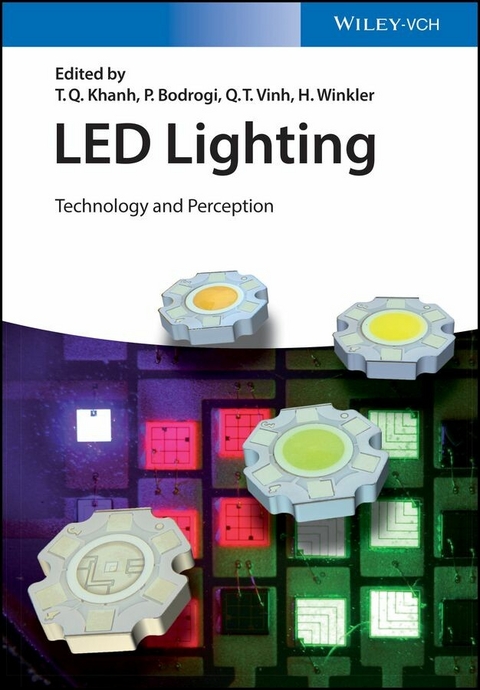
After an introduction to the human visual system and current radiometry, photometry and color science, the basics of LED chip and phosphor technology are described followed by specific issues of LED radiometry and the optical, thermal and electric modeling of LEDs. This is supplemented by the relevant practical issues of pulsed LEDs, remote phosphor LEDs and the aging of LED light sources. Relevant human visual aspects closely related to LED technology are described in detail for the photopic and the mesopic range of vision, including color rendering, binning, whiteness, Circadian issues, as well as flicker perception, brightness, visual performance, conspicuity and disability glare. The topic of LED luminaires is discussed in a separate chapter, including retrofit LED lamps, LED-based road and street luminaires and LED luminaires for museum and school lighting. Specific sections are devoted to the modularity of LED luminaires, their aging and the planning and evaluation methods of new LED installations. The whole is rounded off by a summary and a look towards future developments.
Prof. Tran Quoc Khanh is University Professor and Head of the Laboratory of Lighting Technology at the Technische Universitat Darmstadt in Darmstadt, Germany. He graduated in Optical Technologies from the Technische Universitat Ilmenau. He obtained his PhD degree in Lighting Engineering from the same University. He obtained his Degree of Lecture Qualification (Habilitation) from the same University for his thesis in Colorimetry and Color Image Processing. He gathered industrial experience as a project manager by ARRI CineTechnik in Munchen (Germany). He has been the organizer of the well-known series of international symposia for automotive lighting (ISAL) in Darmstadt and a member of several Technical Committees of the International Commission of Illumination (CIE).
Dr. Peter Bodrogi is Senior Research Fellow at the Laboratory of Lighting Technology of the Technische Universitat Darmstadt in Darmstadt, Germany. He graduated in Physics from the Lorand Eotvos University of Budapest (Hungary). He obtained his PhD degree in Information Technology from the University of Pannonia in Veszprem, Hungary. He obtained his Degree of Lecture Qualification (Habilitation) from the Technische Universitat Darmstadt in 2010 for his thesis on the optimization of modern visual technologies. He co-authored numerous scientific publications and invented patents about color vision and self-luminous display technology. He has been member of several Technical Committees of the International Commission of Illumination (CIE).
Chapter authors:
Andreas Groh, Stefan Bruckner, Quang Trinh Vinh and Dmitrij Polin, Laboratory of Lighting Technology of Darmstadt Technical University, Germany.
Dr. Holger Winkler, Merck KGaA in Darmstadt, Germany.
Dr. Holger Sprute, Lead Engineer Licht & Sicht, Bertrandt AG in Darmstadt, Germany.
Prof. Tran Quoc Khanh is University Professor and Head of the Laboratory of Lighting Technology at the Technische Universität Darmstadt in Darmstadt, Germany. He graduated in Optical Technologies from the Technische Universität Ilmenau. He obtained his PhD degree in Lighting Engineering from the same University. He obtained his Degree of Lecture Qualification (Habilitation) from the same University for his thesis in Colorimetry and Color Image Processing. He gathered industrial experience as a project manager by ARRI CineTechnik in München (Germany). He has been the organizer of the well-known series of international symposia for automotive lighting (ISAL) in Darmstadt and a member of several Technical Committees of the International Commission of Illumination (CIE). Dr. Peter Bodrogi is Senior Research Fellow at the Laboratory of Lighting Technology of the Technische Universität Darmstadt in Darmstadt, Germany. He graduated in Physics from the Loránd Eötvös University of Budapest (Hungary). He obtained his PhD degree in Information Technology from the University of Pannonia in Veszprém, Hungary. He obtained his Degree of Lecture Qualification (Habilitation) from the Technische Universität Darmstadt in 2010 for his thesis on the optimization of modern visual technologies. He co-authored numerous scientific publications and invented patents about color vision and self-luminous display technology. He has been member of several Technical Committees of the International Commission of Illumination (CIE). Chapter authors: Andreas Groh, Stefan Brückner, Quang Trinh Vinh and Dmitrij Polin, Laboratory of Lighting Technology of Darmstadt Technical University, Germany. Dr. Holger Winkler, Merck KGaA in Darmstadt, Germany. Dr. Holger Sprute, Lead Engineer Licht & Sicht, Bertrandt AG in Darmstadt, Germany.
- Introduction
- The human visual system and its modeling for lighting engineering
- LED-components: Principles of radiation generation and packaging
- Measurement and modeling of the LED light source
- Photopic perceptual aspects of LED lighting
- Mesopic perceptual aspects of LED lighting
- Optimization and characterization of LED-luminaires for indoor lighting
- Optimization and characterization of LED-luminaires for outdoor lighting
- Summary
1
Introduction
Peter Bodrogi and Tran Quoc Khanh
The technology of LED lighting (the illumination with light emitting diodes), especially with modern high-power LEDs has developed very rapidly in the past decade. According to the LEDs' tendency to achieve high energy efficiency with superior lighting quality and accordingly, a high level of user acceptance, LEDs have acquired a substantial economical relevance worldwide. The market share of LED light sources and LED luminaires is increasing rapidly at the time of writing. Nevertheless, to ensure good lighting quality for the human light source user, the user's perceptual characteristics (e.g., the way they perceive colors) are considered as important optimization criteria during the design and development of high-tech LED illumination systems. This book presents optimization guidelines for LED technology in the view of human perceptual features within the interdisciplinary framework of lighting engineering.
Lighting engineering deals with the energy efficient and application dependent production, characterization, transmission, and effects of optical radiation on human users taking the aspects of visual perception and light and health aspects into account [1]. The four main subject areas of lighting engineering are shown in Figure 1.1.
Figure 1.1 Subject areas of lighting engineering [1].
As can be seen from Figure 1.1, the principles of light production techniques are important to manufacture light sources (lamps, lamp modules, luminaires, headlights) with certain desirable spectral, energetic, geometric properties, and spatial light distributions of the light they generate. Using advanced illumination techniques, this light is projected onto the object arranged in different room geometries (in interior lighting) or street geometries (in exterior lighting). Light measurement techniques, in turn, have the task to physically measure the descriptor quantities of the visual (e.g., luminance, chromaticity) and light and health (e.g., circadian) characteristics of the illuminating system.
Colorimetry and color science (together with eye psychology and visual psychometry) analyze the answers of the human visual system to the spectral (and spatial) properties of the visual stimulus (i.e., the optical radiation reaching the human eye) in detail. In colorimetry and in color science, numeric descriptor quantities are defined to quantify human perceptions together with the circumstances under which a human visual model is valid, for example, different models for different adaptation levels – ranging between daytime vision down to nighttime vision, or different models for different sizes of the visual stimulus (e.g., 2° vs 10°).
This lighting engineering framework is complemented by theoretical knowledge on the chemistry and material science of phosphors and semiconductors as well as relevant aspects of electronics and thermodynamics. The necessary deep theoretical knowledge is applied to practical problems. Principles of LED design are illustrated by real-life examples so that, at the end, real know-how is conveyed in terms of easy-to-understand and easy-to-use numeric criterion values. The aim is to help apply this knowledge in the everyday practice of engineers involved in the design, development and manufacturing of LED components, light sources, lamps, luminaires, and LED lighting systems. Engineers can use this book as a theoretical reference and a practical guide to solve problems related to these types of questions:
- How can the technology of LED light sources and luminaires be optimized for the human user to increase user acceptance? How can the LED user's visual performance and light and health aspects be enhanced?
- In this respect, what are the most important components (that generate and distribute electromagnetic radiation and dissipate heat) of LED light sources and luminaires?
- What materials can be used to manufacture them and how can these materials be improved and their arrangement improved?
- How can the radiation of LED chips be converted by today's diverse variety of phosphors? How can phosphor converted LEDs be combined with pure (colored) chip LEDs to achieve high lighting quality in a high-end interior lighting system?
- What are the most important chemical, physical, and technological parameters of these LED devices exhibiting previously unknown design flexibility hence huge optimization potentials for human users?
- How can the input (e.g., current, temperature) and output (e.g., spectral radiance) parameters of the LED devices be measured physically?
- How can LED devices be modeled and controlled (e.g., by pulse width modulation) – including their aging phenomena?
- How does the visual stimulus of the scene illuminated by the LED light source come to existence?
- How can LED illumination systems exploit the human visual system's properties to provide an excellent (interior or exterior) environment lit by LEDs for excellent visual performance (excluding glare, flicker, and stroboscopic artifacts) and high lighting quality?
- What interactions are there between the light from the LED light source and the colored objects that reflect it and how does this interaction influence the perceptions or the light and health aspects of human users?
- How can LED lighting systems be optimized for lower luminance levels in typical nighttime automotive lighting and street/road lighting applications from the point of view of the human visual system in order to optimize brightness perception, visual performance, and visual acuity?
- How can objective (numeric) criteria be derived from human measurements that can be used to optimize a LED lighting system by engineering methods? How can we formulate such criteria in terms of really usable numbers in engineering practice?
To answer the above questions and to cope with related practical subjects in real-world application effectively, Figure 1.2 shows the interdisciplinary workflow concept of the present book for the technological and perceptual co-optimization of LEDs.
Figure 1.2 Interdisciplinary workflow concept for the technological and perceptual optimization of LED lighting systems.
As can be seen from Figure 1.2 (going from the upper box in the middle toward the right), the LED lighting system illuminates an indoor scene or an outdoor scene with an arrangement of colored objects with certain spectral reflectance properties at a certain luminance level (daytime, twilight, or nighttime). The light coming from the light source reaches the human eye sometimes directly but is often reflected from the objects of the scene (see also Figure 2.14, left). Reflection changes the spectral composition of the light and a plethora of different color stimuli arises. Parallel to this, the light also generates nonvisual brain signals, for example, via the circadian stimulus which is responsible for the timing of the daily rhythm of the human user.
The stimulus (i.e., the light reaching the eye) has some characteristic properties that strongly influence the perception (see also Figure 2.14, right) it evokes in the human visual system: its viewing angle, its retinal eccentricity after being imaged onto the retina (i.e., the photoreceptive layer in the eye), its luminance, spectral radiance, and spatial structure (e.g., a homogeneous disk or a complex letter structure). Perceptions also depend on the characteristics of the human observer (age, health, and gender). The cognitive interpretations of the perceptions and the decisions based on them (e.g., to purchase or not to purchase a lighting system) also depend on the profession and culture of the user and his or her region of origin he or she happens to live in or has grown up in.
To provide numeric optimization criteria for engineers, usable (i.e., practice oriented and not too complex) models of the human visual system (and nonvisual systems like the Circadian system) can be described systematically and they must be well understood. These models compute the objective optimization criteria for the LED lighting system from the physically measured characteristics of the stimulus (e.g., its spectral radiance distribution). These criteria can be used, in turn, for the optimization process of the different components of the LED illumination system. Now, going back to the upper box in the center of Figure 1.2 again, these optimized components constitute an advanced LED lighting system whose enhanced visual properties can be validated by measuring it physically, computing its improved visual criterion numbers (e.g., a higher color rendering index) and, finally, validating it in a dedicated field study.
As can be seen from Figure 1.2, the objective optimization criteria derived from the human models belong to the left (technological) side of the workflow concept as these criteria represent technological optimization targets. Anyway, technological optimization can be carried out only if usable models of the LED system components are available for the engineer. Models based on the knowledge from physics, chemistry, and material science can be formulated for the LED chip (semiconductor structure), the phosphor, the packaging of the LED light source, its optics, control electronics, the temperature, and current dependence of its light output as well as for the aging of LEDs after thousands or ten thousands of operating hours. If such models and their optimization criteria are known then LED technology will be able to...
| Erscheint lt. Verlag | 24.11.2014 |
|---|---|
| Sprache | englisch |
| Themenwelt | Naturwissenschaften ► Physik / Astronomie |
| Technik | |
| Schlagworte | BASIC • Basics • Beleuchtung • circadian • coauthors • Color • components principles • effect • Electrical & Electronics Engineering • Electromagnetic • Elektrotechnik u. Elektronik • Generation • holgerwinkler • Introduction • Knowledge • LED • LEDs • Leuchtdichte • light • Materials Science • Materialwissenschaften • Optical and Non-Linear Optical Materials • Optical Communications • Optics & Photonics • Optik • Optik u. Photonik • Optische Nachrichtentechnik • Optische u. Nichtlineare Optische Materialien • Optoelektronik • Optronik • Phosphor • Physics • Physik • Radiation • semiconductor • Technology • Visual system |
| ISBN-10 | 3-527-67016-5 / 3527670165 |
| ISBN-13 | 978-3-527-67016-1 / 9783527670161 |
| Informationen gemäß Produktsicherheitsverordnung (GPSR) | |
| Haben Sie eine Frage zum Produkt? |
 EPUB (Adobe DRM)
Kopierschutz: Adobe-DRM
Adobe-DRM ist ein Kopierschutz, der das eBook vor Mißbrauch schützen soll. Dabei wird das eBook bereits beim Download auf Ihre persönliche Adobe-ID autorisiert. Lesen können Sie das eBook dann nur auf den Geräten, welche ebenfalls auf Ihre Adobe-ID registriert sind.
Details zum Adobe-DRM
Dateiformat: EPUB (Electronic Publication)
EPUB ist ein offener Standard für eBooks und eignet sich besonders zur Darstellung von Belletristik und Sachbüchern. Der Fließtext wird dynamisch an die Display- und Schriftgröße angepasst. Auch für mobile Lesegeräte ist EPUB daher gut geeignet.
Systemvoraussetzungen:
PC/Mac: Mit einem PC oder Mac können Sie dieses eBook lesen. Sie benötigen eine
eReader: Dieses eBook kann mit (fast) allen eBook-Readern gelesen werden. Mit dem amazon-Kindle ist es aber nicht kompatibel.
Smartphone/Tablet: Egal ob Apple oder Android, dieses eBook können Sie lesen. Sie benötigen eine
Geräteliste und zusätzliche Hinweise
Buying eBooks from abroad
For tax law reasons we can sell eBooks just within Germany and Switzerland. Regrettably we cannot fulfill eBook-orders from other countries.
aus dem Bereich