Gene Function (eBook)
564 Seiten
Elsevier Science (Verlag)
978-1-4831-8851-5 (ISBN)
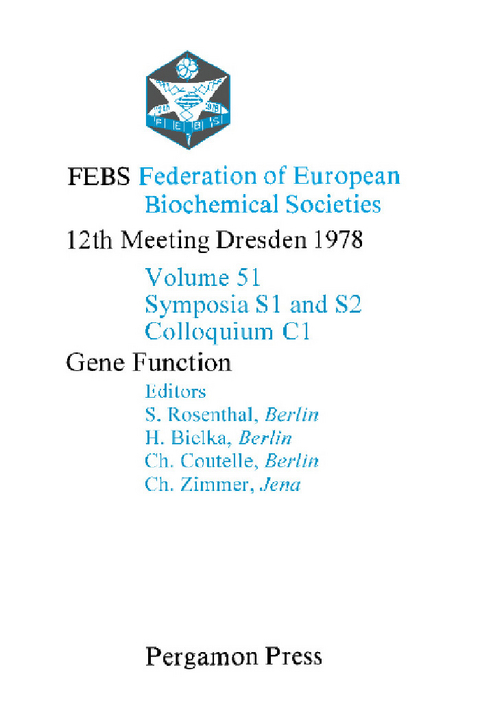
Gene Function, contains the proceedings of the 12th Meeting of the Federation of European Biochemical Societies held in Dresden, Germany in 1978. The meeting provided a forum for discussing progress in the understanding of gene function and covered topics ranging from the functional organization of chromatin to principles of interactions and recognition models. The role of DNA sequence in the recognition of restriction endonucleases and modification enzymes is also examined, along with gene expression, RNA processing and modification, and isolation and synthesis of genes. Comprised of 49 chapters, this volume begins with an overview of what can be learned from the genetic analysis of the lac repressor, followed by a discussion on the topography of the interaction the lac repressor, RNA polymerase, and histones with DNA. The reader is then introduced to complementarity and recognition code between regulatory proteins and DNA; chromatin replication in vitro; and the cytoplasmic "e;petite"e; mutation in Saccharomyces cerevisiae. Subsequent chapters explore arc-like and helical arrangements of nucleosome cores; changes in gene expression during cellular differentiation; polyadenylation and processing of pre-messenger RNA; and the molecular biology of bacteriophages T3 and T7. This book will be of interest to geneticists, biochemists, and molecular biologists.
Front Cover
1
Gene Function 4
Copyright Page
5
Table of Contents 6
PREFACE 10
PART I: FUNCTIONAL ORGANISATION OF CHROMATIN 12
CHAPTER 1. WHAT CAN BE LEARNED FROM THE GENETIC ANALYSIS
14
ABSTRACT 14
INTRODUCTION 14
The functional structure of lac repressor as revealed
15
Negative dominance as a tool to study function of
15
Apparent negative dominance of lac permease mutations 16
Control of the basal level of the lac operon 17
The functional structure of lac repressor as revealed by
18
The functional structure of other repressors as revealed by fusion analysis: Short N-terminal regions bind to DNA 20
Fusions: ß-Galactosidase as a reporter enzyme 20
CONCLUSION 21
ACKNOWLEDGEMENT 21
REFERENCES 21
CHAPTER 2. TOPOGRAPHY OF INTERACTION OF LAC REPRESSOR, RNA POLYMERASE
24
INTRODUCTION 24
METHODS 25
Localization of Ligands in the DNA Grooves and Measurement of DNA Unwinding 25
Sequencing Histones along DNA 25
RESULTS 26
Arrangement of Proteins in the DNA Grooves 26
Unwinding of DNA 28
Arrangement of Histones on DNA 28
DISCUSSION 29
REFERENCES 30
CHAPTER 3. COMPLEMENTARITY AND RECOGNITION CODE
34
ABSTRACT 34
REFERENCES 42
CHAPTER 4. ENZYME-DNA AND REPRESSOR-OPERATOR RECOGNITIONS REGULATORY ELEMENTS IN THE IMMUNITY REGIONS OF PHAGES .
44
REFERENCES 49
CHAPTER 5. CHROMATIN REPLICATION IN VITRO 50
In vitro replicated DNA is associated with nucleosomes 50
Unusual structure of nucleosomes in the vicinity of the replication point 52
CHROMATIN REPLICATION IN VITRO 56
Concluding remarks 58
ACKNOWLEDGEMENT 58
REFERENCES 59
CHAPTER 6. TRANSCRIPTION OF THE GLOBIN GENE IN ISOLATED MOUSE FOETAL
60
ABSTRACT 60
INTRODUCTION 60
METHODS 61
RESULTS 62
Transcription in the presence of 2mM MnCl2 62
Transcription in the presence of 5 mM MgCl2 65
Are globin sequences synthesised in vitro from chromatin? 67
Presence of anti-globin sequences in chromatin and mRNA transcripts 69
DISCUSSION 70
REFERENCES 71
PART II: PRINCIPLES OF INTERACTIONS AND RECOGNITION MODELS 72
CHAPTER 7. THE RECOGNITION OF NUCLEIC ACID STRUCTURES AND BASE SEQUENCES BY PROTEINS. ROLE OF STACKING AND HYDROGEN BONDING INTERACTIONS 74
STACKING INTERACTIONS IN PROTEIN-NUCLEIC ACID ASSOCIATIONS 75
HYDROGEN BONDING INTERACTIONS BETWEEN NUCLEIC ACID BASES AND AMINO ACID SIDE CHAINS 76
CONCLUSION 79
REFERENCES 79
CHAPTER 8. LOCALIZED POSITIVE CHARGES CAN BEND DOUBLE HELICAL NUCLEIC ACID 82
Spermine and tRNA conformation 82
Folding of double helical DNA 88
Acknowledgment 90
REFERENCES 91
CHAPTER 9. RECOGNITION OF THE DNA DOUBLE - HELIX BY MODEL OLIGOPEPTIDES AND IMPLICATIONS FOR PROTEIN INTERACTIONS 94
ABSTRACT 94
INTRODUCTION 94
RESULTS 95
dA . dT Base Pair Recognition 96
Conformational factors governing recognition 97
dG . dC Base Pair Recognition 101
Implications for DNA Protein Interactions 102
REFERENCES 103
CHAPTER 10. ON THE INTERACTIONS OF GENOME-REGULATORY PROTEINS WITH DNA 106
Introduction 106
Recognition of Specific Base-Pair Sequences 106
Lac Repressor Interactions 107
An Equilibrium Model for the Specific Repression of the Lac Operon 110
In Vivo Measurements 114
Non-Equilibrium Aspects 115
Other Systems 117
Acknowledgments 117
References 118
CHAPTER 11. NATURE OF PROTEIN - DNA INTERACTIONS REVEALED BY MODEL POLYPEPTIDE COMPLEXES 120
INTRODUCTION 120
MODEL POLYPEPTIDES 121
POLYPEPTIDE - DNA COMPLEXES 122
Binding of Structural Probes 125
Model Building Studies 126
CONCLUSIONS 128
ACKNOWLEDGEMENT 128
REFERENCES 128
PART III: ROLE OF DNA SEQUENCE IN THE RECOGNITION OF RESTRICTION ENDONUCLEASES AND MODIFICATION ENZYMES 130
CHAPTER 12. THE CYTOPLASMIC "PETITE" MUTATION IN SACCHAROMYCES CEREVISIAE 132
INTRODUCTION 132
RESULTS 133
DISCUSSION 137
REFERENCES 138
CHAPTER 13. COMPLETE NUCLEOTIDE SEQUENCE OF SV40
140
INTRODUCTION 140
THE EARLY REGION 142
THE LATE REGION 142
CONCLUSION 143
REFERENCES 144
CHAPTER 14. RESTRICTION ENDONUCLEASES AS TOOLS IN PHYSICAL MAPPING AND RESTRUCTURING OF BACTERIAL DNA 148
ABSTRACT 148
INTRODUCTION 148
RESULTS 149
1. Properties of the restriction endonuclease from B. sphaericus (Bsp) 149
2. Mapping and cloning of bacterial rRNA genes 151
REFERENCES 156
CHAPTER 15. ON THE CLEAVAGE OF VIRUS DNA BY RESTRICTION ENDONUCLEASE Eco RI 158
ABSTRACT 158
INTRODUCTION 158
QUANTITATIVE ANALYSIS OF DNA FRAGMENTS 159
THE KINETICS OF CLEAVAGE 163
ACKNOWLEDGEMENT 167
REFERENCES 167
CHAPTER 16. S-ADENOSYL-L-METHIONINE-DEPENDENT DEOXYRIBONUCLEASES OF EUKARYOTIC ORIGIN 170
ABSTRACT 170
INTRODUCTION 170
RESULTS 171
DISCUSSION 176
REFERENCES 177
ACKNOWLEDGEMENTS 179
PART IV: FUNCTIONAL ORGANIZATION OF CHROMATIN 180
Chapter 16. The Structure of Chromatin Core Particles and the Higher Order Structure of Chromatin 182
ABSTRACT 182
INTRODUCTION 183
Neutron Scattering from Particles in Solution 184
Neutron Scattering studies of Chromatin Core Particles 187
High Resolution Proton Magnetic Resonance Studies of Chromatin Core Particles 188
Neutron Scattering Studies of Chromatin Multimers 190
DISCUSSION 192
ACKNOWLEDGEMENTS 193
REFERENCES 193
CHAPTER 17. X-RAY AND ELECTRON MICROSCOPE STUDIES ON THE NUCLEOSOME STRUCTURE 204
REFERENCES 208
CHAPTER 18. ARC-LIKE AND HELICAL ARRANGEMENTS OF NUCLEOSOME CORES 210
ABSTRACT 210
INTRODUCTION 210
NUCLEOSOME ARCS 212
NUCLEOSOME CYLINDERS 212
CONFORMATIONAL VARIABILITY 215
BINDING BETWEEN NUCLEOSOME CORES 217
ACKNOWLEDGEMENTS 218
REFERENCES 218
CHAPTER 19. PROPERTIES OF SOLUBLE UNSHEARED CHROMATIN 220
ABSTRACT 220
INTRODUCTION 220
METHODS 221
RESULTS 222
DISCUSSION 228
REFERENCES 229
CHAPTER 20. USE OF RESTRICTION NUCLEASES IN THE ANALYSIS OF CHROMATIN STRUCTURE 230
ABSTRACT 230
INTRODUCTION 230
Structural Studies on Rat Liver Chromatin 232
Satellite DNA Containing Chromatin from Rat Liver 236
Concluding Remarks 238
References 238
PART V: GENE EXPRESSION 242
CHAPTER 21. CHANGES IN GENE EXPRESSION DURING CELLULAR DIFFERENTIATION 244
INTRODUCTION 244
Mouse Genomic DNA Transcribed into Cellular RNA 244
Changes in the mRNA Populations 246
Polysomal Sequences Expressed at the Nuclear Level 249
CONCLUSION 251
ACKNOWLEDGEMENTS 252
REFERENCES 253
Chapter 22. The Spliced Messenger RNAs of Adenovirus-2 256
Abstract 256
Introduction 256
Results 258
Discussion 261
Acknowledgements 262
References 262
CHAPTER 23. SYNTHESIS AND EXPRESSION, OF CHIRONOMUS THUMMI BALBIANI RING RNA 266
ABSTRACT 266
INTRODUCTION 266
RESULTS 267
1. Transcription of Balbiani ring RNA 267
2. Nuoleo-cytoplasmic transport and cytoplasmic localization of BR RNA 268
3. Serological and gel electrophoretic analysis of secretory proteins 268
4. The Balbiani ring genes 269
DISCUSSION 269
REFERENCES 270
CHAPTER 24. GENE EXPRESSION IN LAMPBRUSH CHROMOSOMES 276
ABSTRACT 276
LOOPS AND TRANSCRIPTIONAL ACTIVITY 276
STRUCTURE OF PRIMARY TRANSCRIPT RNP 277
EXPRESSION OF HISTONE GENES 278
ARRANGEMENT OF GENES ON LOOPS 284
REFERENCES 286
PART VI: PROCESSING AND MODIFICATION OF RNA 288
CHAPTER 26. A NOVEL TYPE OF GENE ORGANIZATION IN EUKARYOTIC CHROMOSOMES 290
REFERENCES 295
CHAPTER 27. ENZYMES AND MECHANISMS IN RNA PROCESSING 296
STUDIES ON THE CLEAVAGE OF BACTERIOPHAGE f2 dsRNA 297
MOLECULAR MODEL OF A BACTERIOPHAGE T7 EARLY mRNA PRECURSOR CLEAVAGE SITE 298
ISOLATION AND CHARACTERIZATION OF ACTIVE RNase III PROCESSING SITES FROM E. COLI RNase III MUTANTS 302
CONCLUSIONS 304
REFERENCES 305
CHAPTER 28. 5'-TERMINAL CAPS IN EUKARYOTIC mRNAS 308
References 316
CHAPTER 29. POLYADENYLATION AND PROCESSING OF PRE-mRNA 318
INTRODUCTION 318
METHODS 319
RESULTS AND DISCUSSION 319
ACKNOWLEDGEMENT 326
REFERENCES 326
CHAPTER 30. CONTROL OF RIBOSOMAL RNA PROCESSING IN EUKARYOTES 330
ABSTRACT 330
Processing Starts after Transcription of rRNA Genes is Completed 331
Processing is independent of continuous transcription 333
Multiple Pathways in Pre-rRNA Processing 334
Shortage of Proteins Causes Initially Alterations in Pre-rRNA Processing 335
Concluding Remarks 337
REFERENCES 338
PART VII: MOLECULAR BIOLOGY OF BACTERIOPHAGES T3 and T7 340
CHAPTER 31. T7 DNA REPLICATION - A BRIEF INTRODUCTION - 342
Proteins required for T7 DNA replication 342
Stages of T7 DNA replication 344
REFERENCES 345
CHAPTER 32. VIRUS T7: A PROBE OF CELLULAR CONTROL MECHANISMS 348
A SURVEY OF THE INTRACELLULAR CONTROL PROCESSES 348
THE PROCESS OF INFECTION 351
REFERENCES 355
CHAPTER 33. MOLECULAR BIOLOGY OF BACTERIOPHAGES T3 AND T7: ROLE OF EARLY PHAGE GENES FOR VIRUS-HOST INTERACTIONS 358
References 360
PART VIII: RIBOSOMES 364
CHAPTER 34. THE ESCHERICHIA COLI RIBOSOME 366
RIBOSOMAL PROTEINS 366
ARCHITECTURE 367
RECONSTITUTION 371
MUTANTS 372
REFERENCES 373
CHAPTER 35. PRINCIPLES OF STRUCTURAL ORGANIZATION OF RIBOSOMES 376
INTRODUCTION 376
SPECIFIC SELF-PACKING OF RNA 376
FORMATION OF PARTICLE CORE BY RNA 380
GLOBULAR CONFORMATION OF RIBOSOMAL PROTEINS 383
CONCLUSION 387
REFERENCES 387
CHAPTER 36. AN ALLOSTERIC RIBOSOME DOMAIN 390
INTRODUCTION 390
AGGREGATE STATES IN SOLUTION 390
FUNCTIONS IN ELONGATION 391
SUBUNIT INTERFACE 393
REFERENCES 395
CHAPTER 37. STRUCTURAL AND FUNCTIONAL ORGANIZATION OF THE EUKARYOTIC RIBOSOME 398
INTRODUCTION 398
SEPARATION, ISOLATION AND PROPERTIES OF RIBOSOMAL PROTEINS 399
Separation and Number of Ribosomal Proteins 399
Isolation of Ribosomal Proteins 400
Properties of Isolated Proteins 400
PRESUMPTIVE LOCALIZATION OF PROTEINS IN RIBOSOMAL SUBUNITS 401
PROTEINS IN FUNCTIONAL SITES OF RIBOSOMAL SUBUNITS 403
SYNOPSIS 408
REFERENCES 408
CHAPTER 38. ORGANIZATION AND TRANSCRIPTION OF GENES CODING FOR RIBOSOMAL COMPONENTS IN EUKARYOTES 412
INTRODUCTION 412
ORGANIZATION OF THE RIBOSOMAL REPEATING UNITS IN YEAST 413
GENETIC MAP OF THE RIBOSOMAL REPEATING UNIT OF YEAST 416
ORGANIZATION OF RIBOSOMAL DNA IN VARIOUS EUKARYOTES 418
ACKNOWLEDGEMENTS 420
REFERENCES 421
PART IX: CONTROL OF PROTEIN SYNTHESIS 424
CHAPTER 39. THE REGULATION OF PROTEIN SYNTHESIS BY INTERFERON 426
I. The protein kinase (PK-i) phosphorylating eIF-2 426
II. Oligo-isoadenylate synthesis and activation of nuclease F 431
III. Elongation block reversed by tRNA 434
IV. The "multiphase antiviral state" hypothesis 435
Acknowledgements 435
REFERENCES 436
CHAPTER 40. ROLE OF THE POLYADENYLATE SEGMENT IN THE STABILITY OF EUKARYOTIC MESSENGER RNAs 438
I. Introduction 438
II. Role of the 3'-OH poly (A) Segment on the Stability of Rabbit Globin mRNA injected into Frog Oocytes 439
III. Functional Stabilisation of HeLa cells Histone Messenger RNAs injected into Xenopus Oocytes by 3'-OH Polyadenylation 441
IV. Degradation of the 3'-OH Poly (A) Segment of Globin mRNA injectedinto Frog Oocytes 442
V. Poly (A)-free Globin mRNA Degradation is linked to its Translation 443
VI. Conclusions and discussion 444
VII. Acknowledgements 445
VIII. References 445
CHAPTER 41. RECOGNITION BETWEEN CODON ANE ANTICODON· THE LIMITS OF OUR KNOWLEDGE 448
INTRODUCTION 448
Patterns of reading or misreading 449
Quantitative Aspects 451
REFERENCES 454
PART X. ISOLATION AND SYNTHESIS OF GENES 456
CHAPTER 42. SYNTHESIS AND CLONING OF LACTOSE OPERATOR DNA OF 458
ABSTRACT 458
INTRODUCTION 458
CHEMICAL SYNTHESIS OF LAC OPERATOR 459
CLONING OF SYNTHETIC LAC OPERATOR DNA 459
I. By the Synthesis of lac Operator Containing Eco RI Cohesive Ends 460
II. Use of Synthetic Adaptors 460
ACKNOWLEDGMENT 464
REFERENCES 464
CHAPTER 43. PROCEDURES FOR THE ISOLATION AND CHARACTERISATION OF SPECIFIC GENES FROM ANIMAL CELLS 474
ABSTRACT 474
KEY WORDS 474
CHAPTER 44. STRUCTURE OF A CLONED tDNA REPEAT UNIT FROM XENOPUS LAEVIS 484
Isolation and Arrangement of tRNAmet1 Genes 484
Organization of the Repeat Unit 485
The Genes and their Flanking Sequences 486
Transcription of the Repeat Unit 488
Acknowledgements 488
References 488
CHAPTER 45. THE STRUCTURE OF CLONED RABBIT AND MOUSE ß-GLOBIN GENES 492
ABSTRACT 492
INTRODUCTION 492
Preparation and Characterization of a Hybrid Plasmid containing the Rabbit ß-Globin Gene and neighboring Regions 493
Comparison of the cloned Rabbit and Mouse ß-Globin chromosomal DNA Fragments by Restriction mapping 495
Comparison of Nucleotide Sequences of Rabbit and Mouse ß-Globin DNA 499
DISCUSSION 500
ACKNOWLEDGEMENTS 504
REFERENCES 504
PART-XI: CONSTRUCTION OF HYBRID VECTORS AND TRANSFER OF GENES 508
CHAPTER 46. PLASMID VECTORS: GENERAL PRINCIPLES OF THEIR CONSTRUCTION 510
REFERENCES 516
CHAPTER 47. MAMMALIAN VIRUSES AS VECTORS FOR THE INTRODUCTION OF FOREIGN GENES INTO MAMMALIAN CELLS 520
ABSTRACT 520
INTRODUCTION 520
PROBLEMS IN CLONING GENES IN EUKARYOTIC CELLS 521
FUTURE PROSPECTS 522
Permissive infections: Virions or DNA as vector 523
Non-permissive infections: Virions or DNA as vector 525
REFERENCES 528
CHAPTER 48. TRANSFER OF GENES INTO PLANTS VIA THE Ti-PLASMID OF A. TUMEFACIENS 532
INTRODUCTION 532
GENETIC AND PHYSICAL DEMONSTRATION OF DNA TRANSFER 534
THE GENETIC AND FUNCTIONAL ORGANISATION OF A Ti-PLASMID 538
GENETIC ENGINEERING WITH Ti-PLASMIDS 542
References 544
CHAPTER 49. BENEFITS AND POTENTIAL HAZARDS OF GENETIC ENGINEERING - REPORT OF A ROUND TABLE DISCUSSION 548
Economic use 551
Application in medicine 553
Guide lines and national safety committees 554
AUTHOR INDEX 556
SUBJECT INDEX 560
| Erscheint lt. Verlag | 9.5.2014 |
|---|---|
| Sprache | englisch |
| Themenwelt | Naturwissenschaften ► Biologie ► Biochemie |
| Naturwissenschaften ► Biologie ► Evolution | |
| Naturwissenschaften ► Physik / Astronomie ► Angewandte Physik | |
| Technik | |
| ISBN-10 | 1-4831-8851-5 / 1483188515 |
| ISBN-13 | 978-1-4831-8851-5 / 9781483188515 |
| Informationen gemäß Produktsicherheitsverordnung (GPSR) | |
| Haben Sie eine Frage zum Produkt? |
 PDF (Adobe DRM)
Kopierschutz: Adobe-DRM
Adobe-DRM ist ein Kopierschutz, der das eBook vor Mißbrauch schützen soll. Dabei wird das eBook bereits beim Download auf Ihre persönliche Adobe-ID autorisiert. Lesen können Sie das eBook dann nur auf den Geräten, welche ebenfalls auf Ihre Adobe-ID registriert sind.
Details zum Adobe-DRM
Dateiformat: PDF (Portable Document Format)
Mit einem festen Seitenlayout eignet sich die PDF besonders für Fachbücher mit Spalten, Tabellen und Abbildungen. Eine PDF kann auf fast allen Geräten angezeigt werden, ist aber für kleine Displays (Smartphone, eReader) nur eingeschränkt geeignet.
Systemvoraussetzungen:
PC/Mac: Mit einem PC oder Mac können Sie dieses eBook lesen. Sie benötigen eine
eReader: Dieses eBook kann mit (fast) allen eBook-Readern gelesen werden. Mit dem amazon-Kindle ist es aber nicht kompatibel.
Smartphone/Tablet: Egal ob Apple oder Android, dieses eBook können Sie lesen. Sie benötigen eine
Geräteliste und zusätzliche Hinweise
Buying eBooks from abroad
For tax law reasons we can sell eBooks just within Germany and Switzerland. Regrettably we cannot fulfill eBook-orders from other countries.
aus dem Bereich