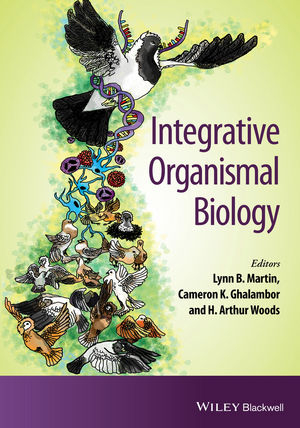
Integrative Organismal Biology (eBook)
John Wiley & Sons (Verlag)
978-1-118-39879-1 (ISBN)
Beginning with grounding theory highlighting the role of the individual in evolutionary and ecological processes, the book covers theory and mechanism from both classic and modern perspectives. Chapters explore concepts such as how genetic and epigenetic variation becomes physiological and phenotypic variation, homeostasis, gene regulatory networks, physiological regulatory networks, and integrators. A concluding section illustrates these concepts through a series of case studies of life processes such as aging, reproduction, and immune defense.
Written and edited by leaders in the field who are actively engaged in teaching and research, Integrative Organismal Biology will be an important advanced textbook for students and researchers across the numerous subdisciplines of integrative biology.
Integrative Organismal Biology synthesizes current understandings of the causes and consequences of individual variation at the physiological, behavioral and organismal levels. Emphasizing key topics such as phenotypic plasticity and flexibility, and summarizing emerging areas such as ecological immunology, oxidative stress biology and others, Integrative Organismal Biology pulls together information from diverse disciplines to provide a synthetic view of the role of the individual in evolution. Beginning with the role of the individual in evolutionary and ecological processes, the book covers theory and mechanism from both classic and modern perspectives. Chapters explore concepts such as phenotypic plasticity, genetic and epigenetic variation, physiological and phenotypic variation, homeostasis, and gene and physiological regulatory networks. A concluding section interweaves these concepts through a series of case studies of life processes such as aging, reproduction, and immune defense. Written and edited by leaders in the field, Integrative Organismal Biology will be an important advanced textbook for students and researchers across a variety of subdisciplines of integrative biology.
Lynn B. Martin is Assistant Professor in the Department of Integrative Biology at the University of South Florida. Dr. Martin is on the editorial boards for Functional Ecology and Proceedings of the Royal Society of London B, and serves as an ad hoc reviewer for numerous journals including American Naturalist, General and Comparative Endocrinology, Evolutionary Ecology, and Science. Cameron K. Ghalambor is Associate Professor in the Department of Biology at Colorado State University. The author of numerous peer-reviewed publications, Dr. Ghalambor also provides reviews for a number of journals including Evolution and Nature, and has served as a grant reviewer for the National Science Foundation, Murdoch Trust, and Natural Environment Research Council, UK. Art Woods is Associate Professor in the Division of Biological Sciences at the University of Montana, Missoula. Dr. Woods serves as a reviewer for numerous journals including Journal of Experimental Biology, Physiological and Biochemical Zoology, Proceedings of the Royal Society of London B, Functional Ecology, and American Naturalist. In 2009 Dr. Woods received one of the National Science Foundation's prestigious CAREER awards in support of his research on leaf microclimates and plant-insect interactions.
* Plasticity, Complexity and the Individual
Cameron K. Ghalambor, Lynn B. Martin and H. Arthur Woods
* The Ecological and Evolutionary Importance of Variation in Life History Reaction Norms
Daniel H. Nussey
* Curve-Thinking: Understanding Reaction Norms and Developmental Trajectories as Traits
Joel Kingsolver, Sarah Diamond, and Richard Gomulkiewicz
* Plasticity and Personality
Kimberley J. Mathot and Niels J. Dingemanse
* Induction and Function of Polyphenic Morphs: Proximate Regulatory Mechanisms and Evolutionary Implications
Anthony J. Zera and Jennifer A. Brisson
* Evolutionary Systems Biology: Shifting Focus to the Context-Dependency of Genetic Effects
Mihaela Pavlicev and Günter P. Wagner
* The Role of Ecological Epigenetics in Integrative Biology
Aaron W. Schrey, Joshua Banta, Holly J. Kilvitis, Christina L. Richards
* An Elephant in the Fog: Unifying Concepts of Physiological Stasis and Change
H. Arthur Woods and J. Keaton Wilson
* Physiological Regulatory Networks: The Orchestra of Life?
Lynn B. Martin and Alan A. Cohen
* Integrating Costs of Reproduction Between the Sexes
Robert M. Cox
* Immune Systems: Linking Organisms, Populations, and Evolution Through Disease
James S. Adelman
* Developmental Plasticity of Individual Variation in Stress Responses
Haruka Wada
* A Common Framework for the Regulation of Growth and Size: Stepping Away from the Trees to See the Forest
Goggy Davidowitz and Bryan R. Helm
* Adding Fuel to the "Fire of Life": Energy Budgets Across Levels of Variation in Ectotherms and Endotherms
Vincent Careau, Shaun S. Killen and Neil B. Metcalfe
* Biological Timekeeping: Individual Variation, Performance, and Fitness
Scott A. MacDougall-Shackleton, Heather E. Watts and Thomas P. Hahn
* Senescence: Integrating Biology from Cradle to the Grave
Mark F. Haussman and Lisa A. Treidel
* Linking Physiology, Climate and Species Distributional Ranges
Francisco Bozinovic and Daniel E. Naya
* Trade-Offs and Biological Diversity: Integrative Answers to Ecological Questions
Paul R. Martin
* Conclusions: The Central Role of the Organism in Biology
H. Arthur Woods, Lynn B. Martin, Cameron K. Ghalambor
"The organism was once the major driving focus of research questions, and this book should usher in a new era of technologically advanced organismcentered research." (The Quarterly Review of Biology, 1 December 2015)
Chapter 1
Plasticity, Complexity, and the Individual
Cameron K. Ghalambor1, Lynn B. Martin2, and H. Arthur Woods3
1Department of Biology and Graduate Degree Program in Ecology, Colorado State University, Fort Collins, Colorado, USA
2Department of Integrative Biology, University of South Florida, Tampa, FL, USA
3Division of Biological Sciences, University of Montana, Missoula, Montana 95812, USA
Introduction
The first half of the 20th century was a pivotal time for biology. The different branches of evolutionary biology, from genetics to paleontology, operated independently, each with its own debates and guiding theories. A major shift started in the 1930s, when theoretical and empirical work in population genetics (1) reconciled Mendelian inheritance with natural selection, (2) demonstrated that microevolution and macroevolution were compatible, and (3) elevated Darwin's views of descent with modification and evolution by natural selection as unifying theories in biology (Mayr & Provine 1998). These achievements, now referred to as the Modern Synthesis (Mayr & Provine 1998), enabled researchers to delineate a set of principles that could explain variation in genetic and phenotypic patterns over space and time. For example, we can understand the maintenance and spread of selfish genetic elements within the genome (e.g., transposable elements) or selfish individuals in a population (e.g., cheaters) using the same conceptual framework and principles of evolution by natural selection. Nevertheless, the Modern Synthesis, in its original conception, was limited: its application and appeal were largely limited to branches of biology interested in population-level processes. While there were attempts to incorporate a role for individual development and physiology into this broader evolutionary synthesis by Goldschmidt (1940), Schmalhausen (1949), and Waddington (1942), such efforts remained outside the focus of mainstream evolutionary biology. As a result, the Modern Synthesis left out areas of biology concerned with the structure and function of individual organisms, such as physiology, development, functional morphology, neuroscience, and behavior (Gottlieb 2001). These organismal branches recognized and embraced evolutionary concepts such as homology in comparative studies (Hall 2012) or how “ontogeny recapitulated phylogeny” (Kalinka & Tomancak 2012), but they largely operated outside an evolutionary framework when studying how organisms work today. Subsequently, much of biology below the level of individuals came to favor reductionism, assuming that greater deconstruction would explain best how organisms, tissues, and cells work (Bartholomew 1986; Strange 2005).
Today, however, biology finds the barriers between fields breaking down; there is an increasing integration of evolutionary principles into organismal biology (Carroll 2005; Jablonka & Lamb 2005; Harrison et al. 2012; Nesse et al. 2010; Perlman 2013; Westneat & Fox 2012), a growing appreciation that organismal function might inform evolutionary theory (Schlichting & Pigliucci 1998; Bell 2009; Flatt & Heyland 2011), and a desire to understand how complex integrated systems, such as whole organisms, function and evolve (Wagner & Altenberg 1996; Stern 2010; Strange 2005; Martin et al. 2011; Noble 2013). The next few years may therefore become another pivotal time for biology, as technical and mathematical advances are diffusing shared approaches across biological levels of organization. Moreover, new, extended syntheses are emerging that are truly integrative in their views on interactions among environments, genomes, and phenotypes (e.g., Schlichting & Pigliucci 1998; West-Eberhard 2003; Jablonka & Lamb 2005; Davidson 2001; Pigliucci & Muller 2010). Whereas the Modern Synthesis simplified biological processes by developing a general theory grounded in mathematical models, these new approaches are playing out against the backdrop of rapid progress toward understanding the mechanisms underlying the complexity of life. In the process, we are faced with what at first glance appears as an overwhelming degree of information and contingency. Our goal here is to argue that as we begin to open the black box linking genotypes, phenotypes, and their natural environments, an evolutionary perspective of how whole organisms function is needed. In doing so, mechanistic studies of form and function will be infused and guided by evolutionary theory, evolutionary biology will incorporate an understanding of how underlying mechanisms constrain or facilitate certain ecological and evolutionary outcomes, and collectively biologists working across scales will be motivated by a shared perspective that promotes developing and testing general theory.
We feel that these goals toward an integrative organismal biology will be served best by elevating the roles of individuals in biology. Already, there is a strong tradition of research on the structure and function across levels of organization (see also Wake 2008; Satterlie et al. 2009; Mykles et al. 2010; Noble 2013). But only recently has this work started to become firmly grounded in evolutionary theory and in natural (as opposed to laboratory) contexts. In this chapter, we focus on two themes that reveal the importance of understanding individuals: (1) the concept of phenotypic plasticity, or the capacity for a given genotype to produce different phenotypes in response to different environments and (2) the concepts of complexity and integration, or how suites of interacting traits across levels of organization respond to, and evolve in response to, environmental variation. Below, we first provide a brief history of progress toward an integrative organismal biology. We then review why the concepts of plasticity, complexity, and integration have such unifying power. We end with a case study of how a focus on understanding mechanisms within individuals can influence biology across scales.
Bridging the Conceptual Divide
Conceptual unification occurs when disciplines come to share underlying theories and questions but use different approaches. The promise of unification is that it will reveal new insights not achievable otherwise. Conceptual unification in biology remains a work in progress, and a key barrier has been the division between wanting to understand how organisms work versus why they work one way as opposed to another (e.g., Mayr 1961; Orians 1962; Dobzhansky 1964). Mayr (1961) referred explicitly to how (functional biology) vs why (evolutionary biology) as complementary but not alternative explanations for pattern and process. In practice, asking how biological systems work lends to reductionism because we often assume (at least implicitly) that insight stems from decomposing wholes into parts. In contrast, evolutionary biology is based on a set of conditions; the presence of heritable variation, the historical and contemporary processes generating and acting upon that variation, and the outcomes and patterns of these processes. These conditions were first fully articulated by Darwin (1859) without any knowledge of DNA or a mechanistic understanding of how organisms were built, and they eventually became codified in the population genetic models developed during the Modern Synthesis. Yet, we now are rapidly moving into an era where the divide between functional and evolutionary biology is eroding.
Evolutionary theory provides context and explanations for patterns that functional biology cannot. For example, understanding the details of transcription and translation does not tell us why genes and proteins are conserved across related taxa, or why they predictably change in response to certain environmental pressures. Similarly, a functional biologist can study the biomechanics of how bill size influences the ability to crush a seed, but an evolutionary biologist is more likely to explain why populations of birds on different islands have larger or smaller bills. Yet, there is a desperate need for unification—because the power of functional or evolutionary biology to explain biological phenomenon is limited when they operate alone. Evolutionary theory's ability to predict how a given population will respond to natural selection is often limited, because genotypes and phenotypes are generally black boxes, as are the developmental and physiological pathways that translate genotypes into phenotypes. Such limitations are pervasive in optimality and game theory models, where the constraints on the response to selection are simply inferred from deviations from a predicted optimum (Parker & Maynard-Smith 1990). Indeed, many evolutionary biologists would argue that a mechanistic understanding is not needed to predict evolutionary outcomes because, over time, natural selection will find optimal solutions. By contrast, others argue we need mechanism if we are to understand the trade-offs that constrain responses to selection. These constraints may be genetic in the form of pleiotropic relationships, physiological or developmental in the form allocation trade-offs between traits competing for the same pool of resources, or functional when selection on one trait or function negatively impacts another. Mechanism therefore provides insight into why one optimal solution rises to the top, and is something that optimality approaches are unable to do. For example, in their review of the regulatory mechanisms underlying polyphenisms, Zera and Brisson (Chapter 5, this volume) demonstrate how the genetic and endocrine basis of different phenotypes...
| Erscheint lt. Verlag | 13.11.2014 |
|---|---|
| Sprache | englisch |
| Themenwelt | Naturwissenschaften ► Biologie ► Evolution |
| Naturwissenschaften ► Biologie ► Ökologie / Naturschutz | |
| Technik | |
| Schlagworte | agign • Ãkologie u. Biologie der Organismen • Ãkologische Genetik • Behavior • Biologie • Biowissenschaften • ecological genetics • ecological immunology • Ecology & Organismal Biology • epigenetic variation • evolutionary biology • Evolutionsbiologie • genetic regulatory networks • genetic variation • homeostasis • immune defense • integrative biology • Integrative Organismal Biology,?individual variation • Life Sciences • Ökologie u. Biologie der Organismen • Ökologische Genetik • organismal biology • Organismus • oxidative stress biology,?evolution • phenotypic?flexibility • Phenotypic plasticity • physiological regulatory networks • Physiology • Reproduction |
| ISBN-10 | 1-118-39879-3 / 1118398793 |
| ISBN-13 | 978-1-118-39879-1 / 9781118398791 |
| Informationen gemäß Produktsicherheitsverordnung (GPSR) | |
| Haben Sie eine Frage zum Produkt? |
 EPUB (Adobe DRM)
Kopierschutz: Adobe-DRM
Adobe-DRM ist ein Kopierschutz, der das eBook vor Mißbrauch schützen soll. Dabei wird das eBook bereits beim Download auf Ihre persönliche Adobe-ID autorisiert. Lesen können Sie das eBook dann nur auf den Geräten, welche ebenfalls auf Ihre Adobe-ID registriert sind.
Details zum Adobe-DRM
Dateiformat: EPUB (Electronic Publication)
EPUB ist ein offener Standard für eBooks und eignet sich besonders zur Darstellung von Belletristik und Sachbüchern. Der Fließtext wird dynamisch an die Display- und Schriftgröße angepasst. Auch für mobile Lesegeräte ist EPUB daher gut geeignet.
Systemvoraussetzungen:
PC/Mac: Mit einem PC oder Mac können Sie dieses eBook lesen. Sie benötigen eine
eReader: Dieses eBook kann mit (fast) allen eBook-Readern gelesen werden. Mit dem amazon-Kindle ist es aber nicht kompatibel.
Smartphone/Tablet: Egal ob Apple oder Android, dieses eBook können Sie lesen. Sie benötigen eine
Geräteliste und zusätzliche Hinweise
Buying eBooks from abroad
For tax law reasons we can sell eBooks just within Germany and Switzerland. Regrettably we cannot fulfill eBook-orders from other countries.
aus dem Bereich