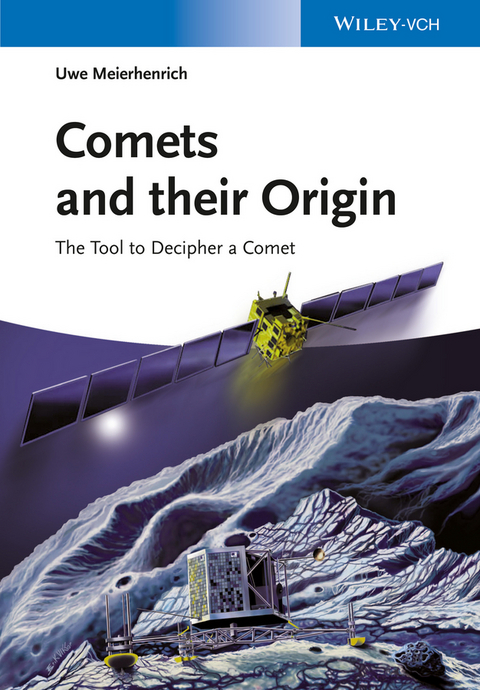

Divided into two parts, the first four chapters of Comets and their Origin refer to comets and their formation in general, describing cometary missions, comet remote observations, astrochemistry, artificial comets, and the chirality phenomenon.
The second part covers the cometary Rosetta mission, its launch, journey, scientific objectives, and instrumentations, as well as the landing scenario on a cometary nucleus. Along the way, the author presents general questions concerning the origin of terrestrial water and the molecular beginnings of life
on Earth, as well as how the instruments used on a space mission like Rosetta can help answer them. The text concludes with a chapter on what scientists expect from the Rosetta mission and how its data will influence our life on Earth.
As a result, the author elucidates highly topical and fascinating knowledge to scientists and students of various scientific backgrounds, allowing them to work with Rosetta‘s data.
Uwe J. Meierhenrich is full Professor of Chemistry and teaches at the University Nice Sophia Antipolis in France. Professor Meierhenrich studied chemistry at the Philipps University of Marburg, Germany. After completing his Ph.D. at the University of Bremen, he identified amino acids in artificial comets at the Max Planck Institute for Solar System Research in Katlenburg-Lindau and at the Centre de Biophysique Moléculaire in Orléans in preparation for the cometary Rosetta mission. Professor Meierhenrich is co-investigator of the cometary sampling and composition COSAC instrument onboard of Rosetta's lander Philae and his scientific research activities are dedicated to the chemistry of comets and the cometary mission Rosetta. He was awarded the Horst Pracejus Prize from the GDCh in 2011 for his work on chirality and enantioselective chromatography.
Uwe J. Meierhenrich is full Professor of Chemistry and teaches at the University Nice Sophia Antipolis in France. Professor Meierhenrich studied chemistry at the Philipps University of Marburg, Germany. After completing his Ph.D. at the University of Bremen, he identified amino acids in artificial comets at the Max Planck Institute for Solar System Research in Katlenburg-Lindau and at the Centre de Biophysique Moléculaire in Orléans in preparation for the cometary Rosetta mission. Professor Meierhenrich is co-investigator of the cometary sampling and composition COSAC instrument onboard of Rosetta's lander Philae and his scientific research activities are dedicated to the chemistry of comets and the cometary mission Rosetta. He was awarded the Horst Pracejus Prize from the GDCh in 2011 for his work on chirality and enantioselective chromatography.
Foreword Professor Michael F. A'Hearn
Foreword Professor Gerhard A. Schwehm
Preface
Part I Comets and Their Origin
1. Introduction
2. The Formation of Comets
3. Astrochemistry: Water and Organic Molecules in Comets
4. The Asymmetry of Life
Part II The Rosetta Mission - Rendezvous With a Comet
5. The Rosetta Cometary Mission: Launch and Target Comet
6. On the Way to Comet 67P/Churyumov-Gerasimenko
7. Rosetta's Rendezvous With the Comet
8. Conclusions and Outlook
Preface
Scientific and public interest in comets is significant. Comets are the most numerous and most pristine objects in the Solar System. They store scientific information about the origin of both the Solar System and the biosphere on Earth. Comets have been messengers and carriers of water and other important molecules, and today, their message is close to being deciphered. Therefore, we continue to be fascinated by these enigmatic objects.
In many aspects, the study of comets is the study of origins. Comets contain information – mineralogical, chemical, and structural information, as well as isotopic clues – about the origin and formation of the Solar System. Furthermore, comets include crucial information about the origin and evolution of planets, including their water inventory, and the origin of the formation of molecules, thereby providing important clues about the origins of life itself, including chirality-related phenomena. Therefore, the title of this book is Comets and their Origin.
The first part of this book will introduce and characterize comets. Based on the information obtained by the Vega, Sakigake, Suisei, and Giotto space probes, which investigated comet 1P/Halley, and also the cometary missions Deep Space 1, Stardust, Deep Impact, Stardust-NExT, and EPOXI, which visited Kuiper belt comets, the book will present our current understanding of the physical and chemical composition of different comets. It will introduce the formation of interplanetary dust particles, Brownlee particles, and the Greenberg model for the formation of cometesimals and comets. It will explain artificial comets that can be generated in the laboratory, and it will describe organic molecules, including the amino acids identified in comets. The book will outline a coherent model for the origin of life on Earth that is motivated by the molecular inventory of comets. Because the origin of life is assumed to require asymmetric precursor molecules, the asymmetric synthesis of chiral organic molecules in artificial comets will be presented. Data will be compared with the enantiomeric excesses identified in different meteorites.
This book aims to link comet data obtained from astronomical studies with experimental astrophysics and widen these fields to include chemistry, biology, and geology.
After Part I, which presents our current understanding of comets and their origin, the book will describe the most recent and ongoing cometary mission, Rosetta, which aims to reach comet 67P/Churyumov–Gerasimenko in August 2014 and to land on the surface of its nucleus in November 2014. Part II of this book begins with Rosetta's launch from Kourou, French Guiana, which was delayed because of a dramatic explosion of an Ariane 5 launcher prior to the originally planned Rosetta launch date in 2002. The book will then describe Rosetta's journey to the target comet Churyumov–Gerasimenko, including its flyby maneuvers around Mars, Earth, and asteroids. On Rosetta's way to the target comet, the space probe observed comet 9P/Tempel during the Deep Impact mission in 2005 and the asteroids Šteins in 2008 and Lutetia in 2010. The data obtained will be presented. The book will describe and characterize Rosetta's target comet, 67P/Churyumov–Gerasimenko. After reaching comet Churyumov–Gerasimenko, the Rosetta spacecraft will enter into an artificial orbit and begin its initial comet observation phase. The soft landing of the landing unit Philae on the cometary nucleus will be described in detail. Initial photos will be taken on the surface of the cometary nucleus, and the first science sequence, using selected scientific instruments, will start. After the presentation of detailed information on the landing and first science sequence, the long-term science sequence will be described. The book will outline the scientific objectives by describing general scientific questions and how the Rosetta instruments will help to answer them. Some of these questions concern the origins of terrestrial water and the molecular beginnings of life on Earth. The book will end with a chapter on what we, scientists, concretely expect from the cometary mission Rosetta and how Rosetta's data will influence our life on Earth. The first pictures and analyses of the comet will arrive on Earth some weeks after the publication of this book. The general aim of the book is to prepare the mind of the scientific community for the landing of Rosetta on the comet and the science that will be performed.
The Rosetta space probe aims to land on a cometary nucleus in November 2014. The mission and landing will attract significant interest from astronomers and astrophysicists, as well as physicists and space engineers. Because the transdisciplinary instrumentation onboard Rosetta's orbiter and the landing unit Philae – which is to be used to investigate cometary organic molecules, isotopic composition, chirality phenomena, and symmetry properties – scientists from disciplines such as geology, chemistry, biochemistry, and biology became involved in this mission. Geologists will use isotope fingerprinting to decipher crucial steps in the formation of the planetary system, including the origin and formation of terrestrial minerals and water. Since 1990, many chemists have contributed to the identification of scientific objectives and the development of the Rosetta mission. The mission will thus address important and new fields of chemical evolution, chirality, and stereochemistry. Astrochemistry is a new domain that will be involved. The life sciences that focus on the origin and evolution of enzymatic and genetic molecules will be addressed. Here, the new and dynamic domains of astrobiology/exobiology and bioastronomy come into play.
Science books, in general, and interdisciplinary science books, in particular, should not be composed of endless lists of facts without appropriate discussions and critical comments. The proposed book will avoid an uncommented listing of the physical parameters of different comets in the form of tables. The aim of the proposed book is rather to present a general science framework for the Rosetta cometary mission. The book should enter into the scientific debates and discussions generated by Rosetta's different instruments and be appreciated by the reader.
Authoring this book, I was fortunate to work with and learn from Professor Wolfram H.-P. Thiemann at the University of Bremen. He introduced me to the intriguing fields of chirality and cometary research. The international collaboration in my research field on the origin of life's molecular asymmetry was initiated by Dir. Dr Helmut Rosenbauer at the Max Planck Institute for Solar System Research in Katlenburg-Lindau, Germany, via the ambitious conception and preparation of the COSAC experiment onboard the Rosetta lander. My thanks go to Dr Rosenbauer for this scientific support and his colleagues Dr Fred Goesmann and Dr Reinhard Roll for their fascinating basic work on COSAC and for plenty of conferences in the midst of fruitful discussions.
It was also a great pleasure to carry out scientific research within the international COSAC team including Dr Hermann Boehnhardt, Dr Jan Hendrik Bredehöft, Dr Jean-Francis Brun, Dr Michel Cabane, Dr Antonio Casares, Dr David Coscia, Professor Pascale Ehrenfreund, Professor Guy Israel, Laurent Janin, Dr Oliver Kuechemann, Professor Takekiyo Matsuo (†), Dr Guillermo M. Muñoz Caro, Professor François Raulin, Dr Harald Steininger, Dr Robert Sternberg, Dr Cyril Szopa, Dr Stephan Ulamec, and Professor H. Wollnik, who provided their full cooperation and scientific support. I also appreciate related discussions with Dr Franz R. Krueger, Professor Kensei Kobayashi, and Dr Jun-ichi Takahashi.
Intensive experimental collaborations were performed with Professor J. Mayo Greenberg (†) at the Raymond and Beverly Sackler Laboratory for Astrophysics at the Leiden Observatory and his group composed of Dr Guillermo M. Muñoz Caro, Dr Willem A. Schutte, and Almudena Arcones Segovia. I acknowledge the pleasant cooperation with Professor Greenberg's Ph.D. student Guillermo M. Muñoz Caro, now at the Astrobiology Center in Madrid, and his carefully performed experiments on the simulation of interstellar ices with isotopically labeled reactants.
I thank for the generous support of Dir. Dr André Brack from the Centre de Biophysique Moléculaire in Orléans. Advanced experiments with circularly polarized light were performed at the Synchrotron Centers LURE and SOLEIL in Paris at beamlines SA-61, SU-5, and DESIRS. I would like to acknowledge the staff of these research centers and especially the substantial and advanced studies of Dr Laurent Nahon on both the generation and detection of circularly polarized synchrotron radiation. Thanks also go to Dr Louis d'Hendecourt and Dr Pierre de Marcellus from the Institut d'Astrophysique Spatiale in Paris-Orsay and to Dr Martin Schwell from the Université Paris VII Denis Diderot. I also appreciate to work with Dr Søren V. Hoffmann and Nykola C. Jones at beamlines UV-1 and CD-1 at Århus University, Denmark, in the Center of Storage Ring Facilities. I wish to thank Dr Max P. Bernstein for his contributions and Dr Jason P. Dworkin (both at NASA Ames Research Center, Moffet Field, California) for discussions on enantioselective chromatographic techniques for samples of interstellar ice analogs.
Moreover, I acknowledge lively discussions on the multifaceted cometary phenomena with all members of my research team at the Institut de Chimie de...
| Erscheint lt. Verlag | 12.11.2014 |
|---|---|
| Sprache | englisch |
| Themenwelt | Naturwissenschaften ► Physik / Astronomie ► Astronomie / Astrophysik |
| Technik | |
| Schlagworte | Aeronautic & Aerospace Engineering • Astronomie • Astronomie u. Astrophysik • Astronomy & Astrophysics • Astrophysik • asymmetry • atomic and molecular physics • Atom- u. Molekülphysik • Atom- u. Molekülphysik • author • Background • Comet • comets • Different • earth sciences • F • foreword professor • Formation • Geophysics • Geophysik • Geowissenschaften • Komet • Life • Luft- u. Raumfahrttechnik • Maschinenbau • mechanical engineering • mission rendezvous • Molecules • P • Part • Physics • Physik • Professor • Rosetta • rosetta cometary mission • rosettas rendezvous • Scientific • students • Way |
| ISBN-10 | 3-527-41279-4 / 3527412794 |
| ISBN-13 | 978-3-527-41279-2 / 9783527412792 |
| Informationen gemäß Produktsicherheitsverordnung (GPSR) | |
| Haben Sie eine Frage zum Produkt? |
 EPUB (Adobe DRM)
Kopierschutz: Adobe-DRM
Adobe-DRM ist ein Kopierschutz, der das eBook vor Mißbrauch schützen soll. Dabei wird das eBook bereits beim Download auf Ihre persönliche Adobe-ID autorisiert. Lesen können Sie das eBook dann nur auf den Geräten, welche ebenfalls auf Ihre Adobe-ID registriert sind.
Details zum Adobe-DRM
Dateiformat: EPUB (Electronic Publication)
EPUB ist ein offener Standard für eBooks und eignet sich besonders zur Darstellung von Belletristik und Sachbüchern. Der Fließtext wird dynamisch an die Display- und Schriftgröße angepasst. Auch für mobile Lesegeräte ist EPUB daher gut geeignet.
Systemvoraussetzungen:
PC/Mac: Mit einem PC oder Mac können Sie dieses eBook lesen. Sie benötigen eine
eReader: Dieses eBook kann mit (fast) allen eBook-Readern gelesen werden. Mit dem amazon-Kindle ist es aber nicht kompatibel.
Smartphone/Tablet: Egal ob Apple oder Android, dieses eBook können Sie lesen. Sie benötigen eine
Geräteliste und zusätzliche Hinweise
Buying eBooks from abroad
For tax law reasons we can sell eBooks just within Germany and Switzerland. Regrettably we cannot fulfill eBook-orders from other countries.
aus dem Bereich