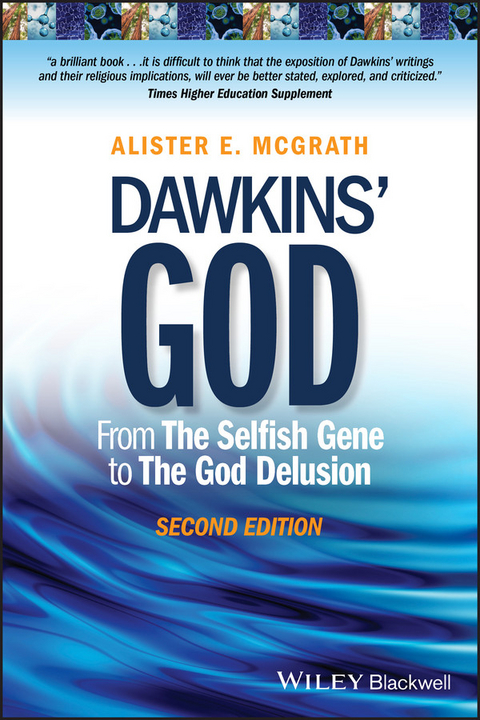
Dawkins' God (eBook)
208 Seiten
Wiley (Verlag)
9781118964798 (ISBN)
- Includes in-depth analysis of Dawkins' landmark treatise The God Delusion (2006), as well as coverage of his later popular works The Magic of Reality (2011) and The Greatest Show on Earth (2011),and a new chapter on Dawkins as a popularizer of science
- Tackles Dawkins' hostile and controversial views on religion, and examine the religious implications of his scientific ideas including a comprehensive investigation of the 'selfish gene'
- Written in an accessible and engaging style that will appeal to anyone interested in better understanding the interplay between science and religion
ALISTER E. MCGRATH is Andreas Idreos Professor of Science and Religion at the University of Oxford. One of the world's leading theologians, he has written numerous critically acclaimed books, including The Intellectual World of C. S. Lewis (Wiley, 2013), Why God Won't Go Away: Engaging the New Atheism (2011), and Darwinism and the Divine: Evolutionary Thought and Natural Theology (Wiley, 2011). He is also the author of some of the most widely used theology textbooks, including the bestselling Christian Theology: An Introduction, now in its fifth edition (Wiley, 2010).
ALISTER E. MCGRATH is Andreas Idreos Professor of Science and Religion at the University of Oxford. One of the world's leading theologians, he has written numerous critically acclaimed books, including The Intellectual World of C. S. Lewis (Wiley, 2013), Why God Won't Go Away: Engaging the New Atheism (2011), and Darwinism and the Divine: Evolutionary Thought and Natural Theology (Wiley, 2011). He is also the author of some of the most widely used theology textbooks, including the bestselling Christian Theology: An Introduction, now in its fifth edition (Wiley, 2010).
Acknowledgments ix
Introduction 1
1 Darwinism: The Rise of a Scientific Theory 7
Natural Selection: Charles Darwin 9
The Mechanics of Inheritance: Gregor Mendel 18
The Discovery of the Gene: Thomas Hunt Morgan 21
The Role of DNA in Genetics 24
What's in a Name? "Darwinism" or "Evolutionary Theory"? 26
2 The Selfish Gene: A Darwinian View of the World 32
Introducing Dawkins 33
Dawkins' Approach: The Selfish Gene 38
The Place of Humanity in a Darwinian Universe 44
Are Genes Really Selfish? 47
What Remains of the "Selfish Gene" Approach? 51
3 Blind Faith?: Evidence, Proof, and Rationality in Science and Religion 57
Faith as Blind Trust? 60
Is Atheism Itself a Faith? 68
Is Christian Faith Irrational? 71
The Problem of Radical Theory Change in Science 77
The Limits of Science 80
Mystery, Insanity, and Nonsense 82
4 The Blind Watchmaker: Evolution and the Elimination of God? 86
The Contours of a Darwinian Worldview 86
Is Darwinism a Complete Explanation? 91
God as an Explanatory Hypothesis? 93
The Elimination of Purpose: Dawkins on Teleology in Nature 96
The Divine Watchmaker: Paley's Grand (but Correctable) Mistake 98
Dynamic Conceptions of Creation: Augustine of Hippo 107
Natural Selection and Religious Beliefs: Darwin's Views 111
The Christian Reaction to Darwin 116
5 Cultural Darwinism?: The Invention of the Meme 120
Universal Darwinism: The Evolution of Culture 120
Introducing the Meme 122
Introducing the "God-Meme" 125
Is Cultural Development Darwinian? 128
Do Memes Actually Exist? 131
The Flawed Analogy between Gene and Meme 133
The Redundancy of the Meme 136
God as a Virus of the Mind? 139
Moving On ... 143
6 The God Delusion: Dawkins on Atheism, Science, and Religion 144
The Cultural Location of The God Delusion 145
The "Warfare" of Science and Religion 149
Natural Science Leads to Neither Atheism Nor Christianity 155
Science, Faith, and Evidence 157
A Darwinian Explanation of Belief in God? 162
Awe, Wonder, and Religion 166
Conclusion 170
Select Bibliography 173
Index 184
Priase for the Previous Edition
"Wielding evolutionary arguments and carefully chosen metaphors
like sharp swords, Richard Dawkins has emerged over three decades
as this generation's most aggressive promoter of atheism. In
his view, science, and science alone, provides the only rock worth
standing on. In this remarkable book, Alister McGrath challenges
Dawkins on the very ground he holds most sacred - rational
argument - and McGrath disarms the master. It becomes readily
apparent that Dawkins has aimed his attack at a naive version of
faith that most serious believers would not recognize. After
reading this carefully constructed and eloquently written book,
Dawkins' choice of atheism emerges as the most irrational of
the available choices about God's existence." Francis
Collins, Director of the Human Genome Project
"In this tour-de-force Alister McGrath
approaches the edifice of self-confident, breezy atheism so
effectively promoted by Richard Dawkins, and by deft dissection and
argument reveals the shallowness, special-pleading and
inconsistencies of his world-picture. Here is a book which
helps to rejoin the magnificence of science to the magnificence of
God's good Creation." Simon Conway Morris, Professor
of Evolutionary Palaeobiology, Cambridge University
"Here Alister McGrath announces what every Darwinian
Fundamentalist needs to hear: that science is and always has been a
cultural practice that is provisional, fallible, and socially
shaped - an enterprise to be cultivated and fostered, but
hardly worshipped or idolised. A devastating critique."
David N. Livingstone, Professor of Geography and Intellectual
History, Queen's University, Belfast
Introduction
I first came across Richard Dawkins in 1977 when I read his Selfish Gene (1976). I was completing my doctoral research in Oxford University’s department of biochemistry, under the genial supervision of Professor Sir George Radda, who went on to become Chief Executive of the Medical Research Council. I was trying to figure out how biological membranes work so successfully by developing new physical methods to study their behavior.
Although it would be some years before The Selfish Gene achieved the cult status it subsequently enjoyed, it was obviously a marvelous book. I admired Dawkins’ wonderful way with words, and his ability to explain crucial – yet often difficult – scientific ideas so clearly. It was popular scientific writing at its best. No surprise, then, that the New York Times commented that it was “the sort of popular science writing that makes the reader feel like a genius.”
By any standards, The Selfish Gene was a great read – stimulating, controversial, and informative. Dawkins had that rare ability to make complex things understandable, without talking down to his audience. Yet Dawkins did more than just make evolutionary theory intelligible. He was willing to set out its implications for every aspect of life, in effect presenting Darwinism as a universal philosophy of life, rather than a mere scientific theory. It was heady stuff – far better, in my view, than Jacques Monod’s earlier work Chance and Necessity (1971), which explored similar themes, but in a rather dull way. And, like all provocative writers, Dawkins opened up debates which were both important and intrinsically interesting – such as the existence of God, and the meaning of life.
Although Dawkins’ atheism was evident in The Selfish Gene, it was presented in an interesting and engaging way – the kind of approach that provokes a good conversation. I was especially interested in Dawkins’ own history, as we had traversed quite different routes – in my case, from atheism to Christianity; in his, from Christianity to atheism. In fact, at that time I was in the process of moving from the study of the natural sciences to Christian theology, combining working in Oxford’s research laboratories with taking tutorials in theology. My long-term goal was to explore the relation of Christian thought and the natural sciences, and my mentors had made it clear that I would need research degrees in both disciplines to be taken seriously.
By June 1978, I had gained my doctorate in molecular biophysics and first-class honors in theology, and was preparing to leave Oxford to begin theological research at Cambridge University. To my surprise, I then received an invitation to lunch with a senior editor at Oxford University Press. Oxford is a very small place, and gossip spreads very quickly. The Press had heard about my “interesting career to date,” he explained, and had an interesting possibility to discuss with me. Dawkins’ Selfish Gene had generated a huge amount of interest. Would I like to write a response from a Christian perspective?
It would be a wonderful book to write. Only a fool, I remember thinking at the time, could resist such an invitation. After much thought, I wrote a polite note thanking my colleague for lunch, and explaining that I did not yet feel ready to write such a book. There were many others better qualified, in my view – such as the biochemist and theologian Arthur Peacocke (1924–2008). It would just be a matter of time before someone else wrote a book-length response to Dawkins’ ideas. So I headed off to Cambridge to do research into Christian theology, before returning to Oxford to lecture in theology in 1983. Oxford University’s excellent library resources meant I was able to keep up and develop my reading in the history and philosophy of science, as well as follow the most recent experimental and theoretical developments in the field.
But I had not forgotten Dawkins. His Selfish Gene introduced a new concept and word into the investigation of the history of ideas – the “meme.” As the area of research I hoped to pursue was the history of ideas (specifically, Christian theology, but set against the backdrop of intellectual development in general), I had done a substantial amount of background research on existing models of how ideas were developed and received within and across cultures. None of them seemed satisfactory.1 But Dawkins’ theory of the “meme” – a cultural replicator – seemed to offer a brilliant new theoretical framework for exploring the general question of the origins, development, and reception of ideas, based on rigorous empirical scientific investigation. I recall with great affection a moment of sheer intellectual excitement, sometime late in 1977, when I realized that there might be a credible alternative to the stale and unpersuasive models of doctrinal development I had explored and rejected at that stage. Might this be the future?2
As I knew from Darwin’s work on the Galapagos finches, it helps to approach evidence with at least a provisional theoretical framework.3 And so I began to explore using the “meme” as a model for the development of Christian doctrine. I shall report more fully on my twenty-five-year evaluation of both the “meme” concept and its utility in a later chapter. Suffice it to say at this stage that I was perhaps somewhat optimistic concerning both its rigorous empirical grounding and its value as a tool for the critical study of intellectual development.
In the meanwhile, Dawkins went on to produce a series of brilliant and provocative books, each of which I devoured with interest and admiration. Dawkins followed The Selfish Gene with The Extended Phenotype (1981), The Blind Watchmaker (1986), River out of Eden (1995), Climbing Mount Improbable (1996), Unweaving the Rainbow (1998), A Devil’s Chaplain (2003), and finally the culmination of his career as an atheist apologist in The God Delusion (2006). Following The God Delusion, Dawkins went on to publish some elegant works of popular science, and an informative memoir of his life, which have informed the analysis in these pages. Yet the tone and focus of Dawkins’ writing changed over the years. As philosopher Michael Ruse pointed out in a review of The Devil’s Chaplain, Dawkins’ focus shifted “from writing about science for a popular audience to waging an all-out attack on Christianity.”4 The brilliant scientific popularizer became a tub-thumping anti-religious polemicist, preaching rather than arguing his case (or so it seemed to his critics).
So what is the source of Dawkins’ hostility to religion? My reading of his works suggests that this animosity is deep-rooted, and not grounded in one specific concern. Four interconnected yet distinct grounds of criticism may be found throughout his writings. All are found in his God Delusion (2006); yet their formulation dates from different stages of his career.
- A Darwinian worldview makes belief in God unnecessary or impossible. Although hinted at in The Selfish Gene, this idea is developed in more detail in The Blind Watchmaker.
- Religion makes assertions which are grounded in faith, a “kind of mental illness” which shies away from a rigorous, evidence-based concern for truth. For Dawkins, truth is grounded in explicit proof; any form of obscurantism or mysticism grounded in faith is to be opposed vigorously. Dawkins’ robust insistence on evidence-based thinking is obvious in The Selfish Gene, and recurs regularly in his later writings.
- Religion offers an impoverished and attenuated vision of the world. “The universe presented by organized religion is a poky little medieval universe, and extremely limited.”5 In contrast, science offers a bold and brilliant vision of the universe as grand, beautiful, and awe-inspiring. This aesthetic critique of religion is developed especially in his 1998 work Unweaving the Rainbow.
- Religion leads to evil. It is like a malignant virus, infecting human minds. This is not strictly a scientific judgment, in that, as Dawkins often points out, the sciences cannot establish what is good or evil. “Science has no methods for deciding what is ethical.”6 It is, however, a profoundly moral objection to religion, deeply rooted within western culture and history, which must be taken with the greatest seriousness.
In 2004, I published the first edition of Dawkins’ God, which aimed to explore and evaluate Dawkins’ views on science and religion through a close reading of his publications – in effect, a belated version of the book I was asked to write back in 1978. There were three main reasons for writing that book. First, Dawkins is a fascinating writer, both in terms of the quality of the ideas he develops, and the verbal dexterity with which he defends them. Anyone who is remotely interested in debates about the meaning of life will find Dawkins an important sparring partner. Augustine of Hippo once wrote of the “eros of the mind,” referring to a deep longing within the human mind to make sense of things – a passion for understanding and knowledge. Anyone sharing that passion will want to enter...
| Erscheint lt. Verlag | 11.11.2014 |
|---|---|
| Sprache | englisch |
| Themenwelt | Geisteswissenschaften ► Philosophie ► Erkenntnistheorie / Wissenschaftstheorie |
| Geisteswissenschaften ► Religion / Theologie | |
| Naturwissenschaften | |
| Schlagworte | Religion & Science • Religion & Theology • Religion u. Naturwissenschaften • Religion u. Theologie • science and religion, atheism, The God Delusion, popular science, theology, god-meme, selfish gene, religious studies, popular theology, Richard Dawkins, new atheism |
| ISBN-13 | 9781118964798 / 9781118964798 |
| Informationen gemäß Produktsicherheitsverordnung (GPSR) | |
| Haben Sie eine Frage zum Produkt? |
 EPUB (Adobe DRM)
Kopierschutz: Adobe-DRM
Adobe-DRM ist ein Kopierschutz, der das eBook vor Mißbrauch schützen soll. Dabei wird das eBook bereits beim Download auf Ihre persönliche Adobe-ID autorisiert. Lesen können Sie das eBook dann nur auf den Geräten, welche ebenfalls auf Ihre Adobe-ID registriert sind.
Details zum Adobe-DRM
Dateiformat: EPUB (Electronic Publication)
EPUB ist ein offener Standard für eBooks und eignet sich besonders zur Darstellung von Belletristik und Sachbüchern. Der Fließtext wird dynamisch an die Display- und Schriftgröße angepasst. Auch für mobile Lesegeräte ist EPUB daher gut geeignet.
Systemvoraussetzungen:
PC/Mac: Mit einem PC oder Mac können Sie dieses eBook lesen. Sie benötigen eine
eReader: Dieses eBook kann mit (fast) allen eBook-Readern gelesen werden. Mit dem amazon-Kindle ist es aber nicht kompatibel.
Smartphone/Tablet: Egal ob Apple oder Android, dieses eBook können Sie lesen. Sie benötigen eine
Geräteliste und zusätzliche Hinweise
Buying eBooks from abroad
For tax law reasons we can sell eBooks just within Germany and Switzerland. Regrettably we cannot fulfill eBook-orders from other countries.
aus dem Bereich