


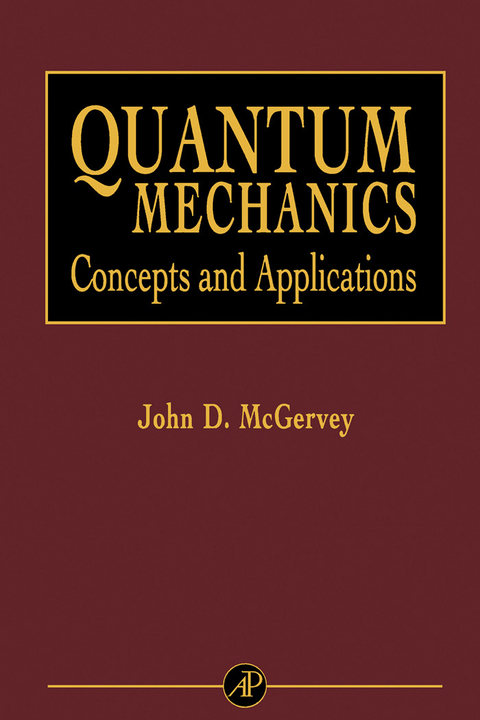
Quantum Mechanics (eBook)
408 Seiten
Elsevier Science (Verlag)
9781483288857 (ISBN)
This re-focused third edition of McGerveys Introduction to Modern Physics is one of the most comprehensive up-to-date textbooks and references sources on quantum mechanics available. This revision fills the gapbetween the mainly descriptive treatments of quantum mechanics, usually found in traditional modern physics texts, and the non-intuitive approaches that treat the subject as a series of mathematical theorems. McGervey achieves this goal with a thoughtfulanalysis of a number of experiments, supplementing these with fully worked examples, and by investigating paradoxes rather than relying on the analysis of a series of dry mathematical theorems. Software, provided with the text, is available for IBM-PC compatible computers with VGA graphics. The software is the basis for the homework problems, many of which have not been used in any form in other books at this level. The text is exceptionally current, a fact reflected in the significant amount of materialbased on articles published in recent years in The American Journal of Physics, The Physical Review, and Science. In all, McGervey provides a lively discussion that will motivate interest and understanding of the subject at the senior undergraduate level.* A re-focused third edition of McGervey's Introduction to Modern Physics* Analyzes a number of different experiments, supplementing these with numerical examples including fully worked problems* Includes software that is the basis for homework problems, many of which have not been seen in any other form in other books at this level* Investigates paradoxes rather than relying on the analysis of a series of dry mathematical theorems
Front Cover 1
Quantum Mechanics: Concepts and Applications 4
Copyright Page 5
Table of Contents 6
Preface 12
CHAPTER 1. The Quantum Concept 16
1.1 The Photoelectric Effect: Failure of Classical Explanations 16
1.2 Atomic Spectroscopy and Discrete Energy Levels in Atoms 20
1.3 The Bohr Model of the Atom 22
1.4 Atomic Collisions 26
1.5 The Correspondence Principle 28
1.6 X Rays: Production and Detection 31
1.7 Moseley's Law 34
1.8 Compton Scattering 35
Summary 38
Additional Reading 38
Exercises 38
CHAPTER 2. Waves and Particles 41
2.1 The de Broglie Wave Hypothesis 41
2.2 Electron Diffraction: The Davisson–Germer Experiment 42
2.3 Fourier Synthesis and Wave Packets 44
2.4 Uncertainty Relations 52
2.5 Traveling Waves 58
2.6 Complementarity 61
Additional Reading 64
Exercises 64
CHAPTER 3. The Schrödinger Equation in One Dimension 69
3.1 Construction of the Wave Equation for a Free Particle 70
3.2 Boundary Conditions, Continuity Conditions, and the Square Well 72
3.3 Probability, Expectation Values, and Operators 83
Additional Reading 91
Exercises 91
CHAPTER 4. Further Analysis of One-Dimensional Bound Systems 95
4.1 Multiple Square Wells 95
4.2 The Simple Harmonic Oscillator and Stepping Operators 99
4.3 The Quantum Bouncer 106
Summary 110
Additional Reading 111
Exercises 111
CHAPTER 5. The Free Particle as a Traveling Wave 115
5.1 The Free Particle and Its Behavior at a Potential Step 115
5.2 Probability Current 119
5.3 Barrier Penetration 123
Additional Reading 128
Exercises 128
CHAPTER 6. Three Dimensions and Angular Momentum 130
6.1 The Schrödinger Equation in Three Dimensions 130
6.2 Spherically Symmetric Potentials 135
6.3 Angular Momentum Operators and Eigenvalues 137
6.4 Statistical Analysis of Angular Momentum Eigenvalues 144
6.5 Experimental Test of Theory: Double Stern–Gerlach Experiment 147
Additional Reading 151
Exercises 151
CHAPTER 7. Angular Momentum and Superposition of States 154
7.1 Eigenfunctions of Angular Momentum Components 154
7.2 The Superposition Postulate 157
7.3 Matrix Methods 162
7.4 Generalized Operators and Dirac Notation 164
Additional Reading 172
Exercises 172
CHAPTER 8. The Radial Schrödinger Equation 174
8.1 Solutions for a Free Particle 174
8.2 The Spherical Potential Well 177
8.3 Example: The Spherically Symmetric Harmonic Oscillator Revisited 182
8.4 Scattering of Particles from a Spherically Symmetric Potential 185
Additional Reading 195
Exercises 195
CHAPTER 9. The Hydrogen Atom 198
9.1 Wave Functions for More Than One Particle 198
9.2 Energy Levels of the Hydrogen Atom 201
Additional Reading 208
Exercises 208
CHAPTER 10. Spin 211
10.1 The Spin Operators 212
10.2 Fine Structure in the Hydrogen Spectrum 213
10.3 Stepping Operators and Eigenvalues of J2 218
10.4 Spin and Relativity: The Dirac Equation and Antimatter 227
Additional Reading 232
Exercises 232
CHAPTER 11. Identical Particles 236
11.1 Identical Particles and Symmetry of Wave Functions 236
11.2 Symmetry of States for Two Identical Particles 240
11.3 Local Realism and the Einstein–Podolsky–Rosen Paradox 242
Summary 247
Additional Reading 248
Exercises 248
CHAPTER 12. Approximate Solutions 250
12.1 Time-Independent Perturbation Theory 250
12.2 The Three-Body System: The Helium Atom 258
12.3 Relativistic Correction, Hydrogen Energy Levels 264
12.4 Tunneling and Alpha-Particle Emission 269
Additional Reading 273
Exercises 273
CHAPTER 13. Atomic Spectroscopy 275
13.1 The Periodic Table of the Elements 275
13.2 Alkali-Metal Spectra 280
13.3 Systems with Two or More Electrons 282
13.4 The Zeeman Effect 291
Additional Reading 296
Exercises 296
CHAPTER 14. Time–Dependent Perturbations and Radiation 298
14.1 Transition Rates for Induced Transitions 298
14.2 Spontaneous Transitions 307
14.3 Derivation of Selection Rules 314
14.4 Examples of Induced and Spontaneous Transitions 320
Additional Reading 326
Exercises 326
CHAPTER 15. Molecular Structure and Spectra 330
15.1 Ionic and Covalent Binding 330
15.2 Molecular Spectra: Vibrational and Rotational States 333
Additional Reading 339
Exercises 339
CHAPTER 16. Quantum Statistics 341
16.1 Three Kinds of Statistics 342
16.2 Derivation of the General Form of Each Distribution Function 346
16.3 Application of Fermi–Dirac Statistics: Free Electrons in Metals 355
16.4 Applications of Bose–Einstein Statistics 365
Additional Reading 376
Exercises 376
APPENDIX A: Probability and Statistics 378
A.1 Definitions 378
A.2 Binomial Distribution 380
A.3 Poisson Distribution 381
A.4 Normal Distribution 382
A.5 Example: Statistics in Detecting Gamma Rays 384
APPENDIX B: The Boltzmann Factor 385
APPENDIX C: Relativistic Dynamics 387
C.1 The Principle of Relativity 387
C.2 The Speed of Light in Free Space 387
C.3 Inertial Frames 388
C.4 Addition of Velocities 389
C.5 Conservation Laws 393
APPENDIX D: Derivation of the Eigenfunctions of the L2 Operator 399
APPENDIX E: Solution of the Radial Equation for the Hydrogen Atom 403
APPENDIX F: Numerical Solution of the Schrödineer Equation 408
F.1 Starting the Program 409
APPENDIX G: "Stable" Particles 415
APPENDIX H: Table of Physical Constants 417
Index 418
| Erscheint lt. Verlag | 22.10.2013 |
|---|---|
| Sprache | englisch |
| Themenwelt | Naturwissenschaften ► Physik / Astronomie ► Quantenphysik |
| Technik | |
| ISBN-13 | 9781483288857 / 9781483288857 |
| Informationen gemäß Produktsicherheitsverordnung (GPSR) | |
| Haben Sie eine Frage zum Produkt? |
 PDF (Adobe DRM)
Kopierschutz: Adobe-DRM
Adobe-DRM ist ein Kopierschutz, der das eBook vor Mißbrauch schützen soll. Dabei wird das eBook bereits beim Download auf Ihre persönliche Adobe-ID autorisiert. Lesen können Sie das eBook dann nur auf den Geräten, welche ebenfalls auf Ihre Adobe-ID registriert sind.
Details zum Adobe-DRM
Dateiformat: PDF (Portable Document Format)
Mit einem festen Seitenlayout eignet sich die PDF besonders für Fachbücher mit Spalten, Tabellen und Abbildungen. Eine PDF kann auf fast allen Geräten angezeigt werden, ist aber für kleine Displays (Smartphone, eReader) nur eingeschränkt geeignet.
Systemvoraussetzungen:
PC/Mac: Mit einem PC oder Mac können Sie dieses eBook lesen. Sie benötigen eine
eReader: Dieses eBook kann mit (fast) allen eBook-Readern gelesen werden. Mit dem amazon-Kindle ist es aber nicht kompatibel.
Smartphone/Tablet: Egal ob Apple oder Android, dieses eBook können Sie lesen. Sie benötigen eine
Geräteliste und zusätzliche Hinweise
Buying eBooks from abroad
For tax law reasons we can sell eBooks just within Germany and Switzerland. Regrettably we cannot fulfill eBook-orders from other countries.
aus dem Bereich


