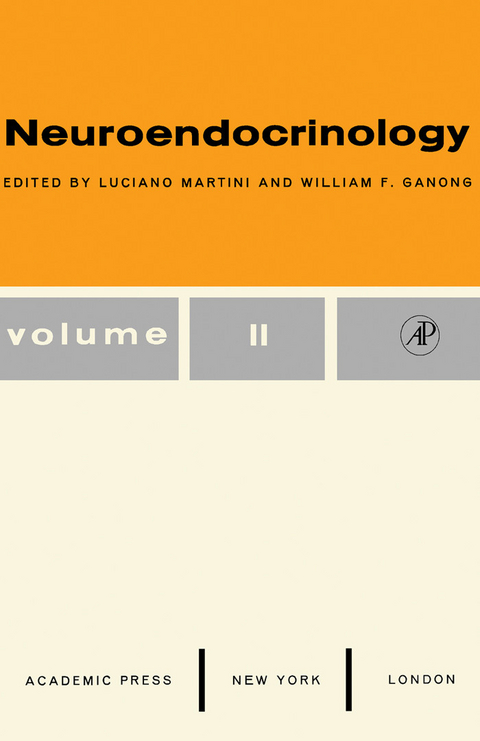
Neuroendocrinology (eBook)
798 Seiten
Elsevier Science (Verlag)
978-1-4832-7505-5 (ISBN)
Neuroendocrinology, Volume II, is the second in a two-volume treatise designed to provide a survey of all aspects of the rapidly expanding science of neuroendocrinology. Only in recent years have the relations between the nervous system and the endocrine system come under intensive scrutiny, but their interactions have already been shown to be multiple and diverse. This diversity is reflected in the range of subjects covered. There are chapters on neural control of endocrine function; the effects of hormones on the brain; brain-endocrine interrelations during various phases of development; and the comparative aspects of neuroendocrine integration. The relation of brain chemistry to endocrine function, the effect of drugs on neuroendocrine mechanisms, and the new discipline of clinical neuroendocrinology have also been considered. Not only neurophysiologists and endocrinologists, but pharmacologists, zoologists, biochemists, psychologists, and those in clinical medicine will find the treatise of interest. Parts of neuroendocrinology have been discussed in other works, but this is the first treatise in which an attempt has been made to cover all ramifications of neuroendocrinology. This book can be used both as a text for advanced students and as a reference source.
Front Cover 1
Neuroendocrinology 4
Copyright Page 5
Table of Contents 10
List of Contributors 6
Preface 8
Contents of Volume 1 16
CHAPTER 17. Role in Reproductive Physiology of Afferent Impulses from the Genitalia and Other Regions 22
I. Introduction 22
II. Innervation of the Reproductive Tract 23
III. The Role of Peripheral Nerves in Reproductive Processes in the Male 25
IV. The Role of Peripheral Nerves in Reproductive Processes in the Female 26
V. Modification of Gonadal Function by Manipulation of the Genital Tract 28
VI. Exteroceptive Stimuli Influencing Reproductive Processes 32
VII. Summary and Conclusions 36
REFERENCES 36
CHAPTER 18. Effects of Light and Visual Stimuli on Endocrine Function 40
I. Introduction 41
II. Physical and Temporal Characteristics of Natural Light, and Their Endocrine Significance 43
III. The Responses of Animals to Light 54
IV. Methods Used to Study the Endocrine Effects of Light, and Common Problems in the Interpretation of Data 57
V. Mechanisms by Which Light Influences Selected Neuroendocrine Functions 61
VI. Summary 71
ACKNOWLEDGMENT 72
REFERENCES 72
CHAPTER 19. Modifications in Reproductive Function after Exposure to Hormones during the Prenatal and Early Postnatal Period 82
I. General Introduction 83
II. The Effect of Pre- and Postnatal Hormone Treatmenton Subsequent Reproduction 83
III. The Persistent Estrus Syndrome, Its Cause, and Its Contributionto the Understanding of the Normal Estrous Cycle 88
IV. Effects of Prepubertal Androgen Treatment on Pituitary Gonadotropin 96
V. Comparative Effects of Prepubertal Treatment with Hormones Other Than Androgen on Subsequent Fertility 100
VI. Effects of Prepubertal Steroid Treatment on Mating Behavior 105
VII. Influence of Exogenous Hormone Administration in Adult Female Rats Pretreated with Sex Steroids before Puberty 108
VIII. Influence of Prepubertal Hormone Treatment on Subsequent Ovarian Steroidogenesis 110
IX. Influence of Prepubertal Administration of Sex Steroids on Reproductive Physiology of the Male 111
X. Other Effects of Prepubertal Steroid Treatment 113
XI. General Comments and Conclusions 115
ACKNOWLEDGMENT 116
REFERENCES 116
CHAPTER 20. Control of the Onset of Puberty 122
I. Introduction 122
II. Prepubertal Development of the Gonads 123
III. The Pituitary and Puberty 138
IV. The Brain and Puberty 144
V. Control of Puberty 153
ADDENDUM 168
ACKNOWLEDGMENT 168
REFERENCES 169
CHAPTER 21. Sexual Behavior: General Aspects 184
I. Introduction 184
II. Gonadal Hormones and Activation of Sexual Behavior in Adult Mammals 188
III. Gonadal Hormones and Organization of Sexual Behavior 199
IV. Genetic and Hormonal Interaction 210
V. Summary 213
REFERENCES 214
CHAPTER 22. Sexual Behavior: Hormonal Control 218
I. Introduction 218
II. The Nervous System: Role in Sexual Behavior 220
III. Sexual Behavior in Nonmammalian Vertebrates 252
IV. Concluding Remarks 252
REFERENCES 254
CHAPTER 23. Melanocyte-Stimulating Hormone and the Intermediate Lobe of the Pituitary: Chemistry, Effects, and Mode of Action 262
I. Introduction 262
II. Chemistry of Melanocyte-Stimulating Hormone 263
III. Effects of Melanocyte-Stimulating Hormone 266
IV. Mode of Action of Melanocyte-Stimulating Hormone 270
V. Concluding Remarks 275
REFERENCES 276
CHAPTER 24. Relation of the Pars Intermediato the Hypothalamus 282
I. Introduction 282
II. Morphological Considerations 283
III. Developmental Interactions 288
IV. Neural Inhibition of the Intermedia 291
V. Nature of Neural Control 294
VI. Summary 298
REFERENCES 298
CHAPTER 25. Adrenal Medullary Secretion and Its Neural Control 304
I. Morphological Considerations 304
II. Hormones of the Adrenal Medulla 312
III. Action of Medullary Hormones 316
IV. Adrenal Medullary Secretion 326
V. Mechanism of Release 340
VI. Chromaffin Cell Tumors 341
VII. Summary 342
REFERENCES 343
CHAPTER 26. Influence of Hormones on Brain Activity 356
I. Introduction 356
II. Methods for Measuring Central Nervous System Activity 357
III. Adrenal Gland 362
IV. Gonads 375
V. Thyroid Gland 380
VI. Parathyroid Gland 383
VII. Pancreas 384
VIII. Growth Hormone (Somatotropin) 385
IX. Summary 385
REFERENCES 387
CHAPTER 27. Effects of Drugs on Neuroendocrine Processes 398
I. Introduction 398
II. Hormone Congeners 399
III. Drugs Acting Directly on Endocrine Organs 401
IV. Drugs Inhibiting the Actions of Hormones on Their Target Organs 406
V. Drugs Altering Hormone Secretion by Acting on the Nervous System 407
VI. Conclusions 434
REFERENCES 435
CHAPTER 28. Neuroendocrine Mechanisms in Invertebrates 460
I. Introduction 460
II. The Components of Invertebrate Neuroendocrine Control 464
III. Brief Survey of Neuroendocrine Mechanisms in the Invertebrates 482
IV. General Comments and Conclusions 497
REFERENCES 499
CHAPTER 29. Neuroendocrine Mechanismsin Lower Vertebrates 506
I. Introduction 506
II. Comparative Anatomy of the Hypophyseal Region 509
III. Functional Hypothalamic-Adenohypophyseal Relationships 521
IV. Extrahypophyseal Functions of the Neurohypophyseal Hormones in Lower Vertebrates 535
V. Discussion and Conclusions 536
VI. Summary 541
REFERENCES 542
CHAPTER 30. Neuroendocrine Mechanisms in Birds 550
I. Introduction 550
II. General Features of the Avian Hypothalamo-Hypophyseal System 552
III. The Morphology of the Avian Hypothalamo-Hypophyseal System 555
IV. Functional Aspects 569
V. Neurohormones and Releasing Mechanisms 583
VI. Afferent Information for Hypothalamic Neuroendocrine Mechanisms 588
VII. Summary 591
ACKNOWLEDGMENTS 593
REFERENCES 593
CHAPTER 31. Brain Neurohumors and Endocrine Function 604
I. Introduction 604
II. Distribution of Neurohumors in the Brain 605
III. Metabolism of Neurohumors 608
IV. Neurohumors as Mediators at Synapses in the Brain 615
V. Melatonin 625
VI. Relation of Neurohumors to Endocrine Function 625
VII. Conclusions 645
REFERENCES 647
CHAPTER 32. Possible Functions of the Pineal Gland 662
I. Introduction 662
II. Pineal Contents and Metabolic Activity 663
III. Melatonin 667
IV. Relation to the Brain 670
V. Effects of Light on the Pineal Gland 671
VI. Relation to the Gonads 672
VII. Relation to the Adrenal Glands 675
VIII. Relation to the Thyroid Gland 676
IX. Relation to the Pituitary Gland 677
X. Comment 677
REFERENCES 678
CHAPTER 33. Abnormalities of Neuroendocrine Functions in Man 686
I. Limitations in the Study of Neuroendocrine Functions in Man 687
II. Gross Deficits of Endocrine Function in Cerebral Disease 689
III. Asymptomatic Disturbances in Endocrine Control Mechanisms 701
IV. Effect of Drugs on Neuroendocrine Function in Man 705
V. Possible Relationship between the Central Nervous Systemand Certain Clinical States 706
VI. Role of the Central Nervous System in the Regulation of Salt and Water Metabolism in Man 710
VII. Summary 715
ACKNOWLEDGMENTS 715
REFERENCES 715
Author Index 722
Subject Index 758
| Erscheint lt. Verlag | 22.10.2013 |
|---|---|
| Sprache | englisch |
| Themenwelt | Studium ► 1. Studienabschnitt (Vorklinik) ► Physiologie |
| Naturwissenschaften ► Biologie ► Humanbiologie | |
| ISBN-10 | 1-4832-7505-1 / 1483275051 |
| ISBN-13 | 978-1-4832-7505-5 / 9781483275055 |
| Informationen gemäß Produktsicherheitsverordnung (GPSR) | |
| Haben Sie eine Frage zum Produkt? |
 PDF (Adobe DRM)
Kopierschutz: Adobe-DRM
Adobe-DRM ist ein Kopierschutz, der das eBook vor Mißbrauch schützen soll. Dabei wird das eBook bereits beim Download auf Ihre persönliche Adobe-ID autorisiert. Lesen können Sie das eBook dann nur auf den Geräten, welche ebenfalls auf Ihre Adobe-ID registriert sind.
Details zum Adobe-DRM
Dateiformat: PDF (Portable Document Format)
Mit einem festen Seitenlayout eignet sich die PDF besonders für Fachbücher mit Spalten, Tabellen und Abbildungen. Eine PDF kann auf fast allen Geräten angezeigt werden, ist aber für kleine Displays (Smartphone, eReader) nur eingeschränkt geeignet.
Systemvoraussetzungen:
PC/Mac: Mit einem PC oder Mac können Sie dieses eBook lesen. Sie benötigen eine
eReader: Dieses eBook kann mit (fast) allen eBook-Readern gelesen werden. Mit dem amazon-Kindle ist es aber nicht kompatibel.
Smartphone/Tablet: Egal ob Apple oder Android, dieses eBook können Sie lesen. Sie benötigen eine
Geräteliste und zusätzliche Hinweise
Buying eBooks from abroad
For tax law reasons we can sell eBooks just within Germany and Switzerland. Regrettably we cannot fulfill eBook-orders from other countries.
aus dem Bereich