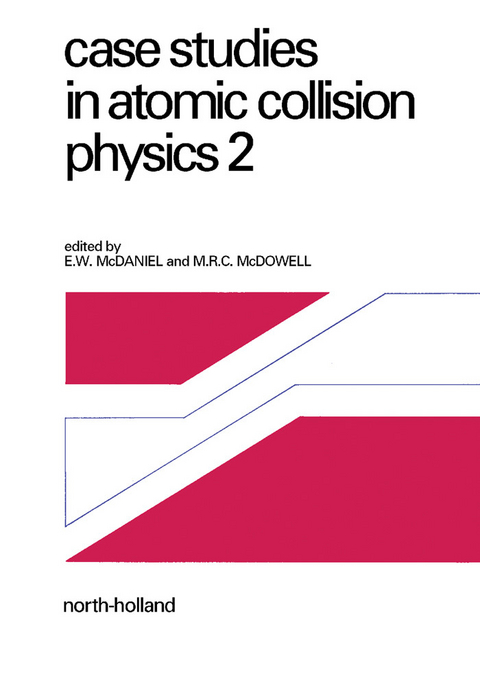
Case Studies in Atomic Collision Physics (eBook)
664 Seiten
Elsevier Science (Verlag)
978-1-4832-7796-7 (ISBN)
Case Studies in Atomic Collision Physics II focuses on studies on the role of atomic collision processes in astrophysical plasmas, including ionic recombination, electron transport, and position scattering. The book first discusses three-body recombination of positive and negative ions, as well as introduction to ionic recombination, calculation of the recombination coefficient, ions recombining in their parent gas, and three-body recombination at moderate and high gas-densities. The manuscript also takes a look at precision measurements of electron transport coefficients and differential cross sections in electron impact ionization. The publication examines the interpretation of spectral intensities from laboratory and astrophysical plasmas, atomic processes in astrophysical plasmas, and polarized orbital approximations. Discussions focus on collision rate experiments, line spectrum, collisional excitation and ionization, polarized target wave function, and application to positron scattering and annihilation. The text also ponders on cross sections and electron affinities and the role of metastable particles in collision processes. The selection is a valuable source of data for physicists and readers interested in atomic collision.
Front Cover 1
Case Studies in Atomic Collision Physics II 4
Copyright Page 5
Table of Contents 8
PREFACE 6
CHAPTER 1. THREE-BODY RECOMBINATION OF POSITIVE AND NEGATIVE IONS 16
1-1. INTRODUCTION TO IONIC RECOMBINATION 18
1-2. HISTORICAL SURVEY 19
1-3. QUASI-EQUILIBRIUM STATISTICAL THEORY AT LOW DENSITIES 28
1-4. IONS RECOMBINING IN THEIR PARENT GAS 34
1-5. GENERAL THIRD BODY 44
1-6. CALCULATION OF THE RECOMBINATION COEFFICIENT 56
1-7. THEORETICAL AND EXPERIMENTAL THREE-BODY IONIC RECOMBINATION COEFFICIENT 77
1-8. SIMPLE TREATMENTS OF THREE-BODY IONIC RECOMBINATION 80
1-9. THREE-BODY RECOMBINATION AT MODERATE AND HIGH GAS-DENSITIES 92
Appendix. THE THOMSON THEORY 100
Acknowledgments 103
References 103
CHAPTER 2. PRECISION MEASUREMENTS OF ELECTRON TRANSPORT COEFFICIENTS 106
2-1. INTRODUCTION 109
2-2. THEORY OF ELECTRON SWARMS 110
2-3. THE ELECTRON DRIFT VELOCITY 122
2-4. THE MEASUREMENT OF DT/µ BY THE TOWNSEND-HUXLEY METHOD 152
2-5. CONCLUSION 170
Acknowledgements 171
References 171
CHAPTER 3. DIFFERENTIAL CROSS SECTIONS IN ELECTRON IMPACT IONIZATION 174
3-1. INTRODUCTION 176
3-2. KINEMATICS AND NOTATIONS 177
3-3. DIFFERENT TYPES OF CROSS SECTIONS 178
3-4. CHOICE OF TARGET GAS AND COLLISION VARIABLES 181
3-5. THE APPARATUS 182
3-6. EXPERIMENTAL RESULTS 197
3-7. COMPARISON WITH THEORY 211
3-8. MEASUREMENTS CLOSE TO THE IONIZATION THRESHOLD 217
Acknowledgement 221
References 221
CHAPTER 4. INTERPRETATION OF SPECTRAL INTENSITIES FROM LABORATORY AND ASTROPHYSICAL PLASMAS 224
4-1. INTRODUCTION 226
4-2. THEORETICAL METHODS 227
4-3. COLLISION RATE EXPERIMENTS 239
4-4. LITHIUM-LIKE IONS 244
4-5. BERYLLIUM-LIKE IONS 257
4-6. HELIUM-LIKE IONS 280
Acknowledgements 303
References 303
CHAPTER 5. ATOMIC PROCESSES IN ASTROPHYSICAL PLASMAS 308
5-1. INTRODUCTION 310
5-2. STELLAR ATMOSPHERES 311
5-3. THE CONTINUOUS SPECTRUM 327
5-4. THE LINE SPECTRUM 344
5-5. COLLISIONAL EXCITATION AND IONIZATION 369
5-6. INTERPRETATION OF OBSERVATIONS 381
5-7. PROBLEMS REQUIRING FURTHER STUDY 402
Acknowledgments 404
References 404
CHAPTER 6. POLARIZED ORBITAL APPROXIMATIONS 414
6-1. INTRODUCTION 416
6-2. THE BASIC METHOD AND NOTATION 417
6-3. THE POLARIZED TARGET WAVE FUNCTION 419
6-4. THE TOTAL POLARIZED ORBITAL WAVE FUNCTION AND THE SCATTERING PROBLEM 438
6-5. APPLICATIONS TO ELECTRON SCATTERING AND REACTIONS 448
6-6. APPLICATION TO POSITRON SCATTERING AND ANNIHILATION 477
References 492
CHAPTER 7. PHOTODETACHMENT: CROSS SECTIONS AND ELECTRON AFFINITIES 498
7-1. INTRODUCTION 500
7-2. PHOTODETACHMENT CROSS SECTIONS 502
7-3. PHOTODETACHMENT THRESHOLDS 508
7-4. EXPERIMENTAL APPROACHES 512
7-5. ELECTRON AFFINITIES 532
Acknowledgment 554
References 554
CHAPTER 8. THE ROLE OF METASTABLE PARTICLES IN COLLISION PROCESSES 562
8-1. INTRODUCTION 564
8-2. PRODUCTION OF METASTABLES 566
8-3. DETECTION AND IDENTIFICATION 576
8-4. CHEMIIONIZATION 589
8-5. ION BEAM STUDIES 628
References 639
AUTHOR INDEX 646
SUBJECT INDEX 662
| Erscheint lt. Verlag | 11.9.2013 |
|---|---|
| Sprache | englisch |
| Themenwelt | Naturwissenschaften ► Physik / Astronomie ► Atom- / Kern- / Molekularphysik |
| Naturwissenschaften ► Physik / Astronomie ► Quantenphysik | |
| Technik | |
| ISBN-10 | 1-4832-7796-8 / 1483277968 |
| ISBN-13 | 978-1-4832-7796-7 / 9781483277967 |
| Informationen gemäß Produktsicherheitsverordnung (GPSR) | |
| Haben Sie eine Frage zum Produkt? |
 PDF (Adobe DRM)
Kopierschutz: Adobe-DRM
Adobe-DRM ist ein Kopierschutz, der das eBook vor Mißbrauch schützen soll. Dabei wird das eBook bereits beim Download auf Ihre persönliche Adobe-ID autorisiert. Lesen können Sie das eBook dann nur auf den Geräten, welche ebenfalls auf Ihre Adobe-ID registriert sind.
Details zum Adobe-DRM
Dateiformat: PDF (Portable Document Format)
Mit einem festen Seitenlayout eignet sich die PDF besonders für Fachbücher mit Spalten, Tabellen und Abbildungen. Eine PDF kann auf fast allen Geräten angezeigt werden, ist aber für kleine Displays (Smartphone, eReader) nur eingeschränkt geeignet.
Systemvoraussetzungen:
PC/Mac: Mit einem PC oder Mac können Sie dieses eBook lesen. Sie benötigen eine
eReader: Dieses eBook kann mit (fast) allen eBook-Readern gelesen werden. Mit dem amazon-Kindle ist es aber nicht kompatibel.
Smartphone/Tablet: Egal ob Apple oder Android, dieses eBook können Sie lesen. Sie benötigen eine
Geräteliste und zusätzliche Hinweise
Buying eBooks from abroad
For tax law reasons we can sell eBooks just within Germany and Switzerland. Regrettably we cannot fulfill eBook-orders from other countries.
aus dem Bereich