


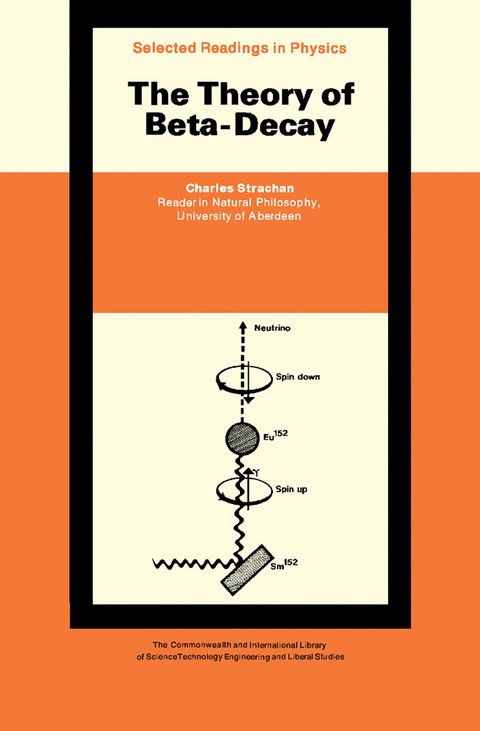
Theory of Beta-Decay (eBook)
22 Seiten
Elsevier Science (Verlag)
9781483280400 (ISBN)
The Theory of Beta-Decay covers the formulas, theories, probabilities, and spectra of beta-decay. This book is divided into 2 parts compassing 12 chapters, and starts with the introduction to the neutrino and the quantum theoretical background, explaining the basic phenomenon of beta-decay and the emission of electrons. The subsequent chapters deal with the interaction and the transition probability, as well as formulas of solutions. These topics are followed by discussions on the developments in the non-conservation of parity and helicity, the two-component theory of the neutrino, possible invariance under time-reversal and charge conjugation, leptonic number of lepton charge, and muon decay and other theories. Other chapters describe the tentative theory of beta-radiation, the detection of the free neutrino, and the selection rules for the beta-disintegration. The last chapters consider questions and experimental test about beta-decay. The chapters also look into the theories and helicity of neutrino, the theory of the Fermi interaction, and the test of the nature of the vector interaction in beta-decay This book will be of value to physicists and researchers in the allied fields.
Front Cover 1
The Theory of Beta-Decay 4
Copyright Page 5
Table of Contents 6
PREFACE 8
PART 1 10
CHAPTER I. Quantum Theoretical Background 12
1.1. Introduction. The Neutrino 12
1.2. Theoretical Background 17
1.3. Dirac's Equation. Particles and Antipartides 26
1.4. Formulation of Dirac's Equation 29
CHAPTER II. The Interaction Hamiltonian. Beta-ray Spectra and Decay Probabilities 35
2.1. The Interaction 35
2.2. The Transition Probability 41
2.3. Parity 43
2.4. Transition Probability (cont.) 46
2.5. Allowed Transitions 50
2.6. Selection Rules, Energy Spectrum, Angular Correlations 53
2.7. Classification of Transitions 62
2.8. Forbidden Transitions and the Effect of the Coulomb Field 76
CHAPTER III. Further Developments 84
3.1. Non-conservation of Parity 84
3.2. Helicity and the Two-component Theory of the Neutrino 86
3.3. Possible Invariance under Time-reversal and Charge 92
3.4. "Leptonic Number" or "Leptonic Charge" 94
3.5. Muon Decay and the Conserved Vector Current Theory 96
3.6. "Weak Magnetism" 105
3.7. Current-current Formulation. Universal Weak Interaction. Cabibbo Theory 109
REFERENCES 111
PART 2 114
PAPER 1. Tentative Theory of Beta-radiation 116
Abstract 116
1. Basic Assumptions of the Theory 116
2. The Operators Occurring in the Theory 118
3. Formulation of the Hamiltonian 119
4. Perturbation Matrix 123
5. Theory of ß-decay 125
6. Factors which Determine the Transition Probability 127
7. The Mass of the Neutrino 128
8. Lifetime and Form of the Distribution Curve for "Allowed" Transitions 129
9. The Forbidden Transitions 132
10. Comparison with Experiment 133
PAPER 2. Detection of the Free Neutrino: a Confirmation 138
Design of the Experiment 139
Experimental Results 142
PAPER 3. Selection Rules for the Beta-disintegration 145
Summary 145
PAPER 4. Question of Parity Conservation in Weak Interactions!* 155
Summary 155
Present Experimental Limit on Parity Nonconservation 156
Question of Parity Conservation in ß decay 158
Possible Experimental Tests of Parity Conservation in ß decays 159
Question of Parity Conservation in Meson and Hyperon Decays 161
Possible Experimental Tests of Parity Conservation in Meson and Hyperon Decays 162
Remarks 165
Appendix 166
PAPER 5. Experimental Test of Parity Conservation in Beta-decay 169
PAPER 6. Parity Nonconservation and a Two-component Theory of the Neutrino, 175
Summary 175
I. Neutrino Field 176
II. Experimental Implications 181
General Remarks 186
PAPER 7. Helicity of Neutrinos 188
PAPER 8. Theory of the Fermi Interaction 194
Summary 194
Acknowledgements 208
PAPER 9. Test of the Nature of the Vector Interaction in Beta-decay 209
Summar 209
I. The Problem of the Vector Interaction 209
II. Analogy with Electromagnetism 212
III. Effect of Weak Magnetism on ß Spectra 215
Acknowledgements 219
Index 220
| Erscheint lt. Verlag | 29.7.2016 |
|---|---|
| Sprache | englisch |
| Themenwelt | Naturwissenschaften ► Physik / Astronomie ► Quantenphysik |
| Technik | |
| ISBN-13 | 9781483280400 / 9781483280400 |
| Informationen gemäß Produktsicherheitsverordnung (GPSR) | |
| Haben Sie eine Frage zum Produkt? |
 PDF (Adobe DRM)
Kopierschutz: Adobe-DRM
Adobe-DRM ist ein Kopierschutz, der das eBook vor Mißbrauch schützen soll. Dabei wird das eBook bereits beim Download auf Ihre persönliche Adobe-ID autorisiert. Lesen können Sie das eBook dann nur auf den Geräten, welche ebenfalls auf Ihre Adobe-ID registriert sind.
Details zum Adobe-DRM
Dateiformat: PDF (Portable Document Format)
Mit einem festen Seitenlayout eignet sich die PDF besonders für Fachbücher mit Spalten, Tabellen und Abbildungen. Eine PDF kann auf fast allen Geräten angezeigt werden, ist aber für kleine Displays (Smartphone, eReader) nur eingeschränkt geeignet.
Systemvoraussetzungen:
PC/Mac: Mit einem PC oder Mac können Sie dieses eBook lesen. Sie benötigen eine
eReader: Dieses eBook kann mit (fast) allen eBook-Readern gelesen werden. Mit dem amazon-Kindle ist es aber nicht kompatibel.
Smartphone/Tablet: Egal ob Apple oder Android, dieses eBook können Sie lesen. Sie benötigen eine
Geräteliste und zusätzliche Hinweise
Buying eBooks from abroad
For tax law reasons we can sell eBooks just within Germany and Switzerland. Regrettably we cannot fulfill eBook-orders from other countries.
aus dem Bereich


