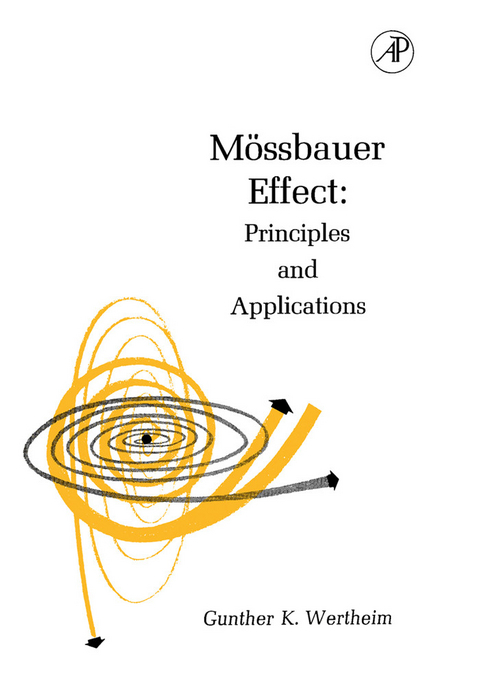
Mossbauer Effect (eBook)
124 Seiten
Elsevier Science (Verlag)
978-1-4832-7503-1 (ISBN)
Mossbauer Effect: Principles and Applications focuses on the processes, methodologies, and reactions involved in Mossbauer effect, as well as atomic motion, use of the effect in studying hyperfine structures, quadropole coupling, and isomer shift. The manuscript first discusses resonant absorption, emission of gamma rays by nuclei, width of gamma-ray spectrum, and emission from bound atoms. The text then surveys counting, modulation, and low-temperature techniques. The publication offers information on relativity and the Mossbauer effect, atomic motion, quadropole coupling, and magnetic hyperfine structure. Discussions focus on gravitational red shift and combined magnetic and electric hyperfine coupling. The text then evaluates magnetism of metals and alloys, chemical applications, and linewidth and line shape. The manuscript is a valuable source of data for physicists and readers interested in the Mossbauer effect.
Front Cover 1
Mössbauer Effect: Principles and Applications 4
Copyright Page 5
Table of Contents 8
Preface 6
Chapter 1. Introduction 10
Resonant Absorption 11
Emission of Gamma Rays by Nuclei 12
Mössbauer's Experiment: Emission from Bound Atoms 17
Why the Mössbauer Effect Is Valuable 20
Width of the Gamma-Ray Spectrum 24
General References 27
Chapter 2. Instrumentation 28
Counting Techniques 29
Modulation Techniques 29
Low-Temperature Techniques 33
Chapter 3. Relativity and the Mössbauer Effect 35
Gravitational Red Shift 35
Thermal Red Shift and the "Twin Paradox" 41
Chapter 4. Atomic Motion 45
Introduction to Chapters V–X 56
The Use of the Mössbauer Effect in the Study of Hyperfine Structure 56
Chapter 5. Isomer Shift 58
Chapter 6. Quadrupole Coupling 68
Chapter 7. Magnetic Hyperfîne Structure 81
Combined Magnetic and Electric Hyperfine Coupling 89
Chapter 8. The Magnetism of Metals and Alloys 94
Rare-Earth Magnetism 100
Chapter 9. Chemical Applications 103
Isomer Shift 103
Quadrupole Splitting 105
Magnetic Dipole Splitting 108
Detection of Dilute Impurities or Short-Lived Charge States 109
Chapter 10. Linewidth and Line Shape 115
Subject Index 122
| Erscheint lt. Verlag | 17.9.2013 |
|---|---|
| Sprache | englisch |
| Themenwelt | Naturwissenschaften ► Physik / Astronomie ► Optik |
| Technik | |
| ISBN-10 | 1-4832-7503-5 / 1483275035 |
| ISBN-13 | 978-1-4832-7503-1 / 9781483275031 |
| Informationen gemäß Produktsicherheitsverordnung (GPSR) | |
| Haben Sie eine Frage zum Produkt? |
 PDF (Adobe DRM)
Kopierschutz: Adobe-DRM
Adobe-DRM ist ein Kopierschutz, der das eBook vor Mißbrauch schützen soll. Dabei wird das eBook bereits beim Download auf Ihre persönliche Adobe-ID autorisiert. Lesen können Sie das eBook dann nur auf den Geräten, welche ebenfalls auf Ihre Adobe-ID registriert sind.
Details zum Adobe-DRM
Dateiformat: PDF (Portable Document Format)
Mit einem festen Seitenlayout eignet sich die PDF besonders für Fachbücher mit Spalten, Tabellen und Abbildungen. Eine PDF kann auf fast allen Geräten angezeigt werden, ist aber für kleine Displays (Smartphone, eReader) nur eingeschränkt geeignet.
Systemvoraussetzungen:
PC/Mac: Mit einem PC oder Mac können Sie dieses eBook lesen. Sie benötigen eine
eReader: Dieses eBook kann mit (fast) allen eBook-Readern gelesen werden. Mit dem amazon-Kindle ist es aber nicht kompatibel.
Smartphone/Tablet: Egal ob Apple oder Android, dieses eBook können Sie lesen. Sie benötigen eine
Geräteliste und zusätzliche Hinweise
Buying eBooks from abroad
For tax law reasons we can sell eBooks just within Germany and Switzerland. Regrettably we cannot fulfill eBook-orders from other countries.
aus dem Bereich