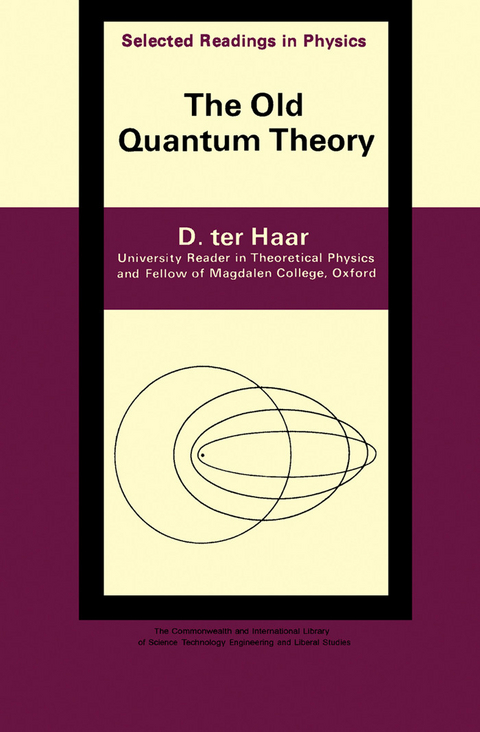
Old Quantum Theory (eBook)
216 Seiten
Elsevier Science (Verlag)
9781483151960 (ISBN)
The Old Quantum Theory explains how the classical laws were modified by Planck, Einstein, Rutherford, Bohr, and other contributors to account for atomic phenomena, comprising the development of quantum theory from its start at the very end of the 19th century until the beginning of the 20th century. This book begins by discussing Planck's discovery of his radiation law, followed by Einstein's introduction to quanta. Next is a description of the Rutherford model of the atom and Bohr's postulates, which are confirmed by the Franck-Hertz experiment. This selection concludes with a description of how Bohr's theory could explain the main features of the atomic spectra. A brief summary of other important developments in the period are also elaborated. This publication is beneficial to students and researchers conducting work on the history of quantum mechanics from the 1900s to the development of wave mechanics.
Front Cover 1
The Old Quantum Theory 4
Copyright Page 5
Table of Contents 6
Preface 8
Introduction 10
PART I 12
Chapter 1. The Black Body Radiation Law 14
Chapter 2. Light Quanta 26
Chapter 3. Rutherford's Atom 36
Chapter 4. Bohr's Atom 45
Chapter 5. Atomic Spectra in the Old Quantum Theory 54
Chapter 6. Radiation Theory 74
References 84
PART II 88
Chapter 1. On an Improvement of Wien's Equation for the Spectrum † 90
References 92
Chapter 2. On the Theory of the Energy Distribution Law of the Normal Spectrum† 93
References 101
Chapter 3. On a Heuristic Point of View about the Creation and Conversion of Light† 102
1. On a Difficulty in the Theory of "Black-body Radiation" 103
2. On Planck's Determination of Elementary Quanta 106
3. On the Entropy of the Radiation 107
4. Limiting Law for the Entropy of Monochromatic Radiation for Low Radiation Density 109
5. Molecular–Theoretical Investigation of the Volume–dependence of the Entropy of Gases and Dilute Solutions 110
6. Interpretation of the Expression for the Volume-dependence of the Entropy of Monochromatic Radiation according to Boltzmann's Principle 112
7. On Stokes' Rule 114
8. On the Production of Cathode Rays by Illumination of Solids 115
9. On the Ionisation of Gases by Ultraviolet Light 117
References 118
Chapter 4. The Scattering of a and ß Particles by Matter and the Structure of the Atom† 119
§3. Probability of Single Deflexion through any Angle 124
§4. Alteration of Velocity in an Atonuc Encounter 126
§5. Comparison of Single and Compound Scattering 128
§6. Comparison of Theory with Experiments 131
§7. General Considerations 139
References 142
Chapter 5. On the Constitution of Atoms and Molecules† 143
Introduction 143
§ 1. General Considerations 145
§2. Emission of Line-spectra 150
§3. General Considerations continued 155
§4. Absorption of Radiation 159
§ 5. The Permanent State of an Atomic System 164
References 170
Chapter 6. On the Excitation of the 2536 Å Mercury Resonance Line by Electron CoHisions† 171
Summary 176
References 177
Chapter 7. On the Quantum Theory of Radiation† 178
1. Basic Hypothesis of Quantum Theory. Canonical Distribution over States 180
2. Hypotheses about Energy Exchange through Radiation 181
3. Derivation of the Planck Radiation Law 183
4. Method of Calculating the Motion of Molecules in the Radiation Field 185
5. Calculation of R 186
6. Calculation of .2 191
7. Results 192
References 194
Chapter 8. On the Connexion between the Completion of Electron Groups in an Atom with the Complex Structure of Spectrat 195
1. The Permanence of Quantum Numbers (Principle of Gradual Construction)! in Complex Structures and the Zeeman Effect 196
2. On a General Quantum Theoretical Rule for the Possibility of the Occurrence of Equivalent Electrons in an Atom 203
References 214
Index 216
| Erscheint lt. Verlag | 7.7.2016 |
|---|---|
| Sprache | englisch |
| Themenwelt | Naturwissenschaften ► Physik / Astronomie ► Mechanik |
| Technik | |
| ISBN-13 | 9781483151960 / 9781483151960 |
| Informationen gemäß Produktsicherheitsverordnung (GPSR) | |
| Haben Sie eine Frage zum Produkt? |
 PDF (Adobe DRM)
Kopierschutz: Adobe-DRM
Adobe-DRM ist ein Kopierschutz, der das eBook vor Mißbrauch schützen soll. Dabei wird das eBook bereits beim Download auf Ihre persönliche Adobe-ID autorisiert. Lesen können Sie das eBook dann nur auf den Geräten, welche ebenfalls auf Ihre Adobe-ID registriert sind.
Details zum Adobe-DRM
Dateiformat: PDF (Portable Document Format)
Mit einem festen Seitenlayout eignet sich die PDF besonders für Fachbücher mit Spalten, Tabellen und Abbildungen. Eine PDF kann auf fast allen Geräten angezeigt werden, ist aber für kleine Displays (Smartphone, eReader) nur eingeschränkt geeignet.
Systemvoraussetzungen:
PC/Mac: Mit einem PC oder Mac können Sie dieses eBook lesen. Sie benötigen eine
eReader: Dieses eBook kann mit (fast) allen eBook-Readern gelesen werden. Mit dem amazon-Kindle ist es aber nicht kompatibel.
Smartphone/Tablet: Egal ob Apple oder Android, dieses eBook können Sie lesen. Sie benötigen eine
Geräteliste und zusätzliche Hinweise
Buying eBooks from abroad
For tax law reasons we can sell eBooks just within Germany and Switzerland. Regrettably we cannot fulfill eBook-orders from other countries.
aus dem Bereich