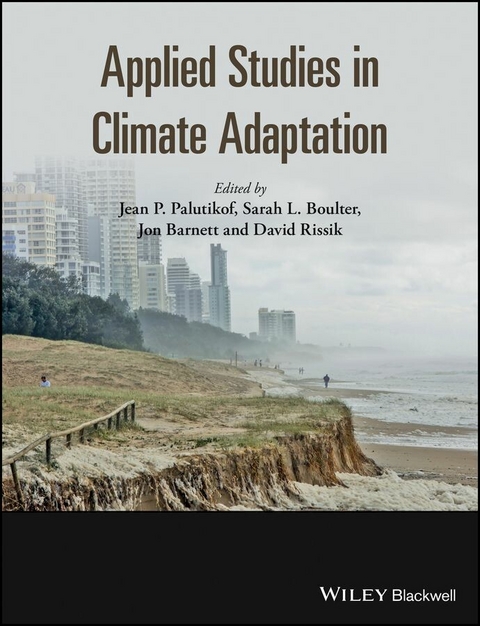
Applied Studies in Climate Adaptation (eBook)
John Wiley & Sons (Verlag)
978-1-118-84503-5 (ISBN)
The book advances knowledge about climate change adaptation practices through a series of case studies. It presents important evidence about adaptation practices in agriculture, businesses, the coastal zone, community services, disaster management, ecosystems, indigneous populations, and settlements and infrastructure. In addition to 38 case studies across these sectors, the book contains horizon-scoping essays from international experts in adaptation research, including Hallie Eakin, Susanne Moser, Jonathon Overpeck, Bill Solecki, and Gary Yohe.
Australia’s social-ecological systems have a long history of adapting to climate variability and change, and in recent decades has been a world-leader in implementing and researching adaptation, making this book of universal relevance to all those working to adapt our environment and societies to climate change.
Jean Palutikof is the Director of the National Climate Change Adaptation Research Facility (NCCARF) where she has built a national program of adaptation research, communication and partnerships. Prior to joining NCCARF she managed the production of the Intergovernmental Panel on Climate Change (IPCC) Fourth Assessment Report for Working Group II (Impacts, Adaptation and Vulnerability). Her research interests focus on climate change impacts, and the application of climatic data to economic and planning issues.
Sarah Boulter is a Research Fellow with NCCARF where she works on synthesis and communication of adaptation research. Her research background includes studies of biodiversity and reproductive ecology of forested systems and the impacts of climate change.
Jon Barnett is a Professor and Australian Research Council Future Fellow in Geography at The University of Melbourne. He is a political geographer who researches the impacts of and responses to environmental change on social systems in Australia, East Asia and the South Pacific.
David Rissik is Deputy Director (General Manager) of the National Climate Change Adaptation Research Facility responsible for the day-to-day management of the Facility and the Synthesis and Integrative Research Program. He has interest and experience in the delivery of applied research to practitioners in ways that are easily accessible and useful. His research background is in coastal and estuarine ecology and management.
The book advances knowledge about climate change adaptation practices through a series of case studies. It presents important evidence about adaptation practices in agriculture, businesses, the coastal zone, community services, disaster management, ecosystems, indigneous populations, and settlements and infrastructure. In addition to 38 case studies across these sectors, the book contains horizon-scoping essays from international experts in adaptation research, including Hallie Eakin, Susanne Moser, Jonathon Overpeck, Bill Solecki, and Gary Yohe. Australia s social-ecological systems have a long history of adapting to climate variability and change, and in recent decades has been a world-leader in implementing and researching adaptation, making this book of universal relevance to all those working to adapt our environment and societies to climate change.
Jean Palutikof is the Director of the National Climate Change Adaptation Research Facility (NCCARF) where she has built a national program of adaptation research, communication and partnerships. Prior to joining NCCARF she managed the production of the Intergovernmental Panel on Climate Change (IPCC) Fourth Assessment Report for Working Group II (Impacts, Adaptation and Vulnerability). Her research interests focus on climate change impacts, and the application of climatic data to economic and planning issues. Sarah Boulter is a Research Fellow with NCCARF where she works on synthesis and communication of adaptation research. Her research background includes studies of biodiversity and reproductive ecology of forested systems and the impacts of climate change. Jon Barnett is a Professor and Australian Research Council Future Fellow in Geography at The University of Melbourne. He is a political geographer who researches the impacts of and responses to environmental change on social systems in Australia, East Asia and the South Pacific. David Rissik is Deputy Director (General Manager) of the National Climate Change Adaptation Research Facility responsible for the day-to-day management of the Facility and the Synthesis and Integrative Research Program. He has interest and experience in the delivery of applied research to practitioners in ways that are easily accessible and useful. His research background is in coastal and estuarine ecology and management.
List of contributors
Lucy Anderton
Department of Agriculture and Food WA, Australia
Veronica Arbon
Wilto Yerlo, University of Adelaide, Australia
John P.Y. Arnould
School of Life and Environmental Sciences, Deakin University, Australia
Emma K. Austin
School of Environmental and Life Sciences, University of Newcastle, Australia
Jon Barnett
School of Geography, University of Melbourne, Australia
Guy Barnett
CSIRO Land and Water Flagship, Australia
R. Matthew Beaty
CSIRO Land and Water Flagship, Australia
Andrew Beer
Centre for Housing, Urban and Regional Planning, University of Adelaide, Australia
Brendan Berghout
Hunter Water Corporation, Australia
Frans Berkhout
Department of Geography, King’s College, UK
Peng Bi
Discipline of Public Health, University of Adelaide, Australia
Gilad Bino
Australian Wetlands, Rivers and Landscapes Centre, University of New South Wales, Australia
Deanne K. Bird
Risk Frontiers, Macquarie University, Australia
John Boland
School of Information Technology and Mathematical Sciences, University of South Australia, Australia
Helen J. Boon
College of Arts, Society and Education, James Cook University, Australia
Sarah L. Boulter
National Climate Change Adaptation Research Facility, Griffith University, Australia
Pamela Box
Department of Environment and Geography, Macquarie University, Australia
Graham L. Bradley
Griffith Climate Change Response Program, Griffith University, Australia
Ian Burton
Adaptation and Impacts Research Group, Meteorological Services Canada, Canada
Rodrigo H. Bustamante
Climate Adaptation Flagship, CSIRO Marine and Atmospheric Research, Australia
Dave Callaghan
School of Civil Engineering, University of Queensland, Australia
Tim Capon
CSIRO Land and Water Flagship and School of Economics, University of Sydney, Australia
Samantha J. Capon
Australian Rivers Institute, Griffith University, Australia
Dean B. Carson
School of Medicine, Flinders University and the Northern Institute, Charles Darwin University, Australia
Lynda E. Chambers
Centre for Australian Weather and Climate Research, Australia
Dong Chen
CSIRO Land and Water Flagship, Australia
Eddo Coiacetto
Griffith School of Environment, Griffith University, Australia
Augustine Conteh
School of Public Health and Social Work, Queensland University of Technology, Australia
Bethany Cooper
Centre for Water Policy and Management, La Trobe University, Australia
Ignacio Correa-Velez
School of Public Health and Social Work, Queensland University of Technology, Australia
Peter Cowell
School of Geosciences, University of Sydney, Australia
Lin Crase
Centre for Water Policy and Management, La Trobe University, Australia
Jason Crean
NSW Department of Primary Industries, Australia
Ryan Crompton
Risk Frontiers, Macquarie University, Australia
Lijie Cui
School of Engineering, University of Newcastle, Australia
Jago Dodson
Global, Urban and Social Studies, RMIT University, Australia
Hallie Eakin
School of Sustainability, Arizona State University, USA
Jane Edwards
CRMA School of Commerce, University of South Australia, Australia
Michelle C. Ellul
Griffith Climate Change Response Program, Griffith University, Australia
Anna Farmery
Institute for Marine and Antarctic Studies, University of Tasmania, Australia
David Feldman
Department of Agriculture and Food WA, Australia
Deane Fergie
Anthropology of Native Title Societies, University of Adelaide, Australia
Aysha Fleming
Climate Adaptation Flagship, CSIRO Marine and Atmospheric Research, Australia
Cameron S. Fletcher
CSIRO Ecosystem Sciences, Australia
Anita Foerster
The University of Melbourne, Australia
Donald C. Franklin
Research Institute for the Environment and Livelihoods, Charles Darwin University, Australia
Stewart Frusher
Institute for Marine and Antarctic Studies, University of Tasmania, Australia
K. Renuka Ganegodage
The School of Economics, University of Queensland, Australia
Stephen T. Garnett
Research Institute for the Environment and Livelihoods, Charles Darwin University, Australia
Rolf Gerritsen
Central Australian Research Group (CARG), Charles Darwin University, Australia
Sandra M. Gifford
Swinburne Institute for Social Research, Swinburne University of Technology, Australia
Michelle Graymore
Water in Drylands Collaborative Research Program, University of Ballarat, Australia
Bridget S. Green
Institute for Marine and Antarctic Studies, University of Tasmania, Australia
Lucy Hackworth
Anthropology of Native Title Societies, University of Adelaide, Australia
Wade L. Hadwen
Australian Rivers Institute, Griffith University, Australia
Emily Hamilton
Australian Council of Social Services, Australia
Alana Hansen
Discipline of Public Health, University of Adelaide, Australia
Ben P. Harman
CSIRO Ecosystem Sciences, Australia
Nick Harvey
Geography, Environment and Population, University of Adelaide, Australia
Peter Hayman
South Australian Research and Development Institute, Australia
Katharine Haynes
Risk Frontiers, Macquarie University, Australia
Benjamin J. Henley
School of Engineering, University of Newcastle, Australia and School of Earth Sciences, University of Melbourne, Australia
Greg Hertzler
Faculty of Agriculture and Environment, University of Sydney, Australia; and Faculty of Natural and Agricultural Sciences, University of Pretoria, South Africa
Sonja Heyenga
CSIRO Ecosystem Sciences, Australia
Alistair J. Hobday
Climate Adaptation Flagship, CSIRO Marine and Atmospheric Research, Australia
Ralph Horne
College of Design and Social Context, RMIT University, Australia
Michael Howes
Griffith School of Environment, Griffith University, Australia
Graeme Hugo
Australian Population and Migration Research Centre, University of Adelaide, Australia
James Innes
Climate Adaptation Flagship, CSIRO Marine and Atmospheric Research, Australia
Lesley Instone
Centre for Urban and Regional Studies, University of Newcastle, Australia
Nazrul Islam
Department of Agriculture and Food WA, Australia
Kim Jenkins
Australian Wetlands, Rivers and Landscapes Centre, University of New South Wales, Australia
Sarah Jennings
School of Economics and Finance, University of Tasmania, Australia
Anthony S. Kiem
School of Environmental and Life Sciences, University of Newcastle, Australia
David King
Centre for Disaster Studies, James Cook University, Australia
Richard T. Kingsford
Australian Wetlands, Rivers and Landscapes Centre, University of New South Wales, Australia
Ross Kingwell
Australian Export Grains Innovation Centre and University of Western Australia, Australia
Michael Kroehn
Centre for Housing, Urban and Regional Planning, University of Adelaide, Australia
George Kuczera
School of Engineering, University of Newcastle, Australia
Natasha Kuruppu
Institute for Sustainable Futures, University of Technology Sydney, Australia
Julia Law
Centre for Housing, Urban and Regional Planning, University of Adelaide, Australia
Lilly Lim-Camacho
Climate Adaptation Flagship, CSIRO Earth System Sciences and Resource Engineering, Australia
Felix Lipkin
CSIRO Ecosystem Sciences, Australia
Adam Loch
CRMA School of Commerce, University of South Australia, Australia
Andrew Macintosh
ANU College of Law, Australian National University, Australia
Karl Mallon
Climate Risk Pty Ltd, Australia
Andrew MARTEL
Faculty of Architecture, Building and Planning, University of Melbourne, Australia
John Martin
LaTrobe University, Australia
Ryan R.J. McAllister
CSIRO Ecosystem Sciences, Australia
Delphine McAneney
Risk Frontiers, Macquarie University, Australia
John McAneney
Risk Frontiers, Macquarie University, Australia
Anthea McClintock
NSW Department of Primary Industries, Australia
Jan McDonald
Faculty of Law, University of Tasmania, Australia
Darryn McEvoy
RMIT University, Australia
Stephen McFallan
CSIRO Land and Water Flagship, Australia
Celia McMichael
School of Social Sciences, La Trobe University, Australia
Kathleen J. Mee
Centre for Urban and Regional Studies, University of Newcastle, Australia
Jacqui Meyers
CSIRO Land and Water Flagship, Australia
Melinda L. Moir
School of Plant Biology, University of Western Australia, Australia
Mohammad Mortazavi-Naeini
School...
| Erscheint lt. Verlag | 27.10.2014 |
|---|---|
| Sprache | englisch |
| Themenwelt | Naturwissenschaften ► Biologie ► Ökologie / Naturschutz |
| Naturwissenschaften ► Geowissenschaften | |
| Technik | |
| Schlagworte | across • Adaptation • adaptation practices • Addition • Advances • Agriculture • atmospheric sciences • Bauingenieur- u. Bauwesen • Book • CASE • Civil Engineering & Construction • climate change • Contains • earth sciences • Environmental change • Environmental Engineering • Environmental Studies • Essays • Geowissenschaften • important evidence • International experts • Klimatologie • Klimatologie u. Meteorologie • Knowledge • Practices • Research • Sectors • series • Studies • Umweltforschung • Umwelttechnik • Umweltveränderungen • Umweltveränderungen |
| ISBN-10 | 1-118-84503-X / 111884503X |
| ISBN-13 | 978-1-118-84503-5 / 9781118845035 |
| Informationen gemäß Produktsicherheitsverordnung (GPSR) | |
| Haben Sie eine Frage zum Produkt? |
 EPUB (Adobe DRM)
Kopierschutz: Adobe-DRM
Adobe-DRM ist ein Kopierschutz, der das eBook vor Mißbrauch schützen soll. Dabei wird das eBook bereits beim Download auf Ihre persönliche Adobe-ID autorisiert. Lesen können Sie das eBook dann nur auf den Geräten, welche ebenfalls auf Ihre Adobe-ID registriert sind.
Details zum Adobe-DRM
Dateiformat: EPUB (Electronic Publication)
EPUB ist ein offener Standard für eBooks und eignet sich besonders zur Darstellung von Belletristik und Sachbüchern. Der Fließtext wird dynamisch an die Display- und Schriftgröße angepasst. Auch für mobile Lesegeräte ist EPUB daher gut geeignet.
Systemvoraussetzungen:
PC/Mac: Mit einem PC oder Mac können Sie dieses eBook lesen. Sie benötigen eine
eReader: Dieses eBook kann mit (fast) allen eBook-Readern gelesen werden. Mit dem amazon-Kindle ist es aber nicht kompatibel.
Smartphone/Tablet: Egal ob Apple oder Android, dieses eBook können Sie lesen. Sie benötigen eine
Geräteliste und zusätzliche Hinweise
Buying eBooks from abroad
For tax law reasons we can sell eBooks just within Germany and Switzerland. Regrettably we cannot fulfill eBook-orders from other countries.
aus dem Bereich