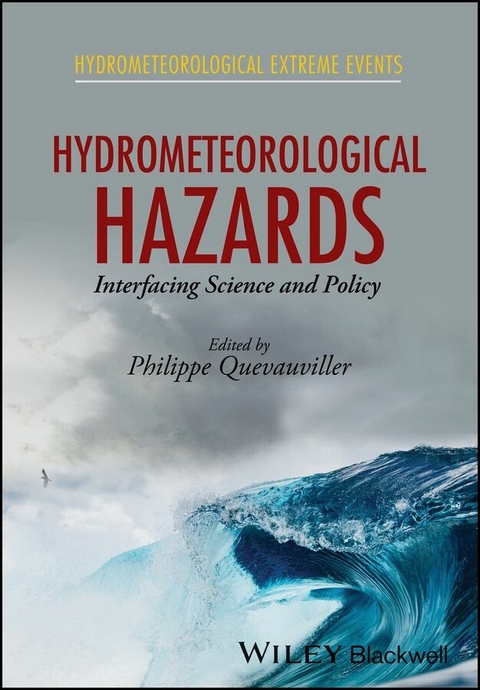
Recent hydrometeorological extreme events have highlighted the increased exposure and vulnerability of societies and the need to strengthen the knowledge-base of related policies. Current research is focused on improving forecasting, prediction and early warning capabilities in order to improve the assessment of vulnerability and risks linked to extreme climatic events.
Hydrometeorological Hazards: Interfacing science and policy is the first volume of a series which will gather scientific and policy-related knowledge related to climate-related extreme events. Invited authors are internationally recognized experts in their respective fields. This volume reflects the most recent advances in science and policy within this field and takes a multidisciplinary approach. The book provides the reader with a state-of-the art account on flash floods, droughts, storms, and a comprehensive discussion focused on the cost of natural hazards, resilience and adaptation.
This book will be an invaluable reference for advanced undergraduates taking courses with a focus on natural hazards including climate-related extreme events. The book will also be of interest to postgraduates, researchers and policy makers in this field looking for an overview of the subject.
Philippe Quevauviller began his career as a researcher in chemical oceanography and holds 2 PhDs and an HDR. He then joined the European Commission as a Research Programme and Policy Officer. He is also Associate Professor at the Vrije Universiteit Brussels.
HYDROMETEOROLOGICAL EXTREME EVENTS Hydrometeorological Hazards: Interfacing Science and Policy Recent hydrometeorological extreme events have highlighted the increased exposure and vulnerability of societies and the need to strengthen the knowledge-base of related policies. Current research is focused on improving forecasting, prediction and early warning capabilities in order to improve the assessment of vulnerability and risks linked to extreme climatic events. Hydrometeorological Hazards: Interfacing Science and Policy is the first volume of a series which will gather scientific and policy-related knowledge on climate-related extreme events. Invited authors are internationally recognized experts in their respective fields. This volume reflects the most recent advances in science and policy within this field and takes a multidisciplinary approach. The book provides the reader with a state-of-the art account of flash floods, droughts, storms, and a comprehensive discussion focused on the cost of natural hazards, resilience and adaptation. This book will be an invaluable reference for advanced undergraduates taking courses with a focus on natural hazards, including climate-related extreme events. The book will also be of interest to postgraduates, researchers and policymakers in this field looking for an overview of the subject.
Philippe Quevauviller began his career as a researcher in chemical oceanography and holds 2 PhDs and an HDR. He then joined the European Commission as a Research Programme and Policy Officer. He is also Associate Professor at the Vrije Universiteit Brussels.
Series Preface
Preface
The Series Editor - Philippe Quevauviller
List of Contributors
PART ONE: SETTING THE SCENE
1.1 A historic experience for a strengthened resilience. European societies in front of hydro meteors 16th-20th centuries
Emmanuel Garnier
1.2 Current understanding of climate change impacts on extreme events
Richard Harding, Nick Reynart, and Alison Kay
1.3 Common features to different hydrometeorological events and knowledge integration
Barbara Zanuttigh
1.4 Science-Policy interfacing
Philippe Quevauviller
PART TWO: POLICY SETTINGS
2.1 When Science meets Policy: Enhancing governance and management of disaster risks
Demetrio Innocenti
2.2 Hydrometeorological extremes and science-policy interface: IPCC
Zbysezk Kundewicz
2.3 A snapshot of EU and international policies relevant to hydrometeorological events
Philippe Quevauviller
PART THREE: OUTLINE OF SCIENTIFIC FEATURES
3.1 Hydroinformatics and its role in flood management
Philipe Gourbesville
3.2 Droughts: how to be prepared for the hazard?
Henny van Lanen
3.3 Drought in the light of climate change in the Mediterranean region
Ana Iglesias and Luis Garrote
3.4 Prediction of storm impacts on beach and dune systems
Paolo Ciavola, Oscar Ferreira, Ap Van Dongeren, Jaap Van Thiel de Vries, Clara Armaroli, and Mitchell Harley
PART FOUR: SOCIAL AND ECONOMIC CONSIDERATIONS
4.1 Assessing the costs of natural hazards - State of the art and the way forward
Volker Meyer et al.
4.2 Resilience and adaptation to hydrometeorological hazards
Maureen Fordham, Hugh Deeming, and Åsa Gerger Swartling
PART FIVE: CONCLUSIONS
5. Conclusions and outlook
Philippe Quevauviller
Index
"Although the book cannot be comprehensive on this vast research field of hydrometeorological hazards at the interface of science and policy, it does give a proficient overview on the topic and selected hydrometeorological extremes. I very much liked reading this well-written book and am looking forward to the next titles within this series." (Environmental Earth Sciences 2015)
Chapter 1.1
Strengthened Resilience from Historic Experience. European Societies Confronted with Hydrometeors in the Sixteenth to Twentieth Centuries
Emmanuel Garnier
Institut Universitaire de France, CNRS and University of La Rochelle, France
1.1.1 Introduction
In his seminal book published in 1992 on the evolution of society from a society of disasters to a society of risk, the sociologist Ulrich Beck clearly distinguishes between a “pre-modern” society qualified as “traditional”, devoid of industries, and a “modern” society (Beck, 1992). In the first case, risk is non-existent, supplanted as it is by a social conviction: threats of all kinds which result from disasters are both natural and totally unpredictable. Against this traditional collective fatalism, he contrasts industrialized society which would redefine the relations which it maintains with its natural environment according to a relationship of domination (Man) and dominated (Nature). For Beck, by inventing the concept of risk, industrialization finally allowed its definition and quantification thanks to an improvement in instrumentation and to scientific progress. However, the historical reality observed in archives about hydrometeors is particularly enlightening. It indicates that the germs of a “risk”-based mentality can be observed very early on, in a time when societies and states remained nevertheless fundamentally agrarian and traditional. This historical work consequently aims to study the “trajectories of vulnerability” of territories and European societies confronted with two types of hydrometeors: droughts and storm surges.
1.1.2 Five centuries of droughts
The results presented in this section fall within the framework of the EU project FP 7 ‘Fostering European Drought Research and Science-Policy Interfacing’ (project number 282769). This project aims to reduce Europe's future vulnerability to and risk of drought by innovative in-depth studies that combine drought investigations in case study areas in water-stressed regions with drought analysis at the pan-European scale. In this perspective, it grants in particular an important role to the historical approach in helping us to understand better the frequency and severity of the droughts during the last 500 years as well as the reactions of the old societies.
Droughts are a factor of historic durability and, because of their impacts on societies, they left multiple indicators in the archives of the last 500 years. For the record, it is necessary to remind ourselves that the general term of ‘drought’ covers different notions. The most frequent meaning of the word is a rainfall deficit and an extreme climate event.
1.1.2.1 Historic material and methods of evaluation
Because of the unpredictable character and the absence of civil services specially dedicated to the study of these extreme events before the middle of the nineteenth century, historians have to make maximum use of the entire corpus of sources. The information we need is often hidden at random in the margins of some documentation and we cannot afford to neglect any type of archive if we want to hope to reconstruct long and relatively reliable chronologies (Garnier, 2010a).
Diaries drafted by private persons (priests, middle-class persons, aristocrats) and municipal chronicles are particularly useful. Besides the private, economic and political events, they are often very sensitive to the extreme events which engender a disaster, etymologically (kata and strophe) an upset. Certain authors provide an integrated approach to the drought by combining visual observations (heights of water on the hydrological scales on bridges), the phenology (state of the vegetation, fires), prices in the markets and even its social expression (scarcity, religious processions, riots).
The catholic church is a faithful ally of the historian studying droughts. Ex voto, small naive paintings hung in churches in France, Spain, Portugal and Italy, are iconographic testimonies which very frequently concern a meteorological abnormality. Often up to the eighteenth century, the extreme event (drought, storm, flood) was considered a demonstration of God's wrath. That is why the ancient societies asked the Church for an intervention.
Thanks to the religious processions, the historian has a relatively homogeneous series of the archival and historic plans because they emanate from the same lay or religious institution which registers them over long periods. These religious ceremonies allow the reconstruction of historic series included generally between 1500 and 1800, sometimes even beyond in the Spanish case (Barriendos and Martin-Vide, 1995; Barriendos, 2005). The Roman Catholic Church or the municipal authorities ordered these qualified ceremonies of rogations (rogativas) in Spain, or processions in Portugal and in France to avoid endangering the established order or the socioeconomic balance. In the case of drought, processions were organised pro pluvia, literally ‘for the rain’.
Then, where wars spared cities, the historian has very precious municipal archives. They contain the registers of the municipal deliberations and the accounts. These documents begin frequently from the end of the fifteenth century. Deliberations and municipal accounts constitute an inexhaustible deposit of climatic data. The meteorological information is omnipresent in these registers and arises from an understandable desire to anticipate the risks of breaks in supplies, of diseases and riots. So any sustained drought sparks off a discussion within the government of the city. That is why the state or municipal authorities, from the fifteenth century, intervened by using diverse tools, such as processions, price controls, requisitions of wheat and, in the case of Valencia, imports of wheat.
Unlike temperature data, which appear around the 1700s, we have to wait until the beginning of the nineteenthth century to get instrumental data on rainfall or water flows. They result from the creation of scientific societies, such as the Royal Society of London, the Royal Academy of the sciences of Paris or the Societas meteorologica palatina of Mannheim in Germany. They may also have been produced by engineers especially devoted to the surveillance of rivers.
To address the lack of reliable instrumental data before 1800, the contents of archives offer two methodological solutions to estimate these natural events for which we have only textual descriptions. The first solution is to use all the chronological mentions of a drought appearing in archives. Concretely, it is a question of noting, for example, the first mention of a religious procession pro pluvia, then the municipal acts which evoke the drying up of the public fountains, the ban on drawing water from certain places, the lay-off of wheatmills and, in the most extreme cases, the problems of supply of wheat and wood via the waterway. Naturally, this list is not exhaustive. However, the location of these indicators in archives allows us to propose the duration in days for the very great majority of the droughts of the past. This choice is acceptable because today the World Meteorological Organization characterizes the drought according to the number of days without rain. Nevertheless, professional ethics require us to specify that the duration defined by the historian does not correspond to a total absence of rain but rather to its chronological perception by societies. Therefore the drought of the historian indicates instead a very dry and long episode with sufficiently important economic and human impacts for it to appear in the archives of the time.
Another methodological choice which can complete the evaluation by duration consists of creating an indexed scale of severity directly built according to the descriptive contents of the drought. Naturally, this results from a systematic inventory of the impacts engendered by the extreme event on societies. The list below shows the types of damage most commonly described in the archives on droughts:
- Rogation pro pluvia
- Early grape harvest dates
- Plants dry and die
- No harvest of hay
- Low water
- ‘No rain’ during the period
- Drying up of springs
- The ground is cracked
- We can ford a river
- Lay-off of wheatmills
- Forest fires
- The cattle die of thirst
- Riots around the springs
- Shortage or/and famine
Thus, the historian can observe the chronology of an event which is well recorded in archives. Figure 1.1.1 describes a particularly severe drought which affected the region of Valencia in 1725 and 1726.
Figure 1.1.1 Estimate of the duration and severity of the Jucar drought of 1725–1726.
From this inventory, a scale of severity between index –1 and index 5 can be realized, as shown in Table 1.1.1.
Table 1.1.1 Index of severity of the droughts (sixteenth to nineteenth centuries).
| Index | Description |
| 5 | exceptional drought: no possible supply, shortage, sanitary problems, very high prices of wheat, forest fires |
| 4 | severe low-water mark: navigation impossible, lay-off of wheatmills, search for new springs, forest fires, death of cattle |
| 3 | general low-water... |
| Erscheint lt. Verlag | 24.10.2014 |
|---|---|
| Reihe/Serie | Hydrometeorological Extreme Events | Hydrometeorological Extreme Events |
| Sprache | englisch |
| Themenwelt | Naturwissenschaften ► Geowissenschaften ► Hydrologie / Ozeanografie |
| Naturwissenschaften ► Geowissenschaften ► Meteorologie / Klimatologie | |
| Technik | |
| Schlagworte | Climatology & Palaeoclimatology • earth sciences • Fluvial Hydrology & Limnology • Geowissenschaften • Hydrologie der Flüsse u. Binnengewässer • Hydrologie der Flüsse u. Binnengewässer • Klimatologie u. Paläoklimatologie • Klimatologie u. Paläoklimatologie • Meteorologie • meteorology |
| ISBN-13 | 9781118629543 / 9781118629543 |
| Informationen gemäß Produktsicherheitsverordnung (GPSR) | |
| Haben Sie eine Frage zum Produkt? |
 EPUB (Adobe DRM)
Kopierschutz: Adobe-DRM
Adobe-DRM ist ein Kopierschutz, der das eBook vor Mißbrauch schützen soll. Dabei wird das eBook bereits beim Download auf Ihre persönliche Adobe-ID autorisiert. Lesen können Sie das eBook dann nur auf den Geräten, welche ebenfalls auf Ihre Adobe-ID registriert sind.
Details zum Adobe-DRM
Dateiformat: EPUB (Electronic Publication)
EPUB ist ein offener Standard für eBooks und eignet sich besonders zur Darstellung von Belletristik und Sachbüchern. Der Fließtext wird dynamisch an die Display- und Schriftgröße angepasst. Auch für mobile Lesegeräte ist EPUB daher gut geeignet.
Systemvoraussetzungen:
PC/Mac: Mit einem PC oder Mac können Sie dieses eBook lesen. Sie benötigen eine
eReader: Dieses eBook kann mit (fast) allen eBook-Readern gelesen werden. Mit dem amazon-Kindle ist es aber nicht kompatibel.
Smartphone/Tablet: Egal ob Apple oder Android, dieses eBook können Sie lesen. Sie benötigen eine
Geräteliste und zusätzliche Hinweise
Buying eBooks from abroad
For tax law reasons we can sell eBooks just within Germany and Switzerland. Regrettably we cannot fulfill eBook-orders from other countries.
aus dem Bereich