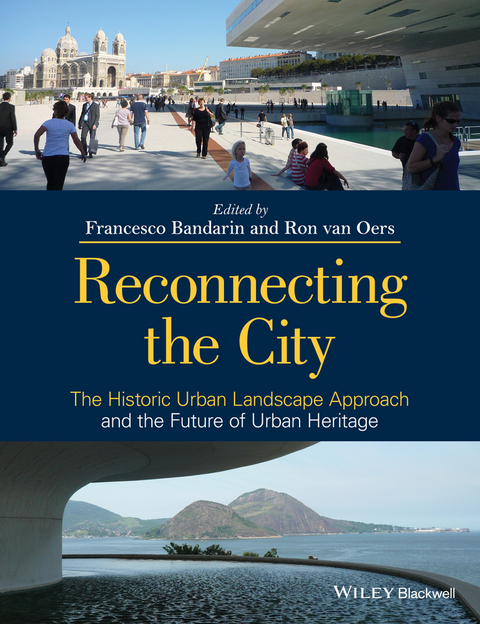
Reconnecting the City (eBook)
John Wiley & Sons (Verlag)
978-1-118-38396-4 (ISBN)
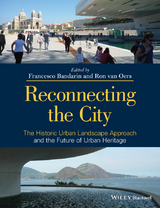
Historic Urban Landscape is a new approach to urban heritage management, promoted by UNESCO, and currently one of the most debated issues in the international preservation community. However, few conservation practitioners have a clear understanding of what it entails, and more importantly, what it can achieve.
Following the publication of The Historic Urban Landscape: Managing Heritage in an Urban Century, the approach
is now further elaborated with a more practical slant and translates the notion
into an operational set of management practices. In this follow-up book, the
editors pull together specially commissioned chapters on best practice in urban
heritage management from established professionals in the field. Drawn from a
variety of disciplines related to urban management and conservation these
authors present and discuss methodologies and practices to consider in the
implementation of the Historic Urban Landscape approach as advocated by UNESCO.
The contributors are selected from professionals who have written, argued or debated about the role of historic
cities in contemporary society. As well as their chapters, there are interviews
with six high-profile people from different regions of the world giving their
critical reflections on the UNESCO approach in relation to their own ideas on
urban heritage conservation and city management.
Reconnecting the City: the Historic Urban Landscape Approach and the Future of Urban
Heritage provides a thorough discussion, structured by themes on issues related to key topics in the field of urban management, from changing demographics and increasing urbanisation to the pressures of economic
development and decentralisation; social interaction; and economic feasibility and financing of heritage conservation.
By presenting a range of methodologies and tools to support urban conservation in a way that is sensitive to cultural differences, the editors encourage a departure from the compartmentalized approaches of today’s urban heritagemanagement.
The book includes contributions from HH The Aga Khan, Rem Koolhaas, Stefano Bianca and Julian Smith – and many other internationally respected figures.
The book’s companion website offers invaluable resources from UNESCO relating to the Historic Urban Landscape
Approach, as well as additional illustrations and web-links.
Francesco Bandarin is UNESCO’s Assistant Director-General for Culture and Professor of Urban Planning at the University Institute of Architecture of Venice. He was formerly Director of the UNESCO World
Heritage Centre and the Secretary of the World Heritage Committee. He is
trained as an Architect (Venice 1975) and Urban Planner (UC Berkeley 1977) and
has pursued an academic career as Professor of Urban Planning at the University
of Venice (IUAV) and a professional career as consultant for international
organizations in the field of urban conservation and development. He has been
actively involved in the Venice Safeguarding Project and in the preparation of
Rome for the year 2000 Jubilee. As Director of the World Heritage Centre he has
promoted the revision of the UNESCO recommendations on historic cities and has
contributed to development of the debate on the role of contemporary
architecture in historic cities, on the management of their social and physical
changes and on the role of communities in the conservation of historic values.
Ron van Oers is Vice Director, World Heritage Institute of Training and Research for Asia and the Pacific (WHITRAP). He was formerly Programme Specialist for Culture at the UNESCO World Heritage Centre, coordinating the World Heritage Cities Programme and the international effort to develop new guidelines for urban conservation, which were adopted as the 2011 Recommendation on the Historic Urban Landscape. He is trained as an Urban Planner (Delft 1993) and received his doctorate (PhD, Delft 2000) on a research into the principles of Dutch colonial town planning (published as book). He is the Founding Editor (together with Dr. Ana Pereira-Roders) of the Journal of Cultural Heritage Management and Sustainable Development (JCHMSD), published by Emerald Group Publishing (UK) and a Member of the Editorial Advisory Board of Change Over Time: International Journal of Conservation and the Built Environment, published by Penn Press, University of Pennsylvania’s School of Design (USA).
Historic Urban Landscape is a new approach to urban heritage management, promoted by UNESCO, and currently one of the most debated issues in the international preservation community. However, few conservation practitioners have a clear understanding of what it entails, and more importantly, what it can achieve. Examples drawn from urban heritage sites worldwide from Timbuktu to Liverpool Richly illustrated with colour photographs Addresses key issues and best practice for urban conservation
Francesco Bandarin was UNESCO's Assistant Director-General for Culture from 2010 to 2014 and is now Professor of Urban Planning at the University Institute of Architecture of Venice. He was formerly Director of the UNESCO World Heritage Centre and the Secretary of the World Heritage Committee. He is trained as an Architect (Venice 1975) and Urban Planner (UC Berkeley 1977) and has pursued an academic career as Professor of Urban Planning at the University of Venice (IUAV) and a professional career as consultant for international organizations in the field of urban conservation and development. He has been actively involved in the Venice Safeguarding Project and in the preparation of Rome for the year 2000 Jubilee. As Director of the World Heritage Centre he has promoted the revision of the UNESCO recommendations on historic cities and has contributed to development of the debate on the role of contemporary architecture in historic cities, on the management of their social and physical changes and on the role of communities in the conservation of historic values. Ron van Oers is Vice Director, World Heritage Institute of Training and Research for Asia and the Pacific (WHITRAP). He was formerly Programme Specialist for Culture at the UNESCO World Heritage Centre, coordinating the World Heritage Cities Programme and the international effort to develop new guidelines for urban conservation, which were adopted as the 2011 Recommendation on the Historic Urban Landscape. He is trained as an Urban Planner (Delft 1993) and received his doctorate (PhD, Delft 2000) on a research into the principles of Dutch colonial town planning (published as book). He is the Founding Editor (together with Dr. Ana Pereira-Roders) of the Journal of Cultural Heritage Management and Sustainable Development (JCHMSD), published by Emerald Group Publishing (UK) and a Member of the Editorial Advisory Board of Change Over Time: International Journal of Conservation and the Built Environment, published by Penn Press, University of Pennsylvania's School of Design (USA).
Acknowledgements
Preface
Francesco Bandarin and Ron van Oers
Introduction. Urban Conservation and the End of Planning
Francesco Bandarin
SECTION 1. The Layered Dimensions of Urban Conservation
Chapter 1. Archaeology: Reading the City through Time
Tim Williams
Chapter 2. How Geology Shapes the Urban Environment
Claudio Margottini and Daniele Spizzichino
Chapter 3. Morphology as the Study of City Form and Layering
Stefano Bianca
Interview. Searching for a Chinese Approach to Urban Conservation
Wang Shu
Case study. Bologna: From Urban Restoration to Urban Rehabilitation
Patrizia Gabellini
Chapter 4. Historic Cities and Climate Change
Anthony Gad Bigio
Interview. Looking at the Challenges of the Urban Century
Filipe Duarte Santos
Chapter 5. The Intangible Dimension of Urban Heritage
Rohit Jigyasu
Interview. Interpreting Cultural Landscapes as Expressions of Local Identity
Lisa Prosper
Case study. The Traditional Chinese View of Nature and Challenges of Urban Development
Feng Han
Chapter 6. Planning and Managing Historic Urban Landscapes
Francesco Siravo
Interview. The Challenge of Urban Transformation
Mohsen Mostafavi
Chapter 7. Cities as Cultural Landscapes
Ken Taylor
SECTION 2. Building the Toolkit
Chapter 8. Evolution of the Normative Framework
Jukka Jokilehto
Chapter 9. Civic Engagement Tools for Urban Conservation
Julian Smith
Interview. Listening to the People, Promoting Quality of Life
His Highness the Aga Khan
Case study. Valuing Cultural Diversity
Richard Engelhardt
Chapter 10. Knowledge and Planning Tools
Jyoti Hosagrahar
Case study. Reading the City of Tokyo
Hidenobu Jinnai
Chapter 11. The Role of Regulatory Systems
Patricia O'Donnell
Interview. Constructing Cultural Significance
Rahul Mehrotra
Chapter 12. Devising Financial Tools for Urban Conservation
Donovan Rypkema
Case study. A User's Guide for Heritage Economics
Christian Ost
Case study. The World Bank's Tools for Urban Conservation
MV Serra
Chapter 13. Researching and Mapping the Historic Urban Landscape
Michael Turner and Rachel Singer
Interview. Heritage and the Metropolis
Rem Koolhaas
Conclusion. The Way Forward: An Agenda for Reconnecting the City
Ron van Oers
Contributors
"I highly recommend the comprehensive and landmark book href="http://www.wiley.com/WileyCDA/WileyTitle/productCd-0470655747.html">The
Historic Urban Landscape: Managing Heritage in an Urban Century
by Francesco Bandarin and Ron Van Oers, to any architects, urban
planners, surveyors, engineers, policy makers, business leaders,
and urban conservation societies who are seeking a complete
overview of the intellectual developments in urban conservation.
This book provides a thoughtful and practical approach that will
benefit the urban conservation efforts around the world in the
twenty-first century." (Blog Business World, 29
May 2012)
Preface
Francesco Bandarin and Ron van Oers
Writing a book is an adventure. To begin with, it is a toy and an amusement; then it becomes a mistress, and then it becomes a master, and then a tyrant. The last phase is that just as you are about to be reconciled to your servitude, you kill the monster, and fling him out to the public.
Winston Churchill
In our previous book The Historic Urban Landscape: Managing Heritage in an Urban Century (Wiley-Blackwell, 2012), we argued that in spite of the decades long call for interdisciplinary work that was formally codified in the 1975 Amsterdam Declaration on Integrated Conservation, there is currently little integration of professions dealing with the process of heritage conservation and urban development. This leaves the field of urban heritage management seriously compartmentalised, with limited exchanges between the professional ‘silos’. This obviously reduces the efficiency and effectiveness of conservation efforts and it creates gaps that can be exploited by the forces that are not interested in the preservation of heritage resources.
In our view, the natural follow-up to the first book was to assemble a range of professional practices and viewpoints related to urban management to broaden the scope and reach of the Historic Urban Landscape as a conceptual framework and operational approach. The Historic Urban Landscape aims to respect and celebrate diversity – of heritage resources and cultural traditions – by suggesting a critical process (not a model) of identification and analysis to arrive at informed decisions regarding the policies and tools aimed at fostering sustainable urban conservation and management.
While affirming the universal importance of urban heritage, it advocates strongly for local solutions to its management, in the face of rapid urbanisation processes, as well as of the different political, cultural, and economic trajectories of contemporary societies. We argue that urban conservation practices over the past 50 years have been successful in creating a global consciousness of the importance of urban heritage and have allowed the safeguarding of many historic areas and cities. However, we also argue that the time has come to look at urban heritage as a resource for the entire city and for its sustainable development. In our view, this goal can be achieved by advancing the methodology for the implementation of the Historic Urban Landscape approach.
The essays in this book relate to a variety of disciplines and professional practices concerned with urban conservation and management, but they do not cover the entire spectrum. Surely other important tools and practices can be put to the fore, including those from the sociological, philosophical, anthropological, ecological and managerial disciplines. As such, this volume is a contribution that needs to be expanded and continued by other professional disciplines, actors and stakeholders.
The chapters are intersected with additional contributions, in the form of ‘case studies’ and ‘interviews’ with prominent professionals and personalities, in order to enlarge the range of opinions and perspectives. The case studies elaborate on particular applications of tools or present relevant examples, while the interviews discuss theoretical issues in relation to cities, urbanisation, communities, and the management of urban heritage in different parts of the world.
The Structure of the Book
Francesco Bandarin's essay ‘Urban conservation and the End of Planning’ opens the reflection by discussing the situation of the disciplines of conservation and planning, in a world dominated by global processes and social and economic dynamics that have profoundly transformed the approaches to urban management and urban development. The separation between historic areas and the rest of the city that has characterised the twentieth century's experience is seen today as a risk as well as a waste of an important stock of knowledge and experience.
The post-war attempts to reconnect conservation and planning have produced important intellectual results, but have proven inadequate to cope with the emergence of global processes and the de facto end of planning as the key urban management tool. In recent years, new methodologies have come to the forefront, based on a landscape approach to urban management that matches the principles expressed by the 2011 UNESCO Recommendation on the Historic Urban Landscape and offers a new possibility to reconnect the city management processes, while also valuing the historic city as a resource for the future. The different contributions presented in the book have been organised in two sections, dealing respectively with the disciplinary perspectives on urban heritage conservation and with the development of a tool-kit for the implementation of the Historic Urban Landscape approach.
Section 1: The Layered Dimensions of Urban Conservation
All cities are the product of a gradual layering process that sometimes spans thousands of years of history, like for example in Damascus, Rome and Delhi, and sometimes this lasts just a few decades, as in Brasilia, Chandigarh and Shenzen. Each layer represents a moment in the history of the city, an expression of its culture, of its economic strength, of the ways it adapts to the physical environment, of its innovation capacities and its technological achievements. The layering process is also the result of the interaction, all along history, between human societies and the environment, with the aim to create human settlements adapted to the needs of life, to the changes of population density and size, to the ambition of its inhabitants: in other words an Urban Landscape, which is the expression of the most complex and resilient invention of humankind, the city.
The first part of this section deals with the physical layers of the city, what we can call the ‘stratigraphy’ of the city. The section starts with an examination of the role of archaeology in interpreting the layers of the urban environment. Tim Williams' essay ‘Archaeology: Reading the City through Time’ discusses the role archaeology plays in today's urban areas, in the planning process and in the construction of civic identity and sense of place. As much as archaeological remains are fundamental to the understanding of an urban complex, they constitute a presence that needs to be managed and made compatible with modern needs. This interface is multidimensional, and it involves scientific and policy choices that affect the way in which the layers of time can be preserved and exposed. It also needs technical capabilities to make compatible, infrastructure development and preservation, as well as it requires a comprehensive integration of the rationale of archaeology in the processes of civic participation and planning.
As much as cities are a layered built construct, they rest on another layered system, the geological strata formed during Earth's history. This relationship is a fundamental one, albeit often forgotten with dire consequences for urban conservation and for the protection of urban environments from natural hazards.
This dimension is discussed by Margottini and Spizzichino in their chapter on ‘How Geology Shapes the Urban Environment’, through a number of case studies ranging from the ancient cities of Mesopotamia to more recent urban formations in Italy (Rome, Orvieto), Africa (Lalibela) and South America (Machu Picchu). This essay discusses the way in which the geological setting has determined the ways in which cities were built, their morphology, building materials and building types, as well as the way they were able to adapt to the hydrological and ecological constraints. The relationship of a city to its geological context is not only at the basis of its resilience through time (or of its collapse) but is also the main reason of the continuity of forms and types through the millennia. Obviously, the industrial age has interrupted this continuity, as it has allowed the use of non-local materials and of new building technologies. This ‘separation’ between the city and its geological context is at the origin of many of today's challenges that are related to urban resilience, sustainability and energy efficiency.
Stefano Bianca's essay on ‘Morphology as the Study of City Form and Layering’ looks at a discipline that analyses the results of the layering process, Urban Morphology, a powerful tool to understand the city's history and to connect it to the processes of its development and rehabilitation. Urban Morphology analyses the historic urban fabric as a complex cellular micro-system that evolves organically. Because this discipline does not focus only on the outstanding monuments, but on the urban fabric as a whole, it can provide a basis for conservation planning and for renovation and adaptation processes that want to emphasise continuity of the urban form and of urban spaces.
The discussion on urban morphology is enriched by two short contributions. The first is an interview with Architect Wang Shu, who discusses the situation of urban conservation in China and the present trends. The second is a case study by Patrizia Gabellini that presents the evolution of the planning approach to conservation of the historic city of Bologna in Italy, well known for having been the first to apply the morphological approach to its historic conservation policies.
Finally, within this part dedicated to the urban physical environment, an issue of great...
| Erscheint lt. Verlag | 23.10.2014 |
|---|---|
| Sprache | englisch |
| Themenwelt | Naturwissenschaften ► Geowissenschaften ► Geografie / Kartografie |
| Technik ► Architektur | |
| Technik ► Bauwesen | |
| Schlagworte | Approach • Architecture • Architektur • Bauingenieur- u. Bauwesen • Bautenschutz u. Bausanierung • Century • Civil Engineering & Construction • clear • conservation practitioners • debated • Denkmalpflege • entails • Heritage • Historic • historic preservation • international • Issues • Managing • New • notion • operational • Practical • Preservation & Renovation of Structures • preservation community • Publication • slant • Stadtforschung • Stadtplanung • UNESCO • Urban • urban planning • urban studies |
| ISBN-10 | 1-118-38396-6 / 1118383966 |
| ISBN-13 | 978-1-118-38396-4 / 9781118383964 |
| Informationen gemäß Produktsicherheitsverordnung (GPSR) | |
| Haben Sie eine Frage zum Produkt? |
 EPUB (Adobe DRM)
Kopierschutz: Adobe-DRM
Adobe-DRM ist ein Kopierschutz, der das eBook vor Mißbrauch schützen soll. Dabei wird das eBook bereits beim Download auf Ihre persönliche Adobe-ID autorisiert. Lesen können Sie das eBook dann nur auf den Geräten, welche ebenfalls auf Ihre Adobe-ID registriert sind.
Details zum Adobe-DRM
Dateiformat: EPUB (Electronic Publication)
EPUB ist ein offener Standard für eBooks und eignet sich besonders zur Darstellung von Belletristik und Sachbüchern. Der Fließtext wird dynamisch an die Display- und Schriftgröße angepasst. Auch für mobile Lesegeräte ist EPUB daher gut geeignet.
Systemvoraussetzungen:
PC/Mac: Mit einem PC oder Mac können Sie dieses eBook lesen. Sie benötigen eine
eReader: Dieses eBook kann mit (fast) allen eBook-Readern gelesen werden. Mit dem amazon-Kindle ist es aber nicht kompatibel.
Smartphone/Tablet: Egal ob Apple oder Android, dieses eBook können Sie lesen. Sie benötigen eine
Geräteliste und zusätzliche Hinweise
Buying eBooks from abroad
For tax law reasons we can sell eBooks just within Germany and Switzerland. Regrettably we cannot fulfill eBook-orders from other countries.
aus dem Bereich