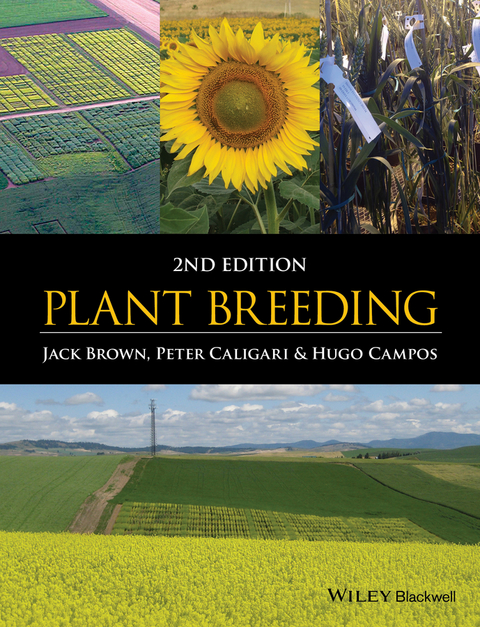
Plant Breeding (eBook)
John Wiley & Sons (Verlag)
978-1-118-87352-6 (ISBN)
This book, Plant Breeding, has it bases in an earlier text entitled An Introduction to Plant Breeding by Jack Brown and Peter Caligari, first published in 2008. The challenges facing today's plant breeders have never been more overwhelming, yet the prospects to contribute significantly to global food security and farmers' quality of life have never been more exciting and fulfilling. Despite this there has been a worrying decline in public funding for plant breeding-related research and support for international centers of germplasm development and crop improvement. In part, this has resulted in a serious reduction in the number of young people interested in devoting their professional careers to plant breeding as well as the number of universities offering plant breeding courses or conducting relevant research in plant breeding.
The authors' aim in writing this book is to provide an integrated and updated view of the current scientific progress related to diverse plant breeding disciplines, within the context of applied breeding programs. This excellent new book will encourage a new generation of students to pursue careers related to plant breeding and will assist a wider audience of agricultural students, agronomists, policy makers and those with an interest in agriculture in gaining insight about the issues affecting plant breeding and its key role in improving the quality of life of people and in securing sufficient food, at the quality required and at an affordable price.
With comprehensive coverage including questions designed for students, and an accompanying website containing additional material to help in the study of the subject, Plant Breeding is an ideal text for all those studying plant and crop sciences, and a convenient reference source for professionals working in the area. All libraries within universities and research establishments where biological and agricultural sciences are studied and taught should have multiple copies of this book.
Jack Brown, Full Professor, Plant Breeding & Genetics, University of Idaho, USA. HNC Mathematics & Statistics, Napier College, Edinburgh, Scotland; MSc and PhD at St Andrews University, St Andrews, Scotland. Professor Brown has over 40 years of experience working as a plant breeder in the public and private sector and has developed and released cultivars of barley, potato, canola, mustard and wheat. Professor Brown currently teaches upper division and graduate classes in plant breeding, genetics, and field crop production.
Peter Caligari, Full Professor, University of Talca, Chile. BSc, PhD and DSc at University of Birmingham, UK. Professor Caligari has over 40 years of research experience in, and application of, genetics and plant breeding in a range of crops including potatoes, cashew nuts, oil palm, lupins, strawberries and blueberries, and extensive teaching experience including plant breeding and genetics at the graduate and post-graduate level.
Hugo Campos, Fellow, Monsanto, Chile. BSc at Universidad Austral de Chile, PhD at the John Innes Centre, UK, MBA at Universidad del Desarrollo, Chile. Dr Campos has over 24 years of experience in plant biotechnology, crop breeding and product development in industry, academia and international agricultural development.
This book, Plant Breeding, has it bases in an earlier text entitled An Introduction to Plant Breeding by Jack Brown and Peter Caligari, first published in 2008. The challenges facing today s plant breeders have never been more overwhelming, yet the prospects to contribute significantly to global food security and farmers quality of life have never been more exciting and fulfilling. Despite this there has been a worrying decline in public funding for plant breeding-related research and support for international centers of germplasm development and crop improvement. In part, this has resulted in a serious reduction in the number of young people interested in devoting their professional careers to plant breeding as well as the number of universities offering plant breeding courses or conducting relevant research in plant breeding. The authors aim in writing this book is to provide an integrated and updated view of the current scientific progress related to diverse plant breeding disciplines, within the context of applied breeding programs. This excellent new book will encourage a new generation of students to pursue careers related to plant breeding and will assist a wider audience of agricultural students, agronomists, policy makers and those with an interest in agriculture in gaining insight about the issues affecting plant breeding and its key role in improving the quality of life of people and in securing sufficient food, at the quality required and at an affordable price. With comprehensive coverage including questions designed for students, and an accompanying website containing additional material to help in the study of the subject, Plant Breeding is an ideal text for all those studying plant and crop sciences, and a convenient reference source for professionals working in the area. All libraries within universities and research establishments where biological and agricultural sciences are studied and taught should have multiple copies of this book.
Jack Brown, Full Professor, Plant Breeding & Genetics, University of Idaho, USA. HNC Mathematics & Statistics, Napier College, Edinburgh, Scotland; MSc and PhD at St Andrews University, St Andrews, Scotland. Professor Brown has over 40 years of experience working as a plant breeder in the public and private sector and has developed and released cultivars of barley, potato, canola, mustard and wheat. Professor Brown currently teaches upper division and graduate classes in plant breeding, genetics, and field crop production. Peter Caligari, Full Professor, University of Talca, Chile. BSc, PhD and DSc at University of Birmingham, UK. Professor Caligari has over 40 years of research experience in, and application of, genetics and plant breeding in a range of crops including potatoes, cashew nuts, oil palm, lupins, strawberries and blueberries, and extensive teaching experience including plant breeding and genetics at the graduate and post-graduate level. Hugo Campos, Fellow, Monsanto, Chile. BSc at Universidad Austral de Chile, PhD at the John Innes Centre, UK, MBA at Universidad del Desarrollo, Chile. Dr Campos has over 24 years of experience in plant biotechnology, crop breeding and product development in industry, academia and international agricultural development.
Chapter 1
Introduction
1.1 Requirements of plant breeders
The aim of plant breeding is to develop genetically superior cultivars that are adapted to specific environmental conditions and suitable for economic production in a commercial cropping system. These new, and more productive cultivars, are increasingly necessary to fulfil humankind's escalating needs for food, fibre and fuels.
The basic concept of varietal development is rather simple and involves three distinct operations:
- produce or identify genetically diverse germplasm from which segregating breeding populations are developed;
- carry out selection procedures on phenotypes or genotypes from within this germplasm to identify superior genotypes with specific improved characteristics;
- stabilize and multiply these superior genotypes and release cultivars for commercial production.
The general philosophy underlying any breeding scheme is to maximize the probability of creating, and identifying, superior genotypes which will make successful new cultivars; in other words, genotypes that will contain all the desirable characteristics/traits necessary for use in a given production system, or at least offer a beneficial trade-off between key advantageous characteristics compared with undesirable ones.
Plant breeders can be categorized into two types. One group of plant breeders is employed within private companies, while the other group works in the public sector (e.g. government-funded research institutes or universities). Private sector and public sector breeders often have different approaches to the breeding process. Many of the differences that exist between public and private breeding programmes are related to the time available for variety release, types of cultivar developed, and priorities for traits in the selection process.
Plant breeders within the public sector are likely to have a number of responsibilities related to academic activities or extension services, in addition to those solely directed towards producing new varieties. Public sector breeders also play an additional, often unappreciated yet critical role: the attraction, training and development of a younger generation of men and women interested in plant breeding. As plant breeding is a combination of science and art, the personal component of training plant breeders at the graduate level is generally recognized as more relevant and significant than in most other areas of science.
Private sector plant breeders tend to have a more clearly defined goal: developing new cultivars and doing it as quickly as possible. In addition, many private breeding organizations are, or are associated with, biotechnology and/or agrochemical companies. As a result, varietal development may be designed to produce cultivars suitable for integration within a specific production system. In many countries, including the US, the ratio of private to public breeders has increased over time, particularly in those highest acreage crops such as maize, soybeans and canola, to mention just a few, as well as in crops with a high profit, such as tomato, pepper and lettuce, where private companies can gain greatest financial returns from seed or chemical sales.
Despite the apparently simple description of the breeding process given above, in reality plant breeding involves a multidisciplinary and long-term approach. Regardless of whether a breeding scheme is publicly or privately managed, a successful plant breeder will require knowledge in many (if not all) of the following subjects:
- Evolution It is necessary to have knowledge of the origins and past progress in adaptation of crop species if additional advances are to continue into the future. When dealing with a crop species, a plant breeder benefits from knowledge of the timescale of events that have modelled the given crop. For example, the time of domestication, geographical area of origin and prior improvements are all important and will help in setting feasible future objectives. In the case of crops where hybridization systems are commercially available, such as canola and corn, the evolution from OP (open pollinated) to hybrid cultivars represents a landmark driving profound changes in ensuing breeding programmes.
- Botany The raw material of any breeding scheme is the available germplasm (lines, genotypes, accessions, etc.) from which agronomically relevant variation can be exploited. The biological relationship that exists within a species and with other species will be a determining factor indicating germplasm variability and availability.
- Biology Knowledge of plant biology is essential to create genetic variation and formulate a suitable breeding and selection scheme. Of particular interest are modes of reproduction, types of cultivar and breeding systems.
- Genetics The creation of new cultivars requires manipulation of genotypes and genes. The understanding of genetic processes is therefore essential for success in plant breeding. Genetics is an ever-developing subject, but knowledge and understanding that is particularly useful will include single gene inheritance, population genetics, the expected frequencies of genotypes under selection, and the prediction of quantitative genetic parameters – all of which will underlie decisions on what strategy of selection will be most effective.
- Pathology A major goal of plant breeding is to increase productivity and quality by selecting superior genotypes. A limiting factor in economic production is the impact of pests and diseases. Therefore developing cultivars that are resistant to detrimental pathogens has been a major contributor to most cost-effective production with reduced agrochemical inputs. Similarly, nematodes, insect pests and viruses can all have detrimental effects on yield and/or quality. Therefore plant breeders must also have knowledge of phytopathology, nematology, entomology and virology.
- Weed science The response of a genotype to competition from weed populations will have an effect on the success of a new cultivar. Cultivars that have poor plant establishment, or lack subsequent competitive ability, are unlikely to be successful, particularly in systems where reduced, or no, herbicide applications are desirable, or their use is restricted. Similarly, in many cases genotypes respond differently, even to selective herbicides. Herbicide tolerance in new crops is looked upon favourably by many breeding groups, although cultivar tolerance to broad-spectrum herbicides can cause management difficulties in crop rotations. Herbicide tolerance brought about by traditional breeding as well as through recombinant DNA techniques has also driven changes in plant breeding approaches.
- Food science Increasingly end-use quality is being identified as one of the major objectives of all crop-breeding schemes. As most crop species are grown for either human or animal consumption, knowledge of food nutrition and other related subjects is important.
- Biometry Managing a plant-breeding scheme has aspects that are no different from organizing a series of large experiments over many locations and years. To maximize the probability of success it is necessary to use an appropriate experimental approach at all stages of the breeding scheme. Plant breeding is continually described as ‘a numbers game’. In many cases this is true, and successful breeding will result in vast datasets on which selection decisions are to be made. These decisions often have to be made under significant time constraints, for instance between harvesting one crop and planting another. Therefore, plant breeders are required to be good data managers.
- Agronomy It is the aim of crop breeders to predict how newly identified genotypes will perform over a wide range of environments. This will require research into agronomic features that may relate to stress tolerance, such as heat, drought, moisture, salinity and fertility. These experiments are essential in order that farmers (the primary customer) are provided with the optimal agronomic husbandry parameters, which will maximize the genetic potential of the new variety. Poor agronomic practice can detrimentally affect the expression of genotypes and the selection of appropriate phenotypes. Despite increasingly powerful statistical tools, poorly managed field trials represent a waste of effort and a risk of reducing the rate of genetic gain expected.
- Molecular biology Advances in molecular biological techniques are having an increasing role in modern plant breeding. Molecular markers are increasingly used by plant breeders to help select (indirectly and directly) for characteristics that are difficult to evaluate in the laboratory, or are time-consuming or expensive to determine accurately on a small plot scale. Genetic engineering and tissue culture operations, such as the development of double haploid populations, are becoming standard in many plant-breeding schemes, and it is likely that further advances will be made in the future. Knowledge of all these techniques and continued awareness of ongoing research will be necessary so that new procedures can be integrated into the breeding scheme where appropriate. In those crops where transgenic variation is commercially available, such as herbicide or insect tolerance in corn, the availability of molecular markers has enabled the development of effective schemes collectively known as trait integration, where a small genomic region carrying a transgenic trait is very quickly...
| Erscheint lt. Verlag | 20.10.2014 |
|---|---|
| Sprache | englisch |
| Themenwelt | Naturwissenschaften ► Biologie |
| Technik | |
| Weitere Fachgebiete ► Land- / Forstwirtschaft / Fischerei | |
| Schlagworte | Agriculture • Bases • Biowissenschaften • Botanik • breeders • Brown • Caligari • centers • Contribute • decline • earlier • Facing • Farmers • Food • Funding • Global • international • Introduction • Landwirtschaft • Life • Life Sciences • Plant • plant breedingrelated • plant science • Prospects • quality • Research • significantly • Text • todays • worrying |
| ISBN-10 | 1-118-87352-1 / 1118873521 |
| ISBN-13 | 978-1-118-87352-6 / 9781118873526 |
| Informationen gemäß Produktsicherheitsverordnung (GPSR) | |
| Haben Sie eine Frage zum Produkt? |
 EPUB (Adobe DRM)
Kopierschutz: Adobe-DRM
Adobe-DRM ist ein Kopierschutz, der das eBook vor Mißbrauch schützen soll. Dabei wird das eBook bereits beim Download auf Ihre persönliche Adobe-ID autorisiert. Lesen können Sie das eBook dann nur auf den Geräten, welche ebenfalls auf Ihre Adobe-ID registriert sind.
Details zum Adobe-DRM
Dateiformat: EPUB (Electronic Publication)
EPUB ist ein offener Standard für eBooks und eignet sich besonders zur Darstellung von Belletristik und Sachbüchern. Der Fließtext wird dynamisch an die Display- und Schriftgröße angepasst. Auch für mobile Lesegeräte ist EPUB daher gut geeignet.
Systemvoraussetzungen:
PC/Mac: Mit einem PC oder Mac können Sie dieses eBook lesen. Sie benötigen eine
eReader: Dieses eBook kann mit (fast) allen eBook-Readern gelesen werden. Mit dem amazon-Kindle ist es aber nicht kompatibel.
Smartphone/Tablet: Egal ob Apple oder Android, dieses eBook können Sie lesen. Sie benötigen eine
Geräteliste und zusätzliche Hinweise
Buying eBooks from abroad
For tax law reasons we can sell eBooks just within Germany and Switzerland. Regrettably we cannot fulfill eBook-orders from other countries.
aus dem Bereich