Analytical Chemistry-4 (eBook)
176 Seiten
Elsevier Science (Verlag)
978-1-4831-5385-8 (ISBN)
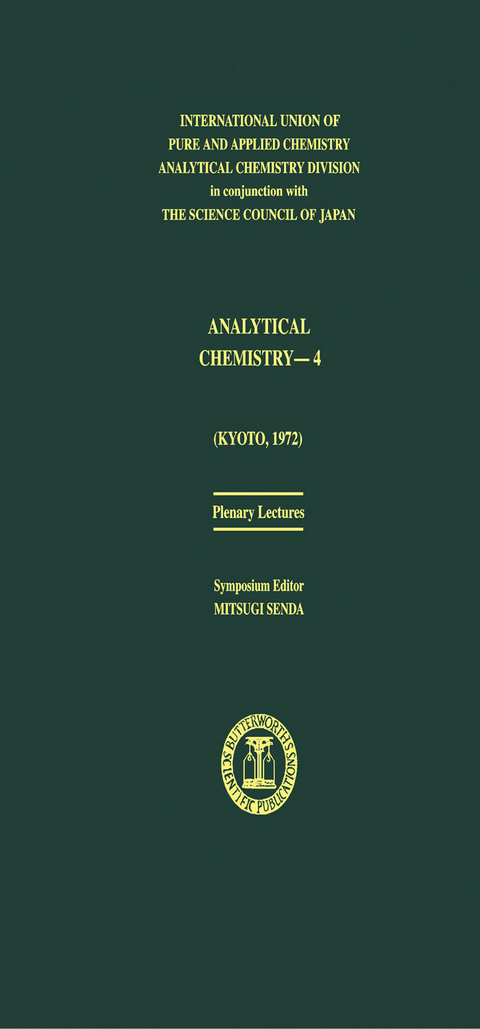
Analytical Chemistry - 4 is a collection of plenary lectures presented at the International Congress on Analytical Chemistry, held in Kyoto, Japan on April 3-7, 1972. This book contains 11 chapters and begins with a summary of the kinetics of complex formation of metals with organic ligands in analytical chemistry. The subsequent chapters deal with the chelate compounds; the concepts of trace analysis; the developments in quantitative organic ultramicro elementary analysis; and the status of radiochemistry and its application to activation analysis. These topics are followed by presentation of precipitation-based ion-selective electrodes, with a particular emphasis on their most important analytical and physicochemical applications. A chapter briefly highlights the progress of analytical chemistry in Japan. The remaining chapters explore the direct metal and alloy analysis based on the selective modulation and resonance detection of conventional atomic absorption spectroscopy. These chapters also look into the status of analytical chemistry studies of air and water pollution. This text will be of great benefit to analytical chemists and researchers.
Front Cover 1
Analytical Chemistry—4 4
Copyright Page 5
Table of Contents 6
ORGANIZING COMMITTEE 7
Chapter 1. KINETICS OF COMPLEX FORMATION OF METALS WITH ORGANIC LIGANDS IN ANALYTICAL CHEMISTRY 8
ABSTRACT 8
INTRODUCTION 8
FAST REACTIONS OF COMPLEX FORMATION 9
SLOW REACTIONS OF COMPLEX FORMATION 9
REPLACEMENT OF LIGANDS IN COMPLEX COMPOUNDS 12
REPLACEMENT OF METALS IN COMPLEX COMPOUNDS 15
CONCLUSION 16
REFERENCES 16
Chapter 2. THE APPLICATION OF CHELATE COMPOUNDS IN ANALYTICAL CHEMISTRY 20
ABSTRACT 20
INTRODUCTION 20
FLUORINE-SUBSTITUTED REAGENTS 21
DIOXIME REAGENTS 23
EDTA INDICATORS AND SOME EDTA ANALOGUES 24
FERROIN AND CUPROIN TYPE REAGENTS 26
RHODANINES 27
STUDIES ON WELL-KNOWN REAGENTS 29
GAS CHROMATOGRAPHY OF METAL CHELATES 30
MASS SPECTROMETRY OF METAL CHELATES 32
ACKNOWLEDGEMENTS 33
REFERENCES 33
Chapter 3. SUR L'ANALYSE DES REACTIONS EN MILIEU NON-AQUEUX AU MOYEN DES METHODES ELECTROCHIMIQUES 36
RESUME 36
Chapter 4. GUIDING CONCEPTS RELATING TO TRACE ANALYSIS 42
ABSTRACT 42
1. INTRODUCTION 42
2. THE CONCEPT OF 'TRACE' SCALES OF WORKING
3. QUANTIFICATION IN CHEMICAL ANALYSIS 46
4. LOGARITHMIC PRESENTATION OF VALUES 48
5. ANATOMY OF THE MEASURED VALUE 49
6. TREATMENT OF CALIBRATION FUNCTIONS 52
7. CALIBRATION METHODS FOR TRACE DETERMINATION 55
8. TYPE OF INFORMATION AND INFORMING POWER 58
9. TOPOLOGIC AL STRUCTURES OF ANALYTICAL PROCEDURES 59
10. SELECTIVITY AND SENSITIVITY OF PROCEDURES FOR MULTICOMPONENT ANALYSIS 61
11. LIMIT OF DETECTION AND LIMIT OF GUARANTEE OF PURITY 64
ACKNOWLEDGEMENT 67
REFERENCES 68
Chapter 5. DEVELOPMENTS IN QUANTITATIVE ORGANIC ULTRAMICRO ELEMENTARY ANALYSIS 70
ABSTRACT 70
METHODS USING DECOMPOSITION IN A GAS FLOW 70
FLASK COMBUSTION METHODS 79
WET COMBUSTION 82
QUANTIFICATION OF THE SAMPLE 86
REFERENCES 87
Chapter 6. THE PROBLEM OF DETECTION 90
ABSTRACT 90
INTRODUCTION 90
THE PROBLEM OF DETECTION 91
Chapter 7. IS RADIOCHEMISTRY THE ULTIMATE IN TRACE ANALYSIS? 100
ABSTRACT 100
INTRODUCTION 101
THE FIELD OF TRACE ANALYSIS 101
THE REAL WORLD OF TRACE ANALYSIS 102
REAGENT BLANKS, HIGH PURITY REAGENTS, CLEAN FACILITIES 105
CONTRIBUTION OF RADIOCHEMISTRY TO THE ANALYSIS OF PRACTICAL TRACE SAMPLES 106
SUMMARY 109
REFERENCES 111
Chapter 8. PRECIPITATE-BASED ION-SELECTIVE ELECTRODES 112
ABSTRACT 112
INTRODUCTION 112
THEORETICAL SECTION 118
PRACTICAL SECTION 130
SOME ANALYTICAL APPLICATIONS OF PRECIPITATE-BASED ION-SELECTIVE ELECTRODES 132
SOME OTHER APPLICATIONS OF ION-SELECTIVE ELECTRODES 140
CONCLUSION 140
REFERENCES 141
Chapter 9. ANALYTICAL CHEMISTRY IN JAPAN 146
ABSTRACT 146
REFERENCES 150
Chapter 10. NON-DISPERSIVE SYSTEMS IN ATOMIC ABSORPTION SPECTROSCOPY 152
ABSTRACT 152
1. INTRODUCTION 152
2. NON-DISPERSIVE SYSTEMS BASED ON SELECTIVE MODULATION 155
3. NON-DISPERSIVE SYSTEMS BASED ON ATOMIC FLUORESCENCE 161
4. SUMMARY AND CONCLUSIONS 168
REFERENCES 168
Chapter 11. ANALYTICAL STUDIES OF THE ENVIRONMENT 170
ABSTRACT 170
WATER ANALYSES 172
AIR ANALYSES 173
ACKNOWLEDGEMENT 176
REFERENCES 177
| Erscheint lt. Verlag | 19.4.2016 |
|---|---|
| Sprache | englisch |
| Themenwelt | Naturwissenschaften ► Chemie ► Analytische Chemie |
| Technik | |
| ISBN-10 | 1-4831-5385-1 / 1483153851 |
| ISBN-13 | 978-1-4831-5385-8 / 9781483153858 |
| Informationen gemäß Produktsicherheitsverordnung (GPSR) | |
| Haben Sie eine Frage zum Produkt? |
 PDF (Adobe DRM)
Kopierschutz: Adobe-DRM
Adobe-DRM ist ein Kopierschutz, der das eBook vor Mißbrauch schützen soll. Dabei wird das eBook bereits beim Download auf Ihre persönliche Adobe-ID autorisiert. Lesen können Sie das eBook dann nur auf den Geräten, welche ebenfalls auf Ihre Adobe-ID registriert sind.
Details zum Adobe-DRM
Dateiformat: PDF (Portable Document Format)
Mit einem festen Seitenlayout eignet sich die PDF besonders für Fachbücher mit Spalten, Tabellen und Abbildungen. Eine PDF kann auf fast allen Geräten angezeigt werden, ist aber für kleine Displays (Smartphone, eReader) nur eingeschränkt geeignet.
Systemvoraussetzungen:
PC/Mac: Mit einem PC oder Mac können Sie dieses eBook lesen. Sie benötigen eine
eReader: Dieses eBook kann mit (fast) allen eBook-Readern gelesen werden. Mit dem amazon-Kindle ist es aber nicht kompatibel.
Smartphone/Tablet: Egal ob Apple oder Android, dieses eBook können Sie lesen. Sie benötigen eine
Geräteliste und zusätzliche Hinweise
Buying eBooks from abroad
For tax law reasons we can sell eBooks just within Germany and Switzerland. Regrettably we cannot fulfill eBook-orders from other countries.
aus dem Bereich