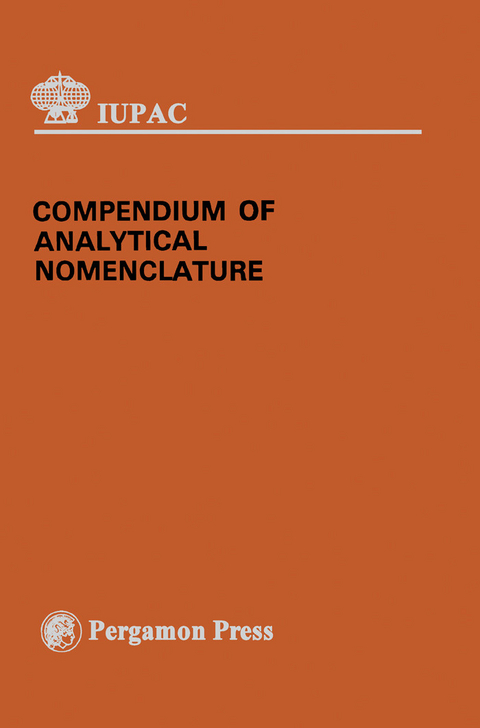
Compendium of Analytical Nomenclature (eBook)
232 Seiten
Elsevier Science (Verlag)
978-1-4831-5089-5 (ISBN)
Compendium of Analytical Nomenclature: Definitive Rules 1977 focuses on the recommended nomenclature and symbols to be used in various disciplines of analytical chemistry. The book first offers information on recommendations for the presentation of the results of chemical analysis; recommendations for terminology to be employed with precision balances; and recommendations on nomenclature for contamination phenomena in precipitation from aqueous solution. The text also takes a look at recommended nomenclature for automatic analysis and recommendations for nomenclature of thermal analysis and mass spectrometry, as well as recommended nomenclature for titrimetric analysis. The publication reviews the practical measurements of pH in amphiprotic and mixed solvents. Topics include operational pH scale; selection of a pH unit for amphiprotic solvents; and interpretation of the measured pH. The text also considers the recommendations on nomenclature and presentation of data in gas chromatography and recommendations on nomenclature for chromatography. The book is a valuable source of data for readers wanting to study analytical nomenclature.
Front Cover 1
Compendium of Analytical Nomenclature: Definitive Rules 1977 4
Copyright Page 5
Table of Contents 6
Chapter 0. PREAMBLE 10
0.1 Sources of the material incorporated in the compendium 10
0.2 General principles of nomenclature standardization 11
0.3 Physical quantities : ways of naming physical quantities 12
0.4 Scope and treatment of the present compendium 14
Chapter 1. RECOMMENDATIONS FOR THE PRESENTATION OF THE RESULTS OF CHEMICAL ANALYSIS 17
1.1 Introduction 17
1.2 General terms 17
1.3 Reliability of results 18
1.4 Expression of results 18
1.5 Symbols 19
1.6 Methods of computation 19
1.7 Appendix 20
Chapter 2. RECOMMENDATIONS FOR TERMINOLOGY TO BE USED WITH PRECISION BALANCES 21
2.1 Introduction 21
2.2 Terminology 21
2.3 Glossary of terms 22
Chapter 3. RECOMMENDED NOMENCLATURE FOR SCALES OF WORKING IN ANALYSIS 24
3.1 Introduction 24
3.2 Sample weight classification (s) 24
3.3 Constituent content classification (c) 25
Chapter 4. RECOMMENDATIONS ON NOMENCLATURE FOR CONTAMINATION PHENOMENA IN PRECIPITATION FROM AQUEOUS SOLUTION 27
4.1 Introduction 27
4.2 Definitions 27
Chapter 5. RECOMMENDED NOMENCLATURE FOR AUTOMATIC ANALYSIS 31
5.1 Introduction 31
5.2 Recommended terminology 31
Chapter 6. RECOMMENDATIONS FOR NOMENCLATURE OF THERMAL ANALYSIS 33
6.1 General recommendations 33
6.2 Terminology 33
6.3 Definitions and conventions 35
Chapter 7. RECOMMENDATIONS FOR NOMENCLATURE OF MASS SPECTROMETRY 37
Chapter 8. RECOMMENDED NOMENCLATURE FOR TITRIMETRIC ANALYSIS 44
Chapter 9. REPORT ON THE STANDARDIZATION OF pH AND RELATED TECHNOLOGY 53
9.1 Introduction 53
9.2 Symbols 53
9.3 Operational definition of pH 53
9.4 Standards for measurement of pH 54
9.5 Ionic activity coefficients 55
9.6 pH of standard solutions 57
9.7 Approximate interpretation of pH 57
9.8 The abbreviation paH 57
Chapter 10. PRACTICAL MEASUREMENT OF pH IN AMPHIPROTIC AND MIXED SOLVENTS 58
10.1 Introduction 58
10.2 The operational pH scale 58
10.3 Interpretation of the measured pH 58
10.4 Extension to other,solvents 59
10.5 Selection of a pH unit for amphiprotic solvents 60
10.6 Operational pH scale for amphiprotic solvents 61
10.7 Reference solutions for values of pH amphiprotic solvents 61
10.8 Accuracy of practical scales 62
Chapter 11. RECOMMENDED SYMBOLS FOR SOLUTION EQUILIBRIA 63
11.1 Introduction 63
11.2 General rules 63
11.3 Complex formation equilibria 64
11.4 Solubility equilibria 67
11.5 Liquid-liquid distribution equilibria 67
Chapter 12. RECOMMENDED NOMENCLATURE FOR LIQUID-LIQUID DISTRIBUTION 69
Chapter 13. RECOMMENDATIONS ON NOMENCLATURE AND PRESENTATION OF DATA IN GAS CHROMATOGRAPHY 73
13.1 Introduction 73
13.2 Name of technique 73
13.3 Apparatus 73
13.4 Reagents 74
13.5 Chromatographie records 75
13.6 Retention parameters 75
13.7 Recommendations: retention data 78
13.8 Apparatus performance 78
13.9 Discussion 79
13.10 Table of terms 81
Chapter 14. RECOMMENDATIONS ON NOMENCLATURE FOR CHROMATOGRAPHY 83
14.1 Chromatography 83
14.2 Principal methods 83
14.3 Classification according to phases used 83
14.4 Classification according to mechanisms 84
14.5 Classification according to techniques used 84
14.6 Terms for special techniques 85
14.7 Terms relating to the method in general 85
14.8 Terms relating to the separation process and the apparatus 87
14.9 Terms relating to quantitative evaluation and the theory of chromatography 89
14.10 Appendix and list of symbols 95
Chapter 15. RECOMMENDATIONS ON ION EXCHANGE NOMENCLATURE 97
15.1 Introduction 97
15.2 Definitions 97
Chapter 16. NOMENCLATURE, SYMBOLS, UNITS AND THEIR USAGE IN SPECTROCHEMICAL ANALYSIS-I. GENERAL ATOMIC EMISSION SPECTROSCOPY 102
16.1 Foreword 102
16.2 General recommendations and practices 102
16.3 Terms and symbols for physical quantities in general use 105
16.4 Terms, symbols, and units related to radiant energy 106
16.5 Terms and symbols for the description of spectrographic instruments 108
16.6 Terms and symbols related to the analytical procedures 110
16.7 Terms and symbols related to fundamental processes occurring in light (excitation) sources 112
16.8 Photographic intensity measurements (photographic photometry) 117
Appendix: Application of the concept of optical conductance 120
Chapter 17. NOMENCLATURE, SYMBOLS, UNITS AND THEIR USAGE IN SPECTROCHEMICAL ANALYSIS - II. DATA INTERPRETATION 123
17.1 Introduction 123
17.2 General concepts 123
17.3 Analytical functions and curves 125
17.4 Terms relating to small concentrations 126
17.5 Glossary of terms and symbols used 126
Chapter 18. NOMENCLATURE, SYMBOLS, UNITS AND THEIR USAGE IN SPECTROCHEMICAL ANALYSIS - III . ANALYTICAL FLAME SPECTROSCOPY AND ASSOCIATED NON-FLAME PROCEDURES 127
18.1 Introduction 127
18.2 Terms and symbols for general quantities and constants 129
18.3 Terms, symbols, and units for the description of the analytical apparatus 129
18.4 Terms and symbols relating to the analytical procedure and the performance of an analysis 139
18.5 Terms, symbols, and units relating to radiant energy, and its interaction with matter 146
18.6 Terms, symbols, and units relating to the gaseous state of matter 152
18.7 Index of terms† 154
Chapter 19. CLASSIFICATION AND NOMENCLATURE OF ELECTROANALYTICAL TECHNIQUES 157
19.1 Introduction 157
19.2 Techniques in which neither the electrical double layer nor any electrode reaction need be considered 161
19.3 Techniques that involve double-layer phenomena but in which any electrode reactions need not be considered 161
19.4 Techniques involving electrode reactions and employing constant excitation signals 162
19.5 Techniques involving electrode reactions and variable excitation signals of large amplitude 165
19.6 Techniques involving electrode reactions and variable excitation signals of small amplitude 169
19.7 Index to Tables 19.2 - 19.6 172
Chapter 20. RECOMMENDATIONS FOR SIGN CONVENTIONS AND PLOTTING OF ELECTROCHEMICAL DATA 175
Chapter 21. RECOMMENDATIONS FOR NOMENCLATURE OF ION-SELECTIVE ELECTRODES 177
21.1 General recommendations 177
21.2 Classification of ion -selective electrodes 180
21.3 Constants and symbols 181
APPENDIX: RECOMMENDATIONS ON THE USAGE OF THE TERMS 'EQUIVALENT' AND 'NORMAL' 184
INDEX 196
| Erscheint lt. Verlag | 3.5.2017 |
|---|---|
| Sprache | englisch |
| Themenwelt | Naturwissenschaften ► Chemie ► Analytische Chemie |
| Technik | |
| ISBN-10 | 1-4831-5089-5 / 1483150895 |
| ISBN-13 | 978-1-4831-5089-5 / 9781483150895 |
| Informationen gemäß Produktsicherheitsverordnung (GPSR) | |
| Haben Sie eine Frage zum Produkt? |
 PDF (Adobe DRM)
Kopierschutz: Adobe-DRM
Adobe-DRM ist ein Kopierschutz, der das eBook vor Mißbrauch schützen soll. Dabei wird das eBook bereits beim Download auf Ihre persönliche Adobe-ID autorisiert. Lesen können Sie das eBook dann nur auf den Geräten, welche ebenfalls auf Ihre Adobe-ID registriert sind.
Details zum Adobe-DRM
Dateiformat: PDF (Portable Document Format)
Mit einem festen Seitenlayout eignet sich die PDF besonders für Fachbücher mit Spalten, Tabellen und Abbildungen. Eine PDF kann auf fast allen Geräten angezeigt werden, ist aber für kleine Displays (Smartphone, eReader) nur eingeschränkt geeignet.
Systemvoraussetzungen:
PC/Mac: Mit einem PC oder Mac können Sie dieses eBook lesen. Sie benötigen eine
eReader: Dieses eBook kann mit (fast) allen eBook-Readern gelesen werden. Mit dem amazon-Kindle ist es aber nicht kompatibel.
Smartphone/Tablet: Egal ob Apple oder Android, dieses eBook können Sie lesen. Sie benötigen eine
Geräteliste und zusätzliche Hinweise
Buying eBooks from abroad
For tax law reasons we can sell eBooks just within Germany and Switzerland. Regrettably we cannot fulfill eBook-orders from other countries.
aus dem Bereich