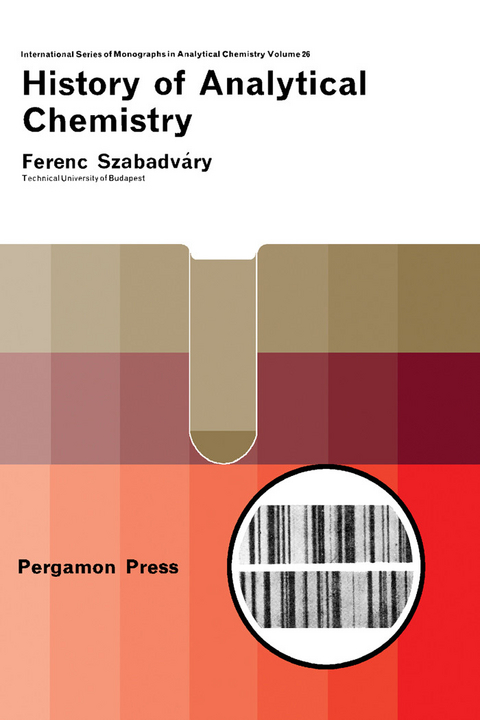
History of Analytical Chemistry (eBook)
430 Seiten
Elsevier Science (Verlag)
978-1-4831-5712-2 (ISBN)
History of Analytical Chemistry is a systematic account of the historical development of analytical chemistry spanning about 4,000 years. Many scientists who have helped to develop the methods of analytical chemistry are mentioned. Various methods of analysis are discussed, including electrogravimetry, optical methods, electrometric analysis, radiochemical analysis, and chromatography. This volume is comprised of 14 chapters and begins with an overview of analytical chemistry in ancient Greece, the origin of chemistry, and the earliest knowledge of analysis. The next chapter focuses on analytical chemistry during the Middle Ages, with emphasis on alchemy. Analytical knowledge during the period of iatrochemistry and the development of analytical chemistry during the phlogiston period are then examined. Subsequent chapters deal with the development of the fundamental laws of chemistry, including the principle of the indestructibility of matter; analytical chemistry during the period of Berzelius; and developments in qualitative and gravimetric analysis. Elementary organic analysis is also considered, along with the development of the theory of analytical chemistry. This book will be helpful to chemists as well as students and researchers in the field of analytical chemistry.
Front Cover 1
History of Analytical Chemistry 4
Copyright Page 5
Table of Contents 6
PREFACE 8
CHAPTER I. ANALYTICAL CHEMISTRY IN ANTIQUITY 12
1. Ancient science 12
2. The origin of chemistry 14
3. The earliest knowledge of analysis 16
Notes and references 19
CHAPTER II. KNOWLEDGE OF ANALYTICAL CHEMISTRY IN THE MIDDLE AGES 20
1. Alchemy 20
2. Knowledge of analysis 24
Notes and references 31
CHAPTER III. ANALYTICAL KNOWLEDGE DURING THE PERIOD OF IATROCHEMISTRY 32
l. The clarification of chemical concepts 32
2. The beginning of analysis in aqueous solutions 37
3. Robert Boyle 46
Notes and references 51
CHAPTER IV. THE DEVELOPMENT OF ANALYTICAL CHEMISTRY DURING THE PHLOGISTON PERIOD
53
l .The phlogiston theory
53
2. The blow-pipe 61
3. Further light on reactions in solution 66
4. The beginnings of gas analysis 73
5. Torbern Bergman 82
Notes and references 92
CHAPTER V. THE ESTABLISHMENT OF THE FUNDAMENTAL LAWS OFCHEMISTRY 96
1. Quantitative analysis before Lavoisier 96
2. The principle of the indestructibility of matter 101
3. Stoichiometry 108
Notes and references 122
CHAPTER VI. THE PERIOD OF BERZELIUS 125
l.The recognition of the composition of minerals 125
2. The life and personality of Berzelius 136
3. The establishment of atomic weights 150
4. The state of analytical chemistry in the age of Berzelius 155
5. The first analytical textbooks 161
Notes and references 167
CHAPTER VII. FURTHER DEVELOPMENTS IN QUALITATIVE AND GRAVIMETRIC ANALYSIS 172
1. Introduction of systematic tests for the ions 172
2. Gravimetric analysis 185
3. Microanalysis 196
Notes and references 203
CHAPTER VIII. VOLUMETRIC ANALYSIS 208
1. Ancient history of titrimetry 208
2. From Descroizilles to Gay-Lussac 219
3. From Gay-Lussac to Mohr 238
4. Friedrich Mohr 248
5. The development of titrimetric analysis before the introduction of synthetic indicators
261
6. Development of indicators 268
7. The development of titrimetric analysis up to the present day 276
Notes and references 282
CHAPTER IX. ELEMENTARY ORGANIC ANALYSIS 295
1. From Lavoisier to Liebig 295
2. From Liebig to Pregl 301
Notes and references 316
CHAPTER X. ELECTROGRAVIMETRY 320
Notes and references 327
CHAPTER XI. OPTICAL METHODS 329
1. Preliminaries of spectroscopy 329
2. Kirehhoff and Bunsen 335
3. Further development of spectrum analysis 344
4. Colorimetry 348
Notes and references 355
CHAPTER XII. THE DEVELOPMENT OF THE THEORY OF ANALYTICAL CHEMISTRY 360
l . The development of physical chemistry
360
2. Wilhelm Ostwald 364
3. Development of the concept of pH 372
4. Theory of titration 376
Notes and references 382
CHAPTER XIII. ELECTROMETRIC ANALYSIS 386
1. The measurement of pH 386
2. Potentiometric titration 389
3. Conductometric titrations 394
4. Polarography 395
Notes and references 398
CHAPTER XIV. OTHER METHODS OF ANALYSIS 401
1. Radiochemical analysis 401
2. Chromatography 404
3. Ion exchange 408
Notes and references 410
AUTHOR INDEX 414
SUBJECT INDEX 422
OTHER TITLES IN THE SERIES IN
430
| Erscheint lt. Verlag | 22.1.2016 |
|---|---|
| Sprache | englisch |
| Themenwelt | Naturwissenschaften ► Chemie ► Analytische Chemie |
| Technik | |
| ISBN-10 | 1-4831-5712-1 / 1483157121 |
| ISBN-13 | 978-1-4831-5712-2 / 9781483157122 |
| Informationen gemäß Produktsicherheitsverordnung (GPSR) | |
| Haben Sie eine Frage zum Produkt? |
 PDF (Adobe DRM)
Kopierschutz: Adobe-DRM
Adobe-DRM ist ein Kopierschutz, der das eBook vor Mißbrauch schützen soll. Dabei wird das eBook bereits beim Download auf Ihre persönliche Adobe-ID autorisiert. Lesen können Sie das eBook dann nur auf den Geräten, welche ebenfalls auf Ihre Adobe-ID registriert sind.
Details zum Adobe-DRM
Dateiformat: PDF (Portable Document Format)
Mit einem festen Seitenlayout eignet sich die PDF besonders für Fachbücher mit Spalten, Tabellen und Abbildungen. Eine PDF kann auf fast allen Geräten angezeigt werden, ist aber für kleine Displays (Smartphone, eReader) nur eingeschränkt geeignet.
Systemvoraussetzungen:
PC/Mac: Mit einem PC oder Mac können Sie dieses eBook lesen. Sie benötigen eine
eReader: Dieses eBook kann mit (fast) allen eBook-Readern gelesen werden. Mit dem amazon-Kindle ist es aber nicht kompatibel.
Smartphone/Tablet: Egal ob Apple oder Android, dieses eBook können Sie lesen. Sie benötigen eine
Geräteliste und zusätzliche Hinweise
Buying eBooks from abroad
For tax law reasons we can sell eBooks just within Germany and Switzerland. Regrettably we cannot fulfill eBook-orders from other countries.
aus dem Bereich