


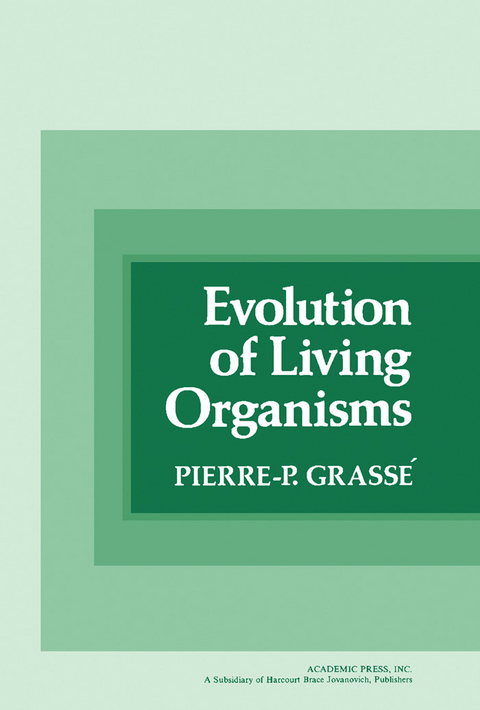
Evolution of Living Organisms (eBook)
308 Seiten
Elsevier Science (Verlag)
978-1-4832-7409-6 (ISBN)
Evolution of Living Organisms: Evidence for a New Theory of Transformation discusses traditional interpretations of evolution with a new assumption. The book presents a rational and general account of real evolutionary phenomena based on paleontology and molecular biological data. The text reviews biological evolution from the simple to the complex or progressive and regressive evolution. The author explains the appearance of types of organization from Captorhinomorphs to Pelycosaurs to the Theriodonts- from which the mammals arose. He also explains that in the evolution to mammals, the transformation of the Theriodonts concerned only the skeleton, muscles, dentition, and not the brain. He cites the case of the Perissodactyls as an example. The author also asserts that paleontology and molecular biology can explain the mechanism of evolution without even detailing the causes of orientations of lineages, of the finalities of structures, of living functions, and of cycles. But this approach will involve metaphysics. This book can be appreciated by anthropologists, researcher and scientists involved in zoology, paleontology, genetics and biochemistry.
Front Cover 1
Evolution of Living Organisms: Evidence for a New Theory of Transformation 4
Copyright Page 5
Table of Contents 6
Preface 10
An Introduction to the Study of Evolution 14
General Observations on the Living World 14
Biological Evolution and Its Occurrences 16
Interpretation of Evolutionary Facts 18
Chapter I. From the Simple to the Complex—Progressive Evolution, Regressive Evolution 22
Increasing Complexity as a Function of Time 23
Chronological Order of Appearance 27
Regressive Evolution 32
The Limits of Evolution 38
Chapter II. Creative Evolution, or the Appearance of Types of Organization 40
General Remarks 40
The Appearance of a Major Pattern of Organization: The Mammals 44
From Captorhinomorphs to Pelycosaurs 45
Theriodonts: Mammalian Ancestors 46
The Cynodont Line 49
"Premammalian" Reptiles Derived from the Cynodonts 50
The Therocephalia-Bauriamorpha 53
Ictidosaurs, Other "Premammalian" Reptile 55
The Evolution of the Jaw Musculature 56
Summary of the Mammalian Characters of Therapsids and of Their Ancestors, The Pelycosaurs 57
A Comparison of the Respective Characters of Mammalian Reptiles and Early Mammals: Gradual Transition from One Class to the Other 60
The Characteristics of Creative Evolution in Theraspid Reptiles 62
The Mammals: A Homogeneous or a Heterogeneous Class? 65
Conclusion 68
Chapter III. Evolution—A Discontinuous Historical Phenomenon 71
Evolutionary Discontinuity 71
The Miocene: An Epoch of Reference 78
The Dampening of Evolution 83
The Genealogical Tree of the Animal Kingdom 85
The Parent Forms and the Creation of Novelties 87
Panchronic Forms and Arrested Evolution 89
Persistence of Evolution 92
Speciation–the Only Present Form of Evolution 95
Evolution Is the Real History of Life 101
Conclusion 102
Chapter IV. Evolution and Chance 105
The Lottery of Life 105
Chance and Its Instrument, Mutation, or the Errors of the Genetic Code 109
Biological Order and Antichance 110
Random Preadaptation 113
Chance and Evolutionary Trends 115
Chance and Organic Complexity 117
Chapter V. Evolution and Natural Selection 121
The Notion of Selection 121
Selection during Ontogeny 122
Selection and Accident 123
Selective Elimination 125
Is Competition Universal? 128
Selection and Demography 130
Artificial Selection by Man (Cultivation and Domestication) 134
Errors or Inabilities of Selection 139
Natural Selection, or Finality in Action 141
Conclusion 142
Chapter VI. Evolution and Adaptation 144
General Remarks 144
Relation of Adaptation to Selection 146
The Limits of Adaptation 148
Not All Is for the Best in Living Things 150
Faulty Evolution 151
Indifferent or Useless Organs 155
Unfavorable Characteristics and Hypertelies 157
Equilibrium of Organism with Environment and Adaptation 159
Variations Caused by the Environment and the Action of the Genes according to the Environment 161
Preadaptation and Selection in Closed Environments 165
Peadaptation and Its Role 173
Coaptation and Adaptation of Unlike Parts 174
Finality and Adaptation 177
Chapter VII. Evolution and Necessity 185
What Biological Necessity Is: Confusion with Usefulness 185
Necessity and Persistence of "Stock Forms 189
Necessity, Selection, and Heterogeneous Populations 190
Necessity and the Genesis of the Major Types of Organization 191
The Animal Creates Its Own Necessity 193
Necessity-Utility: Not the Prime Motive of Biological Evolution 194
Chapter VIII. Activities of the Genes in Relation to Evolution 196
Introduction 196
Exploring the Genome 197
Genesis of New Species through Recombinations of Genes 213
Chapter IX. A New Introduction of Evolutionary Phenomena 215
Introduction 215
Internal Factors in Evolution and the Creative Reactivity of Living Things 217
The Creation of the New 228
Size and New Characteristics 229
Independence and Preeminence of DNA 231
The Intangibility of DNA and the Central Dogma 233
Acquisition of the Information by the Organism 236
Repetition of the Same Gene, and Redundancy 240
Formation of New Genes and Problems It Raises 241
Synthesis of Nucleic Acids and Molecular Acquisition of Information 250
Viral Transduction and Transfer of Alien Information 252
Novelty by Emergence 253
Conclusion 256
Appendixes 260
Appendix I: "Natural" Classification of the Animal Kingdom 261
Appendix II: Geological Time Scale, Including Geological Eras and Periods 265
Appendix III: Glossary 268
Bibliography 275
Author Index 292
Subject Index 298
| Erscheint lt. Verlag | 3.9.2013 |
|---|---|
| Sprache | englisch |
| Themenwelt | Naturwissenschaften ► Biologie ► Evolution |
| Technik | |
| ISBN-10 | 1-4832-7409-8 / 1483274098 |
| ISBN-13 | 978-1-4832-7409-6 / 9781483274096 |
| Informationen gemäß Produktsicherheitsverordnung (GPSR) | |
| Haben Sie eine Frage zum Produkt? |
 PDF (Adobe DRM)
Kopierschutz: Adobe-DRM
Adobe-DRM ist ein Kopierschutz, der das eBook vor Mißbrauch schützen soll. Dabei wird das eBook bereits beim Download auf Ihre persönliche Adobe-ID autorisiert. Lesen können Sie das eBook dann nur auf den Geräten, welche ebenfalls auf Ihre Adobe-ID registriert sind.
Details zum Adobe-DRM
Dateiformat: PDF (Portable Document Format)
Mit einem festen Seitenlayout eignet sich die PDF besonders für Fachbücher mit Spalten, Tabellen und Abbildungen. Eine PDF kann auf fast allen Geräten angezeigt werden, ist aber für kleine Displays (Smartphone, eReader) nur eingeschränkt geeignet.
Systemvoraussetzungen:
PC/Mac: Mit einem PC oder Mac können Sie dieses eBook lesen. Sie benötigen eine
eReader: Dieses eBook kann mit (fast) allen eBook-Readern gelesen werden. Mit dem amazon-Kindle ist es aber nicht kompatibel.
Smartphone/Tablet: Egal ob Apple oder Android, dieses eBook können Sie lesen. Sie benötigen eine
Geräteliste und zusätzliche Hinweise
Buying eBooks from abroad
For tax law reasons we can sell eBooks just within Germany and Switzerland. Regrettably we cannot fulfill eBook-orders from other countries.
aus dem Bereich


