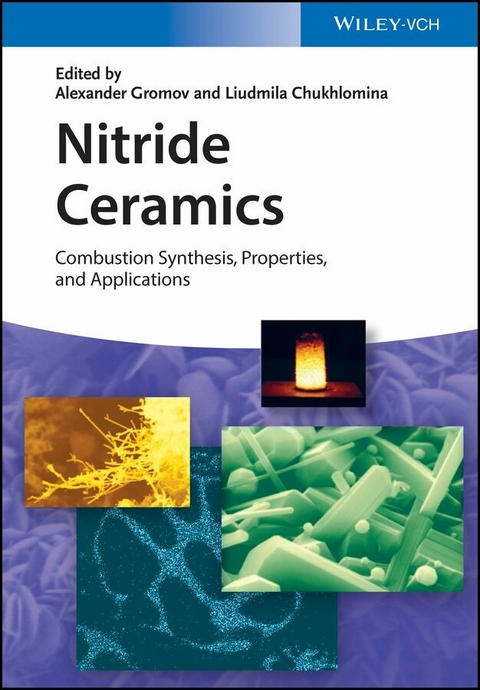
Nitride Ceramics (eBook)
360 Seiten
Wiley-VCH (Verlag)
978-3-527-68454-0 (ISBN)
The result is invaluable reading for researchers and practitioners in the industry as well as those looking for an introduction to the field. It is equally of great interest to chemists and materials scientists as well as engineers working in the area of inorganic and solid-state chemistry, structural and functional materials, catalysis, metallurgy, and electrochemistry.
Alexander A. Gromov is a Humboldt Experienced Researcher and a Visiting Professor at the Georg Simon Ohm Technical University in Nurnberg, Germany, since 2013. Having obtained his academic degrees from Tomsk Polytechnic University (TPU, Russia), he spent most of his career working for TPU, KIT (Karlsruhe, Germany), Fraunhofer ICT (Pfinztal, Germany), University of Ulsan (South Korea) and the Aerospace Engineering Department at Milan Polytechnic University (Polimi, Italy). He has authored over 150 scientific publications and several books and has received numerous Russian scientific awards, including the Russian Academy of Science Medal in 2009.
Liudmila Chukhlomina is a leading researcher at the Department of Structural Macrokinetics, Tomsk Scientific Center, Russia, since 1989. She graduated from Tomsk State University (Russia) in 1978 and then worked in the Scientific Research Institute of Applied Mathematics and Mechanics by Tomsk State University. Dr. Chukhlomina has authored over 130 scientific publications and several books and is also a reviewer for the Russian Foundation for Basic Research.
Alexander A. Gromov is a Humboldt Experienced Researcher and a Visiting Professor at the Georg Simon Ohm Technical University in Nürnberg, Germany, since 2013. Having obtained his academic degrees from Tomsk Polytechnic University (TPU, Russia), he spent most of his career working for TPU, KIT (Karlsruhe, Germany), Fraunhofer ICT (Pfinztal, Germany), University of Ulsan (South Korea) and the Aerospace Engineering Department at Milan Polytechnic University (Polimi, Italy). He has authored over 150 scientific publications and several books and has received numerous Russian scientific awards, including the Russian Academy of Science Medal in 2009. Liudmila Chukhlomina is a leading researcher at the Department of Structural Macrokinetics, Tomsk Scientific Center, Russia, since 1989. She graduated from Tomsk State University (Russia) in 1978 and then worked in the Scientific Research Institute of Applied Mathematics and Mechanics by Tomsk State University. Dr. Chukhlomina has authored over 130 scientific publications and several books and is also a reviewer for the Russian Foundation for Basic Research.
Foreword
Preface
COMBUSTION SYNTHESIS OF NITRIDES FOR DEVELOPMENT OF CERAMIC MATERIALS OF NEW GENERATION
Introduction
Peculiarities of Phase and Structure Formation of Metal and Nonmetal Nitrides in Combustion Mode
Dependence of SHS Nitride Composition and Structure on Infiltration Combustion Mode
SHS Equipment for Powder Synthesis
Synthesis of SHS-Ceramics Based on Silicon and Aluminum Nitrides and SiAlON Powders
Direct Production of Materials and Items Based on Nitride Ceramics by SHS Gasostating
Conclusion
COMBUSTION SYNTHESIS OF BORON NITRIDE CERAMICS: FUNDAMENTALS AND APPLICATIONS
Introduction
Combustion in Boron-Nitrogen System
Mechanism of Structure Formation in CS Wave
Combustion Synthesis of Nitride-Based Ceramics
Final Remarks
COMBUSTION SYNTHESIS OF ALUMINUM NITRIDE (AIN) POWDERS WITH CONTROLLED GRAIN MORPHOLOGIES
Introduction
Combustion Synthesis of Quasi-Aligned AlN Nanowhiskers
Enhanced Thermal Conductivity of Polymer Composites Filled with 3D Brush-Like AlN Nanowhiskers by Combustion Method
Growth of Flower-Like AlN by Combustion Synthesis Assisted with Mechanical Activation
Combustion Synthesis of AlN Porous-Shell Hollow Spheres
Summary and Conclusions
COMBUSTION SYNTHESIS AND SPARK PLASMA SINTERING OF ß-SiAlON
Introduction
CS of High-Purity ß-SiAlON and Densification by SPS
Physical Properties of CS-SPSed ß-SiAlON
Corrosion Resistance
Conclusions of This Chapter
COMBUSTION SYNTHESIS OF AlN (Al3O3N), BN, ZrN, AND TiN IN AIR AND CERAMIC APPLICATION
Thermochemical Features of Aluminum Particles Combustion (Theoretical Background)
Chemical Features of Metals Combustion in Air (Experimental Background)
Nitrides (Oxynitrides) Formation by Metal Powder Combustion in Air
Applcation of the Synthesized Nitrides and Oxynitrides in Dense Ceramics
COMBUSTION SYNTHESIS OF NITRIDES OF VANADIUM, NIOBIUM, AND TANTALUM
Introduction
Experimental Methods of Approach
Results and Discussion
Conclusions
SYNTHESIS OF NITRIDES BY SHS OF FERROALLOYS IN NITROGEN
Introduction
Synthesis of Silicon Nitride by Combustion of Ferrosilicon in Nitrogen
Synthesis of Vanadium Nitride by Combustion of Ferrovanadium in Nitrogen
Synthesis of Niobium Nitride by Combustion of Ferrovniobium in Nitrogen
Synthesis of Titanium Nitride by Combustion of Ferrovtitanium in Nitrogen
Combustion of Ferrochromium in Nitrogen and Synthesis of Chromium Nitride
Combustion of Ferroboron in Nitrogen and Synthesis of Boron Nitride
Application Prospects of Products of Combustion of Ferroalloys in Nitrogen
Conclusions
HALIDES IN SHS AZIDE TECHNOLOGY OF NITRIDES OBTAINING
Introduction
The Use of Ammonia Halides
The Use of Halides of Elements to be Nitrided
The Use of Complexing Halides of Elements to be Nitrided and Alkaline Metals
The Use of Complexing Halides of Ammonia and Elements to be Nitrided
The Use of Halides for Obtaining Refractory Compositions
Efficiency of Use of Halides in Azide SHS Systems
Chemical Stages of Formation of Nitrides in a Mode SHS-Az
Property of SHS-Az Powders
Property of SHS-Az Ceramics
The Synthesis of Nanostructural SHS-Az Powders
Conclusion
AlN CERAMICS FROM NANOSIZED PLASMA PROCESSED POWDER, ITS PROPERTIES AND APPLICATION
Introduction: AlN Ceramics, its Characteristics and Application
Production of AlN Ceramics from Nanosized Plasma Processed Powder
Properties of AlN Ceramics from Nanosized Plasma Processed Powder
Practical Application of Luminescence Properties of AlN Ceramics
Conclusions
AN OVERVIEW OF THE APPLICATION OF NITRIDES AND OXYNITRIDES IN PHOTOCATALYSIS AND ELECTROCATALYSIS
Introduction
Preparation
Photocatalysis
Electrocatalysis
Conclusion
CONCLUSION
Index
1
Combustion Synthesis of Nitrides for Development of Ceramic Materials of New Generation
Inna P. Borovinskaya, Vazgen E. Loryan, and Vladimir V. Zakorzhevsky
1.1 Introduction
Metal and nonmetal nitrides are remarkable compounds characterized by a great number of valuable and interesting properties such as high chemical stability in different aggressive media, heat resistance, ability to transition to superconducting state, excellent semiconducting and dielectric characteristics, high hardness which is sometimes close to that of diamond, and so on. Nitride ceramics is widely applied in various industries, for example, electronics, ferrous and nonferrous metallurgy, aerospace, and nuclear power engineering. It is not surprising that since the time when the first nitrides were obtained, active investigations have been carried out to understand the character of nitrides, their behavior and relationship of their properties with peculiarities of their structure, and chemical bonds. The increasing requirements to the quality and operation properties of nitride ceramics make the researchers improve the available synthesis methods and develop new efficient technologies. Self-propagating high-temperature synthesis (SHS) based on combustion processes [1–6] is one of the leading methods of investigation of theory and practice, structure and phase formation of nitrides in the combustion mode, development of new variations of synthesis and technology of nitrides and composite materials thereof, and items and parts based on nitride ceramics for various application purposes. By this time, a lot of articles have been published in all the spheres of the exploration. Their level is constantly being increased. In this chapter, we try to analyze the investigation results of regularities and mechanism of metal and nonmetal combustion in nitrogen as well as structure and phase formation of nitrides, which appear to be less known or unpublished in literature. Besides, we demonstrate some scientific and practical achievements in development of SHS powder technology of the most important nitrides, direct synthesis of SHS materials and items based on nitride ceramics, and some examples of their practical application. The presented information employs the experimental work carried out at the Institute of Structural Macrokinetics and Materials Science of the Russian Academy of Sciences.
1.2 Peculiarities of Phase and Structure Formation of Metal and Nonmetal Nitrides in Combustion Mode
The first regularities of nitride structure were established by Hagg [7]. He gave the definition of the primary structures in which nonmetal atoms penetrated into the metal crystal lattice and called them “penetration structures.” Face-centered cubic, volume-centered cubic, hexagonal compact, and hexagonal simple types of lattice are the most common for the penetration structures. According to Hagg, transition-metal nitrides (metal-like nitrides) are typical penetration structures. The penetration phases are often considered as heterodesmic compounds with complex superimposition of covalent, metal, and ionic bonds. Many scientists think that the combination of the bonds is the main reason of the extraordinary behavior and unique properties of nitrides. So-called nonmetal nitrides, for example, BN, Si3N4, AlN, and so on, are mainly characterized by covalent bonds and appear to be actual chemical compounds. The works in SHS studied the regularities and mechanism of phase and structure formation of both types of nitrides: metal-like and nonmetal.
1.2.1 Systems of Transition Metal of the IV–V Groups of the Periodic Table with Nitrogen
Single-phase solid solutions of nitrogen in metals are “lower” phases of the systems of metal (IV–V groups)-nitrogen formed directly in the course of SHS. The conditions and mechanism of their formation have been extensively studied in combustion of porous titanium and zirconium samples at gaseous nitrogen pressures of 0.1 up to 500 MPa [8–10]. Theoretical consideration of the possibility of combustion between metals and nonmetals forming merely solid solutions was carried out in [11]. The systems of Zr + N2 and Ti + N2 are the most highly exothermic. Homogeneity regions of α-solid solutions of nitrogen in these metals are fairly large and attain compositions of ZrN0.33 and TiN0.27. Thermodynamic calculations and experiments have shown that the SHS process in Zr + N2 and Ti + N2 systems is possible to occur at the expense of solid solution formation. The dependence of the calculated adiabatic combustion temperature in Zr + N2 system on nitrogen content in the homogeneity region of the solid solution is given in Figure 1.1. The combustion temperatures are seen to be high. A necessary condition for the formation of single-phase solid solution of nitrogen in metals is the arrest of the reaction at the stage of the solid solution formation. The further nitriding of the solid solution can be ceased in several ways. The most common ones are the sample quenching in liquid argon and sharp gas drop immediately after the combustion front passage [1, 8]. The efficient way is also to create the conditions when after-burning (bulk after-nitriding of the samples heated in the combustion front) is unlikely to happen [1, 8]. In Zr + N2 and Ti + N2 systems, such unfavorable conditions are formed spontaneously since the sample under combustion often becomes sintered or molten (especially at nitrogen pressure of >3 MPa), and there is no access for the gas into the combustion zone. Other techniques eliminating the after-burning can be: confining the sample's lateral surface in a gas-tight jacket, implementing the combustion process in the mixture of metals with nitrides in a pure surface combustion mode, which plays the role of a “chemical furnace” to facilitate the product homogenization or dissolving nitrogen with inert gas, for example, argon [8, 12]. Combustion of the mixtures of metals with nitrides in the “chemical furnace” mode is analogous to the furnace synthesis of nitrogen solid solutions in metals by homogenization. American scientist observed the combustion wave propagation due to the formation of TiN1−x thin layer with the formation of nitrogen solid solution in the quenched combustion products using X-ray analysis and scanning electron microscope (SEM) [13].
Figure 1.1 Combustion temperature versus solid solution composition. m – N2 content (relative units).
An important achievement in the studies of the direct combustion synthesis of solid solutions was the production of compositions with minimum nitrogen content (MeN0.13–MeN0.22) and synthesis of single-phase oversaturated solid solutions of MeN0.34–MeN0.45 with nitrogen content exceeding the value known from literature. This fact initiated the hypothesis of nitride formation in the combustion mode by means of saturating metal with nitrogen along with forming oversaturated solid solutions which are then decomposed to form a solid solution of a lower composition and nonstoichiometric nitride MeNx in contrast to commonly accepted mechanism of the reaction diffusion through the product film. In this case, the combustion rate is determined by the rate of the nonmetal dissolution in metal. At this stage, the major heat release takes place. This concept was presented in [14].
The chemical and phase analyses of the compositions from ZrN0.34 to ZrN0.57 prove that the combustion products are oversaturated solid solutions. They decompose when annealed or dissolved in some specific liquids to solid solutions of a lower composition and nonstoichiometric nitrides.
Metallographic investigations of the sample microstructure prove nitride evolution on the grain boundaries.
Generalizing these concepts for various metal–nonmetal systems, one can assume that the systems with wide regions of homogeneity of solid solutions can burn, under certain conditions, involving the stage of the solid solution saturation without yielding any compounds. The systems with narrow regions of homogeneity of solid solutions under specific conditions (reactive mass melting, high pressures) can also produce solid solutions when burning with their subsequent decomposition or crystallization. As to Me–N systems with complex state diagrams (e.g., Ta–N, Nb–N) which comprise solid solutions with narrow regions of homogeneity, single-phase solid solutions in these systems are also formed during the combustion. However, it is difficult to isolate them. They can only be observed in the quenched products in the layers adjacent to the combustion front, so-called warming-up zones [15, 16].
Examples of interaction including nonmetal dissolving in metals in solid–solid systems were described by Vidavsky [17] for Zr–C systems, and by Itin and Bratchykov [18] for SHS intermetallics particularly for Ti–Co system. Aleksandrov and Boldyrev [19] and Holt with coworkers [20] performed direct observation of the dissolving stage during SHS product formation in Ni–Al and Ti–C systems by measuring the phase structure of the combustion wave by means of synchrotron radiation. Shteinberg with coworkers obtained unique results on carbon dissolving in titanium under thermal explosion. The authors thoroughly investigated the mechanism of this process and regularities of structure formation [21].
One of the interesting examples of chemical stages...
| Erscheint lt. Verlag | 16.10.2014 |
|---|---|
| Sprache | englisch |
| Themenwelt | Naturwissenschaften ► Chemie ► Anorganische Chemie |
| Technik | |
| Schlagworte | advanced • Anorganische Chemie • Applications • Batterien u. Brennstoffzellen • Batteries & Fuel Cells • Biotechnologie • Biotechnology • Book • Branches • Ceramics • Chemie • Chemistry • Coatings • comprehensive overview • devices • Different • Electrochemistry • Electronic • Elektrochemie • Energie • Energy • Expanding • Festkörperchemie • Festkörperchemie • Field • Hydrogen, Batteries & Fuel Cells • Industrial Chemistry • Industry • Inorganic Chemistry • keramische Werkstoffe • Materials Science • Materialwissenschaften • Nanomaterialien • nanomaterials • Nanotechnologie • nanotechnology • Oxynitride • Properties • Range • Recent Developments • solid state chemistry • special emphasis • Storage • Surface • Technische u. Industrielle Chemie • Wasserstoff, Batterien u. Brennstoffzellen • Werkstoff |
| ISBN-10 | 3-527-68454-9 / 3527684549 |
| ISBN-13 | 978-3-527-68454-0 / 9783527684540 |
| Informationen gemäß Produktsicherheitsverordnung (GPSR) | |
| Haben Sie eine Frage zum Produkt? |
 EPUB (Adobe DRM)
Kopierschutz: Adobe-DRM
Adobe-DRM ist ein Kopierschutz, der das eBook vor Mißbrauch schützen soll. Dabei wird das eBook bereits beim Download auf Ihre persönliche Adobe-ID autorisiert. Lesen können Sie das eBook dann nur auf den Geräten, welche ebenfalls auf Ihre Adobe-ID registriert sind.
Details zum Adobe-DRM
Dateiformat: EPUB (Electronic Publication)
EPUB ist ein offener Standard für eBooks und eignet sich besonders zur Darstellung von Belletristik und Sachbüchern. Der Fließtext wird dynamisch an die Display- und Schriftgröße angepasst. Auch für mobile Lesegeräte ist EPUB daher gut geeignet.
Systemvoraussetzungen:
PC/Mac: Mit einem PC oder Mac können Sie dieses eBook lesen. Sie benötigen eine
eReader: Dieses eBook kann mit (fast) allen eBook-Readern gelesen werden. Mit dem amazon-Kindle ist es aber nicht kompatibel.
Smartphone/Tablet: Egal ob Apple oder Android, dieses eBook können Sie lesen. Sie benötigen eine
Geräteliste und zusätzliche Hinweise
Buying eBooks from abroad
For tax law reasons we can sell eBooks just within Germany and Switzerland. Regrettably we cannot fulfill eBook-orders from other countries.
aus dem Bereich